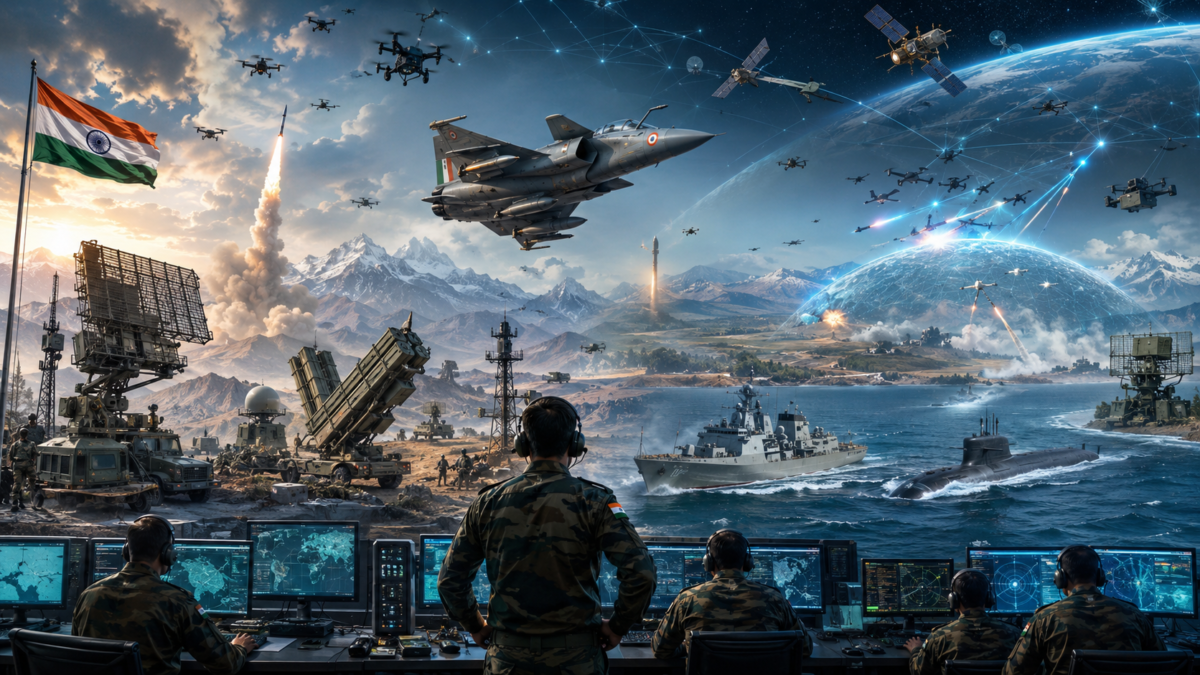
The next war will not wait for India to complete a tender. It may begin with algorithms scanning satellite images, hackers probing electricity networks and inexpensive drones searching for radars, ammunition depots and command posts.
Precision missiles will follow. Electronic warfare will attempt to blind sensors and corrupt navigation signals, while fabricated videos and automated propaganda seek to confuse the public.
Mass drone warfare has already moved from military theory to battlefield routine. Ukraine and West Asia have shown how relatively cheap unmanned systems can locate artillery, strike armour, harass ships and force an opponent to expend costly missiles. Artificial intelligence increasingly helps identify targets, fuse intelligence, plan logistics and coordinate swarms.
India faces an especially unforgiving strategic landscape: a volatile, nuclear-armed Pakistan to the west; a much larger and technologically formidable China along the northern and eastern frontier; and an Indian Ocean increasingly frequented by extra-regional navies.
The true test of readiness, therefore, extends beyond winning a sharp exchange. India must be capable of sustaining a multi-domain conflict while keeping its ports, power grids, communications, transport networks and economy functioning.
Operation Sindoor offered India its clearest recent preview of technology-intensive warfare.
On the night of 7-8 May 2025, Pakistan attempted to attack military targets across northern and western India with drones and missiles. According to the government’s official account of the operation, India’s Integrated Counter-Unmanned Aerial Systems Grid and layered air defences neutralised the attacks.
Legacy Pechora and OSA-AK systems operated alongside low-level air-defence guns, indigenous Akash missiles, electronic-warfare equipment and newer counter-drone weapons. The Indian Air Force’s Integrated Air Command and Control System connected sensors and shooters across a wide area.
India also used loitering munitions and precision weapons offensively. Its electronic-warfare capabilities helped penetrate or suppress Pakistani defences. Later, the Defence Ministry said the Air Force’s IACCS had worked with the Army’s Akashteer and the Navy’s Trigun to create a unified operational picture.
That performance should inspire confidence but not complacency. A short, controlled confrontation cannot fully simulate a prolonged war involving sustained missile attacks, satellite disruption, cyber sabotage, mounting equipment losses and interrupted foreign supplies.
India has built a formidable first punch and a credible shield. It must now build greater depth behind both.
One of the urgent revisions India needs is to accept that drones are ammunition, not equipment. India’s armed forces have clearly recognised the unmanned revolution. The Air Force’s Mehar Baba competition produced a ₹300-crore order for an Indian swarm-drone system, while the Army had manufactured 819 drones internally by early 2026. The Army has also committed to giving every soldier drone-related training by 2027.
Yet scale changes everything.
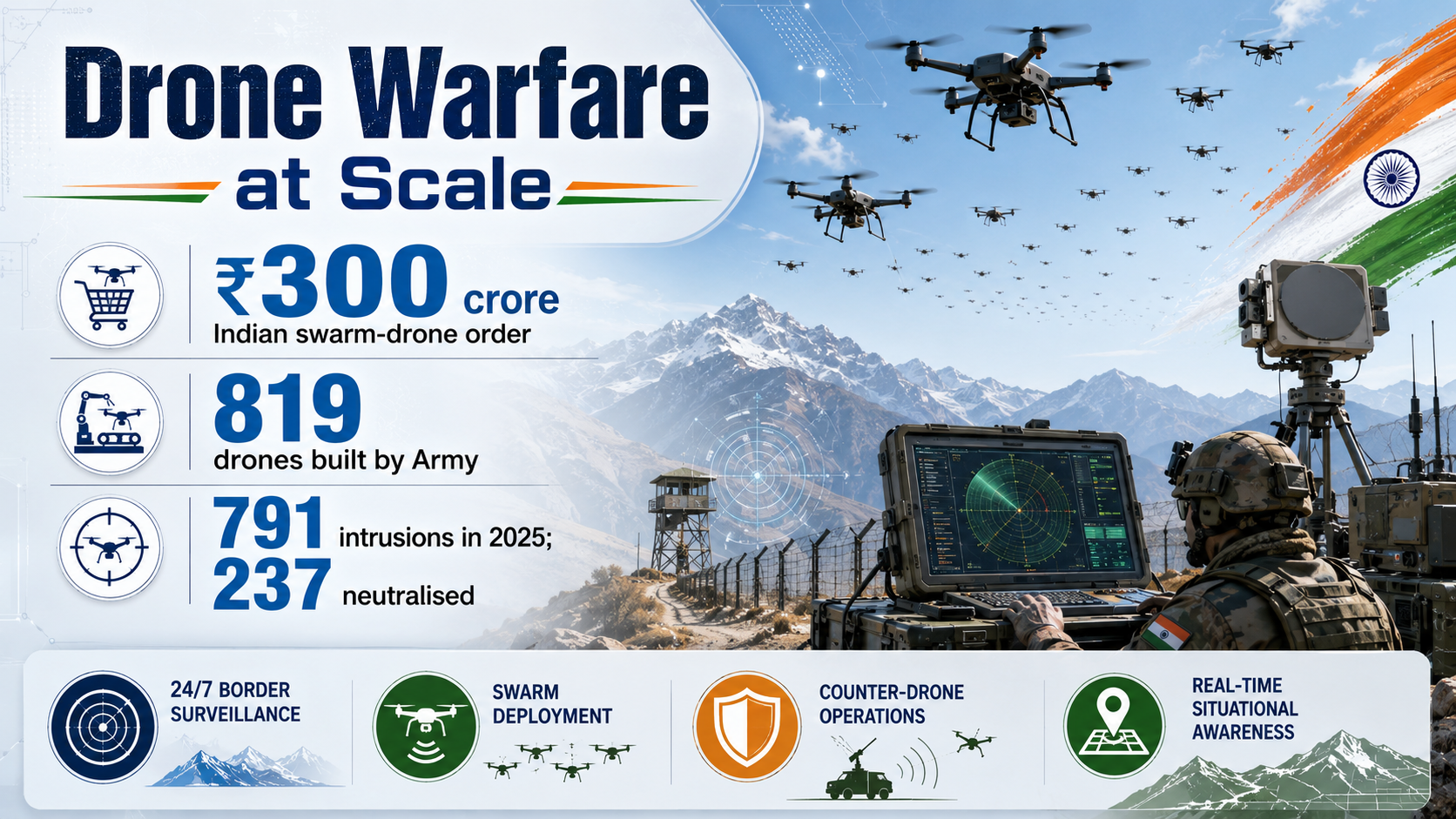
India recorded 791 drone intrusions along its international border in 2025, mainly in Punjab and Rajasthan; 237 were neutralised, according to PRS Legislative Research’s defence analysis. Wartime swarms would present a far more demanding challenge.
India needs reconnaissance drones, one-way attack drones, electronic-warfare drones, high-altitude logistics drones, naval unmanned aircraft, unmanned surface vessels and underwater systems in very large numbers. Procurement must treat many of these platforms as rapidly evolving, expendable munitions — not as aircraft expected to remain unchanged for 20 years.
Counter-drone economics matter just as much. Firing a sophisticated surface-to-air missile at every inexpensive quadcopter would soon become unaffordable. India requires layers of jammers, spoofers, automatic cannon, interceptor drones, micro-missiles and directed-energy weapons, reserving costly missiles for the threats that justify them.
Domestic assembly alone will not provide genuine security. Motors, batteries, thermal cameras, secure communication modules, navigation systems, chips and electronic components must remain available when foreign suppliers restrict exports or global supply chains seize up.
Artificial Intelligence must move from demonstrations to doctrine. Indeed, AI should become the nervous system of the armed forces, not another procurement category.
India possesses abundant software talent and has begun developing AI-enabled surveillance, autonomous systems, predictive maintenance and decision-support tools. The Armed Forces’ 2025 technology roadmap explicitly identifies AI, autonomy, hypersonic weapons, space, cyber capabilities and networked warfare as priorities.
The harder task involves deployment at scale. A useful military AI system must work at the edge, with weak connectivity, under electronic attack and amid deliberate deception. It must distinguish a tank from a decoy, recognise manipulated intelligence and continue operating when cloud access disappears.
India should concentrate on five immediate applications: multi-sensor intelligence fusion; drone and counter-drone coordination; cyber-threat detection; predictive maintenance; and logistics forecasting. A common defence-data architecture would allow the three services to train and operate compatible systems without dissolving necessary security boundaries.
Command responsibility must remain unambiguous. AI may recommend, prioritise and warn, but a human chain of accountability should govern lethal decisions. Speed cannot become an excuse for opacity.
Further, India’s air power needs numbers as well as sophistication. The Indian Air Force retired its final MiG-21s in September 2025, leaving it with about 29 fighter squadrons against an authorised strength of 42. Tejas represents a major indigenous achievement, but production delays have widened the gap between retirement and replacement.
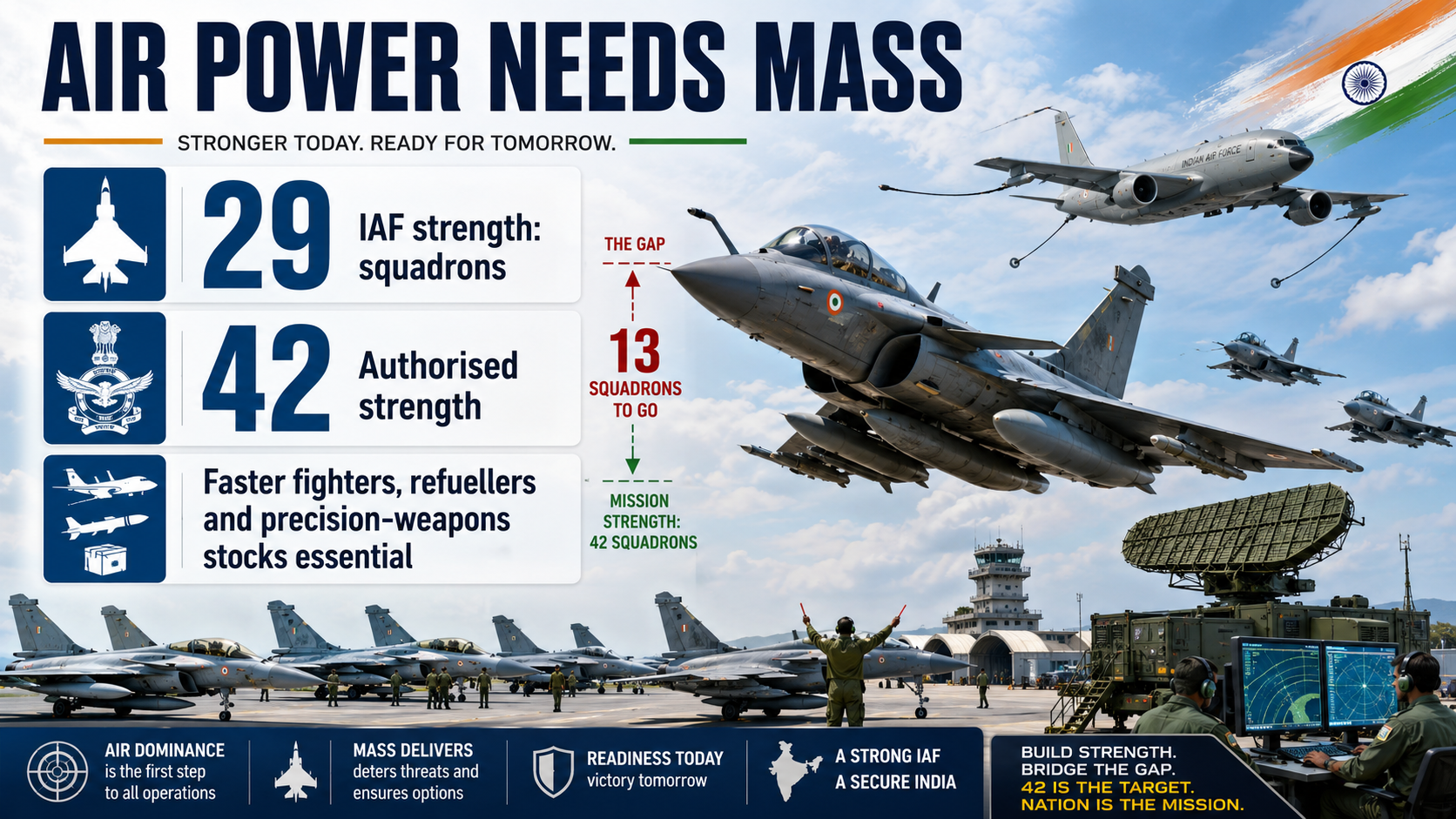
India cannot indefinitely compensate for insufficient mass with the quality of its Rafales, upgraded Sukhoi-30MKIs and advanced missiles. Even an exceptional aircraft can fly only one mission at a time. Attrition, maintenance and the demands of two geographically separated fronts quickly consume available strength.
Fighter induction must accelerate, but fighters alone will not solve the problem. India also requires more airborne early-warning aircraft, aerial refuellers, long-range weapons, hardened shelters, rapid runway-repair units, realistic decoys and large stocks of precision munitions. Manned-unmanned teaming should allow fighters to send cheaper autonomous aircraft ahead as sensors, jammers or weapons carriers.
Off India’s long coastline, the undersea contest may decide who rules the waters of the Indian Ocean, the Arabian Sea and the Bay of Bengal. India’s Navy remains the region’s strongest indigenous naval force. Its shipyards now build aircraft carriers, destroyers, frigates, submarines and anti-submarine vessels. Yet the maritime balance is moving quickly.
India operated 137 ships and submarines in 2025, but 53 per cent of its vessels were more than 15 years old. Fifty-eight ships were under construction and another 62 had received approval. China, meanwhile, has been commissioning more than 15 naval vessels annually and regularly sending submarines into the Indian Ocean, according to a parliamentary assessment summarised by PRS.
India needs faster submarine construction, including conventional boats with air-independent propulsion and nuclear-powered attack submarines. It also needs stronger seabed surveillance, maritime patrol aircraft, anti-submarine helicopters, underwater drones, mine-countermeasure vessels and replenishment ships.

The debate over another aircraft carrier should not crowd out these less glamorous capabilities. An adversary’s submarines, long-range missiles and unmanned systems may pose a greater daily threat to sea lanes than its carrier fleet.
Diego Garcia deserves perspective. The atoll hosts a British-American facility that provides logistical support to US forces in the Indian Ocean and Persian Gulf. It is not a Chinese or Pakistani base, and India’s expanding strategic partnership with the United States makes it inaccurate to describe the installation as inherently hostile.
Its existence nevertheless demonstrates the decisive value of distant logistics hubs. Governments and alignments can change. Friends can turn enemies overnight. India must strengthen the Andaman and Nicobar Islands, Lakshadweep, coastal airfields, protected fuel storage and overseas access arrangements so that no external power can dominate its maritime lifelines.
China poses the more direct long-term basing concern. It already operates a military support base in Djibouti, and the US Department of Defense assesses that Beijing has considered additional military access in countries including Pakistan, Bangladesh, Myanmar and Sri Lanka.
Beside the women, men and conventional war machines, a new crop of combatants is fighting today’s battles — satellites, cyber networks and defence manufacturing units.
Modern forces cannot shoot accurately if they cannot see or communicate. India has dedicated military satellites, strong launch capabilities and proven anti-satellite technology. During Operation Sindoor, the ISRO chairman said at least 10 satellites were working continuously for national security.
A small number of valuable satellites, however, can become attractive targets. India needs proliferated constellations, protected communications, rapid replacement launches, alternatives to satellite navigation and the ability to combine military, commercial and allied imagery.
Cyber defence must extend beyond military networks. A successful attack on ports, railways, banks, telecommunications or the electricity grid could slow mobilisation without striking a single military formation. Regular national exercises should test how civilian and military systems operate under simultaneous cyberattack, misinformation and communications failure.
Industrial resilience presents an equally important challenge. India’s defence exports reached a record ₹38,424 crore in 2025-26, rising almost 63 per cent in one year. Indigenous missiles, radars, artillery, naval vessels and electronic systems represent genuine advances.
At the same time, SIPRI ranked India as the world’s second-largest arms importer during 2021-25, accounting for 8.2 per cent of global imports. Russia still supplied 40 per cent of those imports, although India has diversified towards France, Israel and the United States.
An Indian label on a platform means little if its engine, seeker, transmission, semiconductor or critical material becomes unavailable during a crisis. Self-reliance must be measured by the ability to repair, replenish and modify equipment without foreign permission.
Military factories and defence manufacturing lines must also possess surge capacity. A country prepared for 10 days of combat may not remain prepared after 100. India should maintain rotating war reserves, multiple qualified suppliers for critical components and production lines that can expand quickly. Long-term orders would give private companies a commercial reason to invest in capacity before an emergency. For more analysis on defence strategy, industrial capacity and India’s evolving security priorities, explore our CounterPoint section.
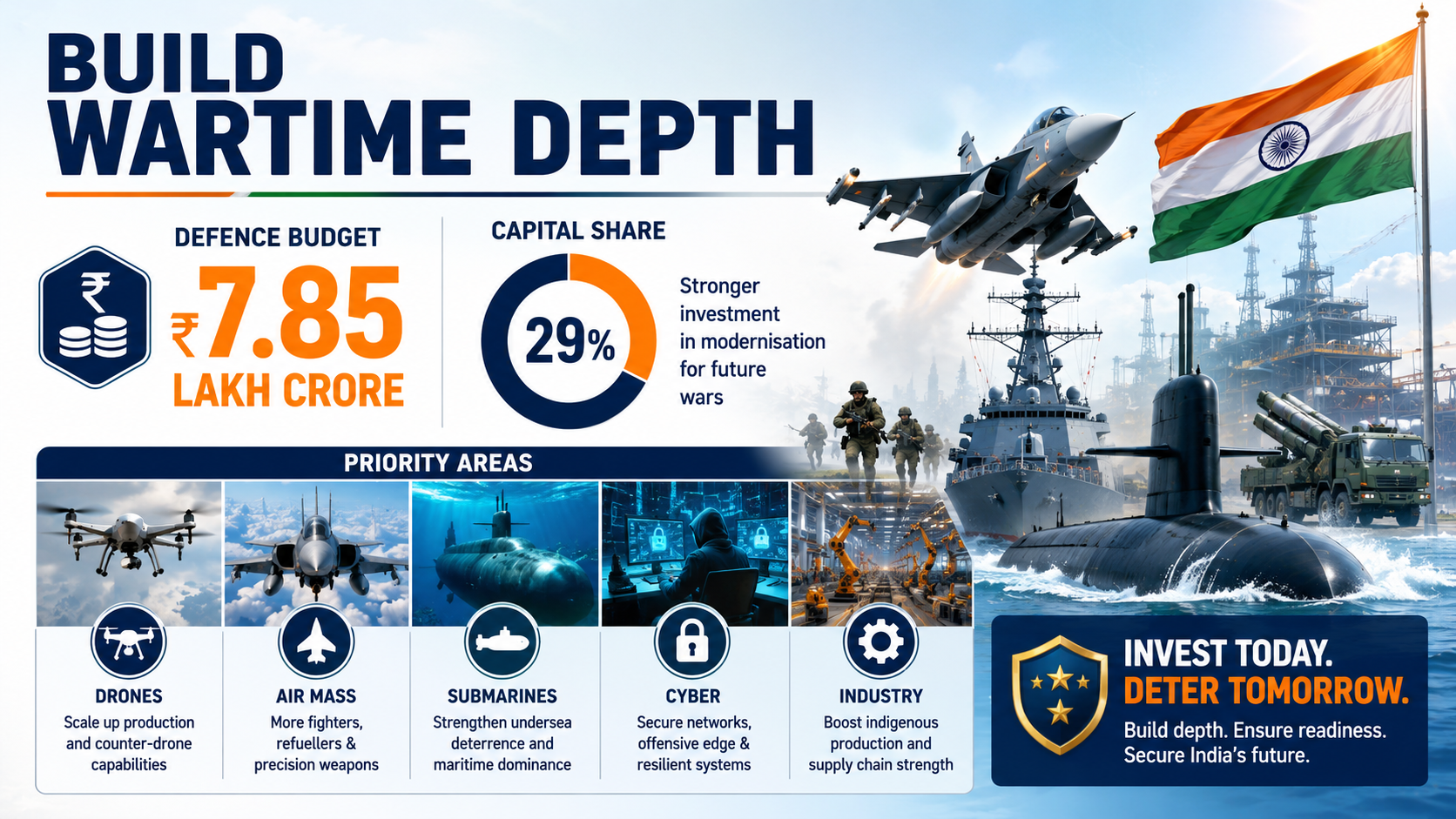
The 2026-27 defence allocation reached a record ₹7.85 lakh crore, including ₹2.19 lakh crore under the capital head. Yet the total amounts to about 2 per cent of GDP, below the 3 per cent recommended by a parliamentary committee.
Only 29 per cent of defence expenditure goes towards capital outlay, against a previously recommended 40 per cent. Defence research accounts for an estimated 3.7 per cent of expenditure, down from 4.7 per cent in 2014-15. India’s own Defence Ministry has sought a gradual increase in R&D spending towards 10 per cent over the next decade.
More money will not automatically create readiness. Stable priorities, competitive development, realistic testing and faster decisions matter just as much. India’s procurement system must accept iterative improvement instead of waiting endlessly for a perfect indigenous system—or importing one after domestic delays become intolerable.
Jointness completes the equation. Operation Sindoor showed what integrated sensors and command networks can achieve. The next step must connect planning, logistics, airspace management, cyber operations, intelligence and long-range targeting across all three services. Organisational boundaries cannot be allowed to slow a kill chain that operates in seconds.
So, is India ready?
India can defend vital targets, impose serious costs and respond with precision. Few adversaries could treat its military power lightly. But prolonged, simultaneous conflict across two land fronts and the Indian Ocean—conducted under cyberattack, satellite disruption and supply-chain pressure—would expose important shortages.
Five priorities demand urgency: expendable drones and economical counter-drone systems; greater combat-air mass and its supporting enablers; undersea and anti-submarine power; resilient space and cyber networks; and an indigenous industrial base capable of replenishing losses at wartime speed.
India has fashioned an increasingly sharp spear. It now needs a much larger quiver, a more resilient shield and the industrial workshop capable of replacing both while the battle continues.