Categories
Beyond

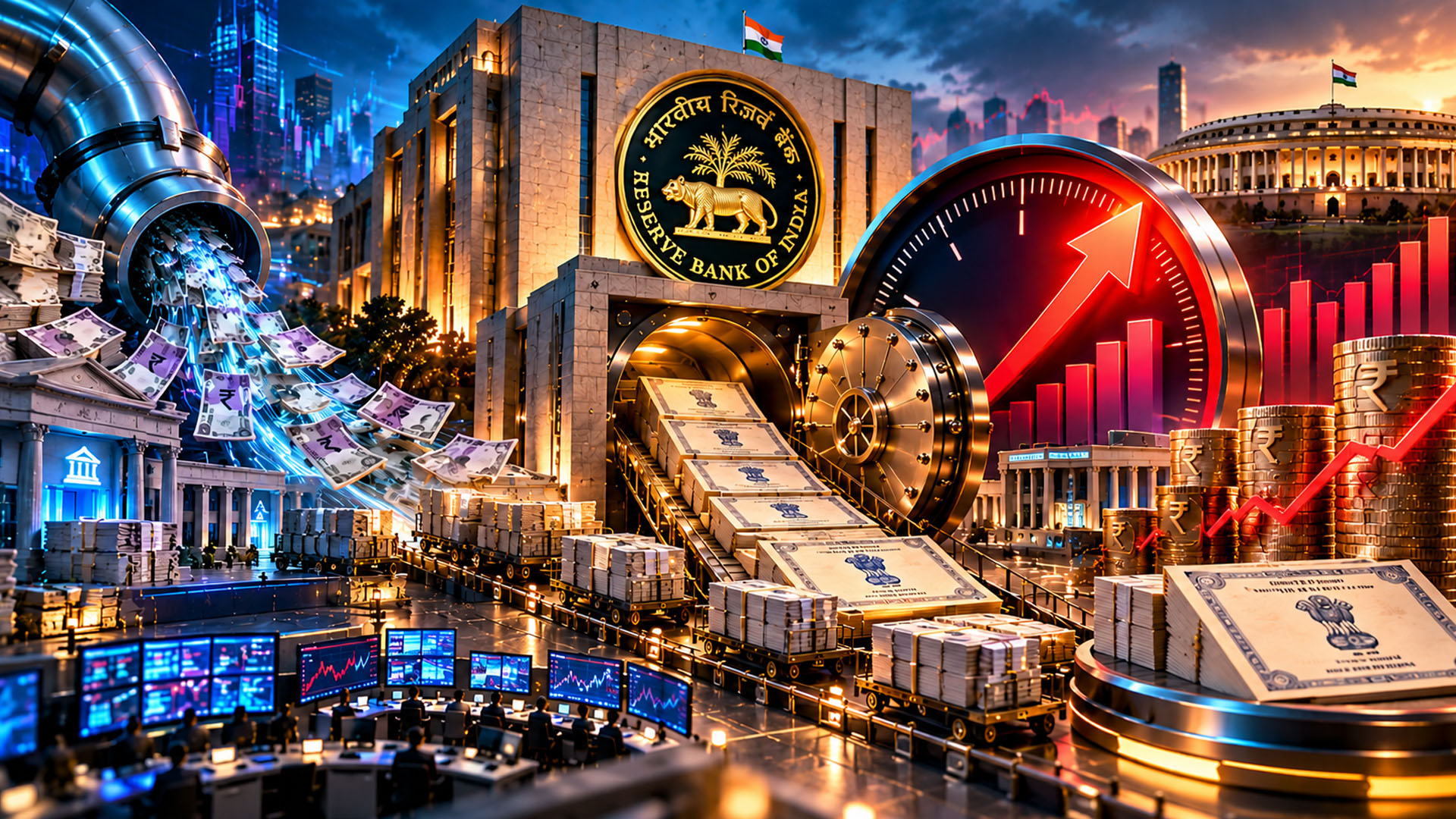
Rupee falls 9 paise, hits record low of ₹90.41

The Indian rupee slipped further on Friday, closing at a record low of ₹90.41 against the US dollar, down 9 paise from the previous session. This marks another milestone in the rupee’s ongoing depreciation trend.

Traders said the fall was mainly due to high demand for dollars from importers who needed to pay for overseas goods and services. At the same time, foreign investors have been pulling money out of Indian stocks and bonds, adding to pressure on the currency.

Global factors also played a role. A stronger dollar abroad and uncertainty in financial markets made investors cautious, keeping the rupee under stress. Analysts said that while the Reserve Bank of India can step in to stabilize the currency, its ability to stop the decline is limited when import demand and capital outflows are high.

The rupee’s slide reflects wider economic challenges, including a trade gap, where India imports more than it exports, increasing the need for foreign currency. Experts expect the rupee to face continued pressure in the coming weeks as global market volatility and domestic economic factors play out.

Despite the fall, some believe the rupee may find temporary support if global dollar strength eases or if capital inflows improve. For now, businesses and consumers may feel the pinch as imports become more expensive and foreign travel or overseas education costs rise.

Also Read: IndiGo moves court for ₹900 crore refund

Categories
Beyond

IndiGo moves court for ₹900 crore refund

IndiGo has launched a legal challenge seeking over ₹900 crore in customs duty refunds, claiming the government’s taxation on aircraft parts returned from overseas repairs is unfair. The airline says it faces double taxation, paying GST on repairs abroad while being charged customs duty again when the same parts are re‑imported into India.

The airline explained that sending parts overseas for repair qualifies as a service, which is taxed under GST. IndiGo paid the tax under the reverse charge mechanism. However, when the repaired parts returned to India, customs authorities treated them as fresh imports, demanding additional duty. The airline argues this approach is unjust, effectively taxing the same transaction twice – first as a service, then as an import of goods.

The case was initially listed before a Delhi High Court bench of Justices Prathiba M Singh and Shail Jain. However, Justice Jain recused herself, citing a conflict of interest, as her son is employed as a pilot with IndiGo. The matter will now be heard by a different bench.

IndiGo stated that it had paid the disputed customs duties “under protest” to avoid delays in returning critical aircraft parts to service. The airline also pointed to previous tribunal and court rulings suggesting that re‑imported parts should not face double levies once GST has been discharged. Customs authorities, however, rejected refund claims, asking the airline to reassess each bill of entry, a process IndiGo says is impractical.

Alongside this case, IndiGo is contesting a GST demand of ₹58.75 crore for the financial year 2020–21. The airline has clarified that these disputes are unlikely to affect operations materially.

This case could have wide implications for the aviation sector and other businesses dealing with imported goods and overseas repairs. The Delhi High Court’s ruling may set an important precedent on how GST and customs duty interact for re‑imported parts, potentially shaping tax practices for years to come.

Also Read: Disney and OpenAI deal brings iconic characters to Sora

Categories
Beyond

42 US states warn tech giants on unsafe AI chatbots

Forty-two US state attorneys general have raised a serious concern with regard to the world’s most widely used AI chatbots are sometimes giving people wrong, confusing, or even harmful answers. They have written a joint letter to major companies including Microsoft, Google, Apple, Meta and OpenAI, warning them to fix these problems quickly.

The attorneys general said they are especially worried about how these chatbots talk to people who are sad, stressed or struggling with mental health issues. In several reported cases, when users expressed fear, confusion or emotional distress, the chatbot’s answers made things worse. Instead of correcting false beliefs or offering safe guidance, some systems encouraged the user’s harmful thoughts. In their letter, the officials described these responses as “delusional” or “sycophantic”,  meaning the AI simply agrees with a user, even when the user is clearly wrong or unsafe.

The states said this behaviour is dangerous and may even break consumer protection laws. They pointed out that millions of people now rely on AI tools for advice sometimes more than they rely on friends, family or professionals. This puts a big responsibility on tech companies to ensure their products do not cause harm.

The group has asked the companies to take several important steps. First, they want stronger safety systems that stop chatbots from giving harmful or misleading answers. Second, they want independent experts to test these AI models and openly share the results. Third, they want clear warnings for users so people know the limitations of AI and understand that chatbots can make mistakes.

The attorneys general have given the companies until mid-January 2026 to explain what actions they will take. They also said they will not hesitate to act if companies fail to protect users.

This joint warning shows how quickly AI has become part of everyday life and how concerned governments are about its risks. While AI can be helpful, state leaders say it must be safe, trustworthy and designed to protect people, especially children and those who are emotionally vulnerable.

Also Read: ₹148 Lakh crore wealth boom for India’s top firms

Categories
Beyond

Gold falls ₹140, Silver near ₹2 lakh on Dec. 12

Gold prices in India dropped a little on 12 December 2025. The price of 24-carat gold was about ₹132,340 for 10 grams, down roughly ₹140 from the previous day. 22-carat gold also fell by around ₹128. The same trend was seen across major cities including Delhi, Mumbai, Bengaluru, Hyderabad and Chennai. Prices in India remained higher than Dubai because of import duty and local taxes.

The small fall in gold rates came after soft global cues, a weaker US dollar and expectations of future interest rate cuts in the US. These international factors continue to influence gold prices in the domestic market.

Silver prices, however, held steady at stronger levels. Silver was priced at around ₹201 per gram, which is close to ₹2,01,000 per kilogram in many parts of India. Some cities reported slightly higher rates depending on local demand.

Both gold and silver prices may vary from shop to shop due to making charges, GST and regional differences.

Also Read: Sensex jumps 300 Points, Nifty moves above 25,950

Categories
Beyond

Indian Rupee hits historic low of ₹90.46 against US Dollar

The Indian rupee weakened further on Thursday, December 11, 2025, touching a historic low of ₹90.46 against the US dollar. This marks the steepest level the rupee has reached in its history, continuing the depreciation trend seen over the past few months.

Several factors contributed to the sharp fall. Ongoing global uncertainties and slow progress in trade negotiations with the United States have rattled investor confidence. At the same time, domestic demand for US dollars from companies making international payments increased pressure on the rupee. Additionally, foreign investors have been pulling funds from Indian markets, adding to the volatility.

This year, the rupee has fallen by over 5 per cent, making it one of the worst-performing Asian currencies in 2025. Analysts say the currency’s decline has been influenced by rising global crude oil prices, high import bills, and widening trade deficits, which have further strained India’s foreign exchange reserves.

In response to the slide, the Reserve Bank of India (RBI) reportedly intervened in the forex market, buying and selling dollars to stabilize the rupee. Such measures are intended to reduce sharp fluctuations and maintain market confidence.

Economists warn that the rupee may continue to face pressure in the near term unless there is progress in trade negotiations, improved foreign investment inflows, and easing of global market uncertainties.

Investors and businesses are closely monitoring the currency movements, as the fall in rupee value impacts import costs, inflation, and international trade. With the year-end approaching, all eyes are on the RBI’s interventions and global market trends to determine if the currency can recover.

Also Read: IndiGo offers Rs 10,000 vouchers to passengers

Categories
Beyond

Mexico hikes tariffs up to 50% on Asian imports

Mexico has approved higher import tariffs on products from several Asian countries, including India and China. The move is meant to protect local industries and increase government revenue. The new duties will come into effect in 2026 and will cover products such as vehicles, auto parts, textiles, plastics, steel, footwear, and clothing.

The bill was passed in the Mexican Senate with 76 votes in favour, five against, and 35 abstentions, after it was approved by the lower house. Most products will face tariffs of up to 35%, while some could see increases as high as 50%. The first version of the proposal included higher tariffs on around 1,400 products, but the final plan reduced duties for nearly two-thirds of them.

Officials say the tariff hike is needed to help Mexican manufacturers compete with cheaper imports from Asia. They believe the new duties will protect jobs, strengthen domestic production, and improve Mexico’s role in global supply chains.

The tariff increase is also expected to boost government revenue, with experts estimating an extra $3.76 billion next year. This is seen as an important step to reduce Mexico’s fiscal deficit.

The decision comes as global trade tensions rise and ahead of a review of the United States-Mexico-Canada Agreement (USMCA). Some trade analysts and business groups have warned that higher tariffs could disrupt supply chains, increase production costs, and raise prices for consumers.

Countries without free-trade agreements with Mexico, including India and China, are likely to feel the biggest impact, as higher duties could make their exports less competitive.

Overall, the move is considered one of the most significant changes in Mexico’s trade policy in recent years. It shows the government’s focus on protecting local industries while managing international trade. Businesses and exporters are now closely watching the changes and preparing for the impact of the new tariffs.

Also Read: Vi Business rolls out smart gas metering for CGD companies

Categories
Beyond

Fed cuts rates again, benchmarks at three‑year low

On December 10, 2025, the Federal Reserve (Fed), under chair Jerome Powell, reduced its benchmark interest rate by 25 basis points, bringing the federal funds rate down to a range of 3.50 %–3.75 %,  the lowest level in nearly three years.

This marks the third consecutive rate cut this year, following similar reductions in September and October. The move comes against a backdrop of persistent inflation and a softening job market, with Fed officials noting “downside risks to employment” alongside still‑elevated prices.

Inside the policy‑making committee, the decision was not unanimous. Out of 12 members, nine voted for the cut, while three preferred either no change or a deeper 50‑basis‑point cut, highlighting divisions over how aggressively to stimulate growth versus guard against inflation.

Importantly, Powell cautioned that future cuts are not guaranteed. He suggested that rates may now be near a neutral point, signaling a potential pause, or at least a slower pace, in further easing.

Beyond rates, the Fed also committed to resuming short-term Treasury bill purchases to bolster liquidity in US money markets, a step not seen since previous crises.

Markets responded quickly. Major US stock indices rallied on the news, the Dow Jones Industrial Average surged nearly 1.3%, while the S&P 500 and Nasdaq Composite also posted strong gains.

That said, global sentiment remained cautious. The Fed’s mixed signals, an uncertain labour‑market outlook, and persistent inflation left many unsure about what comes next, making 2026 a year of close watching for investors.

Also Read: ICICI Prudential AMC IPO opens December 12

Categories
Beyond

Gold at ₹1.30 lakh, Silver near ₹1.92 lakh, per 10 grams

Gold and silver prices climbed across India on December 11, with both metals continuing their steady upward run driven by strong investor demand. In most major cities, 24-carat gold traded at around ₹1,30,480 per 10 grams, marking a modest but steady daily gain. The 22-carat variant hovered near ₹1,19,000 per 10 grams, reinforcing the broad rise across bullion categories.

Silver saw an even sharper jump. Rates reached ₹1,92,160 per kilogram, inching closer to the ₹2-lakh mark that analysts say may soon be tested if current global trends persist. Across cities such as Delhi, Mumbai, Chennai, Bengaluru and Kolkata, silver remained in the ₹1.91–1.92 lakh range, reflecting uniform upward momentum in retail markets.

The surge in precious-metal prices comes amid continued global uncertainty. With financial markets fluctuating and currencies facing pressure, investors are once again gravitating towards traditional safe-haven assets. Analysts note that gold and silver often gain in periods when risk appetite weakens, and the latest price action reflects that sentiment clearly.

Bullion dealers say footfall has remained steady despite the higher rates. However, jewellery buyers, especially those planning wedding purchases, are beginning to feel the pinch. Many are shifting to lighter designs or lower-karat options to manage rising costs. Traders also report that some customers are postponing major purchases, hoping for a correction later in the month.

For investors, the uptick reinforces gold and silver’s role as hedges against volatility. Experts advise monitoring price movements closely, as international developments could continue to influence domestic markets.

Prices are expected to remain elevated in the near term, with global cues, interest-rate trends, and currency movements likely to shape the next leg of the rally.

Also Read: Sensex advances 100 points, Nifty edges above 25,800

Categories
Beyond

Trump signals potential tariffs on Indian rice

US President Donald Trump has suggested that the United States may impose additional tariffs on rice imports from India, citing concerns that Indian rice is being “dumped” at low prices. Speaking at a White House roundtable with US agricultural representatives, he questioned why India is allowed to export rice to the US and indicated that new duties could address the issue.

India already faces some of the highest tariffs globally on rice exports. Despite this, Indian rice—especially premium basmati—remains strong in the US market. According to the Indian Rice Exporters Federation (IREF), India exported around 274,213 metric tonnes of basmati rice, valued at US $337 million, and 61,341 metric tonnes of non-basmati rice, worth US $54.6 million, to the US in 2024–25.

IREF notes that Indian rice appeals to ethnic communities in the US, who prefer its aroma, texture, and cooking quality—qualities that US-grown rice often cannot match. Analysts say any new tariffs would likely have minimal impact on Indian exporters but could increase prices for US consumers. Many experts view Trump’s remarks as politically motivated, aimed at domestic farm interests ahead of upcoming elections rather than as a major shift in trade policy.

Market observers highlight that Indian rice exporters have diversified global markets, ensuring resilience against potential US trade restrictions. While US producers may gain politically from tariff discussions, the economic burden is expected to fall more on consumers than on Indian exporters.

This development underscores the complexity of global trade, where political moves, domestic industry pressures, and international demand intersect. Despite the uncertainty, Indian rice exporters remain confident in sustaining growth, supported by strong overseas demand, premium positioning, and established supply chains.

Also Read: CCI likely to probe IndiGo after flight chaos

Categories
Beyond

CCI likely to probe IndiGo after flight chaos

IndiGo is facing fresh regulatory and legal trouble as the Competition Commission of India (CCI) is likely to launch a formal inquiry into the airline’s business practices. The move comes after IndiGo cancelled more than 5,000 flights in recent weeks due to severe crew shortages and operational disruptions.

The CCI is examining whether IndiGo, which holds nearly 65% of India’s domestic aviation market, may have misused its dominant market position and caused inconvenience to passengers by limiting services or imposing unfair conditions. If the regulator finds a prima facie case, a detailed antitrust investigation could follow.

At the same time, the Directorate General of Civil Aviation (DGCA) has intensified its scrutiny of the airline. The aviation regulator issued a show-cause notice to senior management after repeated flight disruptions linked to the implementation of new pilot duty and rest norms.

Adding to pressure, the Indian government has ordered airlines, including IndiGo, to cut flight operations by 5–10% to stabilise schedules and reduce passenger inconvenience. This has brought IndiGo’s stock into sharp focus in the markets.

If the CCI proceeds with a full probe and finds violations, IndiGo could face financial penalties, operational restrictions, and tighter regulatory oversight. The situation has raised wider concerns about India’s dependence on a single dominant airline and the need for stronger competition in the aviation sector.

Also Read: Neochem Bio shares spike 10% on market debut