Categories
1 Minute-Read

Shadowfax technologies IPO to raise ₹1,907 crore

Shadowfax Technologies, a major Indian logistics and delivery platform, is set to launch its IPO on January 20, closing on January 22, 2026.

The price band is ₹118–₹124 per share, aiming to raise around ₹1,907 crore through a mix of fresh issue and offer-for-sale shares. The company recently turned profitable and has seen significant revenue growth.

Proceeds will fund network expansion, marketing, lease payments, and strategic initiatives. Share allotment is expected by January 23, with BSE and NSE listings planned for January 28.

Categories
Leaders

Zuckerberg–Wang rift surfaces at Meta

Meta Platforms’ ambitious artificial intelligence push is facing internal strain, with reports of growing differences between CEO Mark Zuckerberg and the company’s top AI executive, Alexandr Wang. The friction comes barely months after Meta made one of its biggest bets in the sector, investing over $14 billion to acquire a 49 percent stake in Scale AI and bringing its founder Wang on board as Meta’s Chief AI Officer.

According to reports, the disagreement centres on leadership style, decision-making control, and the long-term direction of Meta’s AI investments. Wang is said to be unhappy with Zuckerberg’s close involvement in day-to-day AI decisions, viewing it as excessive micromanagement that limits autonomy and slows innovation. Zuckerberg, however, is known for taking direct charge of strategic priorities, especially in areas he sees as existential to Meta’s future.

At the heart of the dispute is a difference in vision. Wang and parts of the AI research team reportedly want Meta to focus on building cutting-edge “foundation models” that can compete directly with leading AI developers such as OpenAI and Google. This approach prioritises long-term breakthroughs over immediate commercial returns. In contrast, several long-serving Meta executives prefer a faster rollout of AI tools across products like Facebook, Instagram, and WhatsApp to strengthen advertising and user engagement.

These contrasting priorities have reportedly created an “us versus them” atmosphere inside Meta’s AI division. Some senior leaders are said to question whether Wang, despite his technical credentials, has sufficient experience managing AI initiatives at Meta’s massive scale, where investments are estimated to run into hundreds of billions of dollars over the coming years.

In response to the internal tensions, Zuckerberg has moved to tighten oversight of Meta’s AI operations. A recent organisational reshuffle placed key AI infrastructure and compute resources under direct reporting lines closer to the CEO. While not officially framed as a response to the disagreement, the change effectively reduces Wang’s independent control over critical parts of the AI stack.

The developments come at a crucial time for Meta, which has positioned AI as central to its future growth after years of heavy spending on the metaverse. Industry observers say the situation highlights a broader challenge faced by big tech companies: balancing visionary founders, high-value external hires, and the pressure to deliver both innovation and near-term business results in an intensely competitive AI race.

Also Read: RBI approves Japan’s SMBC India Bank subsidiary

Categories
Technology

Humanoid robot learns to lip-sync

Researchers have developed a humanoid robot that can accurately lip-sync with spoken words and sounds, marking a major advance in human-robot communication. The breakthrough comes from scientists at Columbia University, who trained the robot to move its lips and facial muscles in sync with speech using artificial intelligence rather than fixed programming.

Unlike traditional robots that rely on pre-set rules for facial movement, this robot learns by observing and experimenting. It first studied its own face in a mirror, making thousands of random expressions to understand how its facial motors work. Once it learned the basics, it watched hours of videos showing people talking, allowing it to copy natural lip movements linked to specific sounds.

The robot’s face contains more than two dozen motors that control lips, jaw, cheeks, and other features. Using machine learning, the system connects audio signals directly to these motors, enabling the robot to produce realistic mouth movements for speech and even singing. The model can adapt to different languages because it learns sound-to-movement patterns instead of memorising words.

Scientists say realistic lip-syncing is crucial for making robots appear more natural and trustworthy. Poorly matched speech and facial movements often make humanoid robots seem unsettling to humans. By improving this synchronisation, the new system helps reduce that effect.

The technology could be useful in education, entertainment, healthcare, and customer service, where robots may need to speak clearly and expressively. While the robot still struggles with some complex sounds, researchers believe the work brings machines a step closer to natural, human-like interaction.

Also Read: RBI approves Japan’s SMBC India Bank subsidiary

Categories
Beyond

RBI approves Japan’s SMBC India Bank subsidiary

The Reserve Bank of India (RBI) has given in-principle approval to Sumitomo Mitsui Banking Corporation (SMBC) of Japan to set up a wholly-owned subsidiary (WOS) in India. The move marks a significant expansion of SMBC’s footprint in the country and underlines India’s growing importance in global banking and finance.

At present, SMBC operates in India through branch offices in Mumbai, New Delhi, Chennai and Bengaluru. With the RBI’s approval, these branches will be converted into a locally incorporated subsidiary. Once the bank fulfils all regulatory conditions laid down by the central bank, it will receive a formal licence under the Banking Regulation Act, 1949 to begin operations as an Indian entity.

A wholly-owned subsidiary structure offers several advantages over the branch model. As a locally incorporated bank, SMBC will be able to expand its branch network more freely, offer a wider range of services and operate on terms similar to domestic banks. The subsidiary will have its own capital base and governance framework, with its finances ring-fenced from the parent bank in Japan. This structure also gives the RBI stronger regulatory oversight and helps enhance financial stability.

The approval is especially significant in the context of SMBC’s investment in Yes Bank. In 2025, the Japanese lender acquired about 24.22 per cent stake in Yes Bank, becoming its largest shareholder. While the new subsidiary will operate independently, the development is expected to strengthen SMBC’s ability to support Indian corporates, multinational companies and cross-border business, potentially benefiting partnerships and collaborations within the Indian banking system.

SMBC is one of Japan’s largest financial institutions and has been active in India for over a decade, focusing mainly on corporate banking, project finance and trade finance. The new subsidiary is expected to deepen its engagement with India’s fast-growing economy, particularly in infrastructure, manufacturing, clean energy and international trade.

The RBI’s decision reflects its broader policy of allowing foreign banks to choose between branch operations and wholly-owned subsidiaries, while ensuring strong regulation and local accountability. As India’s banking sector continues to expand, the move is likely to encourage more long-term foreign investment and competition, strengthening the overall financial ecosystem.

Also Read: Citigroup CEO Fraser signals more job cuts

Categories
Leaders

Citigroup CEO Fraser signals more job cuts

Citigroup CEO Jane Fraser has warned employees that further job cuts are likely as the bank presses ahead with a wide-ranging restructuring aimed at improving performance and cutting costs. In a recent internal message to staff, Fraser said the time had come to move away from “old, bad habits” and focus sharply on measurable results rather than effort alone.

Citigroup, one of the world’s largest banks, is already in the middle of a multiyear overhaul that includes reducing management layers, simplifying operations and investing heavily in technology. As part of this plan, the bank aims to cut around 20,000 jobs globally by the end of 2026, which would reduce its workforce by roughly 8 percent. About 1,000 roles are expected to be eliminated in the latest round, adding to the thousands of positions already cut over the past year.

Fraser told employees that 2026 will be a decisive year for the bank. She stressed that while hard work is important, the organisation will be judged on outcomes. According to her, Citigroup must become faster, more disciplined and more competitive, especially as rivals move ahead in areas such as digital banking and automation.

A major factor behind the job reductions is the growing use of automation and artificial intelligence. Fraser acknowledged that new technologies are changing how work is done across the bank, making some roles unnecessary while increasing the need for specialised skills in other areas. Citigroup is upgrading its systems and processes as part of a broader “transformation” programme designed to modernise the bank and reduce long-term costs. The programme is expected to deliver billions of dollars in savings once fully implemented.

Despite the overall headcount reduction, Citigroup plans to continue hiring selectively in priority businesses, including investment banking and areas that support growth. Senior management believes the restructuring will help the bank improve returns, strengthen controls and meet regulatory expectations more effectively.

Fraser’s message signals a tougher stance on performance and accountability as Citigroup enters the next phase of its turnaround. While the changes are expected to be challenging for employees, the leadership argues they are necessary to position the bank for sustainable growth in an increasingly competitive and technology-driven global financial sector.

Also Read: IHG targets 400+ hotels in India in 5 years

Categories
Corporate

IHG targets 400+ hotels in India in 5 years

IHG Hotels & Resorts has announced an ambitious plan to significantly scale up its presence in India, targeting more than 400 hotels that are open or under development within the next five years. The move highlights the company’s strong confidence in India as one of its most important growth markets globally.

At present, IHG operates over 50 hotels in India and has around 80 properties in the pipeline, together accounting for nearly 12,000 rooms. The proposed expansion will more than triple its existing footprint, driven by rising domestic travel, growing demand for branded accommodation, and increasing interest from hotel owners and developers.

IHG currently operates eight brands in India, covering the luxury, premium and mid-scale segments. These include Six Senses, InterContinental, Crowne Plaza, voco, Holiday Inn, Holiday Inn Express, Garner and Staybridge Suites. As part of its next growth phase, the company plans to introduce its Vignette Collection, a luxury and lifestyle brand, in India in early 2026.

Elie Maalouf, Global Chief Executive Officer of IHG Hotels & Resorts, said India continues to be a key growth driver for the group. He pointed to strong economic fundamentals, favourable demographics and robust domestic travel demand as factors supporting long-term expansion. According to the company, hotel owners in India are increasingly confident in globally recognised brands that offer strong distribution systems and loyalty programmes.

Sudeep Jain, Managing Director for South West Asia at IHG, noted that India remains an under-penetrated market for branded hotels, creating significant opportunities across both business and leisure destinations. He added that Holiday Inn and Holiday Inn Express together make up more than 70 per cent of IHG’s current and planned hotels in India, reflecting strong demand in the mid-scale segment.

In recent developments, IHG opened Crowne Plaza Lucknow in May 2025, marking its 50th operational hotel in the country. The group has also signed several new properties under its Garner mid-scale brand in states such as Uttar Pradesh, Jammu & Kashmir, Gujarat and Rajasthan. Expansion of the InterContinental brand is underway in key urban and leisure locations, including Bengaluru, Hyderabad, Mahabalipuram, Kasauli and Kodaikanal.

Also Read: Infosys takes Rs 1,289 crore labour code hit in Q3

Categories
Corporate

Infosys takes Rs 1,289 crore labour code hit in Q3

Infosys Ltd reported a one-time financial hit of Rs 1,289 crore in the third quarter of FY26 due to provisions made under India’s new labour codes, impacting its quarterly profit despite steady revenue growth.

The country’s second-largest IT services company said the charge was linked to changes required after the government notified the new labour codes in November 2025. These codes combine several existing labour laws and require companies to reassess employee-related benefits such as gratuity and leave encashment. Infosys accounted for higher gratuity liabilities arising from past service costs and revised benefit obligations, resulting in the exceptional expense.

For the quarter ended December 31, 2025, Infosys reported a consolidated net profit of Rs 6,654 crore, down 2.2 per cent year-on-year. On a sequential basis, profit declined more sharply due to the one-off provision. However, revenue from operations rose 8.9 per cent year-on-year to Rs 45,479 crore, reflecting stable demand across key markets.

The company said its underlying business performance remained healthy. Infosys recorded strong large deal wins during the quarter, with total contract value of about $4.8 billion. Financial services, manufacturing, and energy and utilities were among the key sectors contributing to growth. Digital and artificial intelligence-led services continued to see traction as clients focused on efficiency and transformation.

Encouraged by better-than-expected execution and deal momentum, Infosys raised its revenue growth guidance for FY26. The company now expects constant currency revenue growth of 3.0–3.5 per cent for the full year, compared with its earlier forecast of 2.0–3.0 per cent.

Infosys said operating margins were impacted by the labour code provision but added that margins remain stable when the one-time cost is excluded. The company maintained its margin guidance for the year, supported by cost control measures and improved utilisation.

Management said it continues to invest in upskilling employees, especially in AI and digital technologies, to stay competitive in a changing business environment. The labour code impact is also being seen across the IT sector, as companies adjust their balance sheets to align with the new regulatory framework.

Infosys stated that the provision is a one-time adjustment and does not affect its long-term growth strategy or financial strength.

Also Read: Trump pushes Microsoft on data centre costs

Categories
Beyond

Trump pushes Microsoft on data centre costs

US President Donald Trump has directed Microsoft to ensure its rapidly expanding artificial intelligence (AI) data centres do not raise electricity costs for Americans. Speaking on January 13, 2026, Trump emphasized that large technology companies must bear their own energy expenses instead of passing them onto residential households. He called on Microsoft to take “major steps” to prevent utility price hikes linked to its operations.

In response, Microsoft announced its “Community‑First AI Infrastructure” initiative, designed to address energy, environmental, and community concerns related to its data facilities. The initiative includes several commitments: the company will pay full electricity costs, ensure water usage is minimized and replenished, hire locally for construction and operational jobs, pay full property taxes without seeking incentives, and invest in community AI education and training through schools, colleges, and libraries.

The announcement comes amid growing public and political scrutiny. Residents in several states have criticized data centre projects for driving up utility bills, consuming large amounts of water, and putting pressure on local infrastructure. Some projects, including a planned Microsoft facility in Wisconsin, were paused after local opposition and activist campaigns.

Microsoft also said it will coordinate with utility companies and state regulators to fund necessary grid upgrades through commercial rates, ensuring that residential customers are not affected. Officials stressed that the program is designed to provide economic, educational, and environmental benefits to host communities while supporting the company’s AI expansion.

Analysts say the move reflects broader concerns about balancing AI innovation with community and environmental protection. As data centres grow to meet the increasing demand for AI services, tech companies are under closer scrutiny to ensure they do not negatively impact local residents or ecosystems.

Trump’s intervention marks a rare public instance of a U.S. president directly influencing corporate operations in the tech sector. The announcement is seen as a signal to other tech firms that they may face similar accountability demands, particularly as AI technology expands rapidly and its infrastructure footprint grows.

Also Read: Tata Elxsi Q3 profit falls 45% amid labour code charges

Categories
Corporate

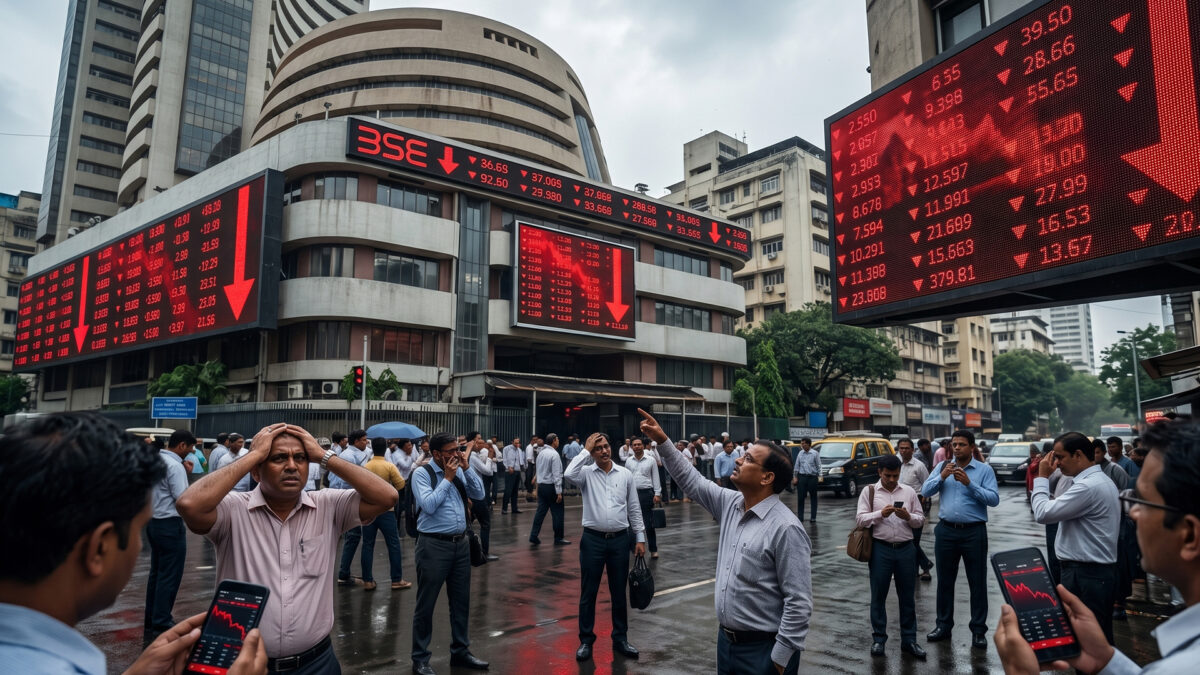
Sensex falls 245 pts, Nifty below 25,700

Markets ended lower on Wednesday, as selling pressure dominated trading amid cautious investor sentiment. The BSE Sensex fell 245 points to close at 86,150, while the Nifty 50 slipped 85 points to end at 25,666, extending the recent trend of volatility.

Sector-wise, IT and realty stocks were the biggest drag, with TCS and Asian Paints among the top losers, dropping nearly 2% each. Profit-booking and sector rotation contributed to the decline in these large-cap names. Other IT and real estate shares also underperformed, keeping the benchmarks under pressure throughout the session.

On the other hand, metal and PSU stocks outperformed, providing selective support to the indices. Tata Steel and Axis Bank were notable gainers, rising on domestic demand optimism and sector-specific interest. Energy and industrial shares also saw modest gains, partially offsetting losses in IT and realty.

Market analysts noted that foreign institutional selling added to the downward pressure, while firm crude oil prices and geopolitical concerns limited risk appetite. Investors appeared cautious ahead of upcoming corporate earnings and macroeconomic updates, keeping markets range-bound.

Trading activity showed a mixed picture, with defensive and industrial sectors attracting interest even as broader market sentiment remained subdued. Experts suggest that a sustained rebound may require clear triggers from earnings surprises or macroeconomic cues, particularly in IT, banking, and metals sectors.

Also Read: Sensex down 150 Points, Nifty below 25,700

Categories
1 Minute-Read

Tata Elxsi Q3 profit falls 45% amid labour code charges

Tata Elxsi reported a 45 percent year-on-year drop in consolidated net profit to ₹108.9 crore for Q3 FY26, down from ₹199 crore in the same period last year.

The decline was largely due to a one-time exceptional charge of ₹95.7 crore following India’s new labour codes, which increased employee benefit provisions. Despite this, the company’s revenue rose slightly by 1.5 percent to ₹953.5 crore, driven mainly by its transportation business segment.

Following the results, Tata Elxsi’s shares fell more than 3 percent. Analysts have noted the cautious outlook while keeping an eye on future growth prospects and cost management.