Categories
Beyond

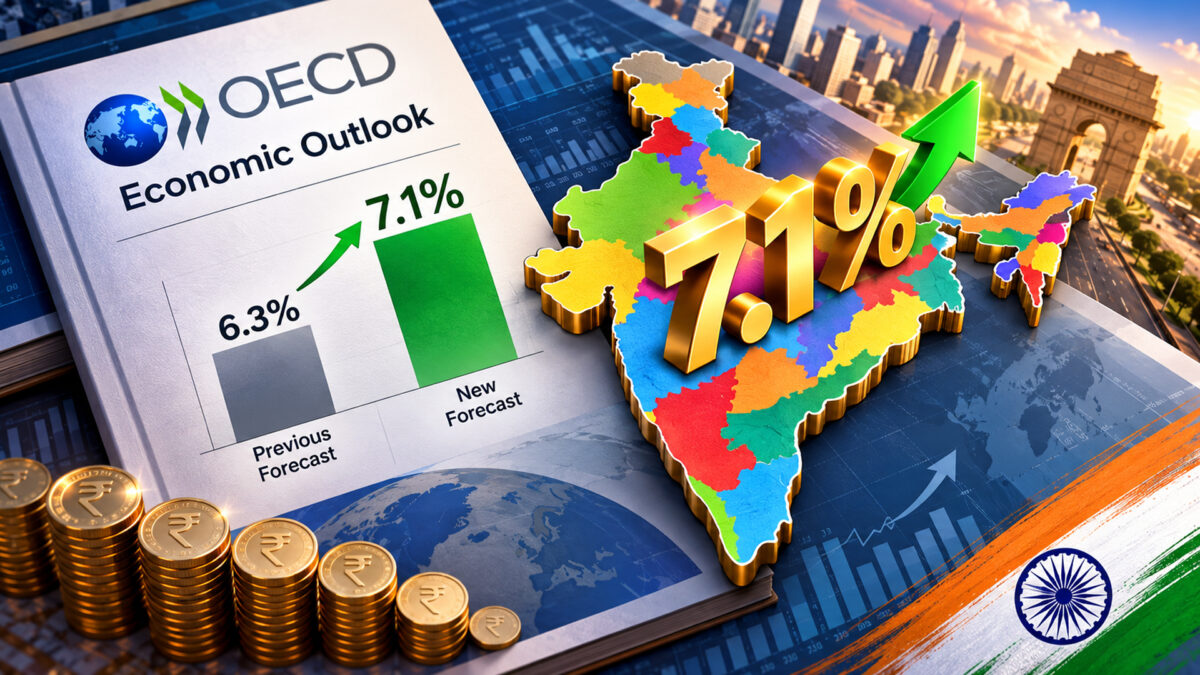
OECD raises India FY27 growth forecast to 7.1%

The OECD has raised its forecast for India’s economic growth in FY27 to 7.1%, offering a stronger outlook for Asia’s third-largest economy. The latest estimate is 80 basis points higher than the 6.3% forecast made by the organisation in June.

The upgrade comes after India’s economy grew faster than expected in the first quarter of FY27. India’s GDP expanded 7.8% in the April-June quarter, supported by strong investment, manufacturing, private consumption and services.

The revised forecast comes at a time when the Indian economy is facing several external challenges, including higher energy prices, geopolitical tensions and uncertainty over global trade.

Domestic demand remains strong

The OECD said India’s growth is being supported by resilient domestic demand and investment. Government measures have also helped households and businesses manage the impact of higher energy costs.

The April-June GDP data showed strength across several parts of the economy. Gross fixed capital formation grew 11.9%, pointing to continued investment activity. Manufacturing expanded 9.2%, while private consumption increased 7.1%.

Financial, real estate and professional services also performed strongly, growing by around 12.1%.

Strong domestic consumption is important for India because it reduces the economy’s dependence on external demand at a time when global trade remains uncertain.

Government spending and infrastructure investment have also continued to support economic activity, while businesses have maintained investment in sectors such as manufacturing, technology and services.

Growth expected to moderate

The higher FY27 forecast does not mean the OECD expects India to maintain the 7.8% growth rate recorded in the June quarter throughout the year.

The organisation expects economic growth to slow from 7.8% in FY26 to 7.1% in FY27, before easing further to 6.5% in FY28.

The OECD expects higher energy costs to reduce household purchasing power during the second half of FY27. Growth could then gradually improve as some of these pressures ease.

This suggests that while India’s overall growth outlook remains strong, the economy could see some moderation after the unusually strong performance recorded in the first quarter.

Other agencies also raise forecasts

The OECD is not the only global institution to have recently become more positive about India’s growth prospects.

S&P Global Ratings has raised its FY27 growth forecast for India to 7% from 6.6%, while Fitch Ratings increased its estimate to 6.9% from 6.4%. The Asian Development Bank also raised its projection to 7% from 6.6%.

Moody’s has put its FY27 growth forecast at 7%.

The series of upgrades reflects the stronger-than-expected performance of the Indian economy and the resilience of domestic demand.

Oil prices remain a major risk

One of the biggest risks to India’s economic outlook is the rise in crude oil prices.

The ongoing conflict in West Asia has disrupted oil supplies and increased uncertainty in global energy markets. Brent crude has recently moved above $100 a barrel, raising concerns for oil-importing countries such as India.

India imports a large share of the crude oil it consumes. Higher oil prices can increase the country’s import bill and put pressure on the rupee. They can also raise transportation and production costs for businesses.

For households, higher fuel and other energy costs can reduce disposable income and affect consumer spending.

The OECD expects government support measures, alternative energy supplies and existing oil inventories to soften some of the impact. However, a prolonged period of high crude prices could still weigh on India’s growth.

Inflation outlook

The OECD expects India’s inflation to remain manageable, although energy prices remain a risk.

It forecasts headline inflation to decline from 4.7% in 2026 to 4.2% in 2027.

Lower inflation could support household spending and provide some room for monetary policy to remain supportive of economic activity. However, a sharp increase in crude oil prices could change that picture by adding fresh pressure to consumer prices.

The inflation outlook will therefore remain important for investors and policymakers as they assess the future path of interest rates.

Global trade remains uncertain

India’s economic performance will also depend on global trade conditions. Higher tariffs, trade restrictions and geopolitical tensions have created uncertainty for exporters and businesses.

Despite these challenges, India’s domestic economy has remained relatively resilient. Services exports, manufacturing investment and consumer demand continue to provide support.

The OECD expects the global economy to grow 2.9% in 2026 and 3% in 2027. While this points to continued expansion, the outlook remains exposed to energy shocks, trade tensions and geopolitical developments.

Strong domestic demand in India could continue to act as a buffer against weaker external conditions.

The latest OECD upgrade strengthens the India GDP growth outlook for FY27, but several factors will determine whether the economy stays on track. Crude oil prices, inflation, interest rates, investment, consumer spending and global trade will remain closely watched in the months ahead.

The 7.1% growth forecast also places India among the fastest-growing major economies, even as the OECD expects growth to moderate from the exceptionally strong pace recorded in the first quarter.
 

Categories
Beyond

NITI Aayog backs double deflation debate

NITI Aayog Vice Chairman Ashok Lahiri has played down the debate over India’s revised GDP methodology, saying the disagreement over the use of double deflation should not be seen as a major battle. He said India has enough data to use the method and that the system can be improved further as better information becomes available.

Lahiri’s comments come at a time when India’s latest economic growth figures have triggered a wider discussion among economists, former policymakers and statisticians. The country recorded real GDP growth of 7.8% in the April-June 2026 quarter, beating most expectations and raising questions about how the new methodology is capturing the pace of economic activity.

The government has defended the revised national accounts series, saying it uses updated data sources and improved methods. The new series, introduced with 2022-23 as the base year, also makes greater use of double deflation to separate changes in prices from changes in actual output.

Double deflation is a statistical method in which the prices of goods produced and the prices of inputs used in production are adjusted separately. This is different from using a single price index for both. The approach can give a clearer picture of real value added, particularly when input costs and selling prices move at different rates.

GDP debate gains momentum

The GDP methodology debate intensified after the strong 7.8% growth figure was released. Former Finance Secretary Subhash Chandra Garg questioned the number, while former RBI Governor Raghuram Rajan raised a broader question about why strong GDP growth has not been accompanied by similarly strong gains in private investment, foreign investment and job creation. Rajan later clarified that his comments were about the broader economic picture rather than an endorsement or rejection of the individual GDP estimate.

The government has maintained that the revised GDP series cannot simply be compared with the previous series because the base year, data sources and methodology have changed. Officials have also pointed out that the new framework uses a more granular set of price indicators.

According to the government’s explanation, the revised system uses more than 300 deflators for inputs and outputs, compared with about 180 earlier. Supporters say this gives the national accounts a more detailed view of price movements across sectors.

The debate is therefore not only about the headline GDP number. It is also about whether India’s statistical system has enough high-quality price and production data to measure real economic activity accurately.

UPI data could boost MSME credit

Lahiri has also highlighted the role of India’s digital payments infrastructure in addressing another major economic challenge — access to formal credit for small businesses.

Speaking at the Global Fintech Fest, he said banks and fintech companies should make greater use of UPI transaction data while assessing loans to micro, small and medium enterprises.

For many MSMEs, securing bank finance can be difficult because they may lack extensive financial records, formal credit histories or sufficient collateral. Their digital payment records, however, can provide lenders with a picture of their sales and cash flows.

A business that receives regular payments through UPI may therefore have a useful digital financial trail even if it does not have years of conventional banking records. Using such data responsibly could allow lenders to assess risk more efficiently and extend credit to businesses that might otherwise struggle to qualify.

Lahiri has pointed to India’s relatively low credit-to-GDP ratio as evidence of the room for expansion. He said India’s ratio is around 53-55%, compared with roughly 150-170% in developed economies.

The greater use of digital data could help narrow this gap, particularly for MSMEs, while also reducing the cost and time involved in credit assessment.

Manufacturing remains a key concern

Lahiri has also identified manufacturing as an area where India needs to make greater progress. Manufacturing’s contribution to the economy has remained around 16% for decades, and raising that share will be important if India wants to create more jobs and build a stronger export base.

Investment is another part of the challenge. Lahiri has put India’s investment rate at around 30-34% of GDP, below the levels seen in countries such as China and South Korea.

Tourism adds another growth avenue

NITI Aayog has also been highlighting tourism as a potential source of jobs, investment and regional economic growth.

An anthology titled Divya Bharat: A Window to the Soul of India was recently released under NITI Aayog’s initiative to showcase destinations across India’s states and Union Territories. The publication covers tourism, culture, cuisine, textiles and handicrafts while drawing attention to lesser-known destinations.

The broader focus is on using India’s cultural and natural diversity to encourage longer tourist stays and spread economic activity beyond major cities.

Taken together, Lahiri’s comments highlight a larger economic agenda. India needs reliable data to measure growth accurately, wider access to formal finance for smaller businesses and higher investment to strengthen its productive capacity.


Categories
Beyond

Q4 current account surplus stands at 0.7% of GDP

India recorded a current account surplus of $7.1 billion, or 0.7% of GDP, in the fourth quarter of FY26, reflecting the strength of the country’s services exports and remittance inflows despite a wider merchandise trade deficit.

According to data released by the Reserve Bank of India (RBI), the surplus marked an improvement in India’s external sector performance during the January-March quarter. The positive balance was primarily driven by robust earnings from services exports and steady inflows of money sent home by Indians working abroad.

Services exports, particularly in information technology, business services, consulting and financial services, continued to remain a key contributor to foreign exchange earnings. India’s globally competitive services sector helped cushion the impact of a growing trade gap in goods.

Remittances also remained a major source of support. Inflows from overseas Indians contributed significantly to the current account balance, highlighting the continued importance of the Indian diaspora to the country’s external finances.

The merchandise trade deficit widened during the quarter as imports outpaced exports. Higher imports of crude oil, electronics, machinery and other goods contributed to the increase. However, the strong performance of the services sector and remittances more than compensated for the trade imbalance.

Economists said the surplus demonstrates the resilience of India’s external sector despite global economic uncertainties. The country’s diversified sources of foreign exchange earnings have helped maintain stability even as international trade conditions remain challenging.

A current account surplus occurs when the value of exports of goods and services, along with income and transfer receipts, exceeds the value of imports and outgoing payments. Such a surplus generally supports the domestic currency and strengthens foreign exchange reserves.

Also Read: Bombay HC quashes 12% retrospective spectrum charge

Categories
1 Minute-Read

India’s GDP growth at 7.8% in Oct–Dec quarter

India’s economy grew 7.8% in the October–December 2025–26 quarter, according to revised GDP data using 2022–23 as the base year. The update incorporates broader data sources and improved methodology, giving a clearer picture of economic activity.

The National Statistics Office also raised the full-year growth forecast to 7.6%, reflecting resilience in consumption, manufacturing, and services despite global uncertainties. Analysts say the figures highlight continued domestic demand and industrial output strength.

India remains one of the fastest-growing major economies, with the new data expected to improve the reliability of future economic reporting.

Categories
Beyond

India’s GDP likely to grow 7.4% in FY26

India’s economy is expected to grow at 7.4 percent in the financial year 2025‑26, according to the government’s first advance GDP estimates. This is higher than last year’s growth of 6.5 percent, signaling a strong economic recovery.

The nominal GDP, which factors in price changes, is projected to rise by 8 percent. The services sector is leading the growth, driven by finance, real estate, trade, transport, and communication. Manufacturing and construction are expected to expand around 7 percent, while agriculture may grow at about 3.1 percent.

Despite global economic challenges, strong domestic demand, investments, and supportive policy measures are helping the economy stay on track. These estimates will guide the upcoming Union Budget, offering a roadmap for fiscal planning in the year ahead.

This early outlook reflects India’s resilience and continued momentum, keeping the country on track for steady growth in FY26.

Also Read: Trump eyes Greenland, military option possible

Categories
Beyond

India’s GDP rises 8.2% in Q2, six-quarter high

India’s GDP recorded a robust 8.2% growth in the second quarter (July–September) of FY 2025–26, marking the fastest expansion in six quarters and exceeding market expectations. The performance comes even before the full impact of the recently announced GST rate cuts has been reflected in the economy.

The secondary sector, which includes manufacturing and industry, grew by around 8.1%, while the tertiary sector, encompassing services such as trade, finance, and transport,  expanded by approximately 9.2%. The primary sector, which covers agriculture, forestry, and mining, posted a modest growth of 3.1%.

Analysts said the growth was supported by strong rural demand, increased government spending, and early export shipments. Consumption showed an uptick ahead of the festive season, partially driven by expectations of lower tax rates under the GST regime.

Despite the upbeat headline numbers, some areas of the economy remain subdued. Urban demand and private investment have yet to pick up significantly, suggesting that growth is currently more dependent on government-led and rural spending.

Economists said sustaining this momentum in the coming months will require a revival in private sector investment and broader consumption across both rural and urban areas.

The Q2 growth indicates that India’s economy continues to show resilience in the face of global uncertainties. If domestic consumption, private investment, and exports continue to strengthen, the country could maintain a healthy growth trajectory in the second half of the fiscal year.

Overall, the numbers reflect a combination of strong rural activity, government support, and industrial recovery, showing that the economy is well-positioned to benefit from policy measures such as GST cuts while navigating ongoing challenges in urban markets and private investment.

Also Read: Meesho IPO to open on Dec 3, plans to raise ₹5,421 cr

Categories
Beyond

India’s GDP to grow 6.5% in FY26

India’s economy is on track for a healthy growth of 6.5% in the next fiscal year (FY26), according to ratings agency S&P Global, which expects growth to rise slightly to 6.7% in FY27. The agency says a mix of government policies, strong household demand, and a good monsoon are helping keep the economy on a steady path.

S&P highlighted that recent tax relief has given middle-class households more money to spend. The government raised the income tax rebate ceiling from ₹7 lakh to ₹12 lakh, freeing up roughly ₹1 lakh crore in extra spending power. Along with cuts in GST on many goods and a lower interest rate, these steps are encouraging people to buy more and businesses to invest.

The monsoon has also helped, boosting farm incomes and rural spending, which are important for the broader economy. At the same time, inflation is expected to stay low, around 3.2%, meaning people’s money retains its value, supporting further consumption.

While domestic demand is strong, S&P warns that India faces challenges from global trade uncertainties. Rising U.S. tariffs and slow demand from some major economies could affect Indian exporters. Companies that rely heavily on foreign markets might feel the impact if global conditions don’t improve.

S&P also noted that, to maintain long-term growth, India needs to revive investment in infrastructure and industry. Trade deals with major economies, especially the U.S., could help by attracting investment and creating jobs in sectors that export goods and services.

Overall, S&P’s outlook paints a positive picture of India’s economy. Growth is being driven mainly by people spending more at home, supported by government policies and favorable weather. But experts say that keeping the momentum will require a balance between domestic demand and global competitiveness.

Also Read: Apple, Amazon, Meta oppose Jio-Vi 6 GHz auction