
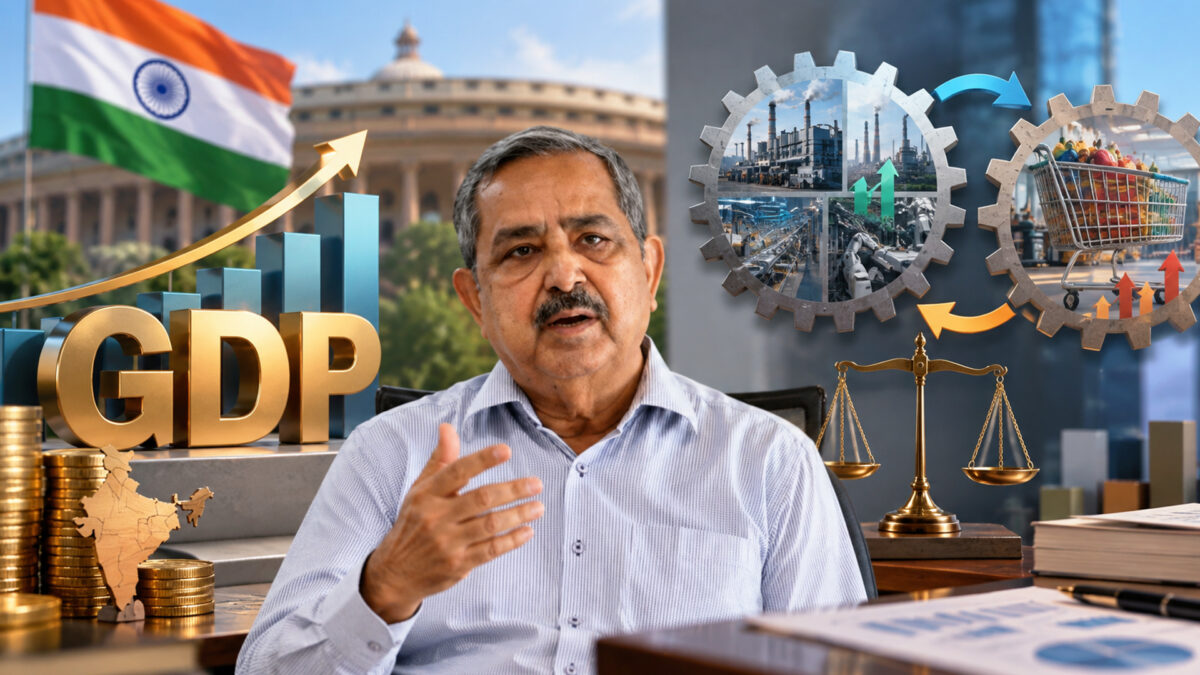
NITI Aayog Vice Chairman Ashok Lahiri has played down the debate over India’s revised GDP methodology, saying the disagreement over the use of double deflation should not be seen as a major battle. He said India has enough data to use the method and that the system can be improved further as better information becomes available.
Lahiri’s comments come at a time when India’s latest economic growth figures have triggered a wider discussion among economists, former policymakers and statisticians. The country recorded real GDP growth of 7.8% in the April-June 2026 quarter, beating most expectations and raising questions about how the new methodology is capturing the pace of economic activity.
The government has defended the revised national accounts series, saying it uses updated data sources and improved methods. The new series, introduced with 2022-23 as the base year, also makes greater use of double deflation to separate changes in prices from changes in actual output.
Double deflation is a statistical method in which the prices of goods produced and the prices of inputs used in production are adjusted separately. This is different from using a single price index for both. The approach can give a clearer picture of real value added, particularly when input costs and selling prices move at different rates.
GDP debate gains momentum
The GDP methodology debate intensified after the strong 7.8% growth figure was released. Former Finance Secretary Subhash Chandra Garg questioned the number, while former RBI Governor Raghuram Rajan raised a broader question about why strong GDP growth has not been accompanied by similarly strong gains in private investment, foreign investment and job creation. Rajan later clarified that his comments were about the broader economic picture rather than an endorsement or rejection of the individual GDP estimate.
The government has maintained that the revised GDP series cannot simply be compared with the previous series because the base year, data sources and methodology have changed. Officials have also pointed out that the new framework uses a more granular set of price indicators.
According to the government’s explanation, the revised system uses more than 300 deflators for inputs and outputs, compared with about 180 earlier. Supporters say this gives the national accounts a more detailed view of price movements across sectors.
The debate is therefore not only about the headline GDP number. It is also about whether India’s statistical system has enough high-quality price and production data to measure real economic activity accurately.
UPI data could boost MSME credit
Lahiri has also highlighted the role of India’s digital payments infrastructure in addressing another major economic challenge — access to formal credit for small businesses.
Speaking at the Global Fintech Fest, he said banks and fintech companies should make greater use of UPI transaction data while assessing loans to micro, small and medium enterprises.
For many MSMEs, securing bank finance can be difficult because they may lack extensive financial records, formal credit histories or sufficient collateral. Their digital payment records, however, can provide lenders with a picture of their sales and cash flows.
A business that receives regular payments through UPI may therefore have a useful digital financial trail even if it does not have years of conventional banking records. Using such data responsibly could allow lenders to assess risk more efficiently and extend credit to businesses that might otherwise struggle to qualify.
Lahiri has pointed to India’s relatively low credit-to-GDP ratio as evidence of the room for expansion. He said India’s ratio is around 53-55%, compared with roughly 150-170% in developed economies.
The greater use of digital data could help narrow this gap, particularly for MSMEs, while also reducing the cost and time involved in credit assessment.
Manufacturing remains a key concern
Lahiri has also identified manufacturing as an area where India needs to make greater progress. Manufacturing’s contribution to the economy has remained around 16% for decades, and raising that share will be important if India wants to create more jobs and build a stronger export base.
Investment is another part of the challenge. Lahiri has put India’s investment rate at around 30-34% of GDP, below the levels seen in countries such as China and South Korea.
Tourism adds another growth avenue
NITI Aayog has also been highlighting tourism as a potential source of jobs, investment and regional economic growth.
An anthology titled Divya Bharat: A Window to the Soul of India was recently released under NITI Aayog’s initiative to showcase destinations across India’s states and Union Territories. The publication covers tourism, culture, cuisine, textiles and handicrafts while drawing attention to lesser-known destinations.
The broader focus is on using India’s cultural and natural diversity to encourage longer tourist stays and spread economic activity beyond major cities.
Taken together, Lahiri’s comments highlight a larger economic agenda. India needs reliable data to measure growth accurately, wider access to formal finance for smaller businesses and higher investment to strengthen its productive capacity.