Categories
Beyond

China’s BYD challenges Trump’s tariffs at US court

Chinese electric vehicle and clean-energy major BYD has taken a significant legal step in the United States, filing a lawsuit against the federal government to challenge tariffs imposed by President Donald Trump.

The case, filed in the US Court of International Trade in New York, seeks refunds for import duties paid since April and questions the legal basis used to impose the levies. BYD’s US subsidiaries argue that the tariffs were introduced under the International Emergency Economic Powers Act (IEEPA), a law meant for national security emergencies, not for imposing broad trade barriers.

The emergency law does not explicitly allow the government to levy import tariffs. BYD is asking the court to order the repayment of duties already paid and to safeguard its right to future refunds if the tariffs are ruled invalid.

While BYD does not sell passenger cars in the US, it has a growing footprint in the country through its electric buses, trucks, batteries, energy storage systems and solar products. Its manufacturing facility in Lancaster, California, employs around 750 workers, making the company an active contributor to local jobs and clean-energy infrastructure.

The legal move places BYD among a rising number of global companies challenging Trump’s trade policies. The dispute also comes as the US Supreme Court considers a separate case that could ultimately decide whether emergency powers can be used to justify such tariffs.

For Washington, the case revives a sensitive debate around trade protectionism and executive authority. For BYD, it is both a financial and strategic decision, aimed at recovering costs while seeking clarity on the rules governing global trade.

Also Read: Balaji Krishnamurthy named Uber CFO
Categories
Beyond

Gujarat signs letter of intent with Starlink

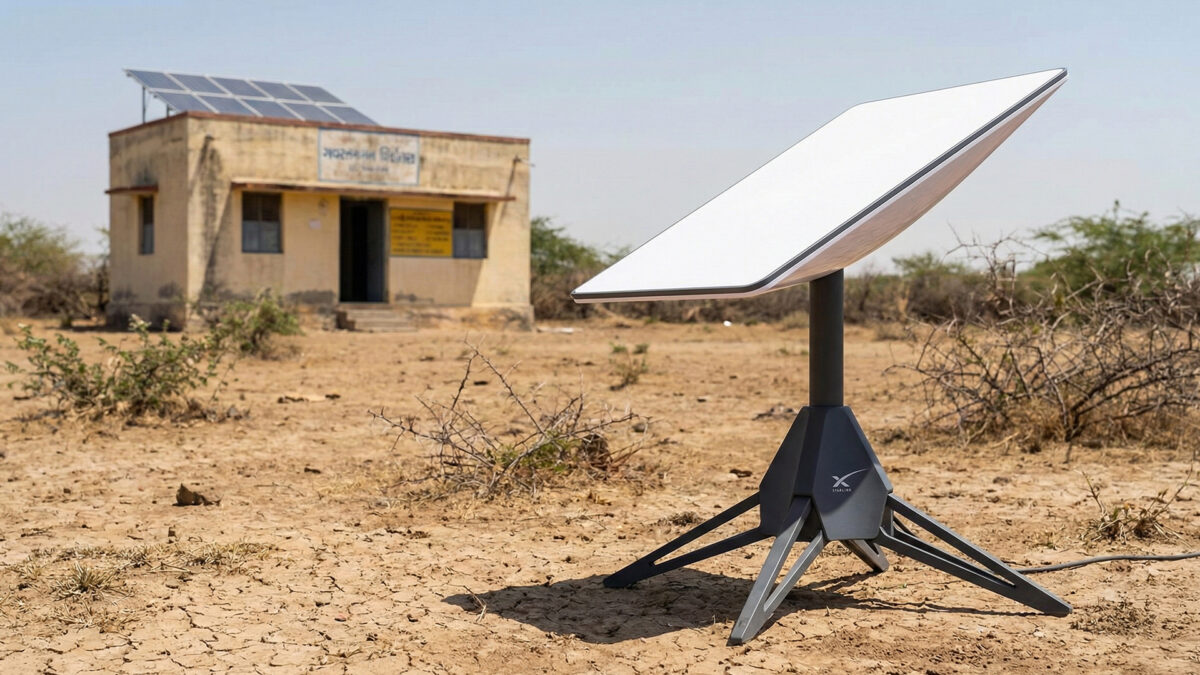
The Gujarat government has signed a Letter of Intent (LoI) with Starlink, the satellite internet company owned by Elon Musk’s SpaceX, to provide high-speed broadband connectivity in remote, tribal and underserved areas of the state. The move is aimed at bridging the digital divide in regions where traditional telecom infrastructure is weak or unavailable.

The LoI was signed in Gandhinagar in the presence of Chief Minister Bhupendra Patel and Deputy Chief Minister Harsh Sanghavi. Senior officials from the state government and representatives of Starlink formalised the agreement, marking Gujarat as one of the first Indian states to explore satellite-based internet solutions at scale.

Under the proposed partnership, Starlink’s low-Earth orbit satellite technology will be used to deliver fast and reliable internet without dependence on fibre cables or mobile towers. This makes it suitable for hilly terrain, forest regions, coastal belts, border areas and islands, where laying physical infrastructure is challenging and costly.

The initial focus will be on connecting government schools, primary health centres, Common Service Centres (CSCs), e-governance offices, disaster management control rooms and remote administrative units. Officials said the project will support online education, telemedicine, digital governance, emergency response systems and public service delivery.

Tribal and aspirational districts are expected to benefit significantly, with improved access to digital learning tools, specialist healthcare consultations and government welfare services. The state also plans to explore satellite connectivity for ports, coastal security, wildlife sanctuaries, highways and industrial estates, especially in areas with patchy network coverage.

Also Read: FPIs return, pump ₹8,100 cr into Indian stocks

Categories
Beyond

Gold trades at ₹1,57,920, Silver at ₹3,00,100

Gold and silver prices in the domestic market recorded marginal gains in early trade on Tuesday, tracking cautious global sentiment and steady investor demand. Twenty-four carat gold rose by ₹10 to trade at ₹1,57,920 per 10 grams, while silver gained ₹100 to settle at ₹3,00,100 per kilogram, according to latest commodity market data.

The slight uptick in prices comes at a time when global markets remain volatile, with investors closely monitoring upcoming economic data from the United States, including inflation and employment numbers. Movements in the US dollar and expectations around interest rate decisions have also influenced bullion prices.

Across major Indian cities, gold prices remained largely uniform. In Mumbai and Kolkata, 24-carat gold was priced at ₹1,57,920 per 10 grams, while Delhi saw prices slightly higher at around ₹1,58,070 per 10 grams. Chennai continued to quote gold at a premium, with prices touching ₹1,59,830 per 10 grams.

Prices of 22-carat gold, commonly used for jewellery, also moved up by ₹10. The yellow metal was trading at ₹1,44,760 per 10 grams in cities such as Mumbai, Kolkata, Bengaluru and Hyderabad. In Chennai, 22-carat gold was priced at ₹1,46,510 per 10 grams, while Delhi quoted the metal at ₹1,44,910.

Silver prices showed modest strength but remained range-bound. The white metal was trading at ₹3,00,100 per kg in key markets including Delhi, Mumbai, Kolkata and Chennai. Market participants noted that silver prices continue to witness volatility due to fluctuations in industrial demand and global commodity trends.

In the international market, precious metals were trading on a weaker note. Spot gold slipped to around $5,016 an ounce, easing from recent record highs, while spot silver also saw mild pressure.

Also Read: Sensex rises 485 Points, Nifty crosses 25,850

Categories
Beyond

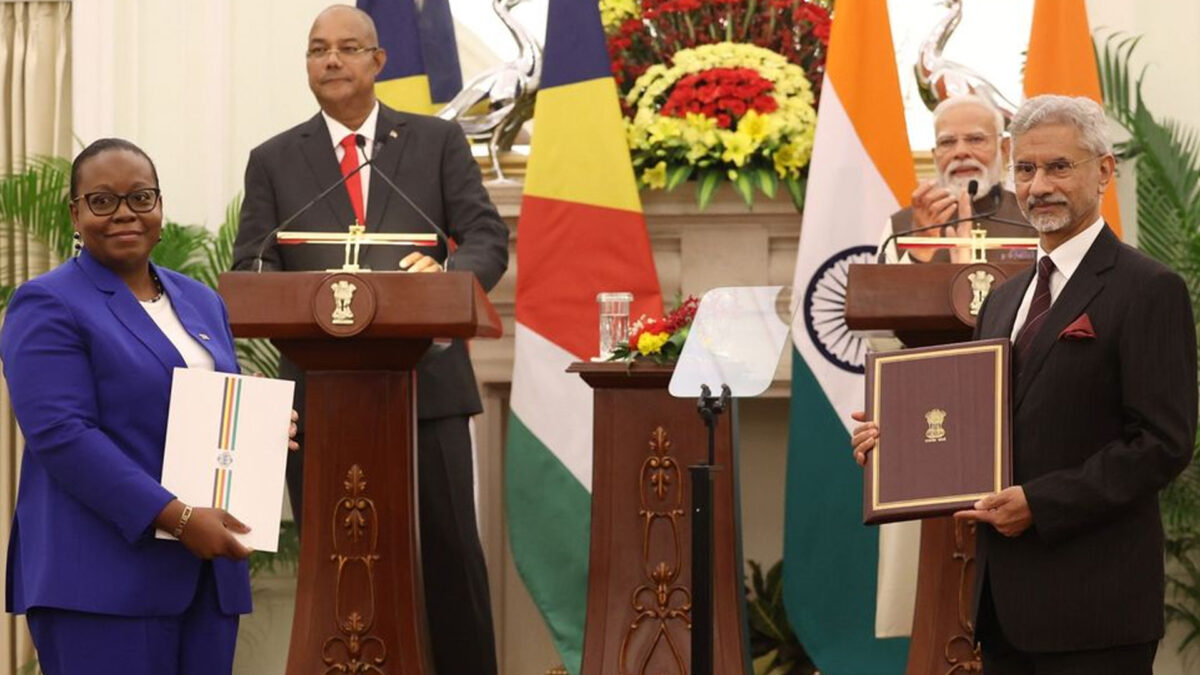
India pledges $175 mn economic support for Seychelles

In a significant move reflecting India’s commitment to regional development, Prime Minister Narendra Modi announced a $175 million special economic package for Seychelles, aimed at supporting the island nation’s key development priorities. The announcement came during a joint press briefing with Seychelles President Patrick Herminie in New Delhi, marking a milestone in the two countries’ long-standing diplomatic and economic partnership.

The package is designed to finance projects that will have a tangible impact on the daily lives of Seychellois citizens. Social housing projects will be a major focus, addressing the pressing need for affordable homes, while investments in electric mobility and vocational training aim to create new employment opportunities, particularly for young professionals. Health infrastructure and maritime security initiatives are also included, reflecting India’s holistic approach to development support.

“This package is about more than funds; it’s about empowering communities and strengthening Seychelles’ capacity for sustainable growth,” Modi said. Analysts note that such initiatives often generate long-term economic benefits, as improved housing, transport, and training contribute to workforce productivity and regional stability.

President Herminie, on his first state visit to India, expressed appreciation for the package, highlighting the strong historical ties and strategic partnership between the nations. He noted that India’s support demonstrates trust and a shared vision for economic resilience and regional stability in the Indian Ocean.

For businesses, this package signals a growing scope for Indian companies to participate in development projects in Seychelles, particularly in infrastructure, technology, and renewable energy sectors.

The agreement also includes capacity-building programs, including training Seychellois civil servants in India, and enhanced digital and trade cooperation, facilitating smoother economic and technological integration. Both governments emphasized that the package aligns with priorities identified by Seychelles and will support projects that directly impact citizens’ livelihoods.

Also Read: India clarifies $500bn US import figure

Categories
Beyond

India clarifies $500bn US import figure

India’s Commerce Minister Piyush Goyal has clarified that the $500 billion figure for imports from the US over five years reflects India’s growing commercial needs, not a firm commitment under the new trade framework.

Goyal emphasized that India “intends to” source goods from the US where it makes sense, but there is no obligation to buy a fixed annual amount. Decisions will depend on price, quality, and demand.

The estimate comes from India’s rising import requirements, expected to reach $2 trillion over five years. Key sectors include energy (crude oil, LNG, LPG), aviation (aircraft, engines, spare parts), technology products, precious metals, and coking coal.

India already has aircraft orders with Boeing worth $50 billion, and future aviation needs could push imports to $80–100 billion. Similarly, growing tech infrastructure,  data centres, AI, and quantum computing,  will drive demand for high-end US products.

Goyal noted that India currently imports about $300 billion of goods that could come from the US. He described the $500 billion figure as conservative, reflecting intent to diversify supply chains rather than any enforced quota.

The interim trade framework also reduces tariffs and gives Indian exporters better access to the US market, benefiting sectors such as pharma, gems and jewellery, and labour-intensive industries.

The clarification addresses concerns that India might be forced into higher imports, reassuring that sensitive sectors like agriculture and dairy remain protected.

Also Read: Sarvam AI beats global rivals in India tests


Categories
Beyond

India-US interim trade deal cheers stock markets

Indian stock markets are seeing fresh optimism after India and the United States agreed on an interim trade deal framework, a move that has eased concerns around tariffs and trade barriers. Though not a full free-trade agreement, the interim pact offers near-term clarity for businesses and exporters, lifting overall market sentiment.

Early signals indicate that Sensex and Nifty 50 are likely to trade higher, supported by strong global cues and hopes of improved India-US trade relations. Market experts say the agreement reduces uncertainty for Indian companies that depend heavily on the US market, especially exporters.

According to market analysts and brokerage reports, export-focused sectors are expected to benefit the most. Stocks that have come into focus include:

In pharmaceuticals, companies such as Sun Pharma, Dr Reddy’s Laboratories, Lupin, Aurobindo Pharma and Divi’s Laboratories are seen gaining due to their strong US exposure.

In IT services, firms like Infosys, HCL Tech, Wipro and LTI Mindtree are expected to benefit as US demand remains steady.
The textiles and apparel sector has also drawn attention, with stocks such as Gokaldas Exports, KPR Mill, Welspun Living, Indo Count Industries and Kitex Garments seen as potential gainers.
In manufacturing and engineering, analysts have highlighted Dixon Technologies, Syrma SGS Technology, Bharat Forge, Sona BLW, Samvardhana Motherson, Sansera Engineering and Avalon Technologies.

Some traders are also tracking Torrent Power, Jindal Steel, ITC, Bharti Airtel and Kotak Mahindra Bank for short-term opportunities, as overall sentiment remains positive.

Despite the upbeat mood, experts caution that the trade deal alone may not drive a long-lasting rally.

Also Read: Sensex up 300 points, Nifty near 25,800

Categories
Beyond

Gold at ₹1,56,590, Silver slips to ₹2,84,900

Gold and silver prices slipped slightly in early trade on Monday, reflecting cautious sentiment in the bullion market. Ten grams of 24-carat gold fell by ₹10 to ₹1,56,590 in major cities such as Mumbai and Kolkata. Prices were marginally higher in Chennai, while Delhi saw rates close to the national average. 22-carat gold also eased by ₹10, trading at around ₹1,43,540 per ten grams.


Categories
Beyond

India removes small-car relief in new fuel emission rules

India has decided to drop the proposed special concession for small petrol cars in its upcoming fuel-efficiency and emission norms, following objections from several domestic automakers. The move is part of a revised draft of the Corporate Average Fuel Efficiency (CAFE) regulations, which will come into force from April 2027 and remain valid for five years.

Earlier, the draft rules had offered relaxed emission targets for petrol cars weighing 909 kg or less. This provision was strongly opposed by companies such as Tata Motors and Mahindra & Mahindra, which argued that it would unfairly favour one manufacturer that dominates the small-car segment. Industry executives said the concession would distort competition rather than promote genuine fuel-efficiency improvements.

After reviewing the feedback, the government removed the small-car exemption and introduced a more uniform framework. The revised draft tightens emission targets across the passenger vehicle segment and reduces the scope for weight-based advantages. All passenger vehicles with a gross weight of up to 3,500 kg will now be assessed under the same broad efficiency principles.

Under the new proposal, average fleet carbon dioxide emissions must fall steadily, reaching about 100 grams per kilometre by 2032, compared to roughly 114 g/km currently. The targets could become even stricter if electric vehicles gain a higher share of overall car sales.

To support the shift towards cleaner mobility, the draft rules provide incentives for electric vehicles and plug-in hybrids through a credit-based system. Automakers that exceed targets can earn credits, while those falling short will need to buy credits or face penalties. Companies may also pool compliance performance with other manufacturers to meet the norms more efficiently.

Penalties for non-compliance could go up to around $550 per vehicle, making adherence financially critical for automakers.

Transport accounts for about 12% of India’s total energy consumption and is a major contributor to carbon emissions and fuel imports. Passenger vehicles form the bulk of these emissions.

Also Read: MRF Q3 profit jumps 119% to ₹692 cr


Categories
Beyond

RBI keeps repo rate at 5.25%, stance neutral

The Reserve Bank of India (RBI) on February 6, 2026, decided to keep the key policy repo rate unchanged at 5.25%, maintaining a cautious approach as inflation remains under control and economic growth stays steady. The decision was taken by the Monetary Policy Committee (MPC) at the end of its bi-monthly review meeting.

Along with the rate pause, the MPC also chose to retain its ‘neutral’ policy stance, signalling that future interest rate decisions will be guided by incoming economic data rather than a fixed bias towards tightening or easing. This means the RBI is keeping its options open amid both domestic stability and global uncertainties.

RBI Governor Sanjay Malhotra said inflation has eased significantly from earlier highs and is now comfortably within the central bank’s target range. Lower food prices, improved supply conditions, and softer global commodity prices have helped contain price pressures. However, the RBI cautioned that risks from unpredictable weather, global energy prices, and geopolitical tensions still remain.

On the growth front, the central bank expressed confidence in India’s economic momentum. It noted that domestic demand remains strong, supported by healthy consumption, rising investment activity, and robust performance in the services sector. Manufacturing activity has also shown signs of improvement, aided by government capital expenditure and stable financial conditions.

The RBI slightly upgraded its growth outlook, reflecting optimism about India’s medium-term prospects, even as global economic conditions remain uneven. At the same time, the MPC stressed the need for vigilance, especially as global financial markets continue to react to policy signals from major central banks.

Also Read: US drops 25% tariff on Indian goods

Categories
Beyond

US drops 25% tariff on Indian goods

In a major relief for Indian exporters, the United States has lifted the extra 25% tariff on Indian goods that was imposed last year over India’s purchases of Russian oil. The tariff rollback, effective February 7, 2026, comes after India pledged to stop both direct and indirect imports of Russian crude, addressing a key US concern.

The decision is part of a new interim trade framework aimed at improving economic ties between the two countries. Under this agreement, the US will reduce general tariffs on Indian products to about 18%, while India will expand purchases of US goods, including energy, aircraft parts, and technology, worth up to $500 billion over the next five years.

Officials say the framework also sets the stage for closer cooperation in defence and supply chains, while easing barriers that had made it harder for Indian exports in sectors like textiles, pharmaceuticals, and machinery to compete in the US market.

This is seen as a boost for Indian businesses, as the removal of the extra levy will make exports more competitive and strengthen long-term trade relations. Both governments described the deal as a step toward a larger bilateral trade agreement, marking a new phase of economic and strategic partnership between the two nations.

Also Read: Reliance returns to Venezuelan oil, buys 2 mn barrels