Categories
Beyond

India clarifies $500bn US import figure

India’s Commerce Minister Piyush Goyal has clarified that the $500 billion figure for imports from the US over five years reflects India’s growing commercial needs, not a firm commitment under the new trade framework.

Goyal emphasized that India “intends to” source goods from the US where it makes sense, but there is no obligation to buy a fixed annual amount. Decisions will depend on price, quality, and demand.

The estimate comes from India’s rising import requirements, expected to reach $2 trillion over five years. Key sectors include energy (crude oil, LNG, LPG), aviation (aircraft, engines, spare parts), technology products, precious metals, and coking coal.

India already has aircraft orders with Boeing worth $50 billion, and future aviation needs could push imports to $80–100 billion. Similarly, growing tech infrastructure,  data centres, AI, and quantum computing,  will drive demand for high-end US products.

Goyal noted that India currently imports about $300 billion of goods that could come from the US. He described the $500 billion figure as conservative, reflecting intent to diversify supply chains rather than any enforced quota.

The interim trade framework also reduces tariffs and gives Indian exporters better access to the US market, benefiting sectors such as pharma, gems and jewellery, and labour-intensive industries.

The clarification addresses concerns that India might be forced into higher imports, reassuring that sensitive sectors like agriculture and dairy remain protected.

Also Read: Sarvam AI beats global rivals in India tests


Categories
Beyond

India-US interim trade deal cheers stock markets

Indian stock markets are seeing fresh optimism after India and the United States agreed on an interim trade deal framework, a move that has eased concerns around tariffs and trade barriers. Though not a full free-trade agreement, the interim pact offers near-term clarity for businesses and exporters, lifting overall market sentiment.

Early signals indicate that Sensex and Nifty 50 are likely to trade higher, supported by strong global cues and hopes of improved India-US trade relations. Market experts say the agreement reduces uncertainty for Indian companies that depend heavily on the US market, especially exporters.

According to market analysts and brokerage reports, export-focused sectors are expected to benefit the most. Stocks that have come into focus include:

In pharmaceuticals, companies such as Sun Pharma, Dr Reddy’s Laboratories, Lupin, Aurobindo Pharma and Divi’s Laboratories are seen gaining due to their strong US exposure.

In IT services, firms like Infosys, HCL Tech, Wipro and LTI Mindtree are expected to benefit as US demand remains steady.
The textiles and apparel sector has also drawn attention, with stocks such as Gokaldas Exports, KPR Mill, Welspun Living, Indo Count Industries and Kitex Garments seen as potential gainers.
In manufacturing and engineering, analysts have highlighted Dixon Technologies, Syrma SGS Technology, Bharat Forge, Sona BLW, Samvardhana Motherson, Sansera Engineering and Avalon Technologies.

Some traders are also tracking Torrent Power, Jindal Steel, ITC, Bharti Airtel and Kotak Mahindra Bank for short-term opportunities, as overall sentiment remains positive.

Despite the upbeat mood, experts caution that the trade deal alone may not drive a long-lasting rally.

Also Read: Sensex up 300 points, Nifty near 25,800

Categories
Beyond

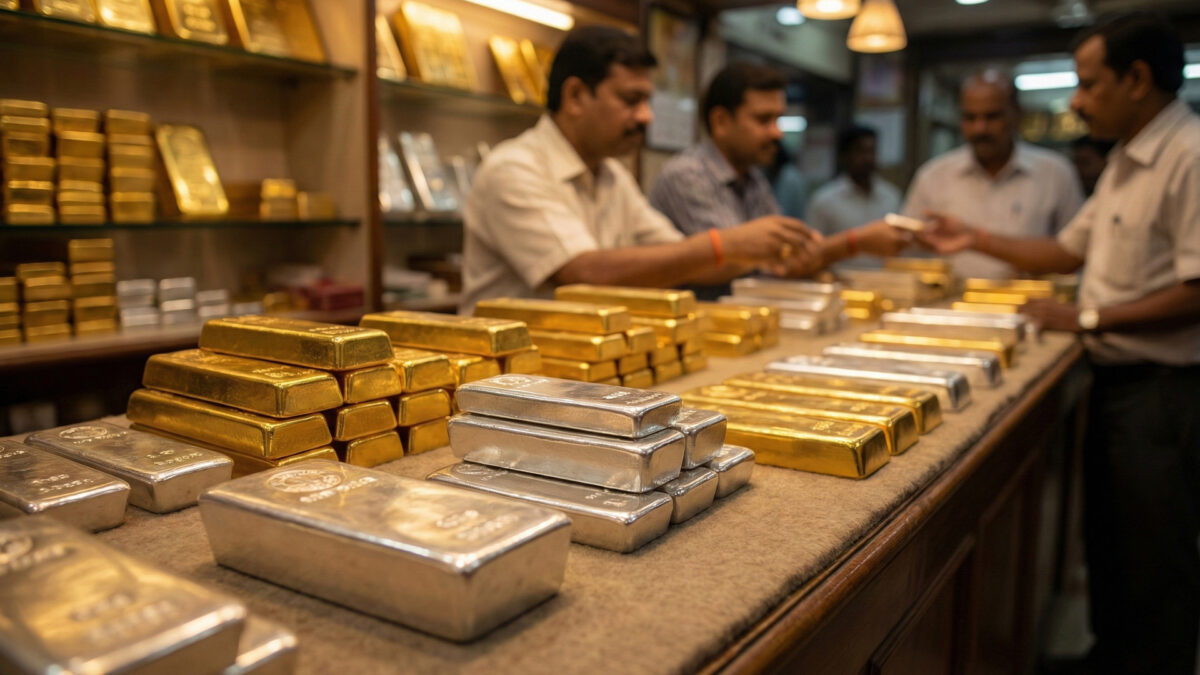
Gold at ₹1,56,590, Silver slips to ₹2,84,900

Gold and silver prices slipped slightly in early trade on Monday, reflecting cautious sentiment in the bullion market. Ten grams of 24-carat gold fell by ₹10 to ₹1,56,590 in major cities such as Mumbai and Kolkata. Prices were marginally higher in Chennai, while Delhi saw rates close to the national average. 22-carat gold also eased by ₹10, trading at around ₹1,43,540 per ten grams.


Categories
Beyond

India removes small-car relief in new fuel emission rules

India has decided to drop the proposed special concession for small petrol cars in its upcoming fuel-efficiency and emission norms, following objections from several domestic automakers. The move is part of a revised draft of the Corporate Average Fuel Efficiency (CAFE) regulations, which will come into force from April 2027 and remain valid for five years.

Earlier, the draft rules had offered relaxed emission targets for petrol cars weighing 909 kg or less. This provision was strongly opposed by companies such as Tata Motors and Mahindra & Mahindra, which argued that it would unfairly favour one manufacturer that dominates the small-car segment. Industry executives said the concession would distort competition rather than promote genuine fuel-efficiency improvements.

After reviewing the feedback, the government removed the small-car exemption and introduced a more uniform framework. The revised draft tightens emission targets across the passenger vehicle segment and reduces the scope for weight-based advantages. All passenger vehicles with a gross weight of up to 3,500 kg will now be assessed under the same broad efficiency principles.

Under the new proposal, average fleet carbon dioxide emissions must fall steadily, reaching about 100 grams per kilometre by 2032, compared to roughly 114 g/km currently. The targets could become even stricter if electric vehicles gain a higher share of overall car sales.

To support the shift towards cleaner mobility, the draft rules provide incentives for electric vehicles and plug-in hybrids through a credit-based system. Automakers that exceed targets can earn credits, while those falling short will need to buy credits or face penalties. Companies may also pool compliance performance with other manufacturers to meet the norms more efficiently.

Penalties for non-compliance could go up to around $550 per vehicle, making adherence financially critical for automakers.

Transport accounts for about 12% of India’s total energy consumption and is a major contributor to carbon emissions and fuel imports. Passenger vehicles form the bulk of these emissions.

Also Read: MRF Q3 profit jumps 119% to ₹692 cr


Categories
Beyond

RBI keeps repo rate at 5.25%, stance neutral

The Reserve Bank of India (RBI) on February 6, 2026, decided to keep the key policy repo rate unchanged at 5.25%, maintaining a cautious approach as inflation remains under control and economic growth stays steady. The decision was taken by the Monetary Policy Committee (MPC) at the end of its bi-monthly review meeting.

Along with the rate pause, the MPC also chose to retain its ‘neutral’ policy stance, signalling that future interest rate decisions will be guided by incoming economic data rather than a fixed bias towards tightening or easing. This means the RBI is keeping its options open amid both domestic stability and global uncertainties.

RBI Governor Sanjay Malhotra said inflation has eased significantly from earlier highs and is now comfortably within the central bank’s target range. Lower food prices, improved supply conditions, and softer global commodity prices have helped contain price pressures. However, the RBI cautioned that risks from unpredictable weather, global energy prices, and geopolitical tensions still remain.

On the growth front, the central bank expressed confidence in India’s economic momentum. It noted that domestic demand remains strong, supported by healthy consumption, rising investment activity, and robust performance in the services sector. Manufacturing activity has also shown signs of improvement, aided by government capital expenditure and stable financial conditions.

The RBI slightly upgraded its growth outlook, reflecting optimism about India’s medium-term prospects, even as global economic conditions remain uneven. At the same time, the MPC stressed the need for vigilance, especially as global financial markets continue to react to policy signals from major central banks.

Also Read: US drops 25% tariff on Indian goods

Categories
Beyond

US drops 25% tariff on Indian goods

In a major relief for Indian exporters, the United States has lifted the extra 25% tariff on Indian goods that was imposed last year over India’s purchases of Russian oil. The tariff rollback, effective February 7, 2026, comes after India pledged to stop both direct and indirect imports of Russian crude, addressing a key US concern.

The decision is part of a new interim trade framework aimed at improving economic ties between the two countries. Under this agreement, the US will reduce general tariffs on Indian products to about 18%, while India will expand purchases of US goods, including energy, aircraft parts, and technology, worth up to $500 billion over the next five years.

Officials say the framework also sets the stage for closer cooperation in defence and supply chains, while easing barriers that had made it harder for Indian exports in sectors like textiles, pharmaceuticals, and machinery to compete in the US market.

This is seen as a boost for Indian businesses, as the removal of the extra levy will make exports more competitive and strengthen long-term trade relations. Both governments described the deal as a step toward a larger bilateral trade agreement, marking a new phase of economic and strategic partnership between the two nations.

Also Read: Reliance returns to Venezuelan oil, buys 2 mn barrels

Categories
Beyond

Reliance returns to Venezuelan oil, buys 2 mn barrels

Reliance Industries has bought 2 million barrels of crude oil from Venezuela, marking its first purchase from the country since mid‑2025. The deal is for delivery in April, and the crude was purchased through trading firm Vitol at a discount compared to global oil prices.

This move shows Reliance is taking advantage of cheaper Venezuelan oil, which is a heavy, sour grade that fits well with its large Jamnagar refinery in Gujarat. The refinery is equipped to process these kinds of crude, helping the company make better profits when refining it. Sources say the oil was bought at roughly $6–7 per barrel lower than Brent crude.

The purchase comes as the United States has eased sanctions on Venezuela, allowing some trading firms to handle its oil. This has made it easier for companies like Reliance to buy Venezuelan crude without running into legal or financial hurdles.

While the US has encouraged India to reduce purchases of Russian crude, India continues to make decisions based on price and energy needs, rather than politics. Officials say India will keep looking for reliable oil sources to meet its growing demand.

Analysts see this as a smart business move by Reliance. With global oil supplies changing due to geopolitical tensions and US‑Venezuela agreements, buying discounted Venezuelan crude can give Indian refiners an economic advantage.

The deal also highlights India’s strategy of diversifying its oil sources to secure steady supplies at competitive prices. By resuming trade with Venezuela, Reliance joins other Indian refiners in exploring alternative crude options while keeping costs under control.

Also Read: Bitcoin slumps to $60,000 as crypto market shakes

Categories
Beyond

Bitcoin slumps to $60,000 as crypto market shakes

Bitcoin plunged sharply this week, falling to around $60,000, marking its lowest level in over a year and highlighting one of the steepest declines in the cryptocurrency’s history. The world’s largest digital asset has now lost more than 50% of its value from its record high of approximately $126,000 in October 2025.

The sudden drop sent shockwaves through the broader crypto market, with Ethereum and other major tokens also seeing steep declines, collectively erasing trillions of dollars in market value since late 2025. The sell-off accelerated Thursday and Friday as Bitcoin broke through several key technical levels. It first slipped below $70,000, then fell under $65,000, and eventually traded around $60,000 before briefly rebounding.

The sudden movement reflects growing investor caution, as many have retreated from risky assets, including cryptocurrencies and technology stocks, amid mounting market volatility. Institutional withdrawals from Bitcoin exchange-traded funds and the forced liquidation of large long positions have further intensified the decline, contributing to a sense of panic among traders.

This downturn comes after months of strong gains, fueled in part by regulatory optimism and increased institutional interest. However, recent developments, including heightened market uncertainty and investor nervousness, have undermined that momentum. Analysts warn that this slump could signal the start of a prolonged bear market, though some note that extreme volatility is a hallmark of cryptocurrency trading, and temporary rebounds remain possible.

Also Read: AI tools set to transform software jobs

Categories
Beyond

India plans $80 bn Boeing aircraft purchase

India is preparing to place one of its largest-ever aircraft orders with US aerospace giant Boeing, following a major trade agreement between the two countries. Commerce and Industry Minister Piyush Goyal said India’s planned purchase could be worth $70–80 billion, potentially exceeding $100 billion when engines, spare parts, and long-term support contracts are included.

The proposed Boeing order is part of a broader push by India to expand imports of American goods across key sectors, including aviation, energy, and advanced technology. Officials have described the demand as “ready,” signaling that negotiations with Boeing could move quickly once the trade deal is formally signed.

The US–India trade agreement is expected to be finalized in March 2026, with a joint statement likely in the coming days. As part of the deal, the United States has agreed to reduce tariffs on Indian exports, which currently average around 50%, while India will commit to purchasing roughly $500 billion worth of US products over five years, including aircraft, engines, and other high-tech equipment.

Analysts say the Boeing order could have a significant impact on both countries’ economies. For the US., it would represent one of the largest single-country sales in Boeing’s history, providing a boost to manufacturing and the aerospace supply chain. For India, the aircraft purchases will support the growth of its civil aviation sector, expand fleet capacity for airlines, and strengthen economic ties with a key trade partner.

While the deal signals a major step in bilateral trade, final details on the number of planes, delivery schedules, and pricing are still being finalized. Officials say discussions with Boeing and US authorities are ongoing to ensure that both countries maximize the benefits of the agreement.

Also Read: RBI says most ₹2,000 notes returned, still legal tender


Categories
Beyond

RBI projects 4.2% inflation in FY27

India’s inflation is expected to gradually rise toward more normal levels over the next year, but without causing stress to the economy, according to the Reserve Bank of India (RBI). The central bank’s latest projections show that consumer price inflation is likely to hover around 4% in FY2026–27, a level the RBI considers ideal for sustainable growth.

Speaking after the Monetary Policy Committee’s recent review, RBI Governor Sanjay Malhotra said the modest rise in inflation reflects improving economic activity rather than runaway price pressures. For the current financial year, inflation is expected to remain low at about 2.1% on average, before inching up to around 3.2% in the final quarter as demand strengthens.

Looking ahead, the RBI expects inflation to average about 4.0% in the first quarter of FY27 and 4.2% in the second quarter. This upward revision, the central bank explained, is driven by normalisation in food prices, steady domestic demand, and global commodity trends. Importantly, inflation is still projected to stay well within the RBI’s comfort band of 2% to 6%.

Against this backdrop, the RBI chose to keep the repo rate unchanged at 5.25% and maintain a neutral policy stance. This decision is aimed at supporting economic growth while remaining alert to any risks to price stability. Stable interest rates help keep borrowing costs predictable for households and businesses.

For consumers, this means prices of everyday essentials are likely to rise slowly and steadily, rather than sharply. For businesses, steady inflation and unchanged rates provide confidence to plan investments, expand operations, and hire more people. Economists say this environment supports sustained growth without overheating the economy.

The RBI also said it will closely monitor food prices, global oil markets, precious metals, and geopolitical developments that could affect inflation going forward.

Also Read: Gold above ₹1.50 lakh, Silver dips to ₹2.35 lakh