Categories
Corporate

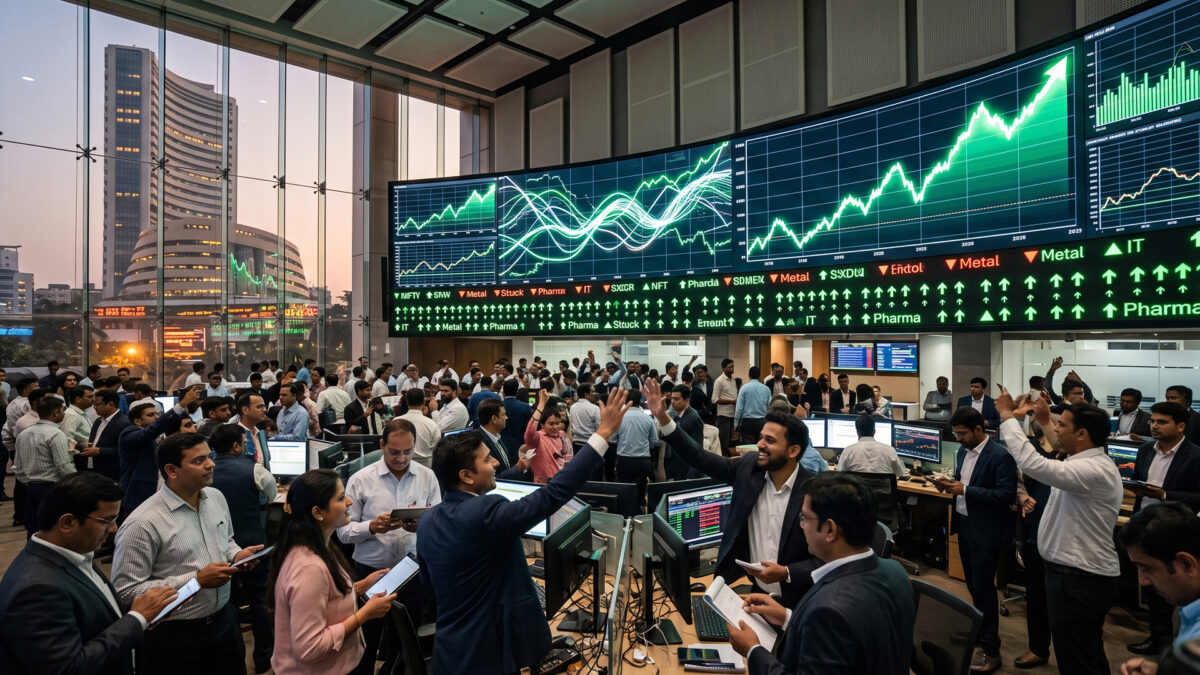
Sensex slips 20 points, Nifty rises to 23,270

Indian stock markets ended on a mixed note on Thursday, with the Nifty closing higher while the Sensex slipped marginally as investors remained cautious after the latest US Federal Reserve rate decision. The 30-share BSE Sensex fell 21.86 points, or 0.03%, to settle at 74,314.59, while the NSE Nifty50 gained 53 points, or 0.23%, to close at 23,270.60.

The session was marked by sharp swings. The Sensex climbed as much as 341 points during the day to touch 74,677.56, while the Nifty also moved above 23,300 before giving up part of its gains. Profit booking at higher levels and concerns over global interest rates kept the recovery in check.

Investors were assessing the impact of the US Federal Reserve’s latest decision to raise interest rates by 25 basis points. The move, along with indications that further tightening could remain possible, kept global markets cautious. Higher US rates can affect foreign investment flows into emerging markets such as India by making dollar assets relatively more attractive.

Crude oil prices remained another concern for domestic investors. Elevated oil prices are particularly important for India because the country imports a large share of its crude requirements. A sustained rise in crude can increase the import bill, put pressure on the rupee and complicate inflation management. Market participants therefore continued to watch oil prices closely.

Despite the cautious mood, buying emerged in several sectors. Auto, metal, media and pharmaceutical stocks were among the stronger performers, while banking and oil and gas stocks faced pressure. The broader market also remained firm, with mid-cap and small-cap indices gaining during the session.

HDFC Life emerged as the standout Nifty gainer, rising around 5%. Tata Motors Passenger Vehicles also gained more than 4%, while SBI Life Insurance advanced over 4%. Bharat Electronics, Dr Reddy’s Laboratories and InterGlobe Aviation were among other stocks that attracted buying interest.

The gains were not broad enough to lift all major stocks. ONGC was the biggest Nifty loser, declining around 1.9%. Titan Company fell about 1.4%, while HDFC Bank dropped around 1.2%. Hindustan Unilever, Coal India and Nestle India also ended lower.

Banking stocks were among the key drags on the market. HDFC Bank and ICICI Bank featured among the major losers, while the Nifty Bank index declined 236.70 points, or 0.42%, to close at 56,055.75. Weakness in heavyweight banking stocks limited the impact of gains in insurance, auto and metal counters.

Tata group stocks, meanwhile, provided support to the broader market. Tata Motors, Tata Steel and Tata Investment gained during the session, with the auto and metal segments benefiting from buying interest. The Nifty Auto index was among the stronger sectoral performers.

Market breadth remained positive despite the subdued headline indices. The gains in mid-cap and small-cap shares indicated that investors were still willing to take selective positions, particularly in stocks that had corrected during the recent market decline. This value buying helped prevent a deeper fall in the benchmark indices.

The National Stock Exchange’s initial public offering also remained a major focus. The ₹22,569-crore NSE IPO opened for subscription on Thursday, adding another layer to the market’s liquidity picture. Strong interest in new issues can divert some investor funds from the secondary market, particularly when several IPOs are open at the same time.

Foreign institutional investor activity continued to be closely watched. Overseas investors have remained sellers in Indian equities, while domestic institutional investors have provided some support. This divergence has helped cushion the impact of foreign selling but has also contributed to volatility in the benchmark indices.

The rupee and global bond yields were also important market indicators. A stronger dollar following the US rate decision could add pressure to emerging-market currencies, including the Indian rupee. Investors are also assessing how higher US borrowing costs could affect global liquidity and capital flows into Indian stocks.

Thursday’s trading showed that investors were not taking a broad-based position in either direction. Instead, buying remained concentrated in selected sectors and stocks, while heavyweight banking, oil and consumer shares faced selling pressure.

The Nifty’s close above 23,250 offered some support after recent volatility, but the index remained below the 23,300 level that investors were watching closely. The Sensex, meanwhile, ended near 74,300 after failing to hold its intraday gains.

Markets are likely to remain sensitive to movements in crude oil, the rupee, foreign fund flows and global interest-rate expectations in the coming sessions. Investors will also track the progress of the NSE IPO and other primary-market offerings.

The mixed close reflected the current mood on Dalal Street: selective buying is providing support, but global monetary policy, elevated oil prices and continued foreign selling are keeping investors cautious.


 

Categories
Beyond

Petrol ₹0.50, diesel ₹20, ATF ₹15 as windfall tax cut

The government has cut the windfall tax on exports of petrol, diesel and aviation turbine fuel (ATF), giving oil exporters some relief as global crude prices remain volatile. The revised rates took effect from September 16 and will remain in force for the next fortnight.

The export levy on petrol has been reduced to ₹0.50 per litre from ₹1.50, while the tax on diesel exports has been lowered to ₹20 per litre from ₹25. The levy on aviation turbine fuel, or ATF, has also been cut to ₹15 per litre from ₹19.

The latest decision partly reverses the increase announced at the government’s previous review on September 1. The diesel levy has been reduced by ₹5 per litre, while the petrol and ATF levies have been lowered by ₹1 and ₹4 per litre, respectively.

The government reviews the windfall tax every two weeks, allowing it to adjust the levy in response to changes in international crude prices, refined petroleum product prices and refinery margins. The latest revision comes against the backdrop of sharp movements in global oil markets caused by concerns over supplies from the Middle East.

The structure of the diesel levy has also changed. The earlier ₹25-per-litre charge consisted of ₹24 in Special Additional Excise Duty (SAED) and ₹1 in Road and Infrastructure Cess. Under the revised structure, the SAED has been reduced to ₹20 per litre and the Road and Infrastructure Cess has been brought down to zero.

For petrol exports, the levy has fallen from ₹1.50 to ₹0.50 per litre. The ATF export tax has come down from ₹19 to ₹15 per litre.

The reduction comes as crude oil prices ease after rising sharply earlier in the week. Brent crude futures were down around 1.2% at $104.59 a barrel in early trading on Thursday, while US West Texas Intermediate crude fell about 1.1% to $101.29 a barrel. Both benchmarks had declined by around $3 on Wednesday.

One factor behind the recent decline in oil prices has been reports that Saudi Arabia is offering additional crude cargoes to Asian refiners. The supplies are being arranged through ship-to-ship transfers off Oman’s Sohar port, helping ease some immediate concerns about shortages.

The global oil market remains sensitive to developments in the Middle East. Concerns about attacks on oil infrastructure, disruptions to crude flows and risks around the Strait of Hormuz have kept prices elevated and contributed to sharp daily movements.

The latest windfall tax reduction is therefore being viewed in the context of changing global oil conditions. India has been reviewing the export levy regularly as crude and refined fuel prices move in response to developments overseas.

India introduced export levies on petroleum products on March 27, 2026, amid the West Asia crisis. The measure was aimed at discouraging excessive exports and ensuring sufficient availability of petroleum products in the domestic market. The fortnightly review mechanism allows the government to change the tax burden as market conditions shift.

The latest move, however, does not mean cheaper petrol or diesel for Indian consumers. The government has not changed the existing excise duty on petrol and diesel meant for domestic consumption. The reduction applies specifically to petroleum products exported from India.

India is a major exporter of refined petroleum products, making changes in export duties important for refiners and oil companies with overseas sales. Petroleum exports accounted for 22.9% of India’s petroleum, oil and lubricants production and 10.8% of gross exports in June 2026, according to PPAC data cited in reports.

Lower export taxes can reduce the burden on refiners selling petrol, diesel and ATF in overseas markets. The impact on individual companies will depend on their export volumes, refining margins and the direction of international fuel prices.

The next review will be closely watched by refiners, exporters and investors. A sustained rise in crude prices could influence the government’s decision on the export levy, while further easing in global oil prices could create room for additional changes.

The immediate outlook for crude oil will continue to depend heavily on developments in the Middle East and the extent to which supply disruptions persist. Any prolonged disruption could push international oil prices higher again, affecting India’s import bill, refinery margins and the broader energy market.


Categories
Corporate

Sensex swings 350 points, Nifty hovers near 23,200

Indian equity markets remained volatile on Thursday, with the Sensex and Nifty swinging between gains and losses in early trade as investors weighed the impact of the US Federal Reserve’s latest rate decision, elevated crude oil prices and continued global uncertainty.

The BSE Sensex opened lower and moved in a narrow range, while the Nifty 50 stayed around the 23,200 level. Sensex was up about 0.16% at 74,452.88, while the Nifty had gained 0.26% at 23,279.45. The benchmarks were supported by selective buying after the recent sell-off, but gains remained limited.

The market is coming off a period of heavy pressure. The Sensex has fallen nearly 4% over the past five weeks, while the Nifty has also remained under pressure. The recent weakness has been linked to concerns over crude oil, foreign fund flows, geopolitical tensions and uncertainty over global interest rates.

Among the prominent gainers in early trade were Reliance Industries, Bajaj Finance, Bharat Electronics, Mahindra & Mahindra and Eternal. Auto and PSU bank stocks also attracted buying interest. Banks and financial stocks were among the sectors helping the broader market stay afloat.

On the losing side, HDFC Bank, Infosys, Tata Consultancy Services, ICICI Bank and Bharti Airtel came under pressure. IT stocks remained particularly weak after the US Federal Reserve raised interest rates, raising concerns that higher borrowing costs could affect technology spending by American companies, an important market for Indian IT firms.

The mixed movement meant that the headline indices did not show a clear direction even as several stocks recorded sharper moves. The Nifty traded between 23,193.65 and 23,267.70 in the early session, highlighting the cautious mood in the market.

A major trigger for Thursday’s trade was the US Federal Reserve’s decision to raise its benchmark interest rate by 25 basis points. The move took the US policy rate to a range of 3.75% to 4%. It was the Fed’s first rate increase in more than three years.

The Fed also indicated that further tightening could follow. Its latest projections showed that 16 of 18 policymakers expected at least one more 25-basis-point increase before the end of 2026. That outlook has kept global investors cautious because higher US interest rates can support the dollar and make emerging-market assets relatively less attractive.

Indian IT stocks felt the pressure from the Fed decision. The Nifty IT index was down around 0.7% in early trade, with investors concerned that higher US borrowing costs could weigh on corporate technology spending.

Oil prices remain another important factor for Indian markets. Brent crude was trading around $106 a barrel, although it eased slightly after reports that Saudi Arabia was offering additional oil cargoes through Oman. The moderation offered some relief, but crude remains high enough to remain a concern for an import-dependent economy such as India.

The rupee also remained under pressure. The Economic Times reported that the Indian currency weakened past ₹96 against the US dollar for the first time in more than a month during Thursday’s trading session. Persistent dollar demand from importers and oil companies has added pressure to the currency.

At the same time, investors are closely watching the primary market as the National Stock Exchange prepares for its much-awaited IPO. The exchange plans to raise up to ₹22,562 crore through an offer for sale by existing investors, adding another major event to an already active IPO calendar.

After several sessions of selling, some investors are returning to select stocks at lower prices. Banks, financial companies and broader market stocks have seen buying interest, suggesting that investors are picking individual opportunities rather than making broad-based bets.

Market sentiment, however, remains sensitive to global cues. High crude prices, the Fed’s tighter interest-rate stance, currency movements and geopolitical developments are likely to keep the Sensex and Nifty volatile through the session.

The immediate focus will remain on whether buying support can hold at lower levels and whether IT weakness continues to offset gains in banks, autos and other sectors.


Categories
Corporate

Sensex gains 333 points, Nifty reclaims 23,200

Markets recovered on Wednesday after two straight sessions of losses, with the Sensex gaining around 333 points and the Nifty 50 reclaiming the 23,200 mark. Buying returned to banking, financial, FMCG and selected heavyweight stocks, although persistent concerns over crude oil prices, US interest rates and geopolitical tensions kept investors cautious.

The BSE Sensex ended 332.63 points, or 0.45%, higher at 74,336.45. The NSE Nifty 50 advanced 99 points, or 0.43%, to close at 23,217.60. The recovery came a day after both benchmarks suffered losses of more than 1%, with the Nifty closing at its lowest level in about five months.

The market opened on a positive note, helped by relatively better global cues and a mild easing in crude oil prices. The Sensex climbed more than 400 points in early trade, while the Nifty moved above 23,250. Gains, however, moderated through the session as investors remained focused on the US Federal Reserve’s interest-rate decision and developments in the Middle East.

Banking and financial stocks provided much of the support. HDFC Life emerged as the top gainer among the Nifty stocks in the afternoon snapshot, rising 2.73%. SBI Life gained 2.65%, while State Bank of India climbed 2.42%. ITC advanced 2.38% and Nestle India added 1.65%.

Other strong performers included Axis Bank and Bharat Electronics. Axis Bank gained about 2.24% in afternoon trade, while BEL rose 2.11%. SBI also remained among the key contributors to the market recovery. The broader strength in financial stocks helped offset weakness in information technology shares.

The biggest pressure came from IT stocks. TCS was the top loser in the Nifty snapshot, falling 2.76% to ₹2,188.80. Wipro declined 1.83%, while Infosys slipped 1.58%. Tech Mahindra and Larsen & Toubro also ended lower, falling 1.14% and 1.12%, respectively.

The weakness in technology stocks came as investors continued to assess the impact of elevated US Treasury yields and the outlook for interest rates. The US 10-year Treasury yield remained around the 5% level, keeping pressure on equity valuations and adding to concerns for companies with significant exposure to overseas markets.

Crude oil remained another major concern for Dalal Street. Brent crude was trading around $108 a barrel despite edging lower during Wednesday’s early trade. Oil prices have remained elevated amid concerns over supply disruptions and continuing tensions in the Middle East. India, as a major crude importer, remains particularly sensitive to a sustained rise in global oil prices.

The rupee also remained under pressure. The Indian currency had closed at around ₹95.96 against the US dollar on Tuesday. A weaker rupee combined with expensive crude can raise concerns about imported inflation and corporate costs, adding another layer of uncertainty for investors.

Foreign institutional investors continued to sell Indian equities. FIIs offloaded shares worth ₹2,977.86 crore on September 15, while domestic institutional investors bought equities worth ₹2,686.05 crore. The divergence highlights the continued support from domestic investors even as overseas flows remain cautious.

The rebound was broad-based, with 12 of 16 major sectoral indices ending higher. FMCG and PSU bank stocks were among the stronger sectors, while IT and pharma were the only major sectoral indices to finish in negative territory.

Wednesday also saw activity in the IPO market. Kanohar Electricals made its stock market debut at ₹685.50 on the NSE against an issue price of ₹632, representing an 8.47% premium. Glass Wall Systems also listed at a premium, opening at ₹194 on the NSE against its issue price of ₹182. Prasol Chemicals, however, made a weaker debut and listed at a discount.

Market participants are now turning their attention to the US Federal Reserve’s policy decision and its guidance on the interest-rate outlook. Any indication of tighter monetary policy could influence global equity flows, bond yields, the dollar and emerging-market currencies, including the Indian rupee.

The market’s Wednesday recovery therefore offered some relief after the sharp sell-off seen earlier in the week, but it did not remove the larger concerns hanging over Indian equities. High crude prices, elevated US yields, foreign selling and geopolitical uncertainty remain key factors investors are watching.

The Sensex and Nifty may have regained some lost ground, but the market remains sensitive to global developments. The next moves in oil prices, the Fed’s policy signals and foreign fund flows are likely to remain central to the direction of the Indian stock market in the near term.


Categories
Corporate

Sensex gains 300 points, Nifty holds above 23,200


Indian equity markets staged a recovery on Wednesday, September 16, after a sharp fall in the previous session. The Sensex gained around 300 points in morning trade, while the Nifty 50 climbed back above the 23,200 mark as investors looked for opportunities in stocks that had recently declined.

The recovery came a day after a heavy sell-off pushed the benchmark indices sharply lower. The Sensex had dropped nearly 778 points on Tuesday, while the Nifty lost close to 280 points. Concerns over rising crude oil prices, higher US bond yields and continued global uncertainty had triggered widespread selling.

Wednesday’s session started on a positive note, with the Sensex gaining about 250 points at the opening. The buying strengthened as the session progressed. At one point, the 30-share index was up more than 400 points, while the Nifty moved towards 23,250.

The rebound was largely driven by value buying. After the recent correction, investors returned to selected large-cap stocks, particularly in banking, automobiles, consumer goods and energy. However, the recovery remained uneven, with several stocks and sectors continuing to face selling pressure.

Mahindra & Mahindra, ITC, Reliance Industries, Hindustan Unilever, Bharat Electronics and Adani Ports were among the stocks supporting the market. Banking and consumer-facing companies also attracted buying interest.

On the other hand, Tata Steel, InterGlobe Aviation and TCS were among the prominent laggards. Several technology stocks remained under pressure, limiting the broader market recovery. Mid-cap and small-cap shares also struggled, indicating that Wednesday’s gains in the benchmark indices did not translate into a broad-based rally.

Market participants were also keeping a close watch on crude oil prices. Oil prices eased during the session after US crude inventories rose unexpectedly, although prices remained elevated because of continuing concerns over global supply disruptions.

Brent crude was trading around $108 a barrel, while US crude remained above $105. Supply concerns were heightened after Saudi Arabia suspended crude loadings at Yanbu port following an attack on the East-West pipeline.

The movement in crude oil remains particularly important for India because the country relies heavily on imports to meet its energy requirements. A sustained rise in oil prices could increase India’s import bill, put pressure on the rupee and add to inflationary concerns. It could also affect the profit margins of companies that are heavily dependent on fuel and other imported inputs.

Global interest rates were another major factor influencing investor sentiment. Markets were awaiting the US Federal Reserve’s policy decision, with investors focused not only on the rate decision but also on the central bank’s guidance for the coming months.

Higher US interest rates and bond yields can make dollar assets more attractive and influence foreign investment flows into emerging markets. Foreign institutional investors have remained net sellers of Indian equities, adding another layer of pressure on domestic markets.

Foreign investors sold Indian shares worth nearly ₹2,978 crore in the previous session, while domestic institutional investors bought shares worth around ₹2,686 crore. Strong domestic buying has provided some support to the market, but continued foreign selling remains a concern.

The rupee also remained under pressure and was trading near ₹95.91 against the US dollar. Elevated crude prices and uncertainty over global interest rates continue to influence the currency’s movement.

Several individual stocks were also in focus during Wednesday’s trading session. Paytm and Yes Bank gained after the government announced a 0.4% merchant discount rate for UPI transactions above ₹2,000. The new framework is scheduled to take effect from October 15.

Renewable energy company Saatvik Green Energy also attracted attention after receiving an order worth more than ₹1,000 crore from the Solar Energy Corporation of India. The announcement triggered strong buying interest in the stock.

The primary market remained active as well. New listings and initial public offerings continued to attract investor attention despite the volatility in the secondary market. Kanohar Electricals made a strong debut, while other newly listed stocks saw mixed movements.

The market’s recovery on Wednesday offered some relief after the previous day’s sharp decline. However, investors remained cautious as several risks continued to hang over the market.

The direction of crude oil prices, movements in US Treasury yields, foreign fund flows and the Federal Reserve’s policy signals are likely to remain key triggers for Indian equities. Investors will also watch whether the Nifty can sustain levels above 23,200 and whether buying interest expands beyond select large-cap stocks.

The latest rebound has therefore brought some stability after the recent sell-off, but market volatility remains high. Traders are likely to remain sensitive to global developments while domestic investors assess valuations and look for stocks that have corrected significantly.


Categories
Technology

Google tests paying publishers for AI answers

Google is testing a new way to pay publishers whose content helps power its artificial intelligence responses, marking a significant shift in how the search giant may value online content in the AI era.

The programme, called the AI Contribution Pilot, is being offered to a limited group of publishers through Google Search Console. Participating websites receive a new earnings section showing how much they have earned from their content contributing to responses across Google AI Overviews, AI Mode and the Gemini app.

The pilot is still in its early stages and Google has not opened it to publishers generally. Industry reports indicate that dozens of publishers have been approached, with the programme appearing to attract particular interest from small and mid-sized publishers. The participating websites are not limited to news organisations, suggesting that Google is testing a broader model for compensating websites whose information is used by its AI systems.

The basic idea is simple: when a publisher’s material makes a meaningful contribution to an AI-generated answer, Google can assign value to that contribution and make a payment. This is different from the traditional search model, where publishers generally depend on users clicking a Google result and visiting their websites to generate advertising or subscription revenue.

Google has described the initiative as an early-stage learning pilot designed to explore how it can reward high-quality content while continuing to provide publishers with traffic and tools. The company has also said it wants to work with websites whose material helps keep its generative AI answers fresh and accurate.

There is, however, an important catch. Publishers can see a monthly earnings figure in Search Console, but Google currently provides little information about how that amount is calculated. The absence of a clear payment formula has already raised questions among publishers about transparency and whether the amounts being offered properly reflect the value of their content.

The system is therefore closer to a pay-per-value or usage-based AI licensing model than a conventional licensing agreement with a fixed annual fee. Publishers do not appear to receive a large upfront payment. Instead, earnings are linked to how Google assesses the contribution of their content to AI responses. Participants can also opt out of the programme.

That distinction matters because Google’s AI products are changing how people consume information online. A user who once searched for a question, opened several websites and read their articles may now receive a complete answer directly on Google through an AI Overview or AI Mode. The change can save users time, but it also creates a difficult business problem for publishers.

Publishers spend money on reporters, editors, researchers, photographers and technology to create the information that AI systems rely on. If users receive the substance of that work without visiting the original website, publishers can lose valuable search traffic, advertising opportunities and potential subscribers.

Recent research has added weight to those concerns. A field experiment published in August found that removing Google’s AI Overviews and AI Mode increased click-through rates to publishers, while an AI Mode-only experience reduced referrals. The findings underline the growing tension between convenient AI search and the economics of the websites that supply the information behind it.

Google has been expanding its measurement tools at the same time. Its Search Console now includes reporting around visibility on generative AI surfaces, giving websites more information about how their content appears in Google’s AI experiences. The new payment pilot takes that relationship a step further by attaching a financial value to some of that AI exposure.

The development also comes as Google faces growing regulatory and legal pressure over the use of publisher content in artificial intelligence. European regulators have been seeking views from publishers on Google’s AI search opt-out system, which allows websites to prevent their content from being used for AI-generated summaries without affecting their traditional search rankings.

The payment experiment could therefore serve several purposes at once. It gives Google a way to test how a future AI content licensing market might work, while giving publishers an opportunity to receive some compensation for material that contributes to AI answers.

Some publishers see that as an important first step. Even if the current payments are small, the fact that Google is testing direct compensation could establish a new precedent: content used by AI systems can have measurable economic value.

Others remain sceptical. Without greater transparency around the calculation of payments, publishers may find it difficult to determine whether the programme offers a fair return. Some industry executives have reportedly described early payouts as too small compared with the advertising revenue their content generates.


Categories
Corporate

Sensex plunges 777 points, Nifty slips below 23,150

The markets reversed early gains sharply on Tuesday, with the Sensex falling 778 points and the Nifty slipping below the 23,150 mark as rising crude oil prices, higher US bond yields and Middle East tensions weighed on investor sentiment.

The Sensex closed at 74,003.82, down 777.94 points, or 1.04%. The Nifty 50 declined 279.05 points, or 1.19%, to end at 23,118.60. The Nifty closed at its lowest level in nearly five months.

The session began on a positive note. The Sensex gained more than 400 points in early trade, while the Nifty moved above 23,500. The gains, however, quickly faded as selling pressure intensified across most sectors. The Sensex eventually lost more than 1,400 points from its intraday high.

Investor wealth fell by around ₹9 lakh crore during the session as concerns over inflation, crude oil prices and global interest rates increased.

Rising crude oil prices remained one of the biggest concerns for Indian investors. Brent crude climbed around 2% to nearly $108 a barrel as tensions in West Asia continued to disrupt energy markets. Reports of damage to Saudi energy infrastructure added to fears of tighter global oil supplies.

Higher oil prices are particularly worrying for India because the country relies heavily on crude imports. A sustained rise in crude prices can increase the import bill, put pressure on the rupee and make it harder for inflation to ease.

Global bond markets also added to the pressure. The US 10-year Treasury yield recently moved above 5%, raising concerns that borrowing costs could remain high for longer. Investors are also reassessing expectations around the US Federal Reserve as higher energy prices could keep inflation elevated.

Higher US yields tend to make dollar-denominated assets more attractive and can encourage foreign investors to reduce exposure to emerging markets such as India. Continued foreign portfolio investor selling has already been a concern for domestic equities.

The sell-off was broad-based. Fifteen of the 16 major sectoral indices ended lower. Nifty Financial Services fell around 1.8%, while the auto index dropped about 2%. Mid-cap and small-cap stocks also faced heavy selling, declining around 2.1% and 2.4%, respectively.

Information technology stocks were the notable exception. The Nifty IT index gained about 2.2%, helped by expectations that a weaker rupee and stronger demand for technology services could support the sector.

HCL Technologies emerged as the biggest gainer among major Nifty stocks, rising 3.95% to ₹1,253.70. Infosys climbed 3.79% to ₹1,077, while Tata Consultancy Services gained 2.28% to ₹2,251. Tech Mahindra rose 2.26% to ₹1,575.90 and Wipro added 1.55% to ₹170.

HDFC Bank also finished higher, gaining about 1.2%. The private lender had submitted two candidates to the Reserve Bank of India for consideration for its next chief executive officer.

The broader market, meanwhile, remained under pressure as investors moved away from riskier assets. Bharat Electronics was the biggest loser among the major stocks, falling 5.30% to ₹382.90. Shriram Finance declined 4.74% to ₹979.80, while Adani Enterprises dropped 4.29% to ₹2,928.60.

InterGlobe Aviation fell 3.96% to ₹4,776 and Grasim Industries declined 3.38% to ₹3,171.

Market participants are also keeping an eye on the rupee, crude prices and upcoming US economic signals. Any further escalation in West Asia could push oil prices higher and add to inflationary pressure.

The large pipeline of initial public offerings in India is another factor being watched by investors. A busy IPO market could absorb some domestic liquidity at a time when foreign fund flows remain uncertain.

The sharp reversal on Tuesday highlights the fragile mood in Indian markets. Investors are balancing strong domestic economic fundamentals against a difficult global backdrop marked by geopolitical tensions, expensive crude oil and higher interest rates.

The immediate direction of the Sensex and Nifty is likely to depend on movements in crude oil, global bond yields, foreign fund flows and developments in West Asia.


Categories
Beyond

Gold trades near ₹1.51 lakh, silver at ₹2.31 lakh

Gold and silver prices moved lower in the Indian market on Tuesday, September 15, as investors remained cautious ahead of the US Federal Reserve’s policy decision. Rising crude oil prices, a stronger dollar and continued geopolitical tensions also kept pressure on precious metals.

The latest movement comes after a period of sharp gains in the gold price and silver price, with both metals remaining sensitive to changes in global interest rates and currency movements. Retail gold rates showed a marginal decline across major cities, while silver also softened in the domestic bullion market.

On the Multi Commodity Exchange (MCX), gold futures were trading around ₹1,51,830 per 10 grams, down 0.06% during morning trade. MCX silver futures were also under pressure, trading around ₹2,31,670 per kg, down about 0.39%.

Another market update showed MCX gold futures at around ₹1,51,304 per 10 grams, while silver futures were near ₹2,32,750 per kg. The differences reflect changing prices during the trading session as bullion markets remained volatile.

Retail gold prices varied across Indian cities depending on local market conditions and pricing practices. In Delhi, 24-carat gold was quoted at around ₹1,51,380 per 10 grams, while 22-carat gold stood at about ₹1,38,765.

Mumbai saw 24-carat gold at around ₹1,51,621 per 10 grams and 22-carat gold at ₹1,39,003. Bengaluru’s 24-carat rate was about ₹1,51,760, while 22-carat gold was priced near ₹1,39,113.

In Kolkata, 24-carat gold was available at around ₹1,51,440 per 10 grams, with 22-carat gold at approximately ₹1,38,820. Hyderabad recorded 24-carat gold at about ₹1,51,740 and 22-carat gold at ₹1,39,095.

Chennai remained among the cities with relatively higher rates, with 24-carat gold at around ₹1,51,940 per 10 grams and 22-carat gold at approximately ₹1,39,278.

Another retail rate set showed gold prices largely unchanged at around ₹1,54,080 per 10 grams for 24-carat gold, with 22-carat gold at about ₹1,41,240-₹1,41,390, depending on the city. Such differences are common because retail jewellery prices can vary based on the seller, procurement costs, taxes and local market conditions.

Silver has also seen significant volatility in September. The metal continues to trade at elevated levels despite the recent correction.

In major cities, one retail rate set placed 999-purity silver at ₹2,31,220 per kg in Delhi, ₹2,31,610 in Mumbai, ₹2,31,800 in Bengaluru, ₹2,31,310 in Kolkata, ₹2,31,730 in Hyderabad and ₹2,32,040 in Chennai.

Another set of retail prices showed silver at ₹2,44,900 per kg in Delhi, Mumbai and Bengaluru, while Kolkata, Hyderabad and Chennai were around ₹2,49,900 per kg. The variation again reflects differences in sources, retail pricing and the timing of rate updates.

The movement in silver rates today is being closely watched because silver has a dual role. It is both a precious metal used for investment and jewellery and an important industrial commodity. Demand from electronics, solar equipment and other industrial applications can therefore influence its price alongside investment demand.

Global markets are currently being pulled in several directions. Crude oil prices have climbed sharply as geopolitical tensions in West Asia raise concerns about supply disruptions.

Brent crude was trading around $107 a barrel, while US West Texas Intermediate crude was above $102 a barrel. Reports of fresh attacks in the region and disruption to key oil infrastructure have added to concerns about global energy supplies.

Higher oil prices can influence gold indirectly by increasing inflation concerns and affecting expectations around central-bank interest rates. A stronger US dollar and elevated bond yields can also make non-yielding assets such as gold less attractive to some investors.

The US Federal Reserve’s interest-rate decision is therefore a key trigger for bullion markets this week. Investors are looking for clues on the direction of US monetary policy. Any indication of lower rates could support gold by reducing the opportunity cost of holding the precious metal, while a hawkish stance could keep prices under pressure.

Spot gold was around $4,300.96 an ounce in early trading after touching its lowest level since August 7 in the previous session. US gold futures were also lower.

Despite the short-term decline, gold continues to attract attention as a traditional safe-haven asset. Persistent geopolitical uncertainty, concerns over inflation and expectations about monetary policy are likely to keep investors interested in bullion.

The latest movement offers a reminder that the gold rate today can change several times depending on global prices, the rupee-dollar exchange rate and domestic demand. Jewellery buyers also need to account for making charges, taxes and other costs, which can make the final purchase price higher than the quoted bullion rate.

Silver buyers face similar differences between benchmark prices and retail quotes. The price of physical silver can vary depending on purity, quantity, location and the seller.

The immediate outlook for gold and silver prices in India will largely depend on the Federal Reserve’s policy signal, movements in the US dollar and bond yields, crude oil prices and developments in West Asia. With several of these factors moving sharply, precious-metal prices are likely to remain volatile in the near term.


Categories
Corporate

Sensex swings 400 points as Nifty battles 23,400

Indian equity markets turned volatile on Tuesday as rising crude oil prices, higher US bond yields and cautious global cues weighed on investor sentiment. The Sensex and Nifty 50 struggled to hold early gains, with buying in information technology stocks providing some support while several heavyweight shares faced selling pressure.

The Sensex opened higher and initially gained around 400 points, while the Nifty 50 moved above the 23,500 mark. The early momentum did not last, however, as investors turned cautious amid renewed concerns over oil prices and global interest rates. The benchmarks swung between gains and losses during the session, reflecting the uncertainty in the market.

The volatility comes after a difficult run for Indian equities. The Sensex and Nifty have remained under pressure in recent sessions as geopolitical tensions, elevated crude prices and foreign investor selling affected sentiment. The benchmarks had also ended lower in the previous session, extending concerns about the near-term direction of the market.

One of the biggest bright spots on Tuesday was the IT sector. The Nifty IT index jumped sharply, with major technology stocks attracting strong buying. HCLTech, TCS, Infosys and Tech Mahindra were among the leading gainers, with HCLTech gaining more than 6% at one stage.

The buying in IT stocks came as investors reassessed concerns around artificial intelligence and its possible impact on traditional technology services. Recent comments from technology executives calling for a more measured approach to AI development also helped improve sentiment towards established IT companies.

HDFC Bank was another major stock in focus. The private sector lender gained after submitting two names to the Reserve Bank of India for the appointment of its next managing director and chief executive officer. The development brought renewed attention to the bank’s leadership transition and supported the stock during a volatile session.

The bank’s board has nominated Kaizad Bharucha and an external candidate for the top position following Sashidhar Jagdishan’s decision not to seek reappointment. HDFC Bank remains one of the most closely watched stocks in the financial sector because of its heavy weight in the benchmark indices.

The gains in IT and HDFC Bank were not enough to lift the broader market decisively. Bharat Electronics, Titan and Shriram Finance were among the stocks facing selling pressure. Grasim Industries and Larsen & Toubro were also among the notable laggards, adding to the uneven market trend.

Crude oil remained the biggest concern for investors. Oil prices have risen sharply amid continuing geopolitical tensions and worries about supply disruptions. Brent crude has remained close to or above the $100-a-barrel level, keeping pressure on oil-importing economies such as India.

Higher crude prices can affect India through several channels. A rise in the import bill can put pressure on the rupee and increase inflation risks. It can also raise input costs for companies and squeeze profit margins across sectors. Investors are therefore closely tracking every move in the global oil market.

The pressure on the Indian rupee has added another layer of uncertainty. A weaker rupee makes imported commodities, particularly crude oil, more expensive. It can also influence foreign investment flows as global investors reassess returns from emerging markets.

US Treasury yields have also remained elevated. Higher yields make dollar-denominated assets more attractive and can encourage global investors to reduce exposure to emerging markets. This has become particularly important for India as foreign portfolio investors have returned to selling shares after strong buying in July and August.

Foreign portfolio investors sold around ₹13,138 crore worth of Indian equities between September 1 and September 11, reversing the buying trend seen in the previous two months. Foreign investors had bought around ₹20,200 crore in July and ₹29,630 crore in August.

The renewed foreign selling has come at a difficult time for the domestic market. Oil prices, the US dollar and bond yields are now moving together to influence investor sentiment. At the same time, domestic institutional investors have continued to provide some support, helping limit the depth of market declines.

Global markets have offered few strong signals either. Asian equities have remained under pressure as investors assess the outlook for interest rates and the economic impact of higher energy prices. The possibility of tighter monetary policy globally is making investors more selective about equities.

Market participants are also keeping a close watch on the US Federal Reserve’s upcoming policy decision. Any change in expectations around interest rates could influence bond yields, the dollar and foreign fund flows into Indian equities.

The domestic market’s immediate technical picture remains cautious. The Nifty has been trading below important moving averages, while the 23,400 level has emerged as an important near-term support zone. A sustained move above 23,550-23,600 could improve sentiment, while a break below support could increase selling pressure.

Despite the recent weakness, analysts continue to point to India’s domestic growth outlook and strong institutional participation as important cushions for the market. Corporate earnings and domestic liquidity could provide support if global pressure from crude oil and bond yields eases.

Tuesday’s trading session highlighted the divided nature of the Indian stock market. IT stocks and HDFC Bank attracted buyers, while several other large-cap shares remained under pressure. With crude oil prices elevated and global interest-rate expectations uncertain, investors are likely to remain cautious and watch global cues closely before taking aggressive positions.


Categories
Uncategorized

South Korea expands espionage law to protect chips

South Korea has expanded its espionage law to cover spying linked to any foreign country, marking a major change in how Seoul plans to protect sensitive technologies and strategic industries. The revised law came into effect on September 13 after a six-month grace period.

The move comes as South Korea faces growing pressure to protect its technology edge in areas such as semiconductors, artificial intelligence, batteries and displays. The country is home to global chip giants including Samsung Electronics and SK Hynix, making advanced semiconductor technology a particularly valuable target for industrial espionage.

The revised Criminal Act creates a new offence for espionage carried out for a foreign country or an equivalent organisation. A person convicted under the new provision faces a minimum prison sentence of three years. Existing rules covering espionage benefiting an enemy state remain in place.

The change closes a gap that had existed in South Korean law for decades. Earlier, espionage charges generally applied to activities benefiting North Korea. When sensitive technology was allegedly transferred to another country, prosecutors often had to use separate laws covering industrial technology protection, trade secrets or technology leaks.

That made it harder to treat some cases as espionage and could result in lighter penalties. South Korean officials and security experts believe the tougher framework will improve deterrence and give investigators a stronger legal route when dealing with foreign-linked technology theft.

The National Intelligence Service welcomed the amendment when it was passed, pointing specifically to the need to protect strategic technologies. Semiconductors, displays, batteries and AI were among the sectors highlighted by the agency.

The new law was passed by South Korea’s National Assembly on February 26 and formally promulgated on March 12. It then went through a six-month implementation period before taking effect on September 13.

The semiconductor industry is at the centre of the debate because South Korea has built a powerful position in the global memory-chip market. Technology developed by companies such as Samsung and SK Hynix is commercially valuable and strategically important as countries compete for leadership in advanced computing, AI and next-generation electronics.

Recent cases have also highlighted the risks. Last year, five former Samsung Electronics employees were indicted over allegations that they transferred key DRAM chip technology to Chinese memory-chip maker CXMT. The case added to concerns in Seoul about employees or former employees taking highly valuable technical knowledge overseas. Samsung and CXMT did not comment at the time.

China has not been named in the revised legislation. The law is written to apply to foreign countries generally rather than targeting a specific government. Still, the timing has drawn attention because South Korea and China are major players in the semiconductor supply chain, while Chinese companies are investing heavily to reduce their dependence on foreign chip technology.

Asked whether the legislation could be viewed as being aimed at Beijing, Chinese Foreign Ministry spokesperson Mao Ning said China expects its companies to conduct international cooperation according to international rules and laws. She also called on countries to protect normal investment and business activities and maintain a fair and non-discriminatory environment.

The new law, however, does not mean that every transfer of commercial information to another country will automatically be treated as espionage. The revised provision requires the information involved to qualify as a national secret and requires a specific connection with a foreign country or equivalent organisation. The circumstances of each case will therefore matter when prosecutors and courts decide whether the law applies.

The amendment also exists alongside South Korea’s separate industrial technology protection laws. Those rules continue to deal with the improper acquisition or disclosure of protected industrial technology and certain national core technologies. The new espionage provision therefore adds another layer to the country’s broader effort to prevent technology leakage.

South Korea’s latest move reflects a wider global shift. As semiconductor technology, AI and advanced manufacturing become closely tied to national security and economic power, governments are increasingly treating technology protection as a strategic priority rather than simply a corporate issue.

The real test for Seoul will now come through investigations and court cases. The revised law gives authorities a stronger tool against foreign-linked espionage, but its impact will depend on how effectively it is enforced and whether it can prevent valuable Korean technology from leaving the country.