Categories
Uncategorized

Sensex falls 330 points, Nifty slips below 23,350

The markets ended lower on Tuesday, September 22, snapping a four-session winning run as selling pressure returned in the second half of the session. The Sensex fell nearly 330 points, while the Nifty 50 closed below the 23,350 mark.

The BSE Sensex dropped 329.91 points, or 0.44%, to settle at 74,529.08. The NSE Nifty declined 85.30 points, or 0.36%, to close at 23,329. The market had started the day on a stronger note, but early gains faded as investors turned cautious.

Selling was particularly visible in information technology, FMCG and banking stocks. The Nifty IT index fell 0.86%, extending its decline for a third straight session. Mphasis, Persistent Systems, TCS, Infosys, HCL Technologies and Tech Mahindra were among the IT stocks that ended lower.

The broader market remained relatively mixed. The Nifty Midcap 100 ended 0.08% higher, while the Nifty Smallcap 100 slipped 0.23%. On the BSE, 2,171 shares advanced and 2,181 declined, showing a broadly weak market at the close.

Coal India emerged as the strongest performer among Nifty 50 stocks, gaining 3.21%. The stock benefited after Morgan Stanley upgraded the company, according to Reuters. Eternal rose 1.82%, while InterGlobe Aviation, popularly known as IndiGo, gained 1.80%. Titan Company and Dr Reddy’s Laboratories also finished higher, rising 1.10% and 1.06%, respectively.

On the other side, Tata Consumer Products was the biggest Nifty loser, falling 1.65%. Nestle India declined 1.52%, while Bajaj Finserv and Bajaj Finance dropped 1.43% and 1.22%, respectively. Sun Pharmaceutical Industries also fell 1.20%.

The IT sector remained one of the main drags on the market. Investors continued to remain cautious about demand and earnings prospects for technology companies. The Nifty IT index has now fallen for three consecutive sessions, adding to the pressure on the broader market.

Foreign fund flows also remained a concern. Foreign institutional investors sold shares worth ₹576.20 crore on Monday, while domestic institutional investors bought equities worth ₹2,797.27 crore. Continued foreign selling has been an important factor keeping investors cautious in recent sessions.

Crude oil prices provided some relief during the session but remained an important factor for Indian markets. Brent crude had fallen sharply on Monday and was trading around $100 a barrel on Tuesday. Investors were watching developments in West Asia, including signs of possible diplomatic engagement between the US and Iran.

Lower oil prices can support Indian equities because India imports a large share of its crude requirements. A sustained rise in crude, on the other hand, can increase inflationary pressure and put pressure on the country’s trade balance and corporate costs.

Global markets offered a mixed backdrop. Asian stocks largely ended higher after Wall Street posted strong gains on Monday. The Dow Jones Industrial Average rose 0.71%, while the S&P 500 gained 1.49%. The Nasdaq climbed 2.26% to a record closing level, helped by strong gains in technology and semiconductor stocks.

Despite these positive global cues, Indian markets struggled to hold their early gains. The upcoming derivatives expiry also added to the day’s volatility, with traders closely watching movements in futures and options positions.

Several individual stocks also remained in focus. Transrail Lighting jumped 14.52% after completing the first phase of a brownfield expansion that increased its conductor manufacturing capacity. Pace Digitek gained 9.11% after its subsidiary received a ₹488.46-crore order from NTPC GE Power Services for a battery energy storage system project.

Garden Reach Shipbuilders and Engineers gained 1% after its board approved a ₹2,896-crore capital outlay for a new greenfield shipyard in West Bengal.

The market’s four-day winning streak has now come to an end, with investors balancing global gains against domestic concerns such as foreign outflows, IT weakness, geopolitical uncertainty and crude oil prices.

The focus is likely to remain on global oil prices, foreign fund flows, the rupee, US bond yields and upcoming corporate developments as investors assess the next direction for the Sensex and Nifty.


 

Categories
Beyond

Gold gains to ₹1,54,090, silver advances to ₹2,40,100

Gold and silver prices moved higher in domestic markets on Tuesday, September 22, as investors continued to track geopolitical tensions, crude oil prices and the outlook for US interest rates.

On the Multi Commodity Exchange (MCX), gold futures were trading 0.20% higher at ₹1,54,090 per 10 grams, while silver futures gained around 0.29% to ₹2,40,100 per kg at around 9:13 am. The moves came as precious metals remained supported by continued uncertainty in global markets.

Gold has remained sensitive to developments in West Asia, with investors closely watching the ongoing US-Iran tensions. Such uncertainty can increase demand for traditional safe-haven assets such as gold, although the metal has also been facing pressure from expectations that US interest rates could remain elevated for longer.

In the international market, spot gold was largely steady at around $4,344 per ounce, while US gold futures were trading near $4,382 per ounce. Investors are awaiting further signals from US Federal Reserve officials for clues about the future direction of monetary policy.

Retail gold prices continued to vary across Indian cities depending on purity and local market conditions.

In Delhi, 24-carat gold was priced at around ₹1,53,460 per 10 grams, while 22-carat gold stood at approximately ₹1,40,672. In Mumbai, 24-carat gold was around ₹1,51,410, with 22-carat gold at nearly ₹1,38,793 per 10 grams.

In Kolkata, 24-carat gold was available at about ₹1,53,520 per 10 grams, while 22-carat gold was around ₹1,40,727. Bengaluru recorded a 24-carat rate of nearly ₹1,53,730, while Hyderabad’s rate stood at about ₹1,53,970.

Chennai remained among the cities with higher retail rates, with 24-carat gold at around ₹1,54,170 per 10 grams and 22-carat gold at approximately ₹1,41,323.

The difference between 24-carat and 22-carat gold is mainly linked to purity. 24K gold is considered the purest form, while 22K gold is widely used for jewellery because it is harder and more durable.

Silver prices also remained firm. Retail 999-fine silver in Delhi was around ₹2,39,130 per kg, while Mumbai recorded nearly ₹2,30,420. Kolkata’s rate was around ₹2,39,230 per kg. Chennai recorded a higher rate of about ₹2,40,240 per kg.

Several factors are influencing the precious metals market. Geopolitical uncertainty remains an important factor, as investors often turn towards gold when concerns over global stability rise.

At the same time, crude oil prices have become an important market cue. Softer crude prices can ease inflationary pressure and reduce concerns around further monetary tightening, which can be supportive for bullion.

Market participants are also watching the US dollar and Treasury yields. A stronger dollar can make gold more expensive for buyers holding other currencies, while higher bond yields can reduce the appeal of non-interest-bearing assets such as gold.

According to market analyst Jateen Trivedi of LKP Securities, gold has been facing some profit booking as the dollar index moved above 100. However, weaker crude prices have provided support to bullion sentiment. He expects gold to remain range-bound but volatile in the near term.

Trivedi expects gold to trade in the $4,250-$4,450 range on COMEX and ₹1,51,000-₹1,56,000 on MCX, although actual prices could change depending on global developments and currency movements.

Gold and silver have both seen significant movements this year, reflecting changing expectations around interest rates, geopolitical risks and investor demand. Silver has also benefited from its industrial demand, adding another layer to its price movement.

MCX prices and international bullion rates are not the only factors that determine the final jewellery price. The rupee-dollar exchange rate, local taxes, making charges and jeweller margins can also affect the price paid by consumers.

With global markets remaining sensitive to US monetary policy, crude oil movements and West Asia developments, gold price today and silver price today are likely to remain closely watched by both investors and retail buyers.


Categories
Corporate

Sensex drops 200 points, Nifty slips below 23,400

Indian benchmark indices lost their early gains on Tuesday as selling in IT stocks dragged the market lower. The Sensex fell more than 200 points, while the Nifty slipped below the 23,400 mark after opening on a positive note.

The Sensex opened around 88 points higher at 74,947, while the Nifty gained nearly 41 points to touch 23,455. The early optimism, however, faded as investors turned cautious and selling emerged in key heavyweight stocks.

Among the top Nifty gainers, Coal India, Adani Enterprises, Trent, IndiGo and Asian Paints were in focus. Coal India led the early advance after Morgan Stanley upgraded its view on the stock.

On the other side, Tech Mahindra, HCL Technologies and Infosys were among the biggest losers. The Nifty IT index remained under pressure, extending its decline for a third consecutive session.

The weakness in technology stocks came despite positive signals from global markets. US equities closed higher in the previous session, while several Asian markets also started Tuesday in positive territory. Technology stocks had supported the US market, but Indian IT shares failed to follow the trend.

Crude oil prices remained another key factor for investors. Oil prices have eased from recent highs, offering some relief to India, one of the world’s major oil importers. Lower crude prices can help reduce pressure on the country’s import bill and inflation.

However, Brent crude continued to trade above the $100-a-barrel mark, keeping energy prices firmly on investors’ radar. Any fresh escalation in West Asia could push oil prices higher and increase concerns for oil-importing economies.

Investors are also watching developments involving the US and Iran as leaders gather for the United Nations General Assembly. Any signs of progress on diplomatic efforts could influence crude prices and global risk sentiment.

Foreign investor activity remains another concern for Dalal Street. Foreign institutional investors sold Indian equities worth around ₹576 crore in the previous session. Domestic institutional investors provided some support, buying shares worth nearly ₹2,797 crore.

The previous session had offered some relief to investors after a prolonged period of weakness. The Sensex had gained more than 564 points, while the Nifty rose nearly 68 points. The rebound came after both indices had suffered six consecutive weekly declines.

Tuesday’s reversal shows that investors remain cautious despite the recent recovery. Market participants are balancing supportive factors such as softer crude prices and strong domestic institutional buying against foreign outflows, geopolitical uncertainty and weakness in IT stocks.

The broader market was relatively steady, with buying interest visible in several mid-cap and small-cap stocks. However, movements in heavyweight shares continued to determine the direction of the benchmark indices.

The 23,400 level on the Nifty will remain important during the session. Investors will also track crude oil prices, the rupee, US bond yields, global markets and FII-DII activity for further direction.

With volatility remaining high, the market could continue to react quickly to global developments and sector-specific moves. For now, IT stocks remain a key drag, while gains in select energy, consumer and other large-cap counters are providing some support.


Categories
Corporate

ASML, Tata Electronics team up for India’s chip push

Semiconductor equipment major ASML has started operations in India, marking a significant step in the country’s efforts to build a stronger domestic chip manufacturing industry.

The Dutch company plans to begin with a small team of around 20 to 30 young engineering graduates. Its expansion in India, however, is expected to depend largely on how quickly the country’s semiconductor ecosystem develops and how successfully Tata Electronics’ planned chip fabrication plant in Dholera, Gujarat, takes shape.

Lin Kiat Yap, ASML’s executive vice-president and head of customer support, said the company would start with a limited workforce and assess how quickly it needs to expand. He linked that growth directly to India’s semiconductor ambitions and Tata Electronics’ progress.

ASML is one of the most important companies in the global semiconductor supply chain. It makes advanced lithography machines that chip manufacturers use to print extremely small circuit patterns onto silicon wafers. The technology is a crucial part of modern chip production.

Its arrival in India therefore goes beyond setting up an office and hiring engineers. The company’s presence is closely tied to the development of local chip manufacturing, equipment support, technical skills and suppliers.

Tata Electronics partnership

At the centre of the expansion is Tata Electronics’ upcoming 300-mm semiconductor fabrication facility in Dholera. ASML and Tata Electronics signed a strategic partnership in May to support the establishment and ramp-up of the fab.

Under the agreement, ASML will provide lithography tools and solutions and work with Tata Electronics on areas including local talent development, supply-chain resilience and research. The partnership is aimed at creating the capabilities needed to operate and expand a commercial semiconductor fab in India.

Tata’s Dholera plant is planned to have a production capacity of 50,000 wafers a month. It is scheduled to begin operations in 2028.

ASML’s senior leadership has stressed that the success of the first large-scale fab will be important for attracting more companies into India’s semiconductor sector.

ASML executive Allan Wayne said Tata Electronics is taking the first major steps in building the ecosystem, but more players will be needed. A successful first fab could encourage other global semiconductor companies and suppliers to look at India more closely.

The Dholera project is also expected to create a wider network of suppliers. Tata Electronics estimates that about 450 vendors will be required to support the plant and is developing a 363-acre vendor park for the ecosystem.

India wants more than one fab

ASML’s India strategy comes at a time when the government is trying to build the semiconductor industry across the entire value chain, from chip design and equipment to manufacturing, packaging and research.

The government’s Semicon 2.0 programme is aimed at expanding this ecosystem. The Centre has announced incentives of around ₹1.27 lakh crore under the programme, while Electronics and IT Minister Ashwini Vaishnaw has said investment proposals worth about $12 billion could come under the new scheme.

The government has also said around ₹1 lakh crore in investment commitments have emerged under the broader semiconductor push, with close to one lakh new employment opportunities expected across the ecosystem.

ASML executives have said India will need several semiconductor fabs if it wants to meet a larger share of its domestic chip demand through local manufacturing.

Wayne said India’s ambition for 2032 would require several fabs, while the government’s longer-term target of meeting a substantial share of semiconductor demand locally by 2035 could require around a dozen large manufacturing plants.

That means the Dholera facility is being watched as an important early test of India’s semiconductor ambitions.

Talent becomes critical

Building fabs is only one part of the challenge. India will also need engineers, technicians, equipment specialists and suppliers with experience in semiconductor manufacturing.

ASML sees India’s engineering talent as one of its strengths. Its initial hiring plan will give the company a local base while the semiconductor ecosystem develops.

The company has also indicated that its role in India could eventually go beyond supporting customers. As more fabs and semiconductor facilities emerge, ASML could expand its local capabilities depending on market demand.

The company has already been looking at India’s supplier base and the ability of domestic industries to meet the highly specialised requirements of semiconductor manufacturing.

A delay or weak production performance could slow the development of the wider supplier network, while a successful launch could help attract more investment and technology partners.

ASML’s India entry therefore comes at a crucial stage. The company’s initial presence may be modest in terms of employee numbers, but its technology is central to the chip manufacturing process.

As Tata Electronics builds its Dholera facility and the government expands its semiconductor incentives, ASML’s India operations will grow alongside the country’s efforts to move from being a major consumer of chips to becoming a larger manufacturing hub.


Categories
Beyond

India’s exports to core BRICS markets jump 34%

India’s exports to four key BRICS economies rose sharply in the first five months of 2026-27, signalling stronger demand for Indian goods across some of the world’s major emerging markets.

Shipments to China, South Africa, Brazil and Russia increased 34% to $19.9 billion between April and August, compared with $14.9 billion during the same period last year, according to Commerce Ministry data. Their combined share in India’s total exports also rose to 9.2% from 8.1% a year earlier.

China accounted for the largest share of the increase. Indian exports to the country rose 39% to $9.6 billion during April-August. The rise comes as India continues to strengthen trade ties with major economies while looking to expand the markets available to its exporters.

South Africa recorded the fastest growth among the four countries. Indian shipments to the African nation jumped 58% during the five-month period. Exports to Brazil rose 13%, while those to Russia increased 11%.

The latest figures show that the original BRICS economies are becoming more important destinations for Indian products. A Commerce Ministry official said the strongest export momentum was coming from the bloc, particularly its four core partners.

The growth is not limited to BRICS markets. Indian exporters also recorded strong gains in several other major economies during the same period.

Exports to Japan rose 43% to $3.43 billion, helped by higher shipments of mineral fuels, electronics and aluminium. Mineral fuel exports to Japan alone increased 76%.

Shipments to Italy climbed about 30% to $3.92 billion, compared with $3.02 billion a year earlier. Exports to South Korea rose 22% to $3.21 billion, with minerals, fuels, electronics, aluminium, iron and steel, and chemicals contributing to the increase.

The stronger export performance comes as Indian businesses seek to widen their presence in global supply chains. Electronics, energy products, metals, chemicals and other industrial goods have emerged as important parts of the export basket.

The increase in shipments to China is particularly significant because China remains one of India’s biggest trading partners. India continues to import much more from China than it exports, resulting in a large trade deficit. The latest export figures, however, show Indian companies making some gains in the Chinese market.

The broader BRICS grouping has also changed considerably in recent years. It originally consisted of Brazil, Russia, India, China and South Africa. Egypt, Ethiopia, Iran, the UAE and Saudi Arabia joined in 2024, while Indonesia became a member in 2025. Several other countries have joined as partner nations.

The current export figures refer specifically to the four core BRICS economies other than India — China, South Africa, Brazil and Russia.

The timing is significant for India as it seeks to diversify its export destinations. Stronger trade with emerging economies can provide exporters with additional markets and reduce dependence on individual countries.

The latest numbers also come after the BRICS Summit held in New Delhi earlier this month, where member countries discussed greater cooperation in areas including trade, investment, supply chains, digital payments and economic integration.

India’s export growth has been supported by rising shipments of manufactured and intermediate goods. The increase in electronics exports is particularly notable as the country seeks to establish itself as a larger manufacturing and export base.

Growing demand from Japan, South Korea and other industrial economies also points to opportunities beyond traditional export markets. Indian companies are increasingly supplying components, industrial materials, energy products and manufactured goods to global businesses.

At the same time, higher exports do not automatically mean a narrower trade deficit. India continues to import large quantities of crude oil, electronics, machinery, chemicals and other goods. The value of imports therefore remains an important factor in determining the country’s overall trade balance.

Still, the rise in exports to the core BRICS economies provides a positive signal for India’s external trade. Shipments to these four countries have grown almost three times faster than exports to the wider BRICS grouping, according to a Commerce Ministry official.

The government is now looking to build on this momentum by opening more markets for Indian manufacturers and exporters. Better access to overseas markets, stronger supply chains and growing demand for Indian-made products could help sustain export growth through the rest of the financial year.

With China leading the increase and South Africa recording the fastest growth, the latest figures underline the growing role of BRICS trade, export diversification and emerging markets in India’s foreign trade strategy.


Categories
Corporate

Sensex jumps 560 points, Nifty closes above 23,400

Indian benchmark indices ended higher on Monday, September 21, as easing crude oil prices, fresh foreign fund buying and positive global cues gave investors some relief after weeks of market pressure.

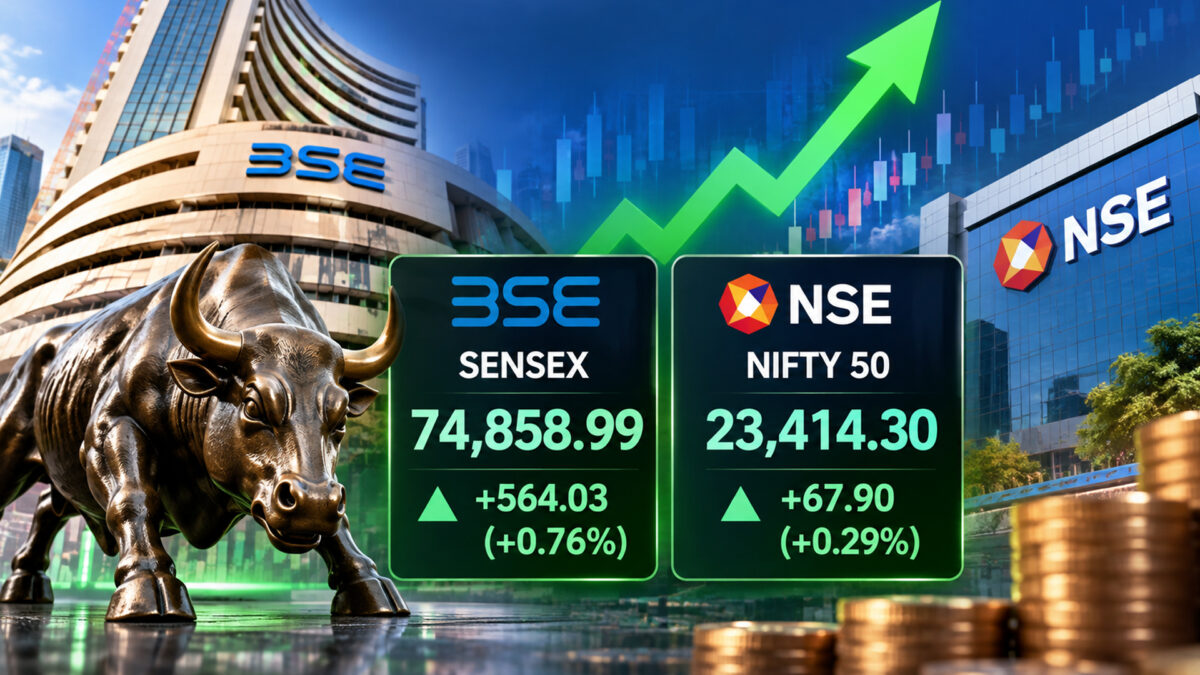
The Sensex climbed 564.03 points, or 0.76%, to close at 74,858.99, while the Nifty 50 gained 67.90 points, or 0.29%, to settle at 23,414.30. The Nifty extended its winning run to four sessions and closed above the 23,400 mark for the first time since September 10.

The recovery came after both benchmarks had recorded six consecutive weekly losses, their longest such losing streak in six years. Monday’s rise reflected renewed buying in heavyweight stocks, particularly after crude oil prices eased from recent highs.

The Sensex moved sharply higher during the day, touching an intraday high of 74,987.40, a gain of more than 690 points from its previous close. The Nifty also briefly crossed 23,450 before giving up some of its gains towards the close.

UltraTech Cement was among the strongest performers on the Sensex, rising more than 4%. HCL Technologies, Eternal and Titan Company were also among the major gainers. HCL Tech and Eternal were among the top performers on the Nifty as well, while ITC, Sun Pharma and Reliance Industries also ended higher.

On the other side, Bharti Airtel was among the biggest laggards, followed by Adani Ports, Bajaj Finance, Power Grid Corporation and Adani Enterprises. Airtel fell around 3% on the Nifty, while Adani Ports declined about 2%.

The broader market did not move in line with the benchmark indices. The Nifty Midcap 100 slipped 0.29%, while the Nifty Smallcap 100 remained broadly flat. This showed that Monday’s recovery was driven more by buying in large companies than by a broad-based rally across the market.

One of the biggest supports for the market was the fall in crude oil prices. Brent crude dropped to around $101.4-$101.7 a barrel, easing concerns over the impact of expensive oil on India’s inflation, corporate costs and trade deficit. India imports a large share of its crude requirements, making oil prices an important factor for the domestic stock market.

The decline in oil prices came despite continuing tensions in West Asia. Investors were watching developments involving the US and Iran, while hopes of diplomatic progress at the United Nations meeting helped ease some concerns about further disruption to oil supplies.

Foreign institutional investors also provided some support. FIIs bought Indian equities worth ₹599.54 crore on Friday, reversing six consecutive sessions of selling. Domestic institutional investors were also net buyers, purchasing equities worth more than ₹1,000 crore, according to exchange data.

Global markets offered another positive signal. Several Asian markets ended higher, while European equities also traded firmly. US stock futures were in positive territory during Indian market hours as investors looked ahead to developments in US-China trade and artificial intelligence talks and a planned meeting between US President Donald Trump and Chinese President Xi Jinping.

Investors were also keeping an eye on the National Stock Exchange’s IPO, which was scheduled to close for subscription on Monday. The issue had already been fully subscribed before the final day, adding to the activity in India’s primary market.

The banking sector also supported the recovery. HDFC Bank and ICICI Bank gained during the session, while Reliance Industries added to the broader market’s strength. These large companies carry significant weight in the benchmark indices, so their movement can have a sizeable impact on the Sensex and Nifty.

The rupee and bond markets also remained on investors’ radar as global monetary policy, oil prices and geopolitical tensions continued to influence sentiment. Elevated crude prices remain a concern even after Monday’s decline, particularly because a prolonged rise in oil could increase inflationary pressure and affect corporate earnings.

Monday’s rebound therefore offered some breathing room to Dalal Street after a prolonged period of selling. But the market remained selective, with large-cap stocks attracting buying while parts of the broader market stayed under pressure.

Investors will now watch crude oil movements, foreign fund flows, developments in the US-Iran conflict, global interest rates and upcoming corporate developments for further direction. After four straight sessions of gains, the ability of the Nifty to hold above 23,400 will remain an important level for market participants in the coming sessions.


Categories
Corporate

Sensex jumps 400 points, Nifty crosses 23,400 in early trade

Indian stock markets started Monday on a strong note, with the Sensex gaining more than 400 points and the Nifty crossing 23,400 in early trade. A drop in crude oil prices, fresh buying in key stocks and positive global cues lifted investor sentiment after weeks of market weakness.

The rally came after both benchmarks had faced pressure in recent sessions, with investors closely tracking geopolitical tensions, foreign fund flows and movements in oil prices.

Buying was visible across several sectors, although the gains were not uniform. UltraTech Cement, Asian Paints and Titan emerged among the leading gainers in the Sensex pack. UltraTech rose more than 3% in early trading, while Asian Paints and Titan also recorded strong gains.

On the other hand, Power Grid, Infosys and Bharti Airtel were among the notable losers. Weakness in some IT and utility stocks limited the broader market’s gains.

The broader market also remained positive, with buying seen in pharma, FMCG and realty stocks. Market breadth was favourable as a large number of stocks traded in the green during the opening hours.

A major support for Indian equities was the easing of crude oil prices. Brent crude slipped towards the $101-$102 a barrel range after rising sharply last week amid concerns over oil supplies from the Middle East.

Lower crude prices are positive for India because the country imports a large share of its oil requirements. A sustained decline could help ease pressure on inflation, the trade deficit and the Indian rupee.

However, oil prices remain above the $100 mark, keeping West Asia tensions and the US-Iran conflict firmly in focus. Any fresh disruption to supplies could push crude prices higher and put pressure on Indian markets.

Foreign institutional investors provided another positive signal after turning buyers at the end of last week. Foreign investors bought Indian equities worth around ₹599 crore on Friday, breaking a seven-session selling streak.

Domestic institutional investors also remained buyers, providing additional support to the market.

Despite the latest buying, foreign fund outflows remain a concern. Foreign portfolio investors have continued to reduce their exposure to Indian equities during September, adding to pressure on the benchmarks.

The Indian rupee opened at around ₹95.81 against the US dollar, compared with Friday’s close of ₹95.87.

The currency received some support from softer crude prices and improved market sentiment. However, the rupee remains under pressure because of elevated oil prices, overseas fund outflows and broader dollar strength.

Asian markets also provided a positive backdrop for Indian equities. Technology and semiconductor stocks gained in several Asian markets, helped by continued optimism around artificial intelligence-related demand.

US markets ended mostly higher in the previous session, with the Nasdaq and S&P 500 gaining, while the Dow closed slightly lower. The positive performance of technology stocks provided some support to Asian markets at the start of the new week.

The focus for investors remains on whether the early gains can hold through the session. Crude oil prices, US-Iran tensions, foreign institutional flows, the rupee and global market trends are likely to remain important triggers for the Sensex and Nifty.

Monday’s rebound comes after a prolonged period of weakness in Indian equities. The market will now look for sustained buying interest to determine whether the latest recovery can continue in the coming sessions.


Categories
Corporate

NSE IPO fully subscribed on second day

The ₹22,569-crore initial public offering (IPO) of the National Stock Exchange of India (NSE) was fully subscribed on the second day of bidding, with strong demand from non-institutional investors and qualified institutional buyers.

The NSE IPO received bids for about 10.28 crore shares against 8.86 crore shares on offer, taking overall subscription to 1.16 times by the end of Friday’s session. The issue opened on September 17 and will remain open until September 21.

Non-institutional investors, which include high-net-worth individuals and other large investors, led the demand. Their portion was subscribed 1.68 times. The qualified institutional buyer (QIB) category was subscribed 1.53 times.

Retail participation was comparatively lower. The portion reserved for retail investors was subscribed 72% by the end of the second day. The employee quota was also fully covered.

The NSE IPO has attracted considerable attention because of its size and the company’s position in India’s financial markets. At ₹22,569 crore, it is currently India’s second-largest IPO, behind Hyundai Motor India’s ₹27,870-crore issue launched in 2024. It has also moved ahead of Life Insurance Corporation of India’s ₹21,000-crore IPO from 2022.

NSE has fixed the IPO price band at ₹1,700 to ₹1,785 per share. At the upper end, the issue values the stock exchange at around ₹4.42 lakh crore.

The IPO is entirely an offer for sale (OFS). This means NSE itself will not receive money from the issue. Existing shareholders are selling up to 12.64 crore shares, and the proceeds will go to those shareholders.

The structure is different from a fresh issue, where a company raises new capital for business expansion or other corporate needs. In the NSE IPO, the public offering mainly gives investors an opportunity to buy shares from existing shareholders while providing NSE with a public-market listing.

Before the IPO opened, NSE raised ₹6,746.18 crore from anchor investors. The exchange allotted 3.78 crore shares at ₹1,785 each to 189 institutional investors. The anchor book included major global and domestic investors, including Life Insurance Corporation of India, Goldman Sachs, Fidelity, Abu Dhabi Investment Authority, Norges Bank and other large financial institutions.

The strong anchor demand had set the tone for the public issue. Market sources indicated that the anchor book received bids several times higher than the shares available.

NSE’s long-awaited stock market debut is also significant because the exchange itself operates one of India’s largest capital-market platforms. Established in 1992, NSE provides trading and related services across equities, equity derivatives, currency derivatives, debt and other financial products.

Its business extends beyond trading. The exchange has operations in clearing and settlement, market data, indices and other financial-market services. Its large market share and established technology infrastructure have made the IPO a closely watched event in India’s primary market.

The issue also comes after a long wait for NSE to become a listed company. Its public-market debut has been delayed for years amid regulatory and legal issues. The listing is now scheduled for September 24.

NSE’s grey market premium has also attracted attention ahead of the listing. However, the premium has declined from earlier levels. Recent market indications suggested a premium of around ₹100 or roughly 6% over the upper end of the IPO price, although grey market prices are unofficial and can change quickly.

Another factor investors are watching is the limited number of shares expected to be freely traded when NSE lists. Only a relatively small portion of the company’s pre-IPO capital will be available for trading initially. This could result in sharper price movements once trading begins.

NSE’s financial performance has also been a key part of the IPO story. The exchange reported a net profit of ₹10,302 crore on revenue of ₹18,713 crore in 2025-26. In the April-June quarter of 2026, it reported a net profit of ₹3,210 crore on revenue of ₹5,252 crore.

The remaining subscription period will show whether retail participation catches up with institutional demand. The IPO will close on September 21, followed by share allotment and the listing later in the week.

The immediate focus will then shift from subscription numbers to NSE’s market debut. Its September 24 listing will mark a major milestone for India’s largest stock exchange and give public-market investors direct access to one of the country’s most closely followed financial-market businesses.


Categories
Corporate

Veegaland shares list at 10% premium

Shares of Veegaland Developers made a strong debut on the stock market on September 18, listing at a 10% premium to the issue price before giving up part of the early gains and closing at ₹146.30.

The Kerala-based real estate developer’s shares opened at ₹154 on the NSE, against the IPO price of ₹140. On the BSE, the stock began trading at ₹151, a premium of nearly 7.9%. The NSE listing gave investors an immediate gain of ₹14 per share over the issue price.

The stock, however, could not hold its opening level. It slipped during the trading session and touched ₹146.30, its lower circuit limit for the day. It finally closed at ₹146.30 on the NSE, still 4.5% above the IPO price. Trading volume stood at more than 52 lakh shares.

The listing came after strong demand for the Veegaland Developers IPO. The ₹210-crore public issue was open for subscription from September 10 to September 15 and was subscribed 13.55 times by the end of the bidding period. Qualified institutional buyers subscribed 17.76 times, while the non-institutional investor portion was subscribed 18.03 times. The retail portion received 9.24 times subscription.

The IPO had a price band of ₹130 to ₹140 per share and consisted entirely of a fresh issue of 1.5 crore shares. There was no offer-for-sale component, meaning the money raised through the issue goes to the company.

Investors could apply for a minimum lot of 107 shares. At the upper end of the price band, one lot required an investment of ₹14,980.

Veegaland Developers plans to use the IPO proceeds to partly fund the development of its ongoing and upcoming real estate projects. Some of the funds will also be used for the acquisition of unidentified land parcels and general corporate purposes. The company had earlier raised ₹63 crore from anchor investors.

The company is part of the V-Guard Group and operates in the residential real estate segment. It focuses on the planning, construction and sale of multi-storey residential apartments in Kerala and other markets.

Its portfolio covers different segments, including premium, mid-premium, ultra-premium and luxury housing. The company’s association with the V-Guard brand was also one of the factors highlighted during the IPO process.

Veegaland’s financial performance has improved in recent years. Its revenue rose to about ₹254.16 crore in FY26 from ₹196.22 crore in FY25. Operating profit increased to ₹36.20 crore from ₹28.27 crore, while net profit rose to ₹26.61 crore from ₹20.43 crore.

The company recorded strong growth across FY24 to FY26, with revenue, EBITDA and profit after tax showing significant increases during the period.

The stock’s first-day movement also showed the difference between a strong IPO debut and sustained buying interest. Veegaland shares opened well above the issue price but later moved down to the lower circuit. The closing price of ₹146.30 remained above the ₹140 IPO price, but was about 5% below the NSE opening price.

Before listing, the grey market premium had indicated a more modest gain. The actual NSE debut at ₹154 was therefore stronger than those expectations. Grey market premiums, however, are unofficial and do not guarantee how a stock will perform after listing.

The company’s market capitalisation after listing was around ₹700 crore. At the closing price, the stock remained close to its first-day listing range, reflecting continued trading interest but also selling pressure after the initial gains.

The first session also saw large trades involving some investors and shareholders. Market data showed several bulk transactions during the day, including purchases at ₹154 and ₹146.30.

The immediate focus will now shift from the IPO listing to the company’s ability to execute its real estate projects and convert its project pipeline into revenue and profits. The company will also need to manage the risks normally associated with property development, including land acquisition, construction costs, project timelines and demand conditions.

Veegaland Developers’ market debut has given IPO investors a positive start, but the first day’s performance is only an early indication. The stock’s future performance will depend on business execution, financial growth and how investors value the company as it begins life as a listed real estate company.


Categories
Corporate

Sensex slips marginally, Nifty holds above 23,300

The markets ended mixed on Friday as a late recovery in select heavyweight shares helped the Nifty 50 finish higher, while the Sensex closed marginally lower. The Nifty 50 gained 75.80 points, or 0.33%, to close at 23,346.40. The index moved above the 23,300 mark during the session and touched an intraday high of 23,389. The Sensex, after gaining as much as 414 points in early trade, lost momentum and ended 19.63 points, or 0.03%, lower at 74,294.96.

Easing crude oil prices, positive Asian market cues and buying in banking and infrastructure stocks supported sentiment. However, continued foreign investor selling and weakness across several Tata Group and information technology stocks limited the gains.

The recovery came after several sessions of weakness in the Indian stock market. Investors found some comfort in lower crude prices, which eased concerns over inflation and India’s import bill. Brent crude remained above $100 a barrel but declined during the session, offering some relief to oil-sensitive sectors and the broader market.

Adani Ports emerged as the biggest Nifty gainer, rising 4.93% in late trading. Adani Enterprises gained 3.31%, while Bharti Airtel climbed 3.12%. HDFC Bank and Bajaj Finance were also among the strong performers, advancing 2.52% and 2.49%, respectively. The gains showed that buying interest was not limited to one sector, with infrastructure, telecom and financial stocks attracting investors.

The losing side was led by Tata Consultancy Services, which fell 3.88%. Tata Motors Passenger Vehicles and SBI Life Insurance were also among the prominent laggards. Coal India and Maruti Suzuki declined as well, adding to the pressure on selected large-cap shares.

Tata Group stocks remained under particular pressure during the session. TCS, Tata Motors Passenger Vehicles, Tata Investment Corporation and Tata Chemicals were among the group companies that recorded sharp declines. The selling came amid continuing uncertainty around Tata Sons, including questions surrounding its leadership and a possible listing of the holding company.

Information technology stocks were another weak spot. Selling in TCS weighed on the Nifty IT index and offset gains in banking and other sectors. The divergence between financial and technology stocks highlighted the selective nature of Friday’s buying rather than a broad-based market recovery.

The broader market, however, showed better participation. Mid-cap and small-cap stocks advanced during the session, with investors using the recent correction to pick up selected counters. The rise in market breadth indicated that domestic buyers remained active even as foreign investors continued to reduce their exposure to Indian equities.

Foreign institutional investor flows remained a concern. Overseas investors have been selling Indian shares amid elevated global bond yields, high US interest rates and uncertainty surrounding the Middle East. Domestic institutional investors have provided some support, helping absorb part of the foreign selling.

Crude oil remained a key factor behind the market’s movements. Prices above $100 a barrel continue to be a concern for India because the country relies heavily on imported crude. A sustained rise in oil prices can increase the import bill, put pressure on the rupee and raise concerns about inflation and corporate costs. The decline in crude on Friday therefore provided some breathing room for investors.

Global market cues were also supportive. Asian equities largely gained, helping improve risk appetite in Indian markets. Lower US bond yields and the easing in oil prices added to the positive tone, although concerns about global monetary policy and geopolitical tensions remained.

The Nifty’s close above 23,300 will be closely watched by traders after the index recovered from recent losses. Friday’s move, however, came against a backdrop of continued caution. The Sensex and Nifty have faced pressure in recent weeks as investors weighed high crude prices, foreign fund outflows, weak global cues and Middle East tensions.

The weekly picture remained weak despite Friday’s recovery. The Nifty declined about 0.22% during the week, while the Sensex lost around 0.65%. This marked the sixth consecutive weekly decline for Indian equities, the longest such losing streak since 2020.

Investors will now track crude oil prices, foreign institutional flows, the rupee and global bond yields for the next market cues. Developments in the Middle East and movement in large-cap stocks, particularly Tata Group and IT shares, are also likely to influence trading. Friday’s gains in the Nifty offered some relief, but the market remains sensitive to global risks and the direction of foreign investment flows.