Categories
Beyond

Tata Sons AGM faces quorum hurdle amid Trust dispute

The Tata Sons annual general meeting (AGM) scheduled for August 18 is facing a fresh procedural hurdle, with restrictions on the Sir Ratan Tata Trust (SRTT) raising serious questions over whether the meeting can meet the required quorum.

The issue comes at a particularly sensitive moment for the Tata Group. N Chandrasekaran, who has led Tata Sons since 2017, has decided not to seek reappointment when his current term ends on February 20, 2027. The Tata Trusts have begun the process of finding his successor, but the same regulatory restrictions affecting the AGM are also complicating the formation of the selection committee.

The immediate problem stems from an order by the Maharashtra Charity Commissioner restricting SRTT from convening trustee meetings. The directive was issued in May following complaints concerning the composition of the trust’s board and alleged non-compliance with provisions of the Maharashtra Public Trusts Act.

SRTT has sought relief from the Charity Commissioner, but the restrictions had not been lifted as of August 14. With the AGM only days away, the trust has little time to resolve the issue. It could also approach the Bombay High Court if regulatory relief does not come through.

SRTT and the Sir Dorabji Tata Trust (SDTT) are the two principal Tata trusts and together hold about 51.5% of Tata Sons. SRTT owns roughly 23.5%, while SDTT holds about 28%.

The problem is not simply that SRTT cannot attend the meeting. Under the Tata Sons Articles of Association, the two trusts have to jointly nominate a representative for the AGM. Article 86 sets out the quorum requirement and includes a jointly nominated representative of SDTT and SRTT.

Since SRTT cannot currently hold a trustee meeting, it cannot formally participate in that nomination process.

SDTT has now informed Tata Sons that the required quorum may not be available. Tata Sons, however, is expected to proceed with the AGM as scheduled. If the required quorum is not present, the meeting could be adjourned. The complication is that the adjourned meeting would still require the joint nominee, leaving the basic problem unresolved unless SRTT receives regulatory relief.

This has created an unusual situation for one of India’s most closely watched corporate groups. The AGM is not merely a routine annual meeting; it comes amid a leadership transition and could determine how quickly the Tata Group moves towards choosing Chandrasekaran’s successor.

The quorum dispute also affects Chandrasekaran’s immediate position.

Chandrasekaran is liable to retire by rotation as a director of Tata Sons. His continuation as chairman is legally linked to his position on the Tata Sons board. If the AGM cannot be validly constituted, however, officials familiar with the Articles of Association say he could continue as a director until a valid AGM is held, when his reappointment can be considered.

Chandrasekaran has already made clear that he does not intend to seek another term as chairman after February 2027. His decision followed months of uncertainty around his reappointment and differences within the Tata leadership structure.

That means the August 18 meeting could still be important even if it does not immediately settle the succession question. A delay could simply push the formal decision-making process further down the road.

The SRTT restrictions have created a second problem for Tata Sons: the selection committee for Chandrasekaran’s successor.

SDTT has already passed a resolution to initiate the setting up of a selection committee as soon as possible, in accordance with the Articles of Association of Tata Sons. The committee will recommend a candidate for appointment as the company’s next chairman.

However, the full process requires participation from both principal trusts. The two trusts are expected to jointly nominate three members to the selection committee.

With SRTT unable to hold a meeting, it cannot make the necessary nominations. As a result, SDTT’s resolution has started the process, but cannot by itself complete the succession mechanism.

The timing is significant. Chandrasekaran’s term ends in February 2027, giving Tata Sons roughly six months to complete the search, evaluate candidates and secure the necessary corporate approvals.

The Charity Commissioner’s action against SRTT is linked to an inquiry into the trust’s governance. The regulator directed the trust to postpone a May 16 meeting and refrain from convening similar meetings until an Inspector’s report is submitted.

The dispute also involves questions about the number of perpetual or life trustees on the SRTT board following changes to Maharashtra’s public trust law. The regulator has powers under Section 36A(1) of the Maharashtra Public Trusts Act to issue directions to a trust.

Separately, the Charity Commissioner’s office is examining allegations concerning the transfer of 833 Tata Sons shares in 1989 from the Navajbai Ratan Tata Trust to Naval H Tata. Former SRTT trustee Vijay Singh had sought an inquiry into the matter. Noel Tata, who is chairman of Tata Trusts and a trustee of the Navajbai Ratan Tata Trust, has denied the allegations, and the regulator is examining his response.

The restrictions have also affected the functioning of SRTT beyond Tata Sons. Accounts have reportedly not been finalised and grants of around ₹400 crore have been held up, while several decisions requiring trustee resolutions remain pending.

.
Categories
Leaders

N Chandrasekaran quits as Tata Sons chairman

N Chandrasekaran has resigned as chairman of Tata Sons, bringing a significant leadership transition to the Tata Group after nearly a decade at the helm of its holding company. Chandrasekaran, however, will continue in the position until the end of his current term on February 20, 2027, according to people familiar with the development and his statement.

The decision comes just days before the Tata Sons annual general meeting scheduled for August 18. The meeting had been expected to consider the reappointment of Chandrasekaran as a director, a key requirement for him to continue as chairman. His decision not to seek another term effectively removes that uncertainty and sets the stage for a leadership succession process at one of India’s most influential business groups.

In his communication to the Tata Sons board, Chandrasekaran said he would not offer himself for reappointment after his existing tenure ends. He also asked the board to begin the process of identifying his successor. The announcement marks the beginning of a transition rather than an immediate departure, allowing him to remain involved in the group’s affairs for several months.

The development follows weeks of uncertainty around Chandrasekaran’s position and the Tata Sons board. Earlier reports had said he was considering stepping down ahead of the August 18 AGM amid questions surrounding his reappointment and tensions within the Tata Trusts structure. Those reports had raised the possibility of an unexpected change at the top of the Tata Group.

Chandrasekaran’s exit is important because Tata Sons sits at the centre of the group’s sprawling business interests, with significant holdings and influence across information technology, automobiles, steel, power, consumer products, hotels, aviation and financial services. The chairman also plays a central role in determining the group’s long-term investment priorities and capital allocation.

His tenure has been marked by an aggressive expansion strategy. Under Chandrasekaran, the Tata Group pushed deeper into aviation following the acquisition and consolidation of Air India, while also increasing investments in semiconductors, electronics manufacturing, batteries, artificial intelligence and other emerging businesses.

The group has simultaneously worked to strengthen its position in traditional businesses while building new growth platforms. Tata Electronics has emerged as a major focus of the group’s semiconductor and electronics ambitions, while Tata Digital has been developed as a consumer technology platform. The group’s investments in battery manufacturing and defence-related capabilities have also formed part of its longer-term strategy.

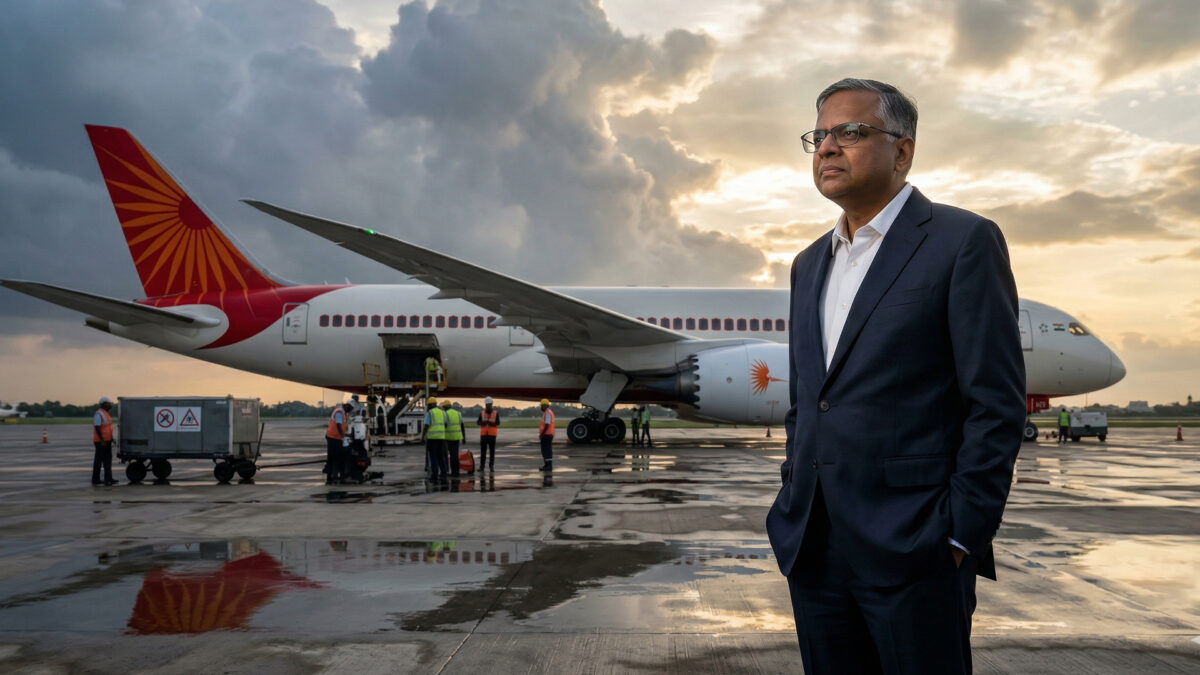
Air India has been one of the most visible projects during Chandrasekaran’s tenure. The Tata Group has been attempting to rebuild the airline following its return to private ownership, with investments in aircraft, technology, operations and customer experience. Chandrasekaran recently described the transformation of Air India as a five-to-10-year effort, highlighting the scale of the challenge facing the group.

The leadership change comes even as Tata Sons remains financially strong. The company’s annual report for FY26 showed revenue rising 9.1% to Rs 42,367 crore, while profit after tax increased 21.8% to Rs 31,961 crore. The improvement was supported by investment gains and earnings from its portfolio of businesses.

At the broader Tata Group level, the business has continued to expand despite challenges in several large investments. The group reported aggregate FY26 revenue of about Rs 16.24 lakh crore, while profit after tax rose sharply during the year.

The financial performance, however, has existed alongside pressure in some of the group’s newer businesses. Air India recorded substantial losses, while Tata Digital, Tata Electronics and battery-related ventures have also required significant investment. Chandrasekaran has defended these businesses as long-term strategic bets rather than investments expected to generate immediate returns.

Markets reacted quickly to the news. Shares of several Tata Group companies came under pressure after the resignation announcement, with Tata Consultancy Services among the most closely watched stocks. TCS shares were reported to be down more than 3% during Wednesday’s trading session, while other Tata companies also declined. The market reaction reflected investor uncertainty surrounding the group’s future leadership and succession process.

Chandrasekaran joined the Tata Group nearly four decades ago and rose through its ranks before becoming chief executive of Tata Consultancy Services in 2009. He became chairman of Tata Sons in 2017, succeeding Ratan Tata in the role. His tenure has therefore covered a major period of transformation for the conglomerate, including the expansion of its global technology, automotive and aviation interests.

The immediate focus will now shift to succession planning. The Tata Sons board will have to identify a leader capable of managing both the group’s established businesses and its ambitious new investments. The next chairman will inherit a conglomerate with a strong financial base, but also major projects requiring sustained capital, execution and strategic patience.

For the Tata Group, the transition is therefore more than a change at the top. It will determine how the conglomerate balances its traditional businesses with its newer bets in technology, aviation, semiconductors, batteries and digital services. With Chandrasekaran remaining until February 2027, the group has several months to prepare for a carefully managed leadership handover.

Categories
Beyond

Air India urged to stay focused amid challenges

Natarajan Chandrasekaran has asked employees of Air India to stay focused and work better as the airline goes through a tough phase. His message comes after the resignation of CEO Campbell Wilson.

At a recent internal meeting, Chandrasekaran told staff to concentrate on their work and improve how things are done. He said that while challenges are there, employees should focus on what they can control and try to perform better.

Air India is currently facing several issues. Rising fuel prices, global tensions and changes in flight routes have made operations more difficult. These factors have also increased costs for the airline.

N Chandrasekaran reminded employees to stay realistic and careful about spending. He stressed the need to manage costs properly while continuing efforts to improve services. He also assured staff that the Tata Group remains committed to supporting the airline.

Since returning to the Tata Group in 2022, Air India has been trying to rebuild its operations. The airline has expanded, upgraded systems and worked on improving its services. However, the journey has not been easy, and it continues to face pressure.

The recent exit of CEO Campbell Wilson has added to the uncertainty. The airline is now looking for new leadership to guide it through the next phase of its transformation.

Also Read: Firebomb thrown at Sam Altman’s home

Categories
Leaders

Tata Trusts stand firm on Chandrasekaran’s leadership

The Tata Trusts have reiterated their support for Natarajan Chandrasekaran as chairman of Tata Sons, saying their earlier resolution backing his third term remains unchanged.

The clarification comes after reports that Noel Tata raised concerns about certain business issues and the group’s future structure. The Trusts, which hold a majority stake in Tata Sons, said there has been no review of their decision.

The move signals continuity in leadership as the conglomerate navigates strategic and structural challenges.

Categories
1 Minute-Read

Tata Sons puts off Chandrasekaran reappointment call

Tata Sons has postponed a decision on the reappointment of its chairman N. Chandrasekaran after he requested the board to take up the matter at a later stage. His present tenure is valid until 2027, and there is no immediate requirement to decide on an extension.

The move is being viewed as a step to follow a proper evaluation process at the appropriate time. Chandrasekaran, who has led the group since 2017, has overseen key restructuring, expansion across businesses and significant reduction in debt.

The board is expected to review the issue closer to the end of his current term.

Categories
1 Minute-Read

N Chandrasekaran leads TCS’ AI shift

Tata Sons chairman N. Chandrasekaran has stepped into a more active leadership role at Tata Consultancy Services (TCS) to drive its transition towards artificial intelligence.

Addressing employees in Dubai, he stressed that AI is reshaping the global technology landscape and warned that traditional IT service models face disruption. Chandrasekaran urged TCS to rethink its operating model, embed AI across all offerings, and focus strongly on reskilling talent.

He also highlighted the need for agility, innovation, and selective acquisitions to stay competitive. The push aims to position TCS as a leader in AI-driven digital transformation worldwide.


Categories
1 Minute-Read

Tata Group charts 2026 path with innovation and impact

Tata Group chairman N Chandrasekaran has shared the group’s vision for 2026, focusing on execution with purpose and innovation that makes a real difference.

The group plans to advance artificial intelligence, expand future-ready manufacturing, and nurture talent for tomorrow. Sustainability is at the heart of their strategy, with green steel and electric mobility leading the way.

Chandrasekaran also highlighted resilience against cyber, operational, and geopolitical challenges, while exploring global opportunities that strengthen India’s position as a technology and manufacturing hub. The approach blends ambition with responsibility, aiming for growth that matters.