Categories
Beyond

Gold ₹1.73 lakh, Silver ₹2.94 lakh

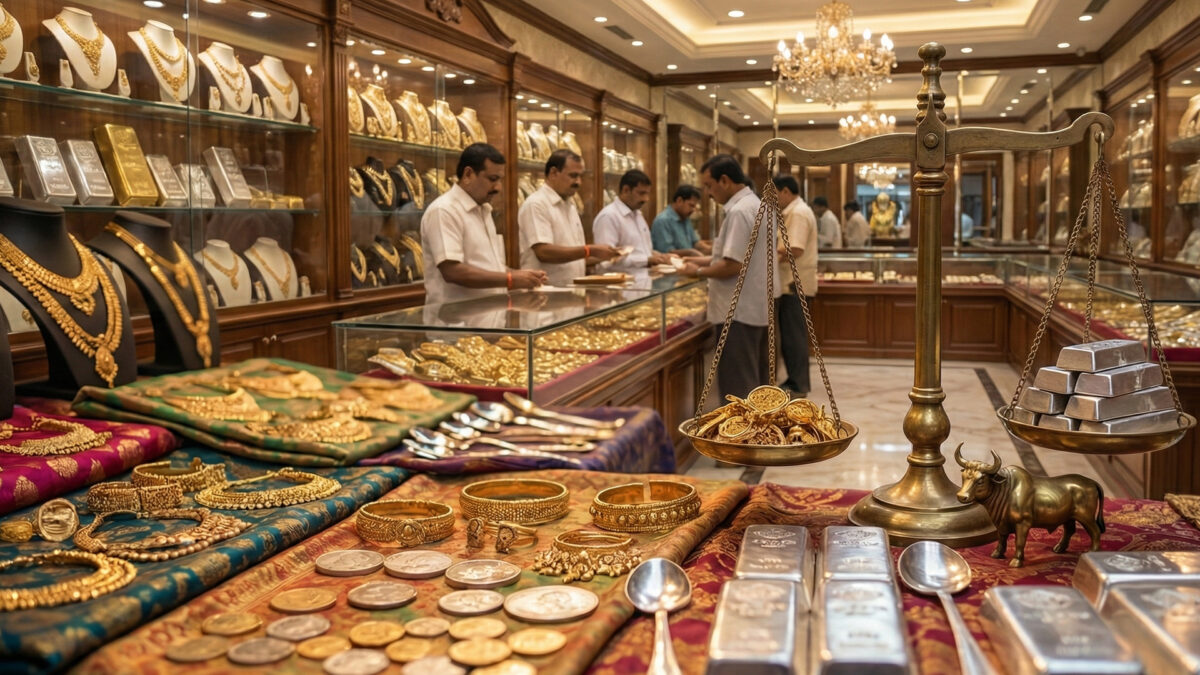
Gold and silver prices surged sharply as escalating tensions in the Middle East drove investors toward safe-haven assets. Heightened geopolitical risks following the US–Israel strikes on Iran triggered volatility across global equity markets, boosting demand for precious metals.

In India, 24-carat gold climbed to ₹1,73,090 per 10 grams, marking a strong rebound from recent levels. The rally reflects a sharp increase of nearly ₹6,000 per 10 grams over a short span as buyers rushed to hedge against uncertainty. 22-carat gold also moved higher in line with the broader trend, tracking gains across major cities including Delhi, Mumbai and Chennai.

Silver prices remained firm, trading around ₹2.94 lakh per kilogram in domestic markets. On the Multi Commodity Exchange (MCX), silver witnessed heightened volatility but held near elevated levels as investment inflows supported prices.

Globally, spot gold prices rallied significantly, supported by safe-haven flows and concerns that the conflict could widen, impacting oil supply routes and global trade. Rising crude oil prices have added to inflation concerns, further strengthening gold’s appeal as a hedge. US gold futures also advanced in tandem with spot prices.

Market analysts say geopolitical instability typically benefits bullion, especially gold, which is considered a long-term store of value during crises. Exchange-traded funds (ETFs) backed by gold and silver also recorded increased inflows, reflecting institutional participation in the rally.

However, experts caution that bullion prices may remain volatile in the near term. Movements in the US dollar, global bond yields and further developments in the Middle East will likely dictate the next trend. If tensions persist or escalate further, gold could test higher levels, while silver may continue to track both safe-haven demand and industrial outlook.

Also Read: Sensex down 1,100 points, Nifty falls to 24,876

Categories
Beyond

New Micron chip plant worth ₹22,500 cr in Gujarat

A major semiconductor facility set up by Micron Technology in Sanand, Gujarat, was started on Friday. This was inaugurated by Prime Minister Narendra Modi, thus marking a significant step in India’s push to become a global electronics manufacturing hub.

The new plant, built with an investment of over ₹22,500 crore, will assemble, test and package semiconductor memory products such as DRAM and NAND chips. These components are widely used in smartphones, laptops, data centres and emerging technologies like artificial intelligence.

The facility is part of the government’s broader semiconductor strategy aimed at reducing India’s dependence on imported chips and strengthening its position in the global supply chain. Officials described it as one of the first large-scale semiconductor projects to begin operations under the national semiconductor mission.

Spread across a large industrial site in Sanand, the plant is expected to generate thousands of jobs over time. Around 2,000 people are already employed, and the workforce is likely to grow significantly as production ramps up. The project is also expected to create indirect employment in logistics, services and ancillary industries.

At the inauguration, Modi said the plant reflects growing global confidence in India’s manufacturing ecosystem. He highlighted the government’s efforts to attract high-tech investments and build a robust semiconductor base in the country.

Industry experts see the Micron facility as a crucial milestone. While India has traditionally relied on other countries for semiconductor production, projects like this are seen as laying the groundwork for a stronger domestic electronics sector.

The chips produced in Gujarat will serve both Indian and international markets, helping integrate the country more deeply into global technology value chains. As demand for memory and data storage continues to rise worldwide, the Sanand plant could play an important role in supporting next-generation digital infrastructure.

Also Read: Fino Payments Bank CEO arrested in GST case

Categories
Beyond

US halts use of Anthropic AI

US President Donald Trump has ordered federal agencies to stop using artificial intelligence tools developed by Anthropic, marking a sharp escalation in tensions between the administration and the fast-growing AI sector.

The directive requires departments to begin phasing out Anthropic’s systems, including those already embedded in administrative and defence operations. According to officials familiar with the decision, the move follows weeks of disagreement over limits placed on the company’s flagship AI model, Claude, particularly in military contexts.

At the heart of the conflict are safeguards built into Anthropic’s technology. The company has imposed restrictions designed to prevent applications such as mass domestic surveillance and fully autonomous weapons. Representatives from the Department of Defense have argued that those constraints reduce operational flexibility and complicate legitimate national security planning.

Trump described the decision as necessary to protect executive authority and ensure that government agencies are not constrained by private-sector policies. The administration is reportedly reviewing existing contracts and examining whether additional regulatory steps could follow.

Anthropic’s chief executive, Dario Amodei, defended the company’s approach, stating that its safety guardrails are central to responsible AI deployment. He warned that removing such protections could lead to unintended and potentially dangerous outcomes. The firm has indicated it may pursue legal avenues if further punitive measures are imposed.

The dispute has drawn significant attention across Silicon Valley, where AI companies are increasingly partnering with government agencies.

Also Read: OpenAI wins Pentagon deal as Donald Trump clashes with Anthropic

Categories
Beyond

DGCA allows 48‑hour free flight cancellations

Air travel just got a lot more flexible for passengers in India. The Directorate General of Civil Aviation (DGCA) has announced new rules allowing travellers to cancel or change their flight bookings within 48 hours of purchase without paying any fees. This means if you book a ticket and quickly realise your plans have changed, you can cancel or modify it without worrying about losing money.

Previously, many airlines charged cancellation or change fees even for tickets cancelled soon after booking. Under the new regulation, all domestic airlines must honour this 48‑hour free window, giving passengers a fair chance to adjust their plans, especially if flights were booked in a hurry or prices changed shortly after purchase.

The DGCA has also introduced a clear refund timeline. Airlines are now required to process all refunds within 14 days, whether it’s a cancellation under the 48‑hour rule or other situations like flight delays, schedule changes, or airline-initiated cancellations. This ensures travellers don’t have to wait weeks to get their money back.

Industry experts say the move will make air travel less stressful and boost confidence among passengers, particularly during peak travel periods or when booking last-minute trips. Airlines are updating their systems to comply, and passengers are encouraged to check their airline’s policies and reach out to customer service if there’s any delay in refunds.

For travellers, this change means more control, transparency, and peace of mind. Whether it’s a sudden change in plans, an unexpected work commitment, or a better deal elsewhere, flyers now have the freedom to manage their bookings quickly and easily.

Also Read:  Block lays off 4,000 employees due to AI shift

Categories
Beyond

Chinese smartphone sales in India fall for first time

For the first time in nearly a decade, Chinese smartphone brands have experienced a decline in sales and revenue in India, a market they once dominated. Industry data shows that demand for devices from leading Chinese companies fell during the financial year 2025, while premium brands such as Apple and Samsung gained ground.

Analysts say the slowdown reflects a shift in consumer preferences toward higher-priced, feature-rich phones, while rising prices and competition from non-Chinese brands have also influenced buying choices. This marks a notable change in India’s smartphone landscape, where Chinese brands have long held the largest market share due to their competitive pricing and wide range of models.

According to market trackers, revenue for the nine largest Chinese electronics companies operating in India, including major players like Xiaomi, Vivo, OPPO, realme and Transsion Holdings, declined compared with the previous year. In contrast, other global brands reported healthy growth.

One key reason for the drop is the premiumisation trend, Indian consumers are increasingly spending on higher-end models. Apple, known for its iPhones, has benefited from this trend, seeing strong demand for its newer models. Samsung has also grown its presence in the mid and high-end segments, gaining users who previously chose budget phones from Chinese makers.

Rising prices have also played a role. As component costs increase globally, Chinese brands have raised smartphone prices, narrowing the cost advantage they once had. This has made the value proposition less compelling for price-sensitive buyers, who are now weighing their options more carefully.

The decline for Chinese brands may prompt them to rethink strategies in India, focusing on innovation, after-sales service and value rather than price alone. Meanwhile, local and global competitors are likely to intensify their efforts to capture emerging opportunities in the world’s second-largest smartphone market.

Also Read: Power lines to go underground in Chandni Chowk

Categories
Beyond

India makes E20 petrol mandatory nationwide

Starting April 1, 2026, every petrol pump across India will sell E20 petrol, fuel blended with 20% ethanol. The decision, announced by the Ministry of Petroleum and Natural Gas, marks a major change in the fuel Indians use every day.

For millions of motorists, the shift may go largely unnoticed at the pump. But behind the scenes, it reflects India’s push to cut pollution, reduce crude oil imports and support farmers who produce crops used to make ethanol, such as sugarcane and maize.

Ethanol is a biofuel made from plant-based materials. Blending it with petrol helps lower harmful emissions from vehicles. Officials say the move will help India reduce its carbon footprint while also saving foreign exchange by importing less crude oil.

Under the new rule, all petrol sold must meet a minimum standard of RON 95, which refers to fuel quality and engine performance. Higher RON fuel reduces engine knocking and supports smoother functioning. Most cars manufactured in recent years are already compatible with E20 fuel.

However, owners of older vehicles may have concerns. Experts say while older cars can generally run on E20, there could be a slight drop in fuel efficiency. Automobile companies have gradually upgraded engines to handle higher ethanol blends, and consumers are being advised to check their vehicle manuals for compatibility.

For farmers, the policy offers a potential boost in income. Increased demand for ethanol means higher demand for crops used in its production. For the government, it is also a step toward energy security and reduced dependence on volatile global oil markets.

While drivers may simply notice a new label at fuel stations, the change represents a broader shift in how India balances environmental responsibility, economic growth and everyday mobility.

Also Read: Narayana Murthy urges youth to master AI

Categories
Beyond

Gold around ₹1.60  lakh, Silver near ₹2.85 lakh

Gold and silver prices in India stayed steady, supported by global uncertainties and demand for safe investments.

In domestic markets, 24‑carat gold traded near ₹1,60,000 per 10 grams, while silver hovered around ₹2.85 lakh per kilogram. These levels are similar to the previous session, showing that prices are holding rather than falling sharply.

On the Multicommodity Exchange (MCX), gold futures were around ₹1,57,900 per 10 grams, up slightly by 0.2%, and silver futures were near ₹2,59,700 per kilogram. Internationally, spot gold remained above $5,200 an ounce and silver around $90 an ounce, keeping domestic prices supported.

City-wise, 24‑carat gold was quoted at about ₹1,60,460–₹1,60,690 per 10 grams in major cities like Chennai, Mumbai, Delhi, Kolkata, and Bangalore. Silver prices ranged between ₹2,65,930 and ₹2,66,320 per kilogram depending on the city and dealer.

Experts say that safe-haven demand is keeping prices stable. Investors often buy gold and silver during uncertain times, such as global political tensions or weak stock markets. At the same time, some short-term traders are booking profits, which keeps prices from rising sharply.

While local prices can vary slightly because of taxes, making charges, and dealer margins, the overall trend is steady. Gold and silver remain attractive for people who want a safe investment or to protect their savings from market ups and downs.

Also Read: Sensex falls 500 points to 81,950, Nifty slips below 25,350

Categories
Beyond

Japan plans missile deployment near Taiwan

Japan has announced plans to deploy surface-to-air missiles on its westernmost island, Yonaguni, a small but strategically important location just over 100 km from Taiwan. The deployment is expected to be completed by 2031 and is part of Tokyo’s broader effort to strengthen its defence in the face of growing regional tensions.

Japanese officials say the move is purely defensive and meant to protect the country’s remote islands, which lie close to potential conflict zones. The government has been increasing its military presence in the southwest in recent years, citing concerns over China’s expanding military activity and the possibility of a crisis involving Taiwan.

Yonaguni, which has a population of around 1,700, has already seen the arrival of troops, radar systems and other military facilities. The planned missile unit will add another layer of protection, allowing Japan to respond more quickly to aerial threats in the area.

Defence Minister Gen Nakatani said strengthening the island’s security is essential because of its location and the changing security environment around Japan. Officials believe that better defences will act as a deterrent and reduce the risk of conflict.

China has repeatedly criticised Japan’s military build-up in the region, saying it increases tensions. Beijing claims Taiwan as its territory and has not ruled out the use of force to take control of it, while Taiwan rejects those claims.

However, the announcement has also drawn mixed reactions from Yonaguni residents.

Also Read: Dr Reddy’s eyes March launch of low-cost Ozempic copy

Categories
Beyond

NSE IX opens global investing route for Indians

In a significant step towards globalising investment opportunities for Indians, NSE International Exchange (NSE IX) has launched a new platform at GIFT City that allows individuals to directly invest in overseas markets.

The Global Access platform has started with US stocks and will gradually expand to more than 30 markets across regions such as Europe, the UK and Japan over the coming months. The facility is available to both resident investors and non-resident Indians, giving them a regulated and streamlined route to diversify beyond domestic equities.

Investments will be made under the Reserve Bank of India’s Liberalised Remittance Scheme (LRS), which permits individuals to remit up to $2.5 lakh abroad in a financial year. The funds will be transferred in rupees and converted into foreign currency for trading in international securities.

A major highlight of the platform is the option of fractional ownership, enabling investors to buy a portion of high-value global stocks instead of purchasing an entire share. The onboarding process has been designed to be fully digital, using PAN, Aadhaar and DigiLocker, and does not require a separate demat account.

The platform operates within the regulatory framework of the International Financial Services Centres Authority (IFSCA) and currently offers access to equities, exchange-traded funds and selected debt instruments. Derivatives and cryptocurrency products are not part of the offering.

Officials say the initiative is aimed at meeting the rising interest among Indian investors in global assets while strengthening GIFT City’s role as an international financial hub. It is also expected to make participation easier for NRIs who often face procedural hurdles in accessing Indian market infrastructure.

Also Read: Amazon AGI Chief David Luan resigns

Categories
Beyond

Gold steady at ₹1,61,900, Silver dips to ₹2,84,900

Precious metals in India showed a mixed trend on Thursday, with gold inching up slightly and silver easing after a recent rally.

The price of 24‑carat gold rose by about ₹10, with ten grams trading at ₹1,61,900 in major cities, while 22‑carat gold hovered around ₹1,48,410 per ten grams. On the other hand, silver saw a small decline of roughly ₹100, with one kilogram priced near ₹2,84,900.

Analysts say gold’s stability reflects continued safe-haven demand amid global uncertainties, including geopolitical tensions and trade-policy pressures. Although there has been some profit-taking after recent gains, gold prices remain comfortably above key support levels. Globally, bullion prices have slightly retraced from recent highs but continue to be supported by macroeconomic factors such as currency movements and risk sentiment.

Silver’s slight fall is seen as a normal post-rally consolidation after a period of volatility. Unlike gold, silver has significant industrial demand, which can amplify price swings. Traders noted that investors are booking profits after the metal’s recent sharp rise, contributing to the modest decline.

For investors, these levels serve as indicators for market sentiment. While gold remains relatively stable, silver may continue to see short-term swings depending on global economic news, currency fluctuations, and industrial demand.

Also Read: Sensex rises 200 points , Nifty at 25,550