Categories
Beyond

Gold falls ₹10 ₹1,45,960, Silver drops ₹2,44,900

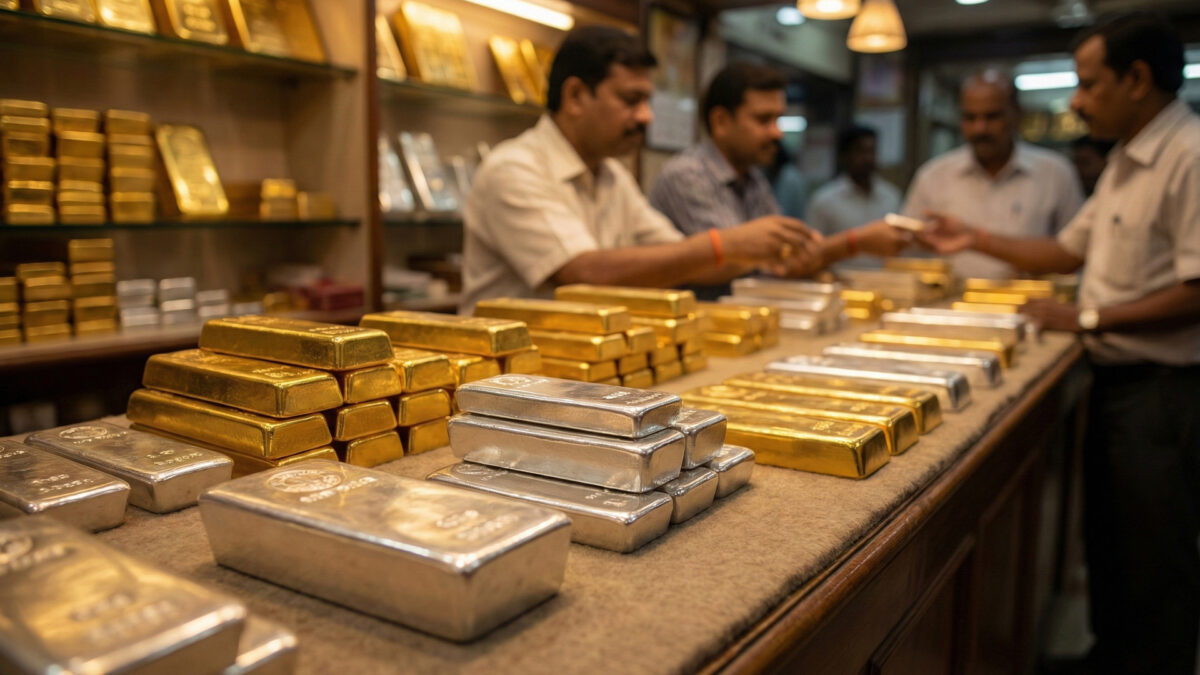
Gold and silver prices witnessed a decline on March 23, 2026, with both precious metals trading lower in domestic markets. Gold slipped marginally while silver also recorded a drop, reflecting subdued demand and global economic pressures.

In India, gold prices fell by ₹10 to ₹1,45,960 per 10 grams, touching a near four-month low. Silver prices also declined by ₹100 to trade at ₹2,44,900 per kilogram, continuing the downward trend seen in recent sessions.

The fall in bullion prices comes despite ongoing geopolitical tensions in the Middle East, which usually support safe-haven assets like gold. However, market dynamics have shifted due to macroeconomic factors, limiting any upward movement in prices.

One of the key reasons behind the decline is the strength of the US dollar. A stronger dollar makes gold more expensive for buyers using other currencies, thereby reducing demand globally. At the same time, rising bond yields have further pressured prices, as investors shift towards interest-bearing assets.

Interest rate expectations have also played a major role. With central banks expected to maintain a tight monetary policy stance to control inflation, gold’s appeal has weakened. Since gold does not provide regular returns like bonds or deposits, higher interest rates tend to reduce its attractiveness.

Silver prices, which are more closely linked to industrial demand, have also come under pressure. Concerns over global economic growth and weaker industrial outlook have weighed on silver, leading to sharper corrections compared to gold.

Additionally, some investors have engaged in profit booking amid market volatility. Selling in bullion markets has also been influenced by losses in equities, prompting investors to rebalance their portfolios.

Also Read: Sensex tanks 1,500 points, Nifty below 23,000

Categories
Beyond

Premium petrol price hiked by over ₹2 per litre

Oil companies in India have increased the price of premium petrol by more than ₹2 per litre. The hike applies only to high-quality fuel variants, while the prices of regular petrol and diesel have been left unchanged.

Premium petrol, sold under names like XP95, Speed, and Power, is mainly used in high-end or performance vehicles. Depending on the city and brand, prices have gone up by around ₹2 to ₹2.35 per litre.

Officials said the increase is due to rising global crude oil prices. Ongoing tensions in oil-producing regions have pushed up international oil rates, making it more expensive for companies to supply fuel. To manage these higher costs, companies have chosen to raise prices only for premium petrol instead of increasing rates for all fuels.

The government has said that this decision will not affect the “common man” because most people use regular petrol or diesel, whose prices remain the same. By limiting the hike to premium fuel, authorities aim to avoid putting pressure on household budgets and everyday expenses.

This move also helps oil companies recover some of their rising costs without causing a wider increase in fuel prices. Industry experts say this is a balanced approach, as it targets a smaller group of users who are less sensitive to price changes.

In several cities, the price of premium petrol has now crossed ₹110 per litre after the hike. However, there are no concerns about fuel shortages, and supply remains steady across the country.

The increase comes after a long period during which fuel prices remained stable despite global market fluctuations.

Also Read: Amazon buys Rivr to test stair-climbing robots for deliveries

Categories
Beyond

RNFI, Jio Bank enable cardless cash via UPI

RNFI Services Ltd has partnered with Jio Payments Bank to roll out a cardless cash withdrawal service using UPI QR codes across India, offering a simpler way for users to access cash without debit cards or ATMs.

The service works through RNFI’s network of business correspondent (BC) outlets. Customers can visit a nearby outlet, scan a UPI QR code using any UPI app, enter the withdrawal amount, and confirm the transaction with their UPI PIN. Once the payment is authorised, the retailer hands over the cash, completing the process within minutes.

This initiative aims to connect digital payments with physical cash access, especially in rural and semi-urban regions where ATM availability is limited. By using the widely adopted UPI platform, the service ensures that users can withdraw cash easily using familiar apps without needing cards or additional tools.

The companies said the system is designed to be quick, secure, and user-friendly, reducing dependence on traditional banking infrastructure. It also removes the need for biometric authentication, making the process more convenient for users who may face issues with fingerprint-based systems.

To maintain safety and control, transaction limits have been set. Users can withdraw up to ₹5,000 per transaction, with a daily limit of ₹10,000 and a monthly cap of ₹50,000. These limits are intended to balance accessibility with security.

RNFI highlighted that despite the growth of digital payments, cash remains an important part of everyday transactions in many parts of India. This service is expected to improve last-mile financial access while also boosting activity across RNFI’s merchant network.

The feature, which was tested in select areas earlier, is now being expanded nationwide. Experts believe such innovations will play a key role in strengthening financial inclusion, allowing more people to access banking services easily.

Also Read: HDFC Bank sacks 3 executives over compliance lapses

Categories
Beyond

Air India, IndiGo, SpiceJet oppose free seat mandate

India’s leading airlines, Air India, IndiGo, and SpiceJet, have expressed strong opposition to a new government rule requiring them to make 60% of flight seats free for selection. Airlines warn that this could force higher base airfares to compensate for lost revenue.

The DGCA, under the Ministry of Civil Aviation, introduced the directive to protect passengers from hidden charges and make booking more transparent. While passengers would benefit from free seat selection on most seats, airlines claim the mandate limits their ability to earn from optional services like preferred window, aisle, and extra-legroom seats.

The Federation of Indian Airlines (FIA) said seat selection fees are a critical source of ancillary revenue. Losing this income, they argue, would hurt airlines financially, especially as operational costs rise and competition remains stiff. According to industry data, charges for preferred seats currently range from ₹200 to ₹2,100 per passenger.

Airlines also raised concerns about government overreach, saying commercial decisions such as pricing and seat allocation should remain under their control. They warned that enforcing the 60% free seat mandate could distort fare structures, potentially impacting ticket pricing and service tiers.

While the government intends to benefit passengers, experts warn that airlines may adjust base fares upwards to recoup lost income. This could mean that, despite free seat selection, the overall cost of travel might rise.

The debate highlights a broader tension in India’s aviation sector: balancing consumer-friendly policies with the financial realities of airlines. Passengers may gain in terms of transparency, but the industry insists on sustainable revenue streams to maintain services and profitability.

Also Read: Snowflake unveils AI tool to automate workflows

Categories
Beyond

US may ease sanctions on Iranian oil

The United States is considering temporarily lifting sanctions on about 140 million barrels of Iranian oil stranded on tankers, aiming to ease sharply rising global energy prices. Treasury Secretary Scott Bessent said the plan could allow the oil to enter international markets for a limited period, providing a short-term supply boost.

The move comes after Iran disrupted shipping in the Strait of Hormuz, a critical route for global oil exports, contributing to surging crude prices. Analysts said releasing Iranian oil could help reduce Brent crude prices, which have remained above $100 per barrel, while attacks on regional infrastructure continue to strain markets.

The proposal would follow a precedent set with stranded Russian crude, allowing temporary sales without altering long-term sanctions policy. Alongside this, the US is considering additional releases from its Strategic Petroleum Reserve to stabilize supplies and manage market pressures.

Critics warn that easing sanctions, even temporarily, could inadvertently support Iran’s military programs. There are also concerns over how US allies, including Japan and other Asian nations, would respond, especially as some fuel exports, such as Chinese jet fuel, have already been halted, tightening regional supply further.

US officials emphasized that any release of Iranian oil would be tightly controlled and temporary, solely aimed at addressing urgent supply disruptions.

Also Read: L’Oréal plans to buy majority stake in Innovist

Categories
Beyond

Cathay Pacific suspends Gulf flights until April

Hong Kong-based airline Cathay Pacific has suspended its flights to Dubai and Riyadh until the end of April, as tensions continue to rise in the Middle East. The decision comes amid growing security concerns and instability in the region’s airspace.

The airline announced that all passenger and cargo services between Hong Kong and key Gulf destinations, including Dubai and Riyadh, will remain halted until April 30. The suspension is an extension of earlier cancellations that were initially scheduled to last until the end of March.

Cathay Pacific said the move was necessary due to the “volatile situation” in the region, emphasising that passenger and crew safety remains its top priority. The airline has been closely monitoring developments and indicated that further changes could be made depending on how the situation evolves.

The disruption is linked to the ongoing conflict in the Middle East, which has led to airspace restrictions, missile activity, and security risks across several countries. The crisis began after military strikes in late February and has since escalated, forcing airlines worldwide to reassess their flight operations.

As a result, many global carriers have either suspended or rerouted flights to avoid affected airspace. The situation has significantly impacted major aviation hubs such as Dubai, causing widespread travel disruptions and forcing passengers to seek alternative routes.

Cathay Pacific has offered affected passengers options including rebooking, rerouting, or full refunds without additional charges. The airline is also increasing capacity on other routes, particularly to European destinations, to accommodate displaced travellers.

Also Read: UK honours Tata Chairman Chandrasekaran with Knighthood

Categories
Beyond

Russian oil tanker diverted to India to dock March 21

A Russian oil tanker carrying around 7.7 lakh barrels of crude oil is set to arrive in India on March 21, highlighting a shift in global oil trade patterns as Indian refiners step up imports from Russia. The vessel, Aqua Titan, will dock at the New Mangalore port after being rerouted from its earlier destination in China.

The tanker had originally departed from a Russian port on the Baltic Sea in January, loaded with Urals crude. It was initially headed toward China but changed course in mid-March while sailing through Southeast Asian waters. The diversion reflects evolving demand dynamics and India’s increasing appetite for discounted Russian oil.

The shipment has been chartered by Mangalore Refinery and Petrochemicals Limited (MRPL), one of India’s key state-run refiners. The company has been actively sourcing crude from alternative suppliers to ensure stable operations and manage supply risks. The arrival of this cargo is expected to support refining activity at its Mangalore facility.

India has significantly increased its imports of Russian crude over the past few years, especially after global energy markets were disrupted by geopolitical tensions. Competitive pricing and flexible supply arrangements have made Russian oil an attractive option for Indian refiners.

Recent weeks have seen multiple instances of tankers changing routes toward India, indicating a broader trend of cargo redirection based on market conditions. Analysts say such diversions are often driven by price advantages, refinery demand, and logistical considerations.

The development also comes at a time when global oil supply chains remain volatile, with uncertainties affecting traditional supply routes from West Asia. By sourcing more oil from Russia, India is working to strengthen its energy security and reduce dependence on a limited number of suppliers.

Also Read: India appoints Vikram Doraiswami as envoy to China

Categories
Beyond

Rupee slips below ₹93 as oil prices soar

Rupee tumbled to a record low of ₹93 against the US dollar on Friday, leaving many investors and everyday citizens worried about rising costs. The slide comes as global oil prices continue to climb, and the dollar strengthens against most major currencies.

India imports most of its oil, so any surge in crude prices hits the economy hard. With Brent crude hovering near $110 per barrel, the country has to spend more dollars to fuel its industries, transport, and households. This rising demand for foreign currency naturally puts downward pressure on the rupee.

Foreign investors have also pulled money from Indian markets recently, adding pressure on the currency. March has seen notable outflows from equities, prompting concerns about market stability.

The Reserve Bank of India (RBI) has stepped in to support the rupee, selling dollars and using other monetary tools to limit the slide. But experts say the currency’s weakness could persist unless global oil prices stabilize or investor sentiment improves.

For the average Indian, a weaker rupee translates to more expensive imported goods, higher travel costs, and potential inflation, especially for essentials like fuel and cooking gas. Businesses dependent on imports also face rising costs, which could eventually filter down to consumers.

Also Read: Gold at ₹1,50,270, Silver at ₹2,59,900

Categories
Beyond

Gold at ₹1,50,270, Silver at ₹2,59,900

Gold and silver prices in India showed minor fluctuations on Friday, reflecting a mix of domestic caution and global optimism. 24‑carat gold traded at ₹1,50,270 per 10 grams, while 22‑carat gold was ₹1,37,740 per 10 grams. Silver also saw a slight dip, trading at ₹2,59,900 per kilogram. Cities including Mumbai, Bengaluru, Hyderabad, Chennai, and Kolkata reported similar trends.

Globally, gold and silver prices gained momentum, rising by around 3%, supported by easing tensions in West Asia and renewed investor confidence. On the Multi Commodity Exchange (MCX), April gold and May silver futures reflected these gains, showing optimism among traders.

For buyers and investors, the key takeaway is that short-term price swings are likely, even as gold and silver remain solid long-term stores of value. Watching both world events and domestic trends is essential for making informed buying decisions.

Market analysts note that domestic and global trends are sometimes at odds. While local prices are influenced by supply, demand, and the rupee’s strength, international bullion reacts strongly to geopolitical developments and safe-haven demand. Other factors, like a strong US dollar and inflation expectations, continue to keep the market volatile.

Also Read: Sensex drops 2,500 points, Nifty falls to 23,000

Categories
Beyond

Brent oil nears $120 due to Middle East crisis

Brent crude oil, the global benchmark, is nearing $120 per barrel as tensions in the Middle East escalate. The rise comes after Iran attacked key energy facilities in the Gulf, sparking worries about supply disruptions that could affect the world’s oil markets.

The attacks targeted major oil and gas sites in countries including Qatar, Saudi Arabia, Kuwait, and the UAE. Notably, Iran struck Qatar’s Ras Laffan LNG complex, one of the largest liquefied natural gas hubs in the world. These strikes came after an earlier Israeli attack on Iran’s South Pars gas field and caused damage that could slow production and exports.

Brent oil prices jumped to nearly $120 per barrel, while US crude prices also saw significant gains. Experts warn that if the conflict continues, oil prices may stay high or rise further.

A key concern is the Strait of Hormuz, a narrow sea passage through which roughly 20% of the world’s oil passes. Any disruption here could reduce oil supply even more, pushing prices higher globally.

The surge in oil costs has also affected other markets. Stock indices in Asia, Europe, and the US have fallen as investors worry about rising energy prices and the impact on inflation. Natural gas prices in Europe have also increased, adding to energy cost concerns.

Countries that import large amounts of oil, such as India, face higher fuel prices, which can lead to increased costs for transport, manufacturing, and everyday goods. Rising energy prices may also put pressure on governments and consumers alike.

Also Read: Iran hits the world’s largest LNG hub in Qatar