Categories
Corporate

Sensex up 27 points, Nifty closes above 24,350

Indian stock markets ended with modest gains on Monday after a volatile trading session, as investors balanced domestic earnings optimism with concerns over rising crude oil prices and global tensions.

The BSE Sensex closed 27 points higher at 78,520.30, while the NSE Nifty50 gained 11 points to settle at 24,364.85. Both benchmark indices moved between gains and losses through the day before ending slightly positive.

Markets opened weak amid worries over the ongoing US-Iran conflict and fears of disruption to oil supplies in the Gulf region. However, buying in select banking, metal and PSU stocks helped markets recover.

Among the top gainers on the Nifty were JSW Steel, SBI, Trent, Asian Paints and Grasim Industries. These stocks saw steady buying interest as investors moved into select sectors.

On the losing side, Jio Financial Services, Tata Motors, Kotak Mahindra Bank, Hindalco and HDFC Life ended lower. Profit booking and cautious sentiment weighed on these shares.

Sector-wise, PSU banks, power, energy and media stocks performed well, while IT, telecom and real estate counters remained under pressure. Midcap and smallcap shares ended mixed, reflecting selective participation in the broader market.

ICICI Bank shares also gained after reporting healthy quarterly earnings, while Jio Financial fell after weaker profit numbers. Indian Energy Exchange declined sharply following regulatory concerns.

The Indian rupee weakened slightly against the US dollar, reflecting cautious sentiment in global markets. Analysts said investors are closely watching quarterly earnings, foreign fund flows and crude oil prices for near-term direction.

Also Read: Air India begins Dreamliner upgrade drive

Categories
Corporate

Air India begins Dreamliner upgrade drive

Air India has introduced its first refurbished Boeing 787-8 Dreamliner, marking a key milestone in the airline’s ongoing transformation under the Tata Group. The upgraded aircraft is part of a wider plan to modernise the fleet, improve passenger comfort and strengthen Air India’s position in the global market.

The airline said seven more Boeing 787-8 aircraft are expected to be upgraded by the end of this year. In total, 26 older Dreamliners are set to undergo refurbishment as part of the makeover programme.

The first upgraded aircraft recently arrived in Delhi after renovation work overseas. It now features a completely refreshed interior, new seating, modern cabin styling and Air India’s updated branding.

One of the biggest changes is the introduction of a three-class cabin layout. Passengers will now be able to choose between Business Class, Premium Economy and Economy Class. The addition of Premium Economy is aimed at travellers looking for more comfort without the higher cost of Business Class.

The aircraft also comes with improved in-flight entertainment systems, upgraded seats and redesigned cabin spaces to enhance the travel experience, especially on long international routes. These Dreamliners are expected to be used on flights to Europe, the UK, Australia and other overseas destinations.

Air India has been undergoing a major revival since returning to the Tata Group. The airline has placed record aircraft orders, launched a new brand identity and started upgrading both domestic and international fleets.

Also Read: UAE seeks US financial lifeline

Categories
1 Minute-Read

UAE seeks US financial lifeline

The United Arab Emirates has reportedly approached the United States for financial support as the Iran war continues with no clear end. Officials are said to have discussed emergency options, including access to US dollar funding through a possible currency swap arrangement.

The move reflects concern over the growing economic impact of the conflict, including market volatility, rising oil prices and pressure on regional trade.

While the UAE has not faced major damage so far, authorities appear to be preparing for a prolonged crisis as uncertainty grows and diplomatic efforts to end the war remain stalled.

Categories
Beyond

Andhra Pradesh to start India’s first private gold mine

India is preparing for a major development in its mining sector as the Jonnagiri gold project in Andhra Pradesh gets ready to begin operations next month. Located in Kurnool district, the mine is being seen as the country’s first major private gold mining project in decades.

The launch is significant because India is one of the world’s largest consumers of gold but depends heavily on imports to meet demand. Every year, the country imports large quantities of gold for jewellery, investment and industrial use. The Jonnagiri project is expected to help improve domestic production and reduce some reliance on overseas supplies over time.

The mine has been developed by private companies with an investment of around ₹400 crore. Industry officials say the project uses modern mining and ore-processing technology and has gone through several years of exploration, approvals and development before reaching the production stage.

The mining area is spread across villages in Kurnool district and is believed to contain sizeable gold resources. Initial estimates suggest the project could produce around 1,000 kilograms of refined gold annually once operations reach full capacity. The mine is expected to remain operational for many years.

Apart from boosting gold output, the project is also expected to generate employment and economic activity in the surrounding region. Local workers may benefit from jobs linked to mining, transport, processing and support services. Infrastructure development in nearby areas could also improve as industrial activity increases.

Experts say the mine is important not only for Andhra Pradesh but for India’s larger mining ambitions. Domestic gold production has remained limited for years, especially after the decline of historic mining centres such as Kolar Gold Fields in Karnataka. The new project could signal renewed interest in exploring and developing India’s mineral resources.

While the mine alone will not dramatically cut India’s gold imports, it is seen as a positive beginning. If successful, it may encourage more private investment in exploration and responsible mining projects across the country.

Officials are expected to formally inaugurate the project once final clearances and trial runs are completed. With gold prices remaining high and demand staying strong, the timing of the launch is being viewed as favourable.

Also Read: Akshaya Tritiya gold buying slows by 30%

Categories
Beyond

Akshaya Tritiya gold buying slows by 30%

Akshaya Tritiya, one of India’s most important occasions for buying gold, witnessed softer demand this year as record-high prices made jewellery purchases costlier for families. Jewellers across the country reported a noticeable drop in volumes, with industry estimates suggesting demand fell by nearly 30% compared to last year.

Even though fewer people bought gold in larger quantities, many customers still visited stores to maintain the tradition of making a purchase on the auspicious day. Instead of heavy ornaments and bridal sets, buyers chose rings, earrings, pendants, coins and lightweight jewellery that better suited their budgets.

Gold prices have surged sharply over the past year, making it difficult for many middle-class households to buy as much as they usually would during the festival. As a result, symbolic purchases became more common, with customers preferring smaller items rather than postponing the tradition completely.

Jewellers said footfall remained healthy in many cities, but average billing patterns changed. Shoppers were more cautious, comparing designs and prices before making decisions. Many also exchanged old jewellery for new pieces to reduce costs.

In Chennai and other southern markets, demand remained relatively steady but buyers were clearly price-sensitive. Some traders also pointed to election-season concerns, saying customers were cautious about carrying large amounts of cash or expensive purchases due to increased monitoring and seizure fears.

At the same time, younger customers showed growing interest in digital gold and other modern investment options. Instead of buying physical jewellery, some investors preferred small-ticket digital purchases that can be accumulated over time. Silver coins and ornaments also attracted attention as a lower-cost alternative.

Despite lower volumes, the total value of festive sales remained strong because gold prices are near historic highs. Industry estimates suggested combined gold and silver trade during Akshaya Tritiya could still remain robust, supported by the high value of each purchase.

Also Read: Gold at ₹1,55,770, Silver at ₹2,74,900 after early dip

Categories
Beyond

Gold at ₹1,55,770, Silver at ₹2,74,900 after early dip

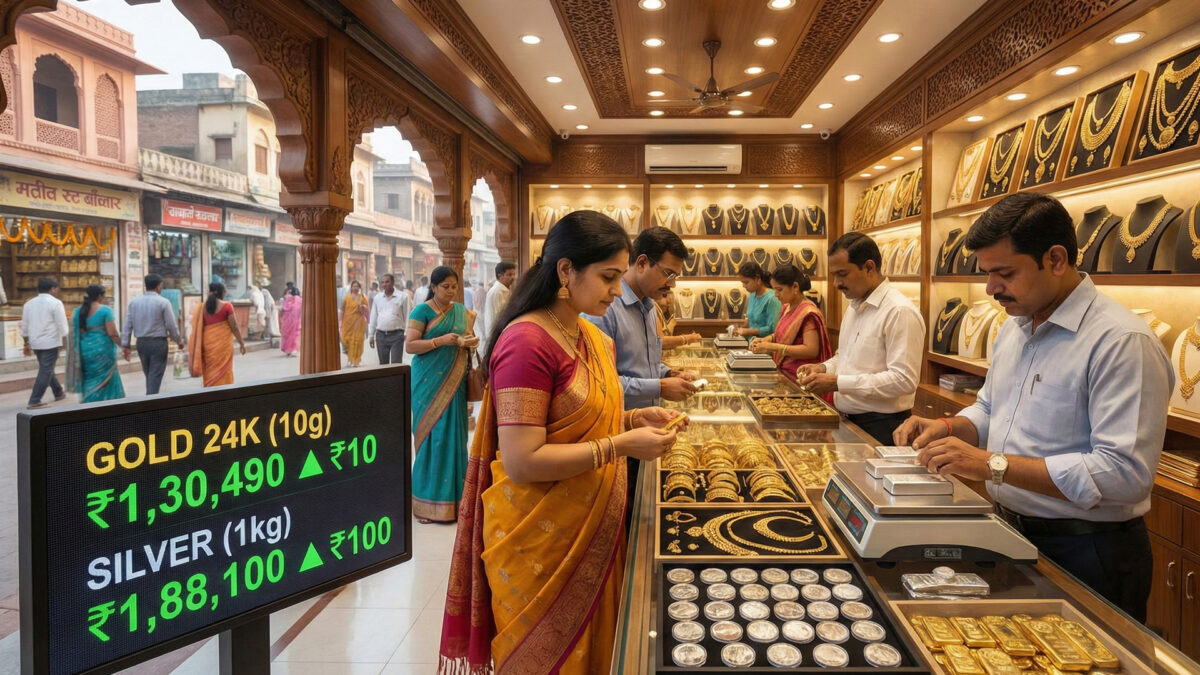
Gold and silver prices edged lower in the domestic market on Monday, giving slight relief to buyers after recent sharp movements in precious metals. The price of 24-carat gold fell by ₹10 to ₹1,55,770 per 10 grams, while silver dropped ₹100 to ₹2,74,900 per kilogram.

The price of 22-carat gold also declined by ₹10, with 10 grams trading at ₹1,42,790 in major cities. In Delhi, 24-carat gold was priced slightly higher at ₹1,55,920, while 22-carat gold stood at ₹1,42,940. Prices in Mumbai and Kolkata remained close to the national average, while Chennai continued to trade at a premium.

The fall in domestic prices followed weakness in international bullion markets. Global gold rates slipped as the US dollar strengthened, making gold more expensive for overseas buyers. A stronger dollar often puts pressure on gold prices because the metal is traded internationally in the US currency.

Investors also remained cautious due to ongoing geopolitical tensions and uncertainty in global markets. Concerns over inflation, interest rates and international conflicts continue to influence the movement of safe-haven assets such as gold.

Market experts said gold is facing mixed signals. On one hand, higher bond yields and a stronger dollar reduce its appeal because gold does not generate interest income. On the other hand, global uncertainty and inflation worries continue to support demand for the yellow metal.

Silver prices also moved lower in line with gold. Besides being a precious metal, silver is widely used in industrial sectors such as electronics, solar panels and manufacturing. Because of this, silver prices often react to both investment demand and economic growth expectations.

In India, jewellery demand has remained moderate as many consumers are delaying purchases due to high prices. Buyers are waiting for a bigger correction before making festive or wedding-related purchases. However, investment demand through bullion and digital gold products has remained steady.

Also Read: Sensex gains 300+ points, Nifty crosses 24,400

Categories
Corporate

Sensex gains 300+ points, Nifty crosses 24,400

Indian stock markets staged a smart recovery on Monday after a weak start, with investors returning to banking and blue-chip stocks. The BSE Sensex rose more than 400 points during trade, while the Nifty 50 moved above the 24,450 mark, showing resilience despite global uncertainty.

Markets had opened lower as investors reacted to weak international cues and rising crude oil prices. Tensions in the Middle East continued to keep traders cautious, with fears that higher oil prices could impact inflation and increase import costs for countries like India.

However, the early losses did not last long. Buyers stepped in soon after the opening bell, especially in banking and public sector stocks. Strong gains in State Bank of India, ICICI Bank and other lenders helped lift the benchmarks into positive territory.

HDFC Bank remained under some pressure after its recent quarterly earnings, which disappointed parts of the market. Even so, analysts said the bank’s long-term outlook remains stable and it continues to be a key player in the sector.

The broader market showed mixed trends, with some midcap and smallcap shares seeing profit booking after recent gains. Still, overall sentiment remained positive as investors focused on company earnings and India’s growth outlook.

Another factor supporting markets has been foreign investor interest. Overseas funds have been net buyers in recent sessions, helping improve confidence and adding momentum to Indian equities.

Experts said markets are balancing strong domestic fundamentals with global risks. While geopolitical tensions and crude oil prices may keep volatility high in the short term, steady earnings growth and continued investor participation could support equities.

If oil prices ease and global concerns calm down, markets may see further gains in the coming sessions. Monday’s rebound once again showed that investors remain willing to buy quality stocks during dips.

Categories
Leaders

Reed Hastings to step down from Netflix

Reed Hastings, the co-founder and long-time leader of Netflix, has announced that he will step down from his role as chairman of the company after nearly 29 years, marking the end of an era for the streaming giant.

Hastings confirmed that he will not stand for re-election at Netflix’s upcoming annual meeting in June 2026. He said he plans to focus on philanthropy and personal projects, bringing a gradual and carefully planned exit from the company he helped build from a DVD rental startup into a global entertainment powerhouse.

The announcement came shortly after Netflix’s recent corporate setback in its bid for Warner Bros. Discovery assets, a deal that ultimately went to rival Paramount Skydance. While the failed acquisition had been closely watched by the industry, Netflix executives have suggested Hastings’ decision was independent and part of a long-prepared leadership transition.

Investor reaction was swift, with Netflix shares slipping after the news broke, reflecting concerns over the departure of one of the company’s most influential figures. However, the company continues to show strong financial performance, with steady revenue growth and expanding global subscriber engagement.

Hastings co-founded Netflix in 1997 and played a central role in its transformation from a DVD-by-mail service into a dominant streaming platform that reshaped global entertainment. Under his leadership, Netflix pioneered binge-watching, invested heavily in original content, and expanded into nearly every major international market.

Over the years, he gradually reduced his operational responsibilities, stepping down as co-CEO in 2023 and later moving into the chairman role, while day-to-day leadership shifted to Ted Sarandos and Greg Peters.

His exit now places full responsibility on the current leadership team as Netflix navigates intensifying competition in streaming, advertising growth, and expansion into new formats like live content and gaming.

Also Read: Vedanta not declared highest bidder for JAL

Categories
Corporate

Vedanta not declared highest bidder for JAL

In a key development in the insolvency proceedings of Jaiprakash Associates Ltd (JAL), the resolution professional has informed the National Company Law Appellate Tribunal (NCLAT) that Vedanta Limited was never formally declared the highest bidder during the resolution process.

According to submissions made before the tribunal, the September 5 communication circulated among bidders only reflected the highest financial value discovered during a competitive evaluation. It was not an official declaration of any successful or winning bidder. The clarification comes amid Vedanta’s challenge to the approval of a rival resolution plan.

The resolution professional argued that Vedanta’s claim of being the highest bidder was misleading and not supported by the actual process followed by the Committee of Creditors (CoC). The CoC, which evaluates bids in insolvency cases, reportedly used a combined assessment model that included both financial and non-financial parameters, rather than selecting a winner based solely on the highest bid amount.

Vedanta has been contesting the approval of Adani Enterprises Limited’s resolution plan for JAL, arguing that its own revised offer was financially superior. The company has also claimed that procedural fairness was not maintained during the final stages of evaluation.

However, the resolution professional maintained before NCLAT that no bidder was officially declared the highest bidder at any stage, and that Vedanta’s interpretation of the communication was incorrect. The tribunal was also told that allowing post-process revisions or selective interpretation of bid communications would undermine the integrity and finality of insolvency proceedings.

The case is part of the larger insolvency resolution of Jaiprakash Associates, a heavily debt-laden infrastructure company undergoing restructuring under the Insolvency and Bankruptcy Code. The matter continues to be examined by the appellate tribunal, with further hearings scheduled to review objections raised by Vedanta and other stakeholders.

Also Read: Apple boosts 30% recycled materials

Categories
Technology

Apple boosts 30% recycled materials

Apple Inc. has announced that 30% of the materials used in its products shipped in 2025 came from recycled sources, the highest share recorded so far. The update was shared in its latest environmental report, highlighting steady progress toward its goal of becoming carbon neutral across its supply chain by 2030.

The company said it has significantly increased the use of recycled materials in core components, including cobalt in batteries, rare earth elements in magnets, and gold and tin in circuit boards. These changes are part of a broader effort to reduce reliance on newly mined resources.

Apple also confirmed that all product packaging is now fully fibre-based, eliminating plastic from boxes. This shift is aimed at making packaging easier to recycle and reducing overall environmental impact.

The company reported that its carbon emissions have fallen by more than 60% since 2015, even as production has grown globally. It also continues to expand recycling systems that recover materials from old devices, including automated disassembly robots.

Apple said the progress supports its “Apple 2030” plan to make all products carbon neutral within the next five years.

Also Read: BBC plans 2,000 job cuts as cost reduction drive