Categories
Corporate

ICICI Pru to halt new inflows into two FoFs

ICICI Prudential Mutual Fund has decided to stop accepting new investments in two of its fund-of-funds (FoF) schemes from January 27, 2026. The decision follows changes in regulatory guidelines and will place the schemes under a grandfathering process, meaning they will continue only for existing investors.

The two schemes affected are the ICICI Prudential Passive Multi-Asset Fund of Fund and the ICICI Prudential Global Advantage Fund of Fund. According to the asset management company (AMC), the structure and investment pattern of these schemes do not fully align with the Securities and Exchange Board of India’s (SEBI) updated framework for FoFs that invest in multiple underlying funds.

As part of this move, no fresh lump-sum investments, SIPs (Systematic Investment Plans), or STPs (Systematic Transfer Plans) will be allowed after the cut-off date. Applications received before 3 pm on January 23, 2026, will be processed as usual. Existing SIPs and STPs will be discontinued from February 5, 2026. In addition, the IDCW reinvestment option in both schemes will be shifted to an IDCW payout option.

While new inflows will stop, existing investors can continue to hold their units. They will also have the flexibility to redeem or switch out their investments at any time, including through Systematic Withdrawal Plans (SWPs). The AMC clarified that there will be no restriction on exits.

The Passive Multi-Asset FoF, launched in 2022, invests in a mix of domestic and international exchange-traded funds (ETFs) and index funds, offering exposure across equity, debt, and gold. The Global Advantage FoF focuses largely on overseas markets through international funds. Both schemes have attracted significant investor interest and assets over time.

ICICI Prudential AMC said the grandfathering will remain in place until the schemes are either merged with other suitable funds or wound up, in line with SEBI rules. This process can take up to three years.

Also Read: Jayant Acharya maps ₹2 lakh cr JSW Steel growth

Categories
Beyond

PFRDA reviews NPS investment rules

The Pension Fund Regulatory and Development Authority (PFRDA) has set up an expert committee to review and modernise the investment framework of the National Pension System (NPS). The move aims to strengthen long-term retirement savings, improve risk management and align NPS investments with evolving market conditions and global best practices.

The nine-member panel, named the Strategic Asset Allocation and Risk Governance (SAARG) Committee, will be chaired by Narayan Ramachandran, former India head and CEO of Morgan Stanley. The committee includes experienced professionals from the fields of asset management, capital markets and financial research.

The National Pension System is a key retirement savings scheme in India, covering government employees, private sector workers and individual subscribers. Any changes to its investment framework are expected to have a significant impact on long-term pension savings and capital market participation.

According to PFRDA, the committee’s main task is to examine the current investment guidelines of NPS and suggest changes that can enhance returns while managing risks effectively. The review will cover strategic asset allocation, diversification across asset classes, and the overall investment structure followed by pension funds under NPS.

The committee will also study governance mechanisms, risk monitoring systems and performance measurement standards. Special focus will be placed on evaluating alternative asset classes such as real estate, infrastructure investment trusts (InvITs), real estate investment trusts (REITs) and private equity, along with their valuation and liquidity norms.

In addition, the panel will assess portfolio stability, liquidity management and the role of intermediaries within the NPS ecosystem. Another key area of review is the integration of environmental, social and governance (ESG) principles into investment decisions, reflecting the growing importance of sustainable investing.

The SAARG committee has been given a nine-month timeline to complete its review and submit recommendations to PFRDA. Based on these suggestions, the regulator may revise existing NPS investment rules to provide greater flexibility, stronger governance and improved retirement outcomes for subscribers.

Other members of the committee include well-known market experts such as Raamdeo Agrawal, Kalpen Parekh, Devina Mehra and Ananth Narayan.

Also Read: Samsung nears Nvidia approval for HBM4 AI chips

Categories
Corporate

Samsung nears Nvidia approval for HBM4 AI chips

Samsung Electronics is nearing certification from Nvidia for its next‑generation HBM4 high-bandwidth memory, a key component for AI processors, according to industry sources. The approval would allow Samsung to supply these advanced chips, strengthening its position in the rapidly growing AI hardware market.

HBM4 memory, a stacked DRAM technology, delivers extremely high data bandwidth and energy efficiency, crucial for feeding large volumes of data into Nvidia’s AI accelerators. Nvidia has relied mainly on SK Hynix for HBM memory, making Samsung’s entry a notable shift in the supply chain.

Reports indicate Samsung is in the final stage of testing after submitting initial HBM4 samples late last year. The company aims to begin mass production in February 2026, with shipments expected soon after certification. Positive feedback from customers on Samsung’s HBM4 design highlights its competitiveness in performance and reliability.

The development has already boosted investor confidence. Samsung’s shares in Seoul gained on news of the potential approval, as analysts see it as a step toward diversifying the supply of high-end AI memory and challenging SK Hynix’s dominance.

Also Read: Shadowfax IPO allotment done, 2.7x subscribed

Categories
Corporate

Shadowfax IPO allotment done, 2.7x subscribed

Shadowfax Technologies Ltd has completed the allotment for its IPO, which attracted strong investor interest. The company’s public offering, valued at ₹1,907 crore, saw an overall subscription of 2.7 times, driven mainly by Qualified Institutional Buyers (QIBs), alongside notable retail participation. The IPO was open for bidding from January 20 to 22, 2026, and allotment was finalised on January 23.

Investors can check their allotment status through the registrar KFin Technologies or via the BSE and NSE websites. Those who did not receive an allocation will have their applications refunded in the coming days.

Shadowfax shares are scheduled to list on the Bombay Stock Exchange and National Stock Exchange on January 28, 2026. Grey market trends—a popular, though unofficial, indicator—suggest that shares could debut at or slightly below the issue price, reflecting cautious sentiment among investors.

The IPO price band was set at ₹118–₹124 per share, with retail investors required to buy a minimum lot of around ₹14,000. The company intends to use the funds to expand its logistics network, strengthen technology infrastructure, and support growth initiatives in its delivery business.

With the allotment completed and refunds underway for non-allocated applications, attention now turns to January 28, when trading begins. The subscription pattern highlighted strong institutional demand, with QIBs oversubscribing their portion, while the retail segment also showed solid participation.

Analysts note that the initial listing performance will be closely watched, as it will indicate investor confidence in Shadowfax’s expansion plans and operational model.

Also Read: Rupee slides to ₹92, raising costs for imports

Categories
Beyond

Rupee slides to ₹92, raising costs for imports

Rupee fell sharply to a record low of ₹92 per US dollar on January 23, 2026, before recovering slightly to ₹91.88. Experts attribute the slide to foreign investors pulling out funds and continued strong dollar demand from importers.

This depreciation affects both households and businesses. Imported goods, particularly crude oil, electronics, and machinery, are becoming more expensive. With India importing nearly 85% of its crude oil, fuel prices and inflation are expected to rise. Families face higher costs for overseas travel and education, while Non-Resident Indians (NRIs) benefit slightly as their remittances now convert into more rupees.

Exporters stand to gain from the weaker rupee, receiving more rupees for every dollar earned. However, companies that rely heavily on imported materials may see their benefits limited. Sectors such as textiles, which are less import-dependent, are likely to benefit the most.

Looking ahead, a Business Standard poll suggests the rupee could trade near ₹92.50 per dollar by the end of March 2026 if current trends persist and foreign outflows continue. Analysts point to delays in a US‑India trade deal and ongoing global uncertainties as key factors keeping the currency under pressure.

The Reserve Bank of India (RBI) has intervened at times to curb volatility, but broader global and domestic forces continue to influence the rupee. Policymakers face the challenge of balancing currency stability with inflation control and economic growth, as households, businesses, and exporters navigate the effects of a weaker rupee.

Also Read: ChatGPT cites Elon Musk’s Grokipedia in responses

Categories
Beyond

Canada rejects China deal after 100% tariff threat

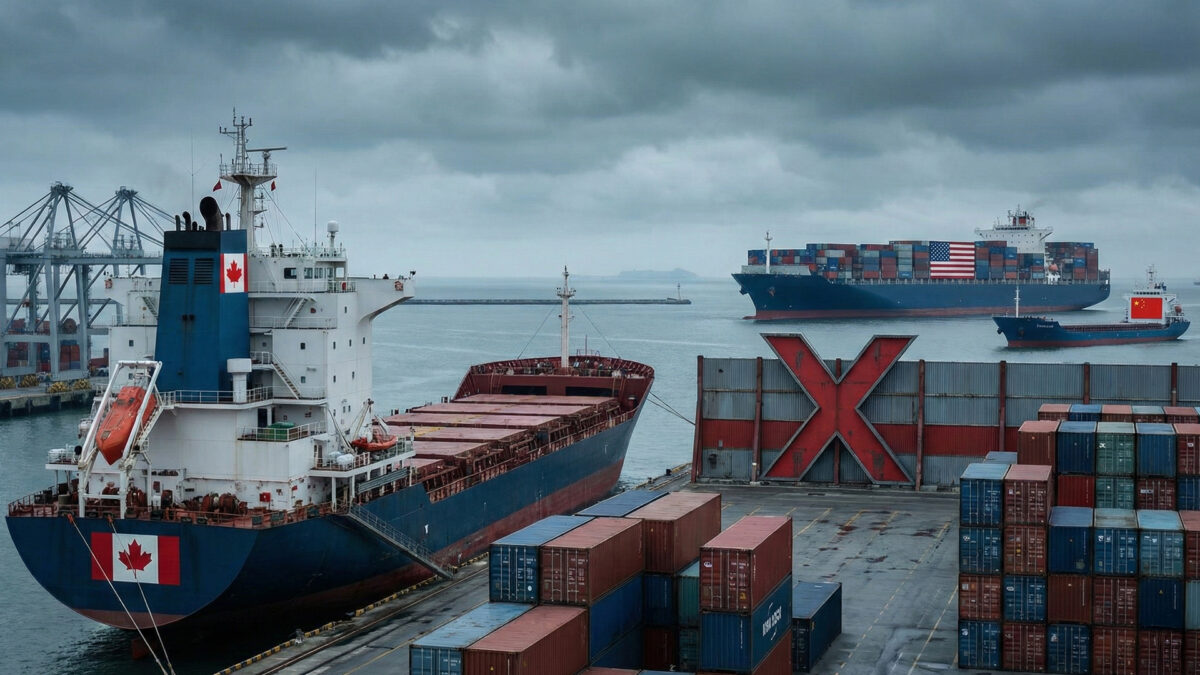
Canada has ruled out any free trade agreement with China, after US President Donald Trump threatened to impose 100 per cent tariffs on Canadian goods if Ottawa went ahead. Prime Minister Mark Carney clarified that Canada remains committed to its North American trade agreements and has no intention of pursuing a broad pact with Beijing.

Speaking on Sunday, January 25, Carney emphasised that Canada’s limited engagement with China has focused only on resolving specific tariff disputes, not on negotiating a full-fledged trade deal. “We respect our commitments under the USMCA. We are not planning any free trade agreements with China or other non-market economies,” he said.

The remarks follow a week of tense exchanges between Washington and Ottawa. Trump’s warnings came after reports that Canada was exploring closer trade ties with China, prompting fears in the US that Chinese goods could gain easier access to North American markets through Canada.

Recent agreements with China have been narrow and targeted. Canada reduced tariffs on a small number of Chinese electric vehicles, while Beijing agreed to ease duties on some Canadian exports, including canola and seafood. These measures, Carney stressed, are far from a comprehensive trade deal.

The US threat has added strain to Canada-US trade relations, but Carney’s firm stance sends a clear message: Ottawa seeks to balance global economic ties while honouring obligations to its North American partners. Analysts say the move highlights Canada’s careful approach to diplomacy, ensuring it can engage with global markets without triggering conflicts with the US.

Also Read: India to cut EU car import duties

Categories
Beyond

India to cut EU car import duties

India is likely to sharply reduce import duties on cars coming from the European Union as part of a comprehensive free trade agreement that is close to being finalised, sources said. The proposed move would bring down tariffs from the current levels of up to 110 per cent to around 40 per cent, marking a significant shift in India’s long-standing protectionist policy for the automobile sector.

The tariff cut is expected to play a crucial role in concluding the India-EU free trade agreement, negotiations for which have been ongoing for nearly 20 years. Officials familiar with the discussions indicate that both sides are keen to seal the deal, with an announcement possible during an upcoming India-EU summit.

Initially, the lower tariffs are likely to apply to a limited number of imported cars, particularly higher-priced models. Over time, duties could be reduced further through a phased approach. European auto majors such as BMW, Mercedes-Benz and Volkswagen are expected to benefit, as high import taxes have so far restricted their sales volumes in the Indian market.

India’s government has traditionally used steep import duties to protect domestic carmakers and encourage manufacturing within the country. To balance domestic interests, the proposed agreement is expected to include safeguards, including delayed tariff cuts for electric vehicles, allowing Indian EV manufacturers time to strengthen their production base.

India is one of the world’s fastest-growing car markets, but imported vehicles make up only a small share due to high costs. A reduction in tariffs could make premium European cars more accessible to Indian consumers while increasing competition in the sector.

Also Read: Qure.ai wins $8 million grant from Gates foundation

Categories
Corporate

Adani Green Q3 profit down 99%

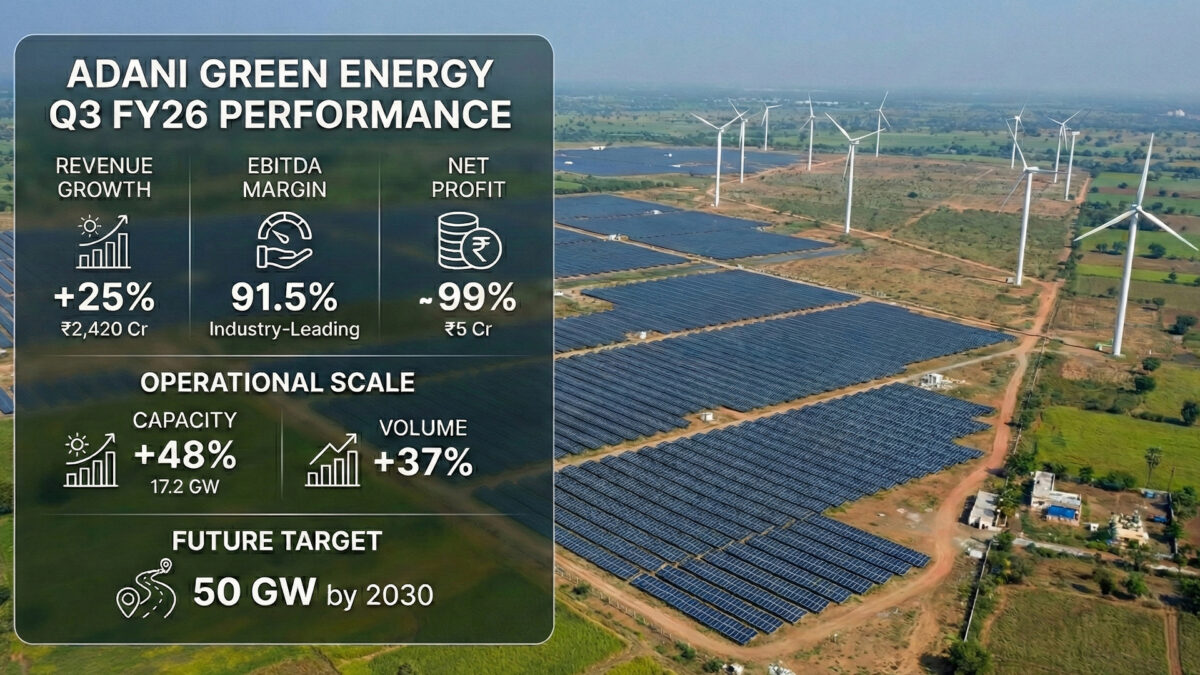
Adani Green Energy Ltd reported a mixed set of results for the third quarter of FY26, marked by strong revenue growth and operational expansion but a sharp decline in net profit due to rising costs.

During the December quarter, revenue from power supply grew 25 percent year-on-year to ₹2,420 crore, driven by a significant increase in generation. Energy sales volumes surged 37 percent compared to the same period last year, reflecting the commissioning of new renewable assets and improved utilisation. Consolidated revenue from operations rose about 12 percent year-on-year to ₹2,618 crore.

Operating performance remained robust. EBITDA from the power supply segment increased 23 percent year-on-year to ₹2,269 crore, underlining strong cash generation from core operations. The EBITDA margin stood at an industry-leading 91.5 percent, although it was marginally lower than the 92 percent recorded in the year-ago quarter, indicating some pressure from rising operating costs.

However, this strong top-line and operating performance did not translate into bottom-line growth. Consolidated net profit attributable to owners plunged by nearly 99 percent year-on-year to ₹5 crore. The sharp fall was primarily due to higher depreciation and interest expenses following aggressive capacity additions, along with the impact of one-off exceptional items during the quarter.

On the operational front, Adani Green continued to scale up rapidly. Its total operational renewable energy capacity expanded 48 percent year-on-year to 17.2 GW. A significant portion of the additions came from the Khavda renewable energy park in Gujarat, which is progressing as the world’s largest renewable energy installation and remains a key growth driver for the company.

Despite near-term pressure on profitability, the company reiterated confidence in its long-term growth strategy. Adani Green said it remains on track to achieve its target of 50 GW of renewable capacity by 2030, supported by a strong project pipeline and India’s accelerating transition towards clean energy.

Also Read: Adani Group fully acquires IANS

Categories
Corporate

Qure.ai wins $8 million grant from Gates foundation

Health-tech company Qure.ai has received an $8 million grant from the Bill & Melinda Gates Foundation, bringing fresh momentum to the fight against tuberculosis and pneumonia, two diseases that still claim millions of lives every year, largely due to late diagnosis.

The funding will help Qure.ai develop AI-powered point-of-care ultrasound tools designed for use by frontline health workers. These tools aim to make early diagnosis possible in places where access to specialist doctors and advanced imaging facilities is limited, such as rural clinics and community health centres.

Founder and CEO Prashant Warier said the grant reflects a shared belief that technology should serve people where the need is greatest. He noted that ultrasound, when paired with AI, has the potential to become a simple, affordable, and reliable diagnostic option at the point of care.

For many patients, especially in underserved regions, reaching a hospital with a trained radiologist can take days or even weeks. Qure.ai’s technology seeks to bridge this gap by combining portable ultrasound devices with artificial intelligence that can quickly analyse images and flag signs of lung disease. This can help healthcare workers make faster decisions and start treatment sooner.

A key part of the project is the creation of a large, open medical database made up of anonymised chest X-rays, ultrasound images, CT scans, lung sound recordings, and lab data. By making this data available to researchers around the world, Qure.ai hopes to encourage collaboration and speed up innovation in lung disease diagnosis.

Also Read: Arijit Basu named part‑time chairman of IndusInd Bank

Categories
Beyond

India-EU trade mega deal inches closer

India and the European Union are close to concluding a comprehensive free trade agreement (FTA), marking a major milestone in bilateral economic relations after years of negotiations. The deal is expected to be announced around the upcoming India-EU Summit on January 27, 2026, subject to formal approvals on both sides, including ratification by the European Parliament.

The proposed pact is among the most ambitious trade agreements pursued by India, covering goods, services, investment, and regulatory cooperation. Bilateral trade between India and the EU stood at an estimated $136–$190 billion in 2024–25, and the agreement is expected to provide a significant boost by lowering tariffs and easing market access for businesses on both sides.

India has taken a cautious approach during the talks, drawing clear red lines around sensitive sectors such as agriculture and dairy to protect domestic producers and rural livelihoods. It has also sought gradual tariff reductions in manufacturing to prevent sudden pressure on local industries, while aiming to attract European investment and strengthen India’s role in global supply chains.

The EU has pushed for wider access for its industrial goods, including automobiles and auto components, as well as greater opportunities in services. Climate-related trade measures have emerged as a key area of negotiation, particularly the EU’s Carbon Border Adjustment Mechanism (CBAM) and sustainability standards linked to its Green Deal. India has raised concerns that these measures could function as non-tariff barriers for energy-intensive exports, while the EU maintains they are essential to ensure fair competition and meet climate goals.

If finalised, the agreement is expected to improve export prospects for Indian sectors such as textiles, apparel, leather, engineering goods, and services, while offering European firms a larger and more predictable market in India. The deal also carries strategic weight, coming at a time when global trade is increasingly fragmented and economies are looking to diversify partnerships.

Also Read: Infosys to recruit 20,000 freshers in FY27