Categories
Corporate

Sensex gains 100 Points, Nifty tops 26,200

The Indian market began the session on a firm note on Friday, with the Sensex opening around 85,788, up 68 points, and the Nifty starting near 26,233, adding about 17 points. The early tone remained positive as investors continued to buy into cyclicals after the recent record-high rally.

Auto and metal stocks supported the market at the open, with Mahindra & Mahindra, Reliance Industries, Hindustan Unilever, Tech Mahindra and Titan gaining between 1% and 2%. Sectorally, the metal index rose around 0.5%, while auto stocks also saw steady traction.

However, the broader mood was mixed as oil & gas stocks traded lower, keeping overall gains in check. Analysts said the opening reflects cautious optimism, with markets expected to stay in a consolidation phase after hitting new peaks earlier in the week.

Also Read: Sensex 85,720, Nifty 26,215 end higher after record peaks

Categories
Technology

OpenAI API user data exposed in Mixpanel hack

OpenAI has confirmed that a security breach at Mixpanel, one of its third-party analytics partners, exposed personal details of some users who rely on the company’s paid API services. The incident took place on 9 November 2025, when hackers gained access to Mixpanel’s systems. Mixpanel later informed OpenAI about the intrusion and shared the compromised dataset for investigation.

According to OpenAI, the leaked information is limited but still sensitive. It includes names linked to API accounts, email addresses, user or organisation IDs, approximate location data based on browser information, and technical details such as the browser, operating system and referring website. This data was collected to track user analytics on OpenAI’s API platform.

Importantly, no confidential user content, passwords, API keys, payment information, billing details, or chat logs were exposed. OpenAI emphasised that the breach does not affect regular consumers using ChatGPT, as this dataset only involved analytics connected to the platform.openai.com API service. All OpenAI models and systems continue to operate normally.

Following the incident, OpenAI immediately removed Mixpanel from all its production environments and ended its use of the company’s analytics services. The company is now contacting all affected users directly through email. OpenAI has also launched a broader review of its security and vendor-management processes to reduce the risk of similar breaches in the future.

Security experts warn that the exposed information could still be used for phishing attempts. With names and email addresses now potentially outside OpenAI’s secure ecosystem, attackers may try to send convincing scam emails pretending to be from OpenAI or related platforms. Users are advised to be cautious about unexpected messages, avoid clicking suspicious links and ensure that multi-factor authentication (MFA) is enabled on all critical accounts.

The incident highlights the vulnerabilities that can arise from third-party service providers, even when a company’s own systems remain secure. As more businesses depend on cloud and AI services, the security of every partner in the chain becomes crucial. OpenAI has reassured customers that it is strengthening auditing practices and increasing oversight of external vendors to prevent similar issues.

Also Read: JP Morgan predicts Nifty50 could hit 30,000 by 2026

Categories
Leaders

Robinhood CEO’s AI venture Harmonic hits $1.45 billion

Harmonic, the AI startup co-founded by Robinhood CEO Vlad Tenev, has closed a fresh $120 million funding round, lifting its valuation to $1.45 billion. The raise underscores Tenev’s growing influence as a tech leader betting on a new direction for artificial intelligence,  one built on mathematical rigour, transparency and verifiable reasoning.

Founded in 2023, Harmonic is attempting to solve a leadership-level challenge facing the AI industry: trust. While most AI models risk “hallucinating,” Harmonic’s flagship system, Aristotle, reasons using formal logic and expresses outputs in a provable programming language. This makes its decision-making traceable, a quality that leaders in high-stakes fields like finance, aerospace and software reliability have been demanding.

Though still pre-revenue, Harmonic’s rapid valuation growth shows that investors view this approach as the future of responsible AI leadership. The new capital will boost computing power, accelerate model development and strengthen its push to build AI that organisations can depend on for mission-critical decisions.

Tenev’s involvement also reflects a shift among global technology leaders,  moving from building apps to building the foundations of the next era of intelligence, where safety, logic and accountability matter as much as raw capability.

Also Read: IMF shifts India to crawl-like regime

Categories
Corporate

Sensex 85,720, Nifty 26,215 end higher after record peaks

The Indian stock market saw a steady but cautious finish on November 27. Both benchmark indices, the Sensex and the Nifty, touched fresh all-time highs during the day before slipping due to profit-booking. The Sensex eventually closed at 85,720, up 111 points, while the Nifty settled at 26,215, gaining 10 points.

Early optimism was driven by expectations of upcoming interest rate cuts and strong domestic investor participation. This pushed banking and financial stocks higher, with names such as HDFC Bank, ICICI Bank, Bajaj Finance and Bajaj Finserv contributing the most to the day’s gains.

However, the rally was capped as selling pressure emerged in the second half of the session. Sectors like oil & gas, realty, energy and consumer durables saw declines, offsetting some of the early momentum. Mid-cap stocks held steady, but small-caps underperformed, signalling a shift toward safer, large-cap bets.

Analysts say the Nifty will need to climb and stay above 26,310 to extend the uptrend, while support lies around the 26,000 mark. Market direction over the next few days will depend on global cues, central bank signals, and domestic economic data.

Also Read: Sensex tops 86,000, Nifty crosses 26,300

Categories
Corporate

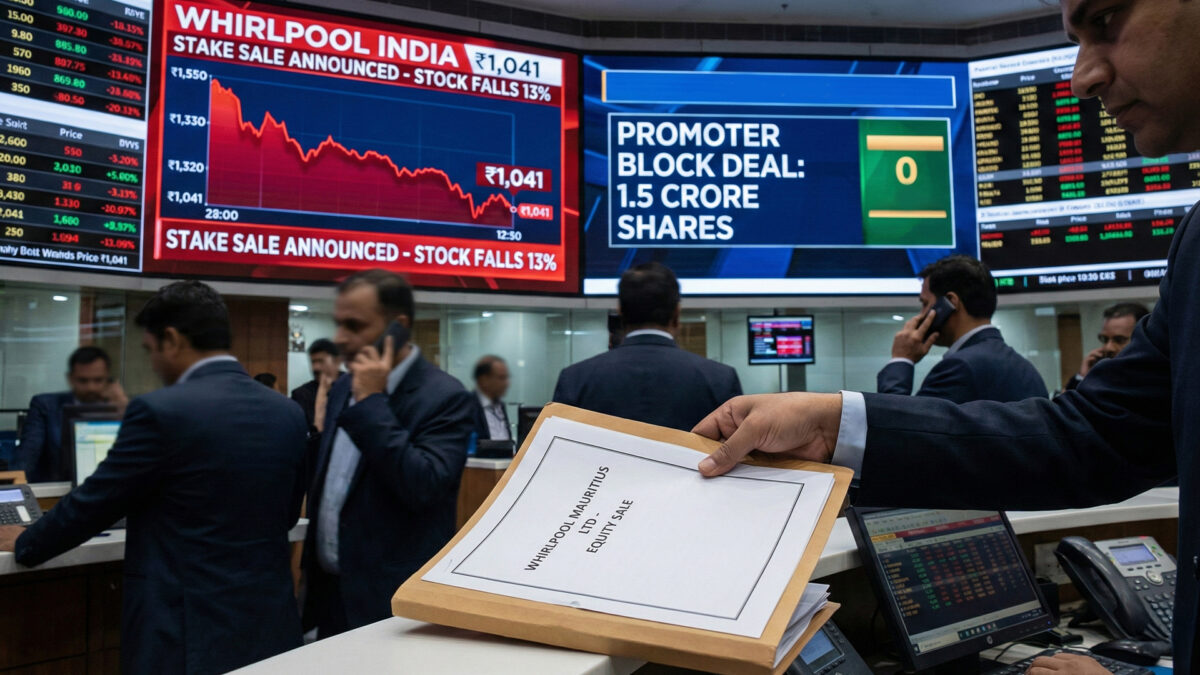
Whirlpool shares fall 13% on ₹965 crore stake sale

Shares of Whirlpool of India fell sharply after its promoter, Whirlpool Mauritius Limited, announced plans to sell part of its stake. The sale will be around 7.5 % of the company, roughly 95 lakh shares, and could raise about ₹965 crore.

The shares will be offered at a “floor price” of ₹1,030 each, about 14 % lower than the previous closing price of ₹1,201.40. Following this announcement, the stock fell as much as 13 % on the Bombay Stock Exchange, hitting ₹1,041.

The sale comes amid weak recent performance. In the September quarter, Whirlpool of India’s consolidated net profit dropped around 21 % to ₹41 crore, while revenue also fell slightly. Over the past year, the company’s shares have declined about 33 %, underperforming the market.

Analysts say the promoter’s sale is part of a long-term trend of the parent company reducing its stake in India. The money from the sale may help the parent company reduce global debt rather than indicate a full exit from Whirlpool of India.

Also Read: Tesla plans deeper India push with full EV ecosystem

Categories
Corporate

Apple challenges $38 billion India antitrust penalty law

Apple Inc. has filed a petition in the Delhi High Court challenging India’s 2024 amendment to the Competition Act, which allows fines based on a company’s global turnover. The move could expose Apple to a potential penalty of up to $38 billion (around ₹3 lakh crore).

The legal dispute stems from a 2022 antitrust probe by the Competition Commission of India (CCI), which accused Apple of abusing its dominance on the iOS App Store by restricting third-party payment options. Apple denies any wrongdoing and says its Indian market share remains small compared to Android, despite significant user growth.

In a detailed 545-page petition, Apple described the law as “arbitrary, unconstitutional, grossly disproportionate and unjust,” arguing that any fine should be limited to revenue earned in India from the specific business under investigation. The company warned that retroactive application of the law could unfairly penalise past practices.

A hearing is scheduled for 3 December 2025, marking the first major test of India’s revised competition-law penalty system against a global technology company.

Also Read: Tesla plans deeper India push with full EV ecosystem

Categories
Beyond

India’s $5 trillion goal delayed, growth strong

The International Monetary Fund (IMF) says India’s economy continues to grow steadily, but the country may reach the $5 trillion GDP mark a year later than previously expected. The new estimate now points to fiscal year 2028‑29, instead of 2027‑28. The main reasons for the delay are a weaker rupee and slower growth in GDP when measured in dollar terms.

Despite the delay, India remains one of the fastest-growing major economies in the world. Strong domestic demand, robust consumer spending, and healthy growth in services and manufacturing are helping the economy stay on track. Inflation is also under control, which supports stable prices and living costs.

The IMF forecasts that India’s economy will grow by 6.6% in FY2025‑26 and 6.2% in FY2026‑27. Even with the $5 trillion milestone pushed back, the underlying growth story remains strong. Policymakers will need to focus on sustaining domestic growth, managing inflation, and keeping the rupee stable to maintain momentum.

Also Read: Deloitte report in Canada faces AI citation controversy

Categories
Corporate

Ravelcare SME IPO ₹24 crore, shares ₹123–₹130

Ravelcare, a personal-care and beauty brand, will open its SME IPO on December 1, closing on December 3, 2025. The company aims to raise around ₹24.10 crore by issuing 18.54 lakh shares at a price band of ₹123–₹130 per share.

About ₹11.5 crore will go into advertising and marketing, while ₹7.8 crore will fund a new manufacturing facility in Amravati. The rest will support general business needs.

Founded in 2018, Ravelcare sells haircare, skincare, and body-care products online. For FY25, revenue was ₹24.98 crore with ₹5.25 crore profit. The IPO proceeds will fund growth, not payouts to existing shareholders.

Also Read: India approves ₹7,280 cr plan to make rare-earth magnets

Categories
Corporate

Sensex tops 86,000, Nifty crosses 26,300

Indian equity markets extended their upward momentum on Thursday, with benchmark indices closing higher for a second straight day on the back of broad-based buying and firm global cues. The Sensex climbed nearly 600 points, while the Nifty added close to 180 points, supported by strength in defensives, technology majors and key manufacturing plays. Overall, 32 of the 50 Nifty constituents ended in the green, signalling renewed risk appetite among investors.

The trading session was defined by steady accumulation across most sectors, even as certain pockets saw mild profit-taking. Defensives such as pharmaceuticals and FMCG maintained a constructive undertone, aided by stable earnings visibility. Technology stocks, buoyed by expectations of improved global demand and easing macro pressures, also contributed meaningfully to the indices’ gains. Manufacturing-linked counters, including select capital goods and industrial suppliers, continued to benefit from strong order flows and domestic capex momentum.

However, sentiment was slightly softer in energy, consumer durables and public-sector banking. These groups witnessed brief phases of consolidation as investors assessed near-term valuations and awaited fresh economic signals. Analysts noted that this pattern reflected a healthy rotation rather than a weakening of broader market strength.

Stock-specific action remained prominent. While most heavyweights moved higher, a few names bucked the trend. Whirlpool of India, Natco Pharma and Kaynes Technology India emerged as notable losers, slipping due to sectoral moderation and selective profit-booking after recent rallies. Market participants suggested that the declines were more technical than fundamental, with no major negative triggers emerging during the session.

Despite these isolated weaknesses, overall market breadth stayed supportive. Mid-cap and small-cap indices also closed in positive territory, indicating that buying interest was not limited to large caps. With global markets stable and domestic indicators holding firm, investors appeared comfortable taking incremental risk, though some caution remained around external triggers such as commodity price fluctuations and central bank commentary.

Also Read: Sensex up 1,022 pts, Nifty rises 320 pts

Categories
Beyond

Apollo Micro, IIT-Chennai, Navy partner for defence tech

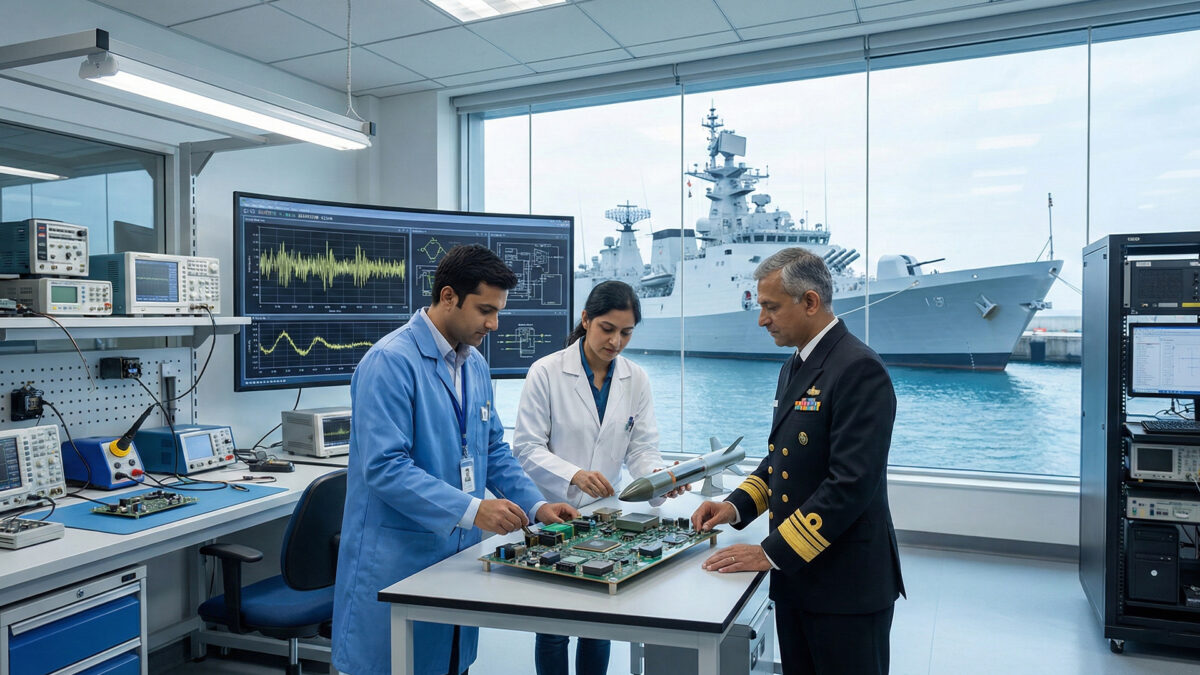
Apollo Micro Systems (AMS) has entered into a three-way Memorandum of Understanding with IIT-Chennai and the Indian Navy’s Directorate General of Naval Armament Inspection (DGNAI) to fast-track the development of indigenous defence technologies. The agreement was formalised at the Swavalamban 2025 event in New Delhi on 25 November.

The partnership brings together three crucial strengths,  academic research, industrial manufacturing, and military operational expertise. Under the arrangement, IIT-Chennai will focus on research, conceptual design and technology development. Apollo Micro Systems will take these concepts forward by building prototypes, refining them for real-world use and enabling large-scale manufacturing. The DGNAI will guide the development with domain knowledge, oversee testing, and ensure compliance with military standards before any system is deployed.

The pact aims to address both current and future defence needs, especially in critical areas such as electronic-warfare systems, precision-guidance technologies, advanced control systems and high-energy armament solutions. Many of these innovations can later be adapted for the Army, Air Force and even space-related applications.

AMS’ leadership described the alliance as a powerful model for strengthening India’s defence ecosystem,  one that blends innovation from academia with industrial capability and operational insight. The company believes this partnership will support the country’s long-term goal of reducing dependence on imported defence technology.

The announcement generated strong market interest, with AMS shares rising around 5% after the MoU was made public, reflecting investor optimism about future defence orders and the company’s expanded role in the indigenisation push.

The collaboration is expected to accelerate the journey from lab-scale research to field-ready systems, reinforcing India’s efforts to build advanced, home-grown defence capabilities under the Aatmanirbhar Bharat mission.

Also Read: Adani Enterprises opens ₹24,930 crore rights issue