Categories
Beyond

World Bank raises India growth forecast to 6.6%

The World Bank has increased India’s growth forecast to 6.6% for the current financial year, up from its earlier estimate of 6.3%.

The revision shows confidence in India’s economy, which continues to perform well compared to other major countries. The growth is mainly being driven by strong demand within the country, including higher spending by consumers and continued government investment.

India remains one of the fastest-growing large economies in the world. Better business activity, stable policies, and ongoing infrastructure development are helping support this growth.

However, the World Bank has also warned about possible risks. Global tensions, especially in West Asia, could affect oil prices. Since India imports a large amount of oil, higher prices may increase costs and put pressure on the economy.

Inflation is another concern, as rising food and energy prices could impact household spending. Global uncertainty may also affect trade and investment.

Despite these challenges, India is in a relatively strong position. A stable banking system, good foreign exchange reserves, and steady policies are expected to help the country handle external pressures.

Also Read: Bengaluru airport tests ‘face as passport’ travel system

Categories
Corporate

Anand Rathi Wealth announces bonus shares, ₹7 dividend

Anand Rathi Wealth has announced a bonus share issue and a dividend along with its latest quarterly results, showing strong business performance.

The company will issue bonus shares in a 1:1 ratio. This means shareholders will get one extra share for every share they own. The move is aimed at rewarding investors and making the stock more accessible in the market.

In addition, the company has declared a final dividend of ₹7 per share for the financial year 2025–26. This will be paid to shareholders after approval at the annual general meeting.

The announcements came as the company reported strong results for the fourth quarter. Net profit rose by around 40% compared to the same period last year, reaching about ₹103 crore. Revenue also grew by nearly 30%, showing steady business growth.

The company’s assets under management (AUM) increased by over 20% year-on-year. This indicates strong client inflows and growing trust among investors. The number of clients also went up during the period.

Experts say bonus shares are usually given when a company has strong reserves. While investors get more shares, the overall value of their investment does not change immediately, as stock prices adjust after the bonus issue.

Also Read: Gold slips ₹10 to ₹1.51 lakh, silver falls ₹2,000

Categories
Corporate

IndiGo rises 11% on ceasefire, lower oil

Shares of IndiGo soared 11% this week, becoming one of the top gainers on India’s Nifty 50, after news of a two-week ceasefire in the Iran conflict and a fall in crude oil prices lifted investor sentiment. Lower fuel costs are particularly good news for airlines, as aviation turbine fuel accounts for a large portion of operating expenses.

The Indian government also stepped in with temporary relief, cutting landing and parking charges at major airports by 25% for three months. This move is designed to ease financial pressure on carriers navigating the ongoing disruptions in West Asia.

Despite the market optimism, airlines continue to face operational challenges. Safety concerns and airspace closures have forced Indian carriers to cancel thousands of flights to the Gulf and West Asia, reducing daily services from around 300–350 to 80–90. Longer routes are being rerouted, adding complexity and costs.

Passengers are feeling the impact too, with fewer flight options and rising fares on affected routes. Some airlines have imposed fuel surcharges and revised ticket prices to manage the volatility.

Domestic carriers like IndiGo and Air India are treading cautiously, gradually restoring operations only as airspace stabilizes.

Also Read: Adam Back denies claims of being Bitcoin creator

Categories
Technology

Muse Spark powers Meta’s AI reset

Meta Platforms has launched a new artificial intelligence model called Muse Spark, as part of its efforts to strengthen its position in the fast-growing AI space.

The move comes under CEO Mark Zuckerberg, who is focusing on rebuilding the company’s AI strategy after earlier setbacks. Muse Spark is the first major product from Meta’s revamped AI division, created to accelerate innovation and compete with global tech rivals.

The new model is designed to power Meta’s AI tools across its platforms. It will be used in the Meta AI app and gradually rolled out to services like Facebook, Instagram, WhatsApp, and Messenger.

Muse Spark can handle both text and images and is built to answer more complex questions. It also offers different response modes, allowing users to choose between quick replies and more detailed explanations.

Meta says the model is faster and more efficient, while still being powerful enough to compete with other leading AI systems. Unlike some of its earlier models, Muse Spark will not be open-source and will mainly be used within Meta’s own platforms.

The launch is part of a larger reset, with the company investing heavily in AI talent and infrastructure. Zuckerberg has said this is just the beginning, with plans to build more advanced AI tools in the future.

Also Read: LIC eyes first bonus share issue

Categories
Leaders

Policybazaar CEO Tarun Mathur resigns

Policybazaar is going through a leadership change, as its CEO Tarun Mathur has stepped down after spending nearly 18 years with the company. Taking his place is Sajja Praveen Chowdary, a long-time member of the organisation.

Mathur officially left his role on April 7, 2026, citing personal reasons. Over the years, he has been closely involved in building Policybazaar into one of India’s most popular platforms for buying insurance online. His exit marks the end of a long and important chapter for the company.

Chowdary’s appointment as CEO has been approved by the Insurance Regulatory and Development Authority of India (IRDAI), making the transition official. He is not new to the business and has been part of the parent company, PB Fintech, since 2011.

Before becoming CEO, Chowdary led the “Policybazaar for Business” division, which focuses on insurance solutions for companies and small businesses. He brings over 17 years of experience and has worked across different areas like product development, technology, and business strategy.

Since he already understands the company well, the leadership change is expected to be smooth. The transition had also been planned in advance, with Mathur’s exit linked to the approval of his successor.

Policybazaar remains a major player in India’s growing digital insurance space, helping millions of users compare and buy policies online. With Chowdary now at the helm, the company is expected to continue focusing on growth and improving its services for both individual customers and businesses.

Also Read: Anthropic delays new AI model over risks

Categories
Corporate

$64bn takeover bid for universal music

Universal Music Group, the world’s largest music label, has received a massive $64 billion takeover offer from billionaire investor Bill Ackman and his firm Pershing Square Capital Management.

The proposal includes both cash and shares and is aimed at buying out current investors to take greater control of the company. Universal Music has confirmed it received the offer and said its board is reviewing it carefully before making any decision.

Ackman, who is already an investor in the company, believes the music giant is undervalued. According to him, factors like where the company is listed and how it is structured may be holding back its true market value. Through this deal, he hopes to unlock more growth and attract a wider pool of investors.

One possible change under the proposal is shifting the company’s stock listing to the United States. This could increase visibility among global investors and potentially boost its valuation further.

Universal Music represents some of the biggest names in the music industry and plays a key role in shaping global music trends. Despite its strong position, decisions like this takeover depend heavily on the approval of major shareholders.

Some large investors, including those linked to the Bolloré family, hold significant stakes in the company. Their support will be crucial for the deal to move forward.

Also Read: Disney plans 1,000 job cuts

Categories
Beyond

RBI keeps Repo rate at 5.25%

The Reserve Bank of India has decided to keep its key policy rate, the repo rate, unchanged at 5.25%, signalling a cautious approach as it navigates a complex global and domestic environment.

The decision was announced after the latest meeting of the Monetary Policy Committee (MPC), which voted to maintain the current rate while continuing with a “neutral” stance. This means the central bank is keeping its options open, depending on how inflation and growth trends evolve in the coming months.

Alongside the rate decision, the RBI projected India’s economic growth at 6.9% for the financial year 2026–27. While the outlook remains positive, it reflects a slightly moderated pace amid global uncertainties. Inflation is expected to average 4.6%, staying within the RBI’s comfort range but still requiring close monitoring.

The central bank highlighted that risks from global developments remain a concern. Ongoing geopolitical tensions, particularly in West Asia, and fluctuations in crude oil prices could impact both inflation and economic activity. Any sharp rise in oil prices may increase input costs and put pressure on household budgets.

Despite these risks, the RBI expressed confidence in the strength of the domestic economy. It pointed to steady consumption, improving investment activity, and stable financial conditions as key supporting factors.

For borrowers, the unchanged repo rate means lending rates on home, auto and other loans are likely to remain stable for now. This provides some relief to households and businesses that have been adjusting to higher interest rates over the past few years.

Also Read: Gold at ₹1.53 lakh, Silver near ₹2.60 lakh

Categories
Corporate

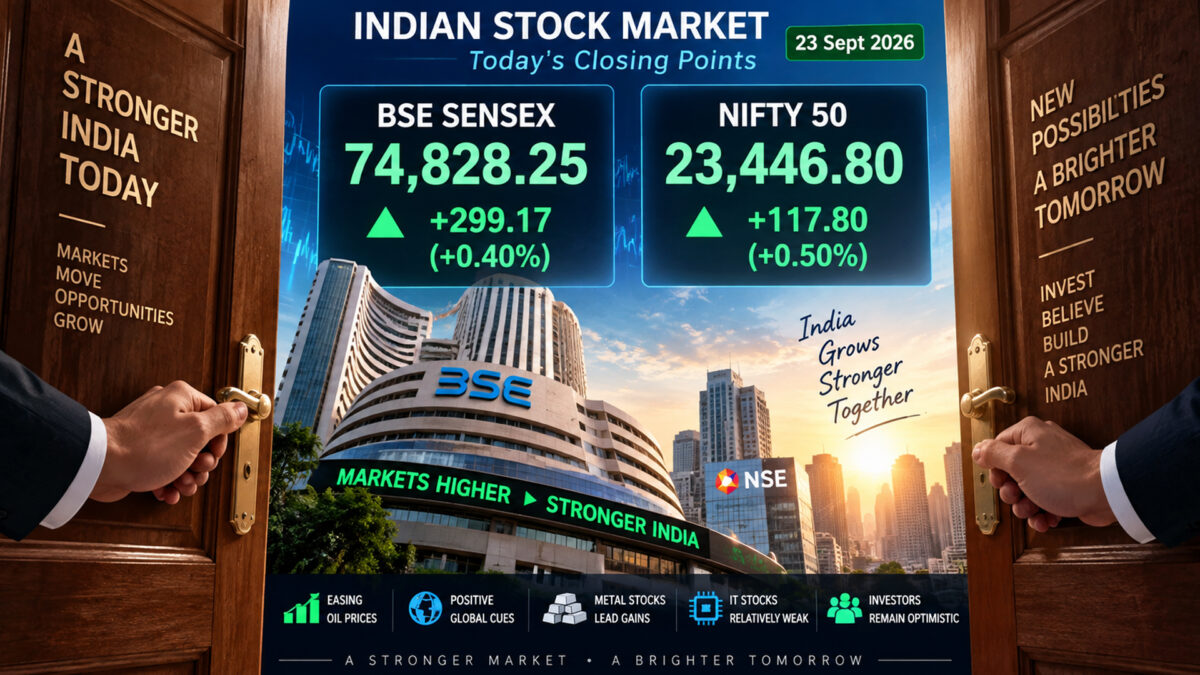
Sensex rises to 3000 points, Nifty hovers near 24,000

Indian equity markets delivered a powerful rally on April 8, 2026, with benchmark indices posting gains of nearly 4 per cent, driven by strong global cues and easing geopolitical concerns.

The BSE Sensex surged 2,946 points to close around 77,562, while the Nifty50 jumped 874 points to hover near the 24,000 mark. The sharp rise reflected renewed investor confidence after recent volatility.

The rally was led by banking and financial stocks, with HDFC Bank and ICICI Bank seeing strong buying interest. Auto stocks such as Mahindra & Mahindra also advanced, while realty counters posted solid gains amid improved sentiment.

Among the broader market, metal and infrastructure stocks contributed to the upside, supported by easing commodity prices. Midcap and smallcap indices also moved higher, indicating widespread participation across sectors.

However, not all sectors joined the rally. IT stocks, including Infosys, came under pressure due to weak global tech cues. Defensive names such as Hindustan Unilever also lagged, as investors shifted focus toward cyclical and growth-oriented sectors.

Also Read: Infosys, Harness team up for AI delivery

Categories
Corporate

Infosys, Harness team up for AI delivery

Infosys has partnered with Harness to improve how enterprises build and deliver software using artificial intelligence. The collaboration focuses on fixing inefficiencies that arise after code is written, especially in testing, deployment and operations.

While AI tools have significantly accelerated coding, companies still face delays and risks in the later stages of software delivery. These include manual processes, security checks and performance monitoring, which often slow down releases. Infosys and Harness aim to close this gap by introducing AI-driven automation across the entire software lifecycle.

As part of the partnership, Infosys will integrate its AI-led platforms, including Topaz and its cloud capabilities, with Harness’ software delivery solutions. This will enable businesses to automate key processes such as continuous integration, testing, deployment and monitoring, making software releases faster and more reliable.

The companies said the collaboration will help reduce manual intervention, improve productivity and ensure better governance. This is particularly important as enterprises scale up AI adoption and need stronger control over how applications are deployed and managed.

Another key benefit is expected in cost and efficiency. By automating repetitive tasks, engineering teams can spend less time on maintenance and more time on innovation. This can lead to quicker product launches and improved customer experience.

The partnership is also aimed at supporting large digital transformation and modernisation programmes, especially in industries where reliability and compliance are critical. Faster deployment cycles combined with improved system stability are expected to be major outcomes.

Industry observers note that the move reflects a broader shift in the technology sector. Companies are no longer focusing only on AI-assisted coding but are increasingly looking at end-to-end AI-driven software delivery.

Also Read: Beacon Group names Dr Rajesh Patel as CEO


Categories
Leaders

Beacon Group names Dr Rajesh Patel as CEO

Beacon Group has appointed Dr Rajesh Patel as its new Group Chief Executive Officer, effective April 1, 2026, in a move aimed at strengthening its leadership team and accelerating growth.

Dr Patel brings more than three decades of experience in the healthcare and diagnostics industry. Over his career, he has worked across key areas such as business development, sales, marketing, and strategic planning. He is widely recognised for driving operational improvements and expanding businesses within the diagnostics sector.

In his new role, Dr Patel will oversee operations across the group’s key entities, including Beacon Diagnostics, Vector Biotek, and Biogeny Diagnostics. His focus will be on aligning strategies across these companies, improving coordination, and ensuring efficient execution of business plans.

The company said Dr Patel will play a crucial role in shaping its long-term vision. His responsibilities include driving expansion into new markets, strengthening organisational capabilities, and enhancing overall service quality. He is also expected to lead efforts to build stronger relationships with customers and partners across the healthcare ecosystem.

Beacon Group is looking to expand its footprint in the in-vitro diagnostics (IVD) segment, a fast-growing area in India’s healthcare industry. The company aims to cater to a wide range of clients, including large laboratory chains, hospitals, and independent labs, while maintaining a strong focus on innovation and quality.

Welcoming the appointment, the company’s leadership expressed confidence that Dr Patel’s experience and strategic approach will help guide Beacon Group through its next phase of growth. His leadership is expected to support the company’s ambition of becoming a major player in the diagnostics market.

Also Read: Gautam Adani gets US Court hearing