Categories
Corporate

Sensex tumbles over 450 points, Nifty slips below 24,050

The markets faced sharp selling pressure on Monday, with the Sensex dropping more than 450 points and the Nifty 50 slipping below the 24,050 mark in morning trade. Rising crude oil prices, weak global cues, foreign fund outflows and uncertainty over US interest rates weighed on investor sentiment as the market began the final session of August on a cautious note.

The Sensex opened lower and extended its losses as selling spread across several sectors. The index fell more than 450 points during early trade, while the Nifty 50 moved closer to the psychologically important 24,000 level. The decline came after the market had staged a recovery in the previous session, highlighting the fragile sentiment among investors. On friday, Sensex closing showcased a rise of 300 points  while Nifty settle above 24,150.

Among individual stocks, HDFC Bank emerged as one of the biggest gainers on the Nifty 50. The private sector lender rose nearly 2%, providing some support to the banking index. ICICI Bank was also trading higher. HDFC Bank remained in focus following the announcement that its managing director and CEO Sashidhar Jagdishan would not seek reappointment for another term.

The gains, however, were outweighed by losses elsewhere. NALCO was among the biggest Nifty 50 losers, falling around 3.7%. KPIT Technologies declined nearly 3%, while Persistent Systems slipped around 2.7%. Tata Elxsi and ICICI Asset Management were also among the stocks facing significant selling pressure.

The weakness in technology stocks was particularly visible, with the Nifty IT index declining around 1.5%. Infosys and other major IT counters came under pressure as investors remained concerned about global interest rates, technology spending and the outlook for the US economy. The reversal came a day after IT stocks had helped the domestic market recover.

The rise in crude oil prices was one of the key reasons behind Monday’s cautious mood. Brent crude moved towards the $90-a-barrel mark amid renewed geopolitical tensions. For India, which depends heavily on imported crude oil, higher energy prices can have a direct impact on inflation, the trade deficit and the rupee.

A sustained increase in crude prices could also put pressure on corporate profitability, particularly for industries that have high fuel or transportation costs. Investors therefore tend to react quickly to sharp movements in global oil prices, especially when the Indian stock market is already facing concerns over foreign portfolio investment flows.

Global market cues were another source of pressure. Investors continued to monitor US Treasury yields and expectations around the Federal Reserve’s interest-rate policy. Higher US yields can make dollar-denominated investments more attractive, potentially encouraging global investors to move money away from emerging markets.

Foreign institutional investors have remained an important factor for Indian equities in recent weeks. Continued selling by overseas funds could keep pressure on large-cap stocks and benchmark indices. Domestic institutional buying, meanwhile, could help limit the downside if investors view the correction as an opportunity to accumulate quality stocks at lower valuations.

The banking sector presented a mixed picture. HDFC Bank and ICICI Bank gained, while several public sector lenders traded lower. Bank of Baroda, Canara Bank, Punjab National Bank and State Bank of India were among the stocks under pressure. The divergence within the banking space showed that investors were taking a selective approach rather than selling the entire sector indiscriminately.

Reliance Industries was another major stock in focus. Its shares declined after its weight in the MSCI Global Standard Index was reduced as part of the latest index rebalancing. Such changes can trigger buying or selling by funds that track MSCI indices, resulting in higher volumes and short-term volatility in affected stocks.

The MSCI reshuffle is expected to remain an important market theme as investors assess the impact of changes in stock weightings. Several Indian companies are seeing their representation in global indices adjusted, potentially influencing institutional flows during the transition.

The broader market also reflected the risk-off mood. Mid-cap and small-cap stocks faced selling pressure, although the decline was less uniform than in the large-cap segment. Investors have become increasingly cautious about valuations in parts of the broader market after a strong period of gains.

Monday’s fall followed a positive session on Friday. The Sensex had gained 330.92 points to close at 77,264.51, while the Nifty 50 rose 84.80 points to finish at 24,175.65. The recovery had raised hopes that the market could stabilise after recent weakness. However, renewed pressure from global markets and commodities quickly changed the tone.

Market participants will now closely watch the Nifty’s ability to hold the 24,000 level. A sustained break below this zone could increase selling pressure, while a recovery above recent resistance levels would be needed to improve sentiment. Traders are also likely to track movements in the Sensex, Nifty 50, Bank Nifty and sectoral indices for signs of stabilisation.

Investors will also be watching upcoming domestic and global economic indicators, including India’s growth data, US employment figures, crude oil prices, currency movements and signals from the Federal Reserve. These factors could determine the direction of foreign fund flows and the broader risk appetite in the Indian stock market.

As August draws to a close, investors are likely to remain cautious rather than make aggressive bets. The focus will be on whether the Nifty can defend the 24,000 mark and whether global pressures begin to ease. Until then, volatility is likely to remain a defining feature of trading on Dalal Street.


 

Categories
Beyond

Delhi CNG price rises ₹3.89 to ₹86.98

CNG users across Delhi-NCR will have to pay more from Saturday after Indraprastha Gas Limited (IGL) raised compressed natural gas prices by Rs 3.89 per kg, citing a sharp increase in the cost of imported liquefied natural gas (LNG).

The revised rates came into effect from 6 am on August 29. In Delhi, the price of CNG has increased from Rs 83.09 per kg to Rs 86.98 per kg. The increase comes at a time when international gas markets are facing renewed pressure from geopolitical tensions, supply disruptions and stronger demand for LNG.

The latest revision affects consumers across several geographical areas supplied by IGL. In Noida and Ghaziabad, CNG now costs Rs 95.59 per kg, while consumers in Gurugram will pay Rs 92.01 per kg. The revised rate is Rs 95.47 per kg in Meerut, Muzaffarnagar and Shamli. Rates in other IGL-operated markets have also been revised.

For Delhi residents, the increase means motorists will immediately feel the impact each time they refill their vehicles. The effect could be more significant for auto-rickshaw drivers, taxi operators, app-based cab drivers, delivery fleets and other commercial users who depend heavily on CNG.

IGL said the increase has been necessitated by the rising cost of input gas. A significant portion of the gas used to meet growing CNG demand is sourced through imported LNG, making domestic CNG prices increasingly sensitive to developments in international gas markets.

Global LNG prices have risen sharply since the escalation of the West Asia conflict. IGL pointed to elevated spot-market prices and disruptions affecting LNG cargo movements through the Strait of Hormuz. The waterway is a critical route for global energy supplies, and concerns over shipping disruptions have added to volatility in international gas prices.

The company has also highlighted stronger demand for natural gas in Europe, where utilities are building inventories ahead of the winter season. Higher demand, combined with concerns over supply availability, has put additional pressure on international LNG benchmarks.

According to IGL, the increase in international gas prices has been particularly significant in recent months. The company said the Asia-based JKM LNG benchmark had risen from around $10.99 per million British thermal units (MMBtu) to about $23.41 per MMBtu, representing an increase of roughly 113%. Europe’s TTF gas benchmark also climbed from approximately $11.36 to $23.35 per MMBtu, a rise of about 105%.

IGL said Delhi’s CNG prices had not moved in line with the full scale of the international increase. Between late February and August 27, the Delhi retail price rose from Rs 77.09 to Rs 83.09 per kg, an increase of about 7.8%. During the same period, international gas benchmarks recorded much sharper gains.

The company described the latest Rs 3.89 per kg increase as a calibrated adjustment intended to partially offset the higher cost of input gas while maintaining reliable supplies to consumers. It also said efforts would continue to optimise sourcing costs.

The latest hike is the fifth increase in Delhi-NCR CNG prices this year and the first since May. Earlier in May, IGL raised prices by a cumulative Rs 6 per kg through four separate revisions over 10 days. Those increases were also linked to higher global energy costs amid the West Asia conflict.

The repeated increases are likely to keep transportation costs under pressure across the National Capital Region. CNG is widely used by public transport operators and commercial vehicles, including autorickshaws, taxis, buses and goods carriers. Any sustained rise in fuel expenses could eventually put pressure on passenger fares and freight charges.

The immediate impact on private vehicle owners will depend on how frequently they use their cars and their average mileage. A Rs 3.89 increase per kg can add up over time for high-mileage users, particularly those who rely on their vehicles for daily commuting.

The price gap between different NCR cities will also remain significant because CNG retail prices are influenced by factors such as local taxes, transportation expenses and the cost of supplying gas to individual markets. Delhi’s revised price of Rs 86.98 per kg remains lower than rates in several neighbouring cities.

The latest CNG price hike also underlines India’s exposure to global energy-market movements despite the country’s growing efforts to diversify its energy sources. When imported LNG becomes more expensive, city gas distributors face higher procurement costs, which can eventually be reflected in retail prices.

The immediate concern raised by consumers is whether the increase will be temporary or become part of a longer period of elevated fuel prices. That will largely depend on international LNG prices, shipping conditions, geopolitical developments in West Asia and the availability of domestic and imported gas.

With the new rates now in force, Delhi-NCR motorists and commercial transport operators are likely to closely watch global energy prices for signs of relief. Any easing in LNG prices and supply disruptions could reduce pressure on domestic CNG costs, while continued volatility could keep fuel expenses elevated.

Categories
Corporate

Tempsens Instruments shares surge 111% on debut

Investors in Tempsens Instruments had little reason to complain on Friday as the company made a spectacular debut on the stock exchanges. The shares opened at ₹634 on the NSE, 111.33% above the issue price of ₹300, more than doubling investors’ money within minutes of listing.

On the BSE, the stock began trading at ₹631.20, translating into a gain of about 110.4%. The strong opening made Tempsens one of the standout new listings in the Indian stock market this year.

The impressive debut came after an equally strong response to the company’s initial public offering. The ₹650-crore issue was subscribed nearly 184 times during the bidding period from August 20 to 24. Investors put in bids for billions of shares, far exceeding the number offered by the company.

The issue had a fresh share sale worth ₹95 crore, while shares worth ₹555 crore were offered for sale by existing shareholders. Before the public issue, Tempsens had also raised around ₹194.5 crore from anchor investors.

The company had fixed its IPO price at ₹300, the upper end of its ₹286-₹300 price band. At the listing price of ₹634, an investor who received shares in the IPO was sitting on a gain of ₹334 per share immediately after trading began.

The strong debut was supported by expectations built up in the grey market before listing. The unofficial market had indicated a sizeable premium, raising hopes of a blockbuster opening. Even so, the actual gain of more than 111% underlined just how strong investor demand was.

Tempsens Instruments is not a household name, but it operates in a specialised industrial segment. The company makes temperature measurement and control products used by industries where accurate monitoring of heat and temperature is critical. Its portfolio includes thermocouples, resistance temperature detectors, cables and other thermal engineering products.

Its products find applications across sectors such as steel, power, oil and gas, cement, automotive and other industrial businesses. This gives the company exposure to India’s wider manufacturing and industrial investment cycle.

For the company, the listing is an important transition. The focus will now move away from the IPO and towards whether Tempsens can deliver the growth investors are expecting.

That is also where the story becomes more complicated for investors entering the stock now.

The spectacular listing has already taken the share price far above the IPO level. While early investors have received a handsome return, anyone buying at around the listing price is paying more than twice what IPO allottees paid. The question is whether the company’s earnings can eventually catch up with the sharp rise in its valuation.

A strong first-day performance can create excitement, but it can also bring volatility. Some investors who received shares at ₹300 may choose to lock in profits after the huge opening gain. If selling pressure builds, the stock could see sharp movements in the days ahead.

The huge IPO subscription should also be viewed carefully. An issue being heavily oversubscribed demonstrates demand, but it does not by itself guarantee future share-price performance. Once the excitement surrounding the listing fades, investors are likely to focus more closely on revenue growth, profit margins, cash flows and new orders.

For investors who missed the IPO, analysts have advised against blindly chasing the stock after its dramatic debut. A more measured approach could be to wait for the initial excitement to settle and assess the company’s fundamentals at more reasonable valuations.

The company’s niche business remains an important positive. Demand for industrial automation, temperature-control systems and specialised engineering products could benefit from India’s manufacturing expansion. However, maintaining that growth will require the company to continue winning orders, expanding its product range and protecting margins.

The listing also provides a boost to the broader IPO market, which has seen strong investor participation in recent issues. Tempsens’ performance shows that investors remain willing to pay a premium for companies they believe have strong growth prospects, particularly those operating in specialised industrial sectors.

Still, the real test begins after the debut-day celebrations. A 111% jump is a remarkable start, but sustaining investor confidence will depend on business performance rather than market excitement.

Tempsens Instruments has given its IPO investors an exceptional opening-day reward. Now the company has to prove that its underlying business can justify the optimism reflected in its newly listed share price.


Categories
Corporate

SK Hynix begins $4 bn AI chip project in Indiana

South Korean semiconductor giant SK Hynix has broken ground on a more than $4 billion advanced packaging and production facility in Indiana, marking a major step in its efforts to expand its presence in the United States and meet rapidly rising demand for memory used in artificial intelligence.

The groundbreaking ceremony took place on August 27 at Purdue Research Park in West Lafayette, Indiana. The project is being developed in partnership with Purdue University and is expected to become a major hub for advanced semiconductor packaging, research and development.

The facility is particularly significant because it will focus on High Bandwidth Memory, or HBM, a specialised memory technology that has become essential to modern AI systems.

AI boom drives HBM demand

The rapid growth of generative AI and large-scale data centres has created huge demand for high-performance memory.

AI processors need to access enormous quantities of data at extremely high speeds. HBM addresses this requirement by placing multiple layers of memory close together, allowing data to move between memory and processors much faster than with conventional memory technologies.

HBM has therefore become a critical component in AI accelerators and high-performance computing systems.

SK Hynix is one of the world’s leading HBM manufacturers and has benefited significantly from the AI investment cycle. The company expects the memory shortage affecting the industry to persist through the end of 2030, underlining its belief that demand will remain strong for several years.

Indiana facility targets advanced packaging

The Indiana project will not initially manufacture semiconductor wafers from the beginning of the chip-making process.

Instead, SK Hynix plans to produce advanced wafers at its facilities in South Korea and send them to Indiana. The US facility will then handle advanced packaging and testing before the finished products are supplied to customers.

This makes the project an important addition to SK Hynix’s global manufacturing network while allowing the company to establish a significant part of its advanced packaging operations closer to US customers.

The cleanroom at the Indiana facility is expected to be ready in the second half of 2028. Mass production of next-generation HBM4E memory is planned for the second half of 2029.

Once fully operational, the facility is expected to have annual production capacity running into several hundred thousand wafers.

Advanced packaging becomes increasingly important

The focus on packaging reflects a wider shift taking place across the semiconductor industry.

As conventional chip scaling becomes increasingly difficult and expensive, manufacturers are looking for other ways to improve computing performance. Advanced packaging allows multiple semiconductor components to be combined or stacked into a single package, improving communication between them.

This technology is particularly important for AI hardware because modern AI workloads require processors and memory to communicate continuously and at extremely high speeds.

SK Hynix plans to build an advanced packaging research and development testbed alongside the production facility. The company will work with Purdue University and other partners on technologies covering advanced packaging and system integration.

The partnership could also help create a specialised talent pool for the semiconductor industry in Indiana.

Investment supports US semiconductor ambitions

The project comes as the United States seeks to strengthen domestic semiconductor manufacturing and reduce its dependence on overseas supply chains.

The Indiana investment has received support under the US CHIPS and Science Act, including $458 million in government funding and access to loans of up to $500 million.

The US has been encouraging semiconductor companies to establish more manufacturing capacity domestically, particularly for technologies considered strategically important to artificial intelligence, defence and the broader digital economy.

SK Hynix’s Indiana facility will not completely remove America’s dependence on Asian semiconductor production because the wafers used at the plant will initially come from South Korea.

However, carrying out advanced packaging and testing in the United States will bring a key part of the HBM supply chain closer to American technology companies and data-centre operators.

Project expected to create thousands of jobs

The investment is also expected to deliver a substantial economic boost to the West Lafayette region.

SK Hynix estimates that the project could support about 7,000 direct and indirect jobs. Around 1,000 employees are expected to work at the facility once commercial operations are established.

The company also expects more than 100 businesses to potentially become part of the project’s supplier network.

That could create opportunities for companies providing semiconductor equipment, materials, components, construction and specialised services.

The project for Indiana strengthens the state’s efforts to attract advanced manufacturing and high-technology investment. Purdue University’s involvement adds an important research and education component to the development.

SK Hynix expands its semiconductor investment

The Indiana project is part of a much larger investment programme by SK Hynix.

The company has approved investments of about 54.3 trillion Korean won, equivalent to roughly $38 billion, through 2031. The spending will cover semiconductor capacity expansion and related investments, including projects in South Korea.

The company is increasing investment as AI infrastructure expands rapidly around the world. Technology companies are spending heavily on data centres and specialised processors, creating strong demand for the memory products needed to operate those systems.

Maintaining its leadership in HBM is becoming increasingly important for SK Hynix as competition intensifies among global memory-chip manufacturers.

Long-term bet on artificial intelligence

The Indiana facility represents a long-term bet on the continued growth of AI and the hardware infrastructure supporting it.

The decision to begin construction several years before planned HBM4E mass production reflects the lengthy development cycle involved in semiconductor projects. New facilities require significant investment, specialised equipment, highly trained workers and extensive testing before commercial production can begin.

By establishing an advanced packaging operation in Indiana, SK Hynix will have a stronger presence in the US semiconductor ecosystem while remaining connected to its established manufacturing base in South Korea.

The project also demonstrates how the AI boom is changing the semiconductor industry. Demand is no longer limited to faster processors. High-performance memory, advanced packaging and secure supply chains have become equally important to the development of next-generation computing.

With construction now under way, SK Hynix is positioning its Indiana operation to become an important part of the US AI hardware ecosystem when HBM4E production begins in 2029.


Categories
Leaders

Warsh Flags Inflation at Jackson Hole speech

Federal Reserve Chair Kevin Warsh delivered his closely watched Jackson Hole speech on Friday, with investors looking for signals on the future direction of US interest rates as inflation remains above the central bank’s target.

The speech marked Warsh’s first major appearance at the annual economic policy symposium since becoming Fed chair. His remarks came at a crucial point for the US economy, with policymakers divided over whether interest rates need to remain high to control inflation or whether monetary policy should begin becoming less restrictive.

The Federal Reserve has kept its benchmark interest rate in the 3.50%-3.75% range. However, inflation remains well above the Fed’s 2% target, making the next policy decision increasingly difficult.

The latest inflation figures have complicated expectations for monetary easing. The personal consumption expenditures price index, which the Fed closely monitors when setting monetary policy, rose 3.7% in July from a year earlier.

Core PCE inflation, which excludes volatile food and energy prices, also remained elevated at 3.3%.

The numbers indicate that inflation has not yet returned to a level that would allow the Federal Reserve to comfortably declare victory. While price pressures have eased from their earlier peaks, progress towards the 2% target has slowed.

That leaves Warsh facing a difficult choice. Keeping rates high for longer could help bring inflation under control, but it could also place additional pressure on consumers, businesses and economic growth.

The debate has also exposed differences among Federal Reserve policymakers.

Three officials dissented at the July policy meeting, supporting a 25-basis-point increase in the benchmark rate. Their position underlined concerns that current monetary policy may not be restrictive enough to contain inflation.

Other policymakers have taken a more cautious approach, arguing that the Fed needs to assess incoming economic data before deciding whether another rate increase is necessary.

The disagreement has made Warsh’s communication particularly important. Markets are looking for greater clarity on how the new Fed chief weighs inflation against employment and growth when setting interest rates.

The US bond market has become an increasingly important part of the monetary-policy discussion.

Long-term Treasury yields have remained elevated as investors assess inflation risks, government borrowing requirements and the country’s large fiscal deficit. The 30-year Treasury yield has moved around the 5.3% level, adding to concerns about long-term borrowing costs.

Higher Treasury yields can tighten financial conditions even if the Federal Reserve does not raise its benchmark rate.

Mortgage rates, corporate borrowing costs and other forms of credit are influenced by long-term government bond yields. As a result, elevated yields can make borrowing more expensive for households and businesses and potentially slow economic activity.

The Treasury Department has also been taking steps to manage conditions in the long-term government bond market.

Treasury buybacks of longer-maturity securities are intended to improve market liquidity and manage the supply of outstanding debt. The measures have attracted attention because they come as investors demand higher returns for holding long-term US government bonds.

The developments highlight the increasingly complicated relationship between monetary policy, government borrowing and financial markets.

The Federal Reserve sets short-term interest rates, while long-term Treasury yields are determined by a broader combination of inflation expectations, economic growth, government debt supply and investor demand.

Investors entered the Jackson Hole meeting with expectations for the Fed’s next move still uncertain.

Earlier hopes for interest-rate cuts have been challenged by stronger inflation readings. At the same time, concerns about the economic outlook have prevented markets from completely ruling out monetary easing.

Warsh has also taken a different approach to forward guidance. Rather than offering markets a detailed roadmap for future interest-rate decisions, he has emphasised the importance of responding to economic data as it emerges.

That approach gives the Federal Reserve greater flexibility but makes it harder for investors to predict the timing and scale of future rate moves.

His Jackson Hole speech was therefore being closely watched for clues about the broader policy framework that will guide the Fed in the months ahead.

The Fed’s decisions have consequences well beyond the US economy.

Changes in US interest rates can influence the dollar, global bond yields, stock markets and commodity prices. Higher US rates can attract money into dollar-denominated assets while increasing borrowing costs internationally.

Gold prices are also affected by expectations for US monetary policy. When Treasury yields and interest rates rise, gold can become less attractive because the precious metal does not generate interest income. Conversely, expectations of lower rates can support demand for gold.

Warsh’s Jackson Hole appearance comes at an important stage of his tenure. The Federal Reserve is under pressure to restore inflation to its 2% target while avoiding unnecessary damage to economic growth and employment.

The challenge is complicated by high Treasury yields, uncertainty over government borrowing and differing views within the central bank itself.

Markets will now scrutinise upcoming inflation, employment and economic-growth data for evidence of where monetary policy is heading.


Categories
Beyond

Gold, silver prices fall to ₹1.58 lakh, ₹2.40 lakh

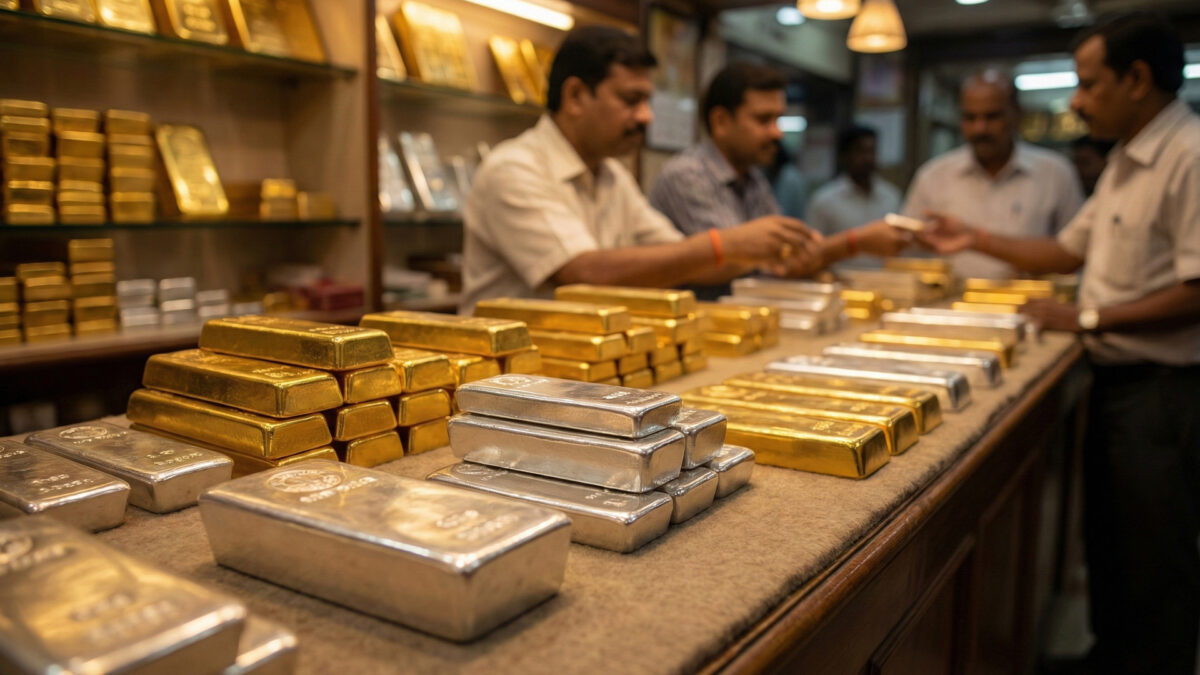
Gold and silver prices remained under pressure on Friday, August 28, wherein on the Multi Commodity Exchange (MCX), gold futures were trading at around ₹1,58,410 per 10 grams, down about 0.75% during the morning session. Silver futures were also lower, trading at approximately ₹2,40,750 per kg, down around 0.43%.

The movement comes as global investors assess the direction of US interest rates, the strength of the dollar and continuing uncertainty around geopolitical tensions. Investors turned cautious ahead of key signals from the US Federal Reserve and continued to monitor geopolitical developments. Domestic bullion prices moved lower in early trade, with both metals facing selling pressure after a strong run in recent sessions.

Gold prices ease after recent gains

Gold has seen considerable volatility through August, with prices climbing sharply earlier in the month before giving up some of those gains.

According to the latest retail market data, the average Indian price for 24-carat gold stood around ₹1,58,334 per 10 grams, while 22-carat gold was around ₹1,44,857 per 10 grams on August 28. Both rates were lower than the previous session.

The latest movement reflects a broader correction in the domestic gold market. Gold had reached significantly higher levels earlier this week, but prices have since softened as traders booked profits and waited for fresh signals from global markets.

The precious metal remains well above its levels seen at the beginning of the month, highlighting the sharp rise in prices despite the recent pullback.

City-wise gold rates on August 28

Retail gold prices vary slightly between cities because of local taxes, transportation costs, demand and dealer margins.

In Delhi, 24-carat gold was priced at around ₹1,58,150 per 10 grams, while 22-carat gold stood at approximately ₹1,44,971.

In Mumbai, the 24-carat rate was around ₹1,58,430 per 10 grams, with 22-carat gold at nearly ₹1,45,228.

Bengaluru recorded a 24-carat gold price of around ₹1,58,340, while 22-carat gold was about ₹1,45,145.

In Kolkata, 24-carat gold was available at around ₹1,58,000 per 10 grams, while 22-carat gold was priced near ₹1,44,834.

Prices were somewhat higher in Chennai, where 24-carat gold was around ₹1,58,670 per 10 grams and 22-carat gold stood at approximately ₹1,45,448.

Silver also retreats from recent highs

Silver has also experienced strong price movements in recent weeks, benefiting from investor demand and expectations surrounding industrial consumption.

However, silver prices softened on Friday. MCX silver was trading near ₹2,40,750 per kg, while retail rates for 999-purity silver varied across major cities.

In Delhi, 999-fine silver was priced at approximately ₹2,39,730 per kg. Mumbai recorded a rate of around ₹2,40,150, while Bengaluru stood at about ₹2,40,510.

Silver was priced higher in Chennai at approximately ₹2,41,020 per kg, while Hyderabad recorded a rate close to ₹2,40,700 per kg.

The decline suggests that investors are also booking profits after silver’s recent rally.

US Fed signals remain crucial

One of the biggest factors influencing gold and silver markets is the outlook for US interest rates.

Investors are closely watching comments from Federal Reserve Chair Kevin Warsh at the Jackson Hole economic symposium. Any indication about the timing or pace of future rate changes could influence the dollar and US Treasury yields, which in turn affect precious metals.

Gold generally benefits when interest rates and bond yields fall because the opportunity cost of holding a non-yielding asset becomes lower. Conversely, expectations of higher rates can put pressure on bullion prices.

Market participants are therefore waiting for clearer guidance before making large fresh bets on gold.

Geopolitical tensions add to market volatility

Geopolitical developments are another important factor keeping precious metals markets unsettled.

Uncertainty surrounding the US-Iran situation and the wider Middle East remains a concern for investors. Questions around the future of the Strait of Hormuz, a critical route for global energy shipments, have added another layer of uncertainty to financial markets.

Iran has reportedly linked any understanding over the Strait to wider developments involving conflicts in the Middle East. At the same time, prospects for an immediate return to diplomacy remain uncertain.

Such developments can encourage investors to seek safe-haven assets such as gold, although the immediate price reaction also depends on movements in the dollar and US bond yields.

Gold remains higher for August

Despite the recent correction, gold has delivered a strong performance over the broader August period.

India’s 24-carat gold rate began the month at around ₹1,41,399 per 10 grams and was near ₹1,58,334 on August 28. The metal also touched a much higher monthly peak earlier in the month.

This means the recent fall should be viewed in the context of a larger upward move rather than as a complete reversal of the precious metal’s broader trend.

What buyers should watch now

For jewellery buyers, the latest fall could offer some relief after the sharp rise in gold prices. However, retail buyers should remember that quoted bullion rates do not necessarily represent the final amount payable at a jewellery store.

Making charges, GST and other applicable costs can increase the final jewellery bill.

Investors, meanwhile, are likely to focus on global interest-rate expectations, the US dollar, bond yields and geopolitical developments before deciding whether the recent correction represents a temporary pause or the beginning of a deeper decline.


Categories
Corporate

Sensex soars 300 points, Nifty holds above 24,100

Indian equity markets staged a strong recovery in early trade on Friday, August 28, after a sharp fall in the previous session. The Sensex jumped more than 300 points, while the Nifty 50 moved above the 24,100 mark as investors returned to select large-cap and information technology stocks. The opening gains offered some relief after Thursday’s heavy selling, although the overall mood remained cautious amid global uncertainties.

The Sensex opened higher and extended its gains during the morning session, while the Nifty also strengthened as buying emerged across several sectors. Information technology stocks were among the biggest contributors to the market’s recovery. Infosys and Eternal were among the notable gainers, rising around 2% each in early trade. The Nifty IT index also outperformed other sectoral indices as investors responded positively to stronger global technology cues.

The recovery, however, was not uniform. SBI Life Insurance and Tata Consultancy Services were among the notable laggards in early trading. The mixed performance of heavyweight stocks indicated that investors were still being selective rather than making broad-based bets across the market.

Among individual stocks, Tejas Networks was one of the prominent movers. The company came into focus after securing a major order from Tata Consultancy Services, triggering strong buying interest. Ather Energy was another stock in focus after Hero MotoCorp increased its stake in the electric two-wheeler maker to 32.8% through an investment of about $184 million. The development provided fresh support to the electric vehicle company’s shares.

Friday’s rebound followed a particularly volatile session on Thursday, when the Sensex and Nifty came under intense selling pressure towards the close. The Sensex ended the previous session sharply lower, while the Nifty slipped below the 24,100 level. The decline came amid heightened volatility surrounding the first monthly derivatives expiry after the introduction of the new Closing Auction Session mechanism.

The unusual price movements during the final minutes of Thursday’s trading session left investors cautious. Friday’s gains therefore represent an attempt by the market to stabilise rather than a clear indication that the recent volatility has ended.

Global cues are also playing an important role in determining the direction of Indian equities. Technology stocks received support from the positive performance of US technology shares, helping domestic IT counters recover. Investors are closely watching developments in the US, particularly signals on interest rates and the outlook for the global economy.

US Federal Reserve policy remains a major factor for emerging markets. Any indication of a more accommodative monetary policy could improve global risk appetite and encourage foreign investors to allocate more money to equities. Conversely, a hawkish policy stance could strengthen the US dollar and keep pressure on emerging-market assets, including Indian stocks.

Crude oil prices are another key factor for the Indian stock market. Oil prices remained below recent highs and were heading towards a weekly decline. Lower crude prices are generally favourable for India because the country relies heavily on imports to meet its energy needs. Cheaper oil can reduce the import bill, ease inflationary pressures and improve corporate cost conditions.

However, geopolitical tensions continue to create uncertainty in the energy market. Developments involving the United States and Iran remain closely watched by investors. Any escalation that affects oil production, transportation or shipping through key routes could send crude prices higher. Such a move could increase India’s import costs and put pressure on inflation and the rupee.

Foreign institutional investor flows remain another concern for domestic equities. Overseas investors have been selling Indian shares amid concerns over valuations, global interest rates and geopolitical risks. Domestic institutional investors have helped absorb some of this selling, providing a degree of stability to the market.

From a technical perspective, the 24,000-24,100 range remains an important support zone for the Nifty 50. Holding above this area could help the index attempt a recovery towards 24,300 and beyond. On the other hand, a sustained break below 24,000 could increase selling pressure and weaken the short-term outlook. The 24,300-24,400 zone is expected to remain an important resistance area.

Traders will be watching whether the index can hold its early gains and build on Friday’s recovery. The strength in IT stocks is a positive signal, but weakness in selected heavyweight shares suggests that investors have not completely regained confidence.

The market is therefore likely to remain sensitive to global developments, crude oil movements, foreign fund flows and US monetary policy expectations. After Thursday’s sharp sell-off, Friday’s early gains have provided some breathing room. However, a sustained recovery will require buying support across a wider range of sectors and stocks.

The direction of the Sensex and Nifty through the rest of the session will indicate whether Friday’s rebound can turn into a meaningful recovery or remain a short-term bounce after a volatile trading session.


Categories
Corporate

Sensex plunges 530 points, Nifty slips below 24100

Indian equity markets came under renewed selling pressure on Thursday, with the Sensex falling more than 500 points and the Nifty 50 slipping below the 24,100 mark. The decline came despite a firm opening and positive cues from global markets, as weakness in heavyweight stocks and expiry-day volatility pulled the benchmarks lower.

The BSE Sensex fell 539.35 points, or 0.70%, to close at 76,933.59, while the NSE Nifty 50 declined 116.90 points, or 0.48%, to settle at 24,090.85. The market began the day on a stronger note, but gains faded as selling intensified through the session.

The Nifty initially moved above 24,200, while the Sensex gained more than 100 points in early trade. Investors took some comfort from easing crude oil prices and gains across several Asian markets. A positive outlook from US chipmaker Nvidia also lifted sentiment around technology and artificial intelligence stocks globally.

However, domestic factors soon took centre stage. Thursday also marked the monthly derivatives expiry, which added to intraday swings. Selling gathered pace in the second half of the session, leaving both benchmarks close to their day’s lower levels.

Among the top gainers, Adani Enterprises emerged as one of the strongest performers on the Nifty, while Kotak Mahindra Bank also advanced around 1.7%. Adani Ports, Bharat Electronics and Cipla were among other notable stocks that finished higher.

Adani Enterprises’ gain provided some support to the benchmark, but it was not enough to offset declines in several large-cap stocks. Kotak Mahindra Bank also stood out among financial stocks as investors picked up select banking counters despite broader weakness in the sector.

On the losing side, Hindalco Industries was among the biggest Nifty laggards. HDFC Bank also remained under pressure, falling around 2.2% and touching its lowest level in nearly two-and-a-half years. Mahindra & Mahindra, HCL Technologies and Shriram Finance were among the other prominent losers.

HDFC Bank’s decline became a major drag on the Sensex and Nifty because of the stock’s heavy index weight. The lender has been facing investor concerns following reports of a proposed US securities class-action lawsuit involving the bank and two senior executives over alleged illegal payments linked to the Maharashtra State Road Development Corporation. HDFC Bank has rejected the allegations and said it would defend itself.

Uncertainty surrounding the future leadership of HDFC Bank has added to the pressure. Investors are also watching developments around CEO Sashidhar Jagdishan, whose current term is scheduled to end in October. The combination of legal concerns and leadership uncertainty has made the bank a closely watched stock in recent sessions.

The weakness was not limited to a few heavyweight companies. Market breadth remained negative, with more than 2,300 stocks ending lower against around 1,700 gainers. The Nifty Midcap and Smallcap indices also closed marginally lower, indicating that cautious sentiment extended beyond the large-cap segment.

Sector-wise, metals, automobiles, oil and gas, FMCG and parts of the financial sector faced selling. Hindalco’s decline weighed on the metal index, while Mahindra & Mahindra contributed to pressure on auto stocks. Technology shares such as HCL Technologies also ended lower.

Pharmaceutical and consumer durable stocks showed relatively better resilience, reflecting some movement towards defensive areas as investors became cautious.

Crude oil prices offered some relief to the domestic market. Brent crude remained around the $87-$88 a barrel range amid expectations that diplomatic efforts involving Iran could ease geopolitical tensions and eventually support the reopening of the Strait of Hormuz. Lower oil prices are generally favourable for India because the country imports a large share of its crude requirements.

Global markets were also largely supportive. Asian equities gained after Nvidia’s upbeat revenue outlook strengthened expectations of continued spending on artificial intelligence and semiconductors. US stock futures also remained positive. However, these cues could not sustain buying interest on Dalal Street.

The Indian rupee, meanwhile, weakened against the US dollar. It closed at ₹95.54 per dollar, compared with ₹95.41 in the previous session.

Foreign institutional investors had bought Indian equities worth ₹502 crore on August 26, while domestic institutional investors were much stronger buyers at ₹6,425 crore. Despite this institutional support, domestic selling pressure dominated Thursday’s session.

The latest decline has left investors watching the 24,000 level on the Nifty closely. A sustained move below that mark could increase selling pressure, while a recovery above 24,200 would be needed to improve near-term sentiment.

Thursday’s session also highlighted how quickly sentiment can change during a derivatives expiry. The market started with optimism but ended firmly in the red, leaving investors cautious about the next move in the Sensex and Nifty 50.


Categories
Beyond

Gold falls to ₹159,400, silver slips to ₹240,200

Gold and silver prices remained volatile on Thursday, August 27, with domestic retail rates showing a sharp decline from the previous day’s levels even as international bullion prices found some support. The movement comes as investors weigh geopolitical uncertainty, changing expectations around US interest rates and the outlook for the dollar ahead of the Jackson Hole central bankers’ gathering.

According to the latest retail bullion data, 24-carat gold was priced at ₹159,400 per 10 grams, while 22-carat gold stood at ₹146,117 per 10 grams. Silver 999 fine was quoted at ₹240,200 per kg. The rates provide a broad benchmark, while the final price paid by consumers can be higher after GST, making charges and other jeweller-specific costs are added.

The decline in retail rates comes after a period of strong gains in precious metals. Gold has been moving sharply in recent sessions as investors react to changing expectations about US monetary policy and continued uncertainty in global markets. Silver has also seen large swings, reflecting both investor demand and expectations for industrial consumption.

In major cities, prices remained above the national retail benchmark in several cases. In Delhi, 24K gold was quoted at around ₹160,250 per 10 grams, while 22K gold stood at ₹146,896. Silver 999 was priced at about ₹242,140 per kg. In Mumbai, 24K gold was around ₹160,530 per 10 grams and 22K gold at ₹147,153, while silver was quoted at ₹242,550 per kg.

Chennai continued to record relatively higher gold and silver prices among the major cities tracked. The 24K gold rate was around ₹160,990 per 10 grams, while 22K gold was ₹147,574. Silver 999 fine was quoted at approximately ₹243,280 per kg. Hyderabad also reported higher rates, with 24K gold at ₹160,780 and silver at ₹242,950 per kg.

The latest price movement highlights an important distinction between retail gold prices and MCX gold rates. While retail rates were lower, gold futures on the Multi Commodity Exchange moved higher in early trading. MCX Gold October futures were trading at around ₹160,751 per 10 grams, up nearly 0.7% during early trade. MCX Silver September contracts also gained about 1.04%, trading near ₹242,124 per kg around 9.05 am.

This divergence reflects the fast-moving nature of bullion markets, where domestic retail prices, futures contracts, international prices, currency movements and local market conditions do not always move in exactly the same direction.

Internationally, gold was consolidating near the $4,600-an-ounce level. The precious metal had slipped 1.4% in the previous session, ending a five-day winning run, before recovering some ground. Silver also strengthened, gaining around 0.6% to $68.54 an ounce.

A key factor for gold prices is the direction of US monetary policy. Investors are closely watching economic data and comments from US Federal Reserve officials for clues about the timing and pace of future rate moves. The annual Jackson Hole gathering is therefore expected to attract considerable attention from bullion traders.

Gold generally benefits when investors expect lower interest rates because falling yields can make non-interest-bearing assets such as bullion more attractive. Conversely, expectations of higher rates can strengthen the dollar and Treasury yields, putting pressure on gold.

The US dollar remained near an eight-day high on Thursday after recent US inflation and economic data slightly increased expectations of a possible Federal Reserve rate hike. A stronger dollar can make gold more expensive for buyers holding other currencies, potentially limiting demand.

Geopolitical developments are another important factor. Continued uncertainty around the Middle East has kept safe-haven demand for gold alive. At the same time, expectations that diplomatic discussions could ease tensions around the Strait of Hormuz have contributed to a decline in crude oil prices. Brent crude fell to around $87.24 a barrel on Thursday, extending its losing streak.

The actual jewellery bill depends on the purity chosen, the prevailing local rate, GST and making charges. 24K gold is the purest commonly quoted form, while 22K gold is preferred for much jewellery because it is harder and more suitable for regular use.

The recent volatility means buyers and investors may want to distinguish between short-term price movements and longer-term trends. Gold continues to attract interest as a hedge against uncertainty, while silver is influenced by both investment demand and its wider industrial applications.

With the Federal Reserve’s policy outlook, the US dollar, geopolitical developments and global economic data all influencing bullion markets, gold and silver prices could remain volatile in the near term. For Indian buyers, Thursday’s softer retail rates may offer some relief, but the wider market remains sensitive to global developments and could move sharply in either direction.


Categories
Corporate

Sensex slips 100 points, Nifty trades below 24,200

Indian equities struggled to hold on to early gains on Thursday as investors turned cautious ahead of the derivatives expiry, with weakness in heavyweight HDFC Bank pulling the benchmark indices lower.

The BSE Sensex opened 103.82 points higher at 77,576.76, while the Nifty 50 started at 24,277.60. The initial optimism, however, faded as selling emerged in large-cap stocks. Around the morning session, the Sensex was down about 0.12% at 77,379.50, while the Nifty slipped 0.06% to 24,191.85.

HDFC Bank was the biggest weight on the benchmarks, with its shares falling around 1%. The stock came under pressure following reports of a US class-action lawsuit involving the bank and two executives. Given its significant weight in both the Sensex and Nifty, the decline had an outsized impact on the overall market.

Among the stocks showing strength, Bharat Electronics was one of the notable gainers, rising around 1% after the defence electronics company announced new orders worth ₹730 crore. Bajaj Finance and several other financial stocks also found buying interest. Technology stocks received some support from the positive global cues, while selected metal and banking shares traded higher.

The broader market was not as weak as the headline indices suggested. Seven of the 16 major sectoral indices were trading higher, while the midcap and smallcap segments remained largely steady. This indicated that investors were still finding opportunities beyond some of the large-cap stocks under pressure.

Tata Power was among the prominent losers in early trading. Its shares fell around 4% after the company lost a $490-million arbitration challenge in Singapore. The development added to pressure on the power stock and made it one of the key names to watch during Thursday’s session.

ICICI Prudential Asset Management Company was another notable decliner, falling around 3.7%. The stock came under pressure after British insurer Prudential Plc announced plans to sell up to a 2% stake in the asset management company. The proposed stake sale raised concerns about additional supply in the market and weighed on investor sentiment towards the stock.

The movement in crude oil prices provided some relief to Indian investors. Brent crude declined around 0.5%, helped by signs of easing tensions in the Middle East. Iran and Oman were involved in negotiations concerning the Strait of Hormuz, while diplomatic efforts by Qatar were also aimed at reducing regional tensions. For India, lower crude prices are generally positive because the country imports a large portion of its oil requirements. A sustained decline could reduce pressure on the import bill, inflation and corporate costs.

Global technology stocks provided another positive signal. Asian technology shares gained after Nvidia reported stronger-than-expected earnings and offered an upbeat sales outlook. The development renewed optimism around artificial intelligence spending and supported technology stocks across global markets. However, the positive global backdrop was not strong enough to overcome domestic selling pressure in key index heavyweights.

Investors were also watching the rupee, foreign institutional investor flows and movements in US bond yields. The broader global interest-rate outlook remains an important factor for emerging markets such as India, particularly as investors assess where US monetary policy could be headed in the coming months.

The expiry of derivatives contracts added another layer of caution. Traders typically expect increased volatility around expiry as positions are adjusted and rolled over. The Nifty had already ended Wednesday’s session at 24,207.75, down 126.80 points or 0.52%, while the Sensex lost 183 points. The weak close had set a cautious tone for Thursday’s trading session.

The Nifty’s struggle to remain above 24,200 therefore remained a key level for traders. A sustained move below this mark could keep sentiment under pressure, while a recovery above the level may encourage selective buying. With the Sensex also finding it difficult to reclaim 77,500, market participants were likely to remain watchful rather than make aggressive bets.

Dalal Street is being pulled in different directions. Falling oil prices and stronger global technology stocks are providing a cushion, but selling in heavyweight banks and select corporate names is limiting the upside. Bharat Electronics, Bajaj Finance and other selected stocks are offering support, while HDFC Bank and Tata Power remain major drags. The market’s direction through the rest of the session will likely depend on expiry-related volatility, global cues, crude prices and institutional activity.