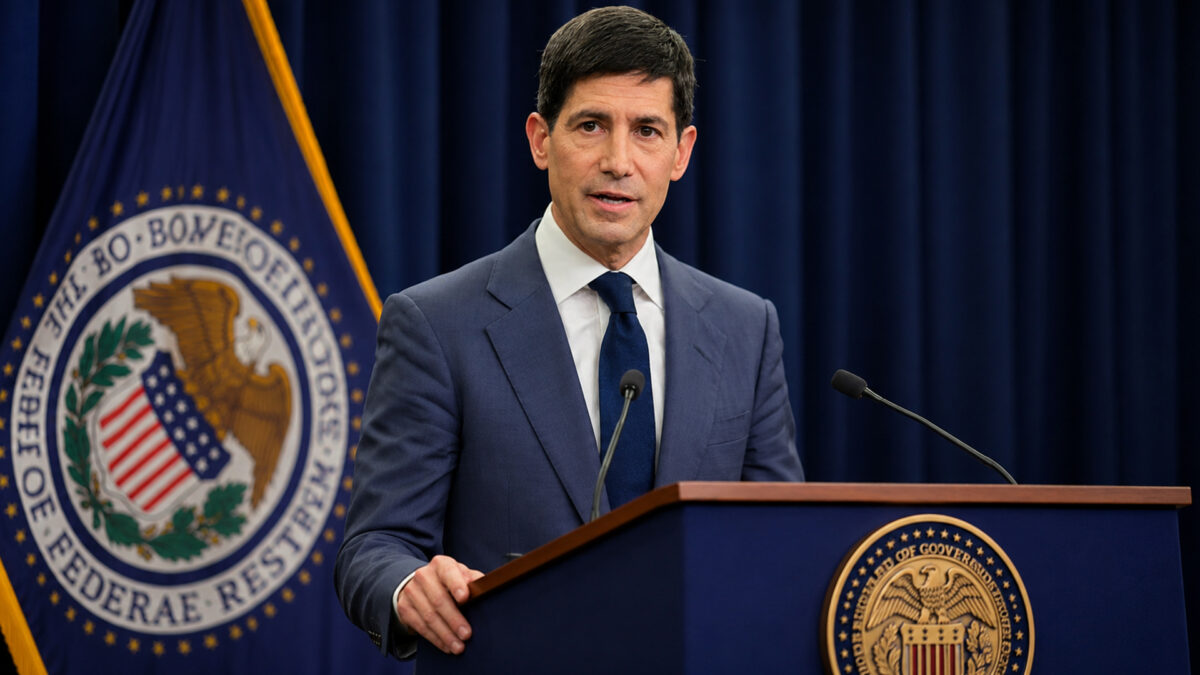
Federal Reserve Chair Kevin Warsh delivered his closely watched Jackson Hole speech on Friday, with investors looking for signals on the future direction of US interest rates as inflation remains above the central bank’s target.
The speech marked Warsh’s first major appearance at the annual economic policy symposium since becoming Fed chair. His remarks came at a crucial point for the US economy, with policymakers divided over whether interest rates need to remain high to control inflation or whether monetary policy should begin becoming less restrictive.
The Federal Reserve has kept its benchmark interest rate in the 3.50%-3.75% range. However, inflation remains well above the Fed’s 2% target, making the next policy decision increasingly difficult.
The latest inflation figures have complicated expectations for monetary easing. The personal consumption expenditures price index, which the Fed closely monitors when setting monetary policy, rose 3.7% in July from a year earlier.
Core PCE inflation, which excludes volatile food and energy prices, also remained elevated at 3.3%.
The numbers indicate that inflation has not yet returned to a level that would allow the Federal Reserve to comfortably declare victory. While price pressures have eased from their earlier peaks, progress towards the 2% target has slowed.
That leaves Warsh facing a difficult choice. Keeping rates high for longer could help bring inflation under control, but it could also place additional pressure on consumers, businesses and economic growth.
The debate has also exposed differences among Federal Reserve policymakers.
Three officials dissented at the July policy meeting, supporting a 25-basis-point increase in the benchmark rate. Their position underlined concerns that current monetary policy may not be restrictive enough to contain inflation.
Other policymakers have taken a more cautious approach, arguing that the Fed needs to assess incoming economic data before deciding whether another rate increase is necessary.
The disagreement has made Warsh’s communication particularly important. Markets are looking for greater clarity on how the new Fed chief weighs inflation against employment and growth when setting interest rates.
The US bond market has become an increasingly important part of the monetary-policy discussion.
Long-term Treasury yields have remained elevated as investors assess inflation risks, government borrowing requirements and the country’s large fiscal deficit. The 30-year Treasury yield has moved around the 5.3% level, adding to concerns about long-term borrowing costs.
Higher Treasury yields can tighten financial conditions even if the Federal Reserve does not raise its benchmark rate.
Mortgage rates, corporate borrowing costs and other forms of credit are influenced by long-term government bond yields. As a result, elevated yields can make borrowing more expensive for households and businesses and potentially slow economic activity.
The Treasury Department has also been taking steps to manage conditions in the long-term government bond market.
Treasury buybacks of longer-maturity securities are intended to improve market liquidity and manage the supply of outstanding debt. The measures have attracted attention because they come as investors demand higher returns for holding long-term US government bonds.
The developments highlight the increasingly complicated relationship between monetary policy, government borrowing and financial markets.
The Federal Reserve sets short-term interest rates, while long-term Treasury yields are determined by a broader combination of inflation expectations, economic growth, government debt supply and investor demand.
Investors entered the Jackson Hole meeting with expectations for the Fed’s next move still uncertain.
Earlier hopes for interest-rate cuts have been challenged by stronger inflation readings. At the same time, concerns about the economic outlook have prevented markets from completely ruling out monetary easing.
Warsh has also taken a different approach to forward guidance. Rather than offering markets a detailed roadmap for future interest-rate decisions, he has emphasised the importance of responding to economic data as it emerges.
That approach gives the Federal Reserve greater flexibility but makes it harder for investors to predict the timing and scale of future rate moves.
His Jackson Hole speech was therefore being closely watched for clues about the broader policy framework that will guide the Fed in the months ahead.
The Fed’s decisions have consequences well beyond the US economy.
Changes in US interest rates can influence the dollar, global bond yields, stock markets and commodity prices. Higher US rates can attract money into dollar-denominated assets while increasing borrowing costs internationally.
Gold prices are also affected by expectations for US monetary policy. When Treasury yields and interest rates rise, gold can become less attractive because the precious metal does not generate interest income. Conversely, expectations of lower rates can support demand for gold.
Warsh’s Jackson Hole appearance comes at an important stage of his tenure. The Federal Reserve is under pressure to restore inflation to its 2% target while avoiding unnecessary damage to economic growth and employment.
The challenge is complicated by high Treasury yields, uncertainty over government borrowing and differing views within the central bank itself.
Markets will now scrutinise upcoming inflation, employment and economic-growth data for evidence of where monetary policy is heading.