
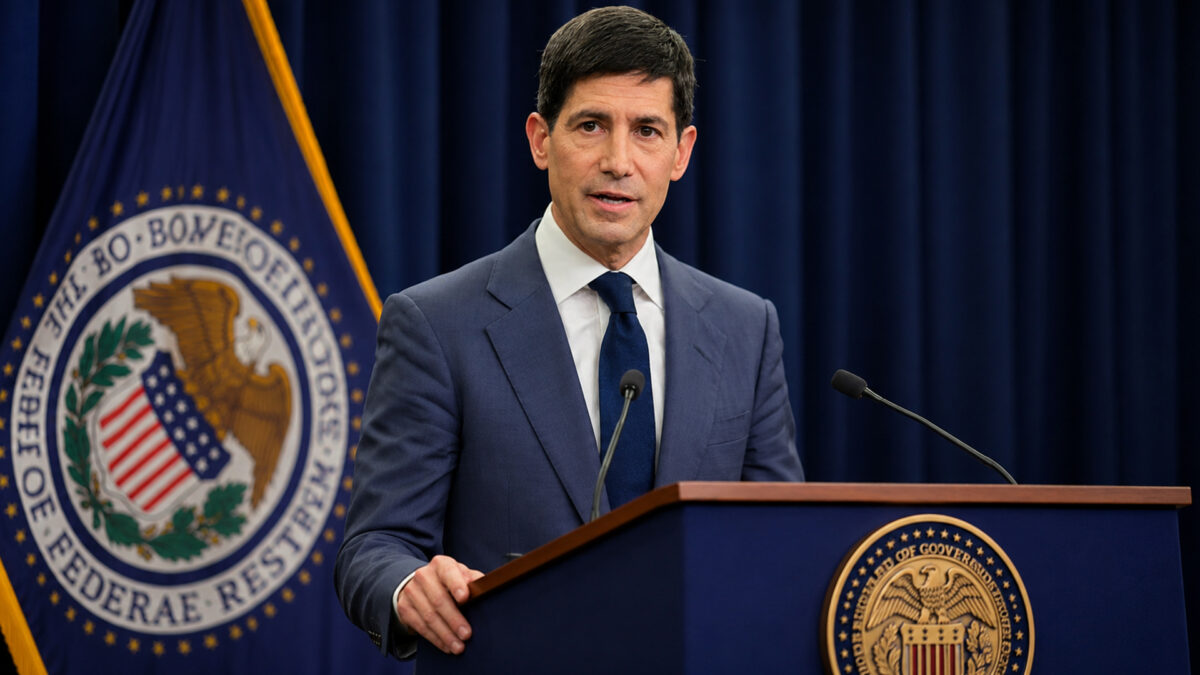
Kevin Warsh is facing an early and unusually difficult test as chairman of the US Federal Reserve, after a sharp split emerged within the central bank over interest rates and the best way to control inflation.
The Federal Open Market Committee (FOMC) kept the federal funds rate unchanged at 3.5% to 3.75% at its July 28-29 meeting. But the decision was far from unanimous. Three officials voted for a 25-basis-point rate increase, leaving the final vote at 9-3. It was the first time since 1993 that three Fed policymakers dissented in favour of a rate hike.
The disagreement puts Warsh, who took over as Fed chair earlier this year, in a challenging position. His immediate task is not simply to decide where interest rates should go, but also to keep policymakers working together while maintaining confidence in the US central bank.
Warsh has repeatedly stressed the importance of price stability and has adopted a more data-driven approach to monetary policy. After the latest meeting, he indicated that the Fed would remain focused on bringing inflation back towards its 2% target. The central bank has kept rates unchanged throughout 2026 so far, as policymakers weigh persistent inflation against the health of the labour market and wider economic risks.
The three dissenters wanted rates to rise immediately, reflecting concern that inflation remains too high. The majority, however, preferred to wait for more evidence before tightening monetary policy.
That difference matters because the US economy is presenting the Fed with competing signals. Economic activity remains relatively solid, while productivity and capital investment have been strong. At the same time, inflation remains above the Federal Reserve’s 2% goal. The central bank has also been monitoring the impact of energy prices, geopolitical tensions and other supply-side pressures.
For households and businesses, the Fed’s decision has wider implications. Higher interest rates can make borrowing more expensive for consumers and companies, while keeping rates higher for longer can weigh on investment and spending. A premature rate cut, on the other hand, could risk allowing inflation to remain stubbornly high.
Financial markets are therefore watching Warsh’s every signal. Investors are trying to determine whether the July decision represents a temporary pause or the beginning of a longer period of tight monetary policy.
The bond market has already reflected some of that uncertainty. Treasury yields have moved higher this year, while investors have been reassessing expectations for the path of US interest rates. The Fed’s own July monetary policy report noted that market expectations had shifted towards higher rates, with investors at the time pricing the federal funds rate at around 4% by the end of 2026.
Warsh’s communication style is also attracting attention. Rather than offering strong forward guidance about future rate moves, he has indicated that the Fed should allow incoming economic data and financial conditions to shape decisions. That approach gives policymakers more flexibility, but it can also leave investors with fewer clear signals about what comes next.
The challenge is particularly important because the Federal Reserve’s credibility depends not only on its decisions but also on its ability to present a coherent policy message. A visibly divided FOMC can make markets more uncertain and complicate the transmission of monetary policy.
The disagreement does not necessarily mean the Fed is in crisis. Policymakers have always held different views about inflation, employment and interest rates. But the size and direction of the July split make it an important moment for Warsh’s leadership.
The chairman will also have to balance competing pressures from outside the Fed. President Donald Trump has previously pushed for lower interest rates, while Warsh has sought to emphasise the central bank’s responsibility for price stability. Maintaining the Fed’s policy independence will therefore remain an important part of his job.
The July meeting also showed how difficult the current economic environment has become. Policymakers must assess inflation without ignoring employment, economic growth, financial markets and geopolitical developments. The Middle East conflict, in particular, has added uncertainty around energy prices and inflation.
The Fed’s internal split could also shape expectations for the dollar, US Treasury yields and global markets. Any signal that policymakers are leaning towards higher rates could strengthen the dollar and push borrowing costs higher worldwide, while a shift towards rate cuts could have the opposite effect. For investors, the focus will now remain on upcoming inflation and jobs data, as well as how Warsh manages differing views within the FOMC.