Categories
Leaders

N Chandrasekaran quits as Tata Sons chairman

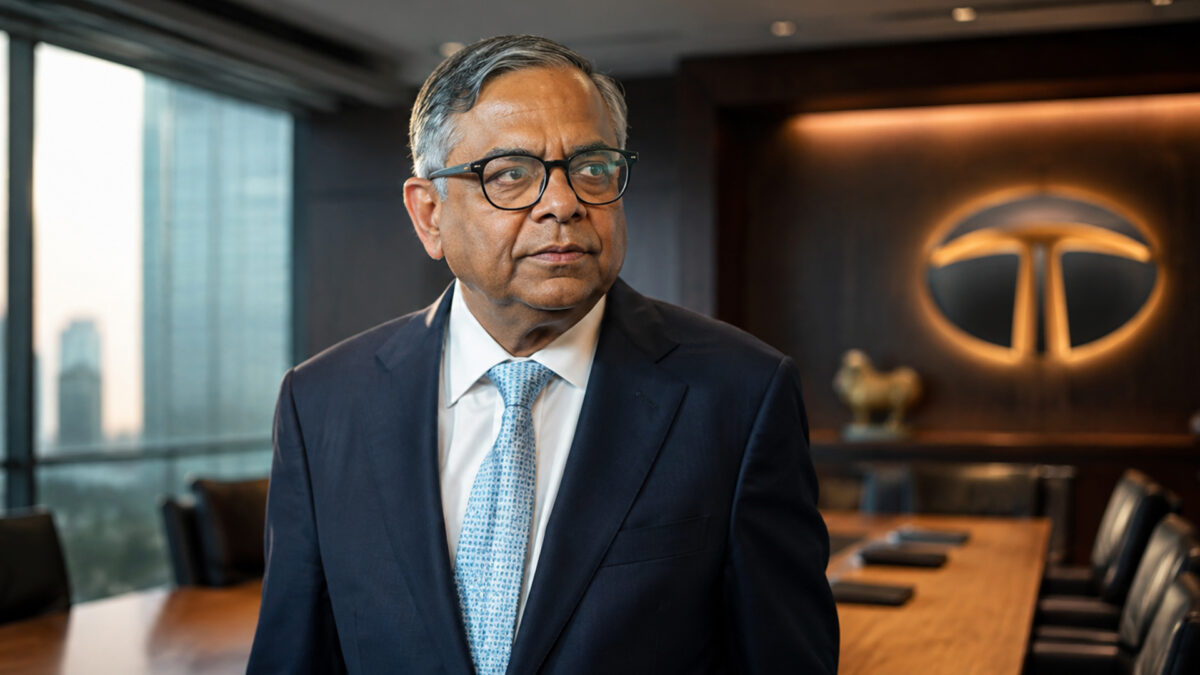
N Chandrasekaran has resigned as chairman of Tata Sons, bringing a significant leadership transition to the Tata Group after nearly a decade at the helm of its holding company. Chandrasekaran, however, will continue in the position until the end of his current term on February 20, 2027, according to people familiar with the development and his statement.

The decision comes just days before the Tata Sons annual general meeting scheduled for August 18. The meeting had been expected to consider the reappointment of Chandrasekaran as a director, a key requirement for him to continue as chairman. His decision not to seek another term effectively removes that uncertainty and sets the stage for a leadership succession process at one of India’s most influential business groups.

In his communication to the Tata Sons board, Chandrasekaran said he would not offer himself for reappointment after his existing tenure ends. He also asked the board to begin the process of identifying his successor. The announcement marks the beginning of a transition rather than an immediate departure, allowing him to remain involved in the group’s affairs for several months.

The development follows weeks of uncertainty around Chandrasekaran’s position and the Tata Sons board. Earlier reports had said he was considering stepping down ahead of the August 18 AGM amid questions surrounding his reappointment and tensions within the Tata Trusts structure. Those reports had raised the possibility of an unexpected change at the top of the Tata Group.

Chandrasekaran’s exit is important because Tata Sons sits at the centre of the group’s sprawling business interests, with significant holdings and influence across information technology, automobiles, steel, power, consumer products, hotels, aviation and financial services. The chairman also plays a central role in determining the group’s long-term investment priorities and capital allocation.

His tenure has been marked by an aggressive expansion strategy. Under Chandrasekaran, the Tata Group pushed deeper into aviation following the acquisition and consolidation of Air India, while also increasing investments in semiconductors, electronics manufacturing, batteries, artificial intelligence and other emerging businesses.

The group has simultaneously worked to strengthen its position in traditional businesses while building new growth platforms. Tata Electronics has emerged as a major focus of the group’s semiconductor and electronics ambitions, while Tata Digital has been developed as a consumer technology platform. The group’s investments in battery manufacturing and defence-related capabilities have also formed part of its longer-term strategy.

Air India has been one of the most visible projects during Chandrasekaran’s tenure. The Tata Group has been attempting to rebuild the airline following its return to private ownership, with investments in aircraft, technology, operations and customer experience. Chandrasekaran recently described the transformation of Air India as a five-to-10-year effort, highlighting the scale of the challenge facing the group.

The leadership change comes even as Tata Sons remains financially strong. The company’s annual report for FY26 showed revenue rising 9.1% to Rs 42,367 crore, while profit after tax increased 21.8% to Rs 31,961 crore. The improvement was supported by investment gains and earnings from its portfolio of businesses.

At the broader Tata Group level, the business has continued to expand despite challenges in several large investments. The group reported aggregate FY26 revenue of about Rs 16.24 lakh crore, while profit after tax rose sharply during the year.

The financial performance, however, has existed alongside pressure in some of the group’s newer businesses. Air India recorded substantial losses, while Tata Digital, Tata Electronics and battery-related ventures have also required significant investment. Chandrasekaran has defended these businesses as long-term strategic bets rather than investments expected to generate immediate returns.

Markets reacted quickly to the news. Shares of several Tata Group companies came under pressure after the resignation announcement, with Tata Consultancy Services among the most closely watched stocks. TCS shares were reported to be down more than 3% during Wednesday’s trading session, while other Tata companies also declined. The market reaction reflected investor uncertainty surrounding the group’s future leadership and succession process.

Chandrasekaran joined the Tata Group nearly four decades ago and rose through its ranks before becoming chief executive of Tata Consultancy Services in 2009. He became chairman of Tata Sons in 2017, succeeding Ratan Tata in the role. His tenure has therefore covered a major period of transformation for the conglomerate, including the expansion of its global technology, automotive and aviation interests.

The immediate focus will now shift to succession planning, putting Tata Sons among the major Indian businesses undergoing senior leadership and succession changes. The board will have to identify a leader capable of managing both the group’s established businesses and its ambitious new investments. The next chairman will inherit a conglomerate with a strong financial base, but also major projects requiring sustained capital, execution and strategic patience.

For the Tata Group, the transition is therefore more than a change at the top. It will determine how the conglomerate balances its traditional businesses with its newer bets in technology, aviation, semiconductors, batteries and digital services. With Chandrasekaran remaining until February 2027, the group has several months to prepare for a carefully managed leadership handover.
Categories
Beyond

RBI keeps Tata Sons in upper layer

The Reserve Bank of India (RBI) has retained Tata Sons in the Upper Layer of non-banking financial companies (NBFCs) for 2026-27, keeping the long-running question over a possible stock-market listing of the Tata Group holding company alive.

The RBI’s latest classification brings Tata Sons under enhanced regulatory oversight at a time when the company is seeking to surrender its Core Investment Company (CIC) registration. The central bank has made it clear that Tata Sons’ inclusion in the upper layer does not prejudice its pending application for deregistration.

For Tata Sons, the development is significant because an NBFC-Upper Layer (NBFC-UL) classification generally carries a mandatory listing requirement. The company was first placed in the upper layer in 2022, and under the earlier framework it was expected to list within three years.

However, Tata Sons has been trying to avoid that outcome. It applied to the RBI in March 2024 to surrender its CIC registration and had repaid its debt as part of its efforts to move away from the regulatory conditions that could trigger a public listing. That application is still being examined.

The RBI changed the way upper-layer NBFCs are identified in June 2026. Under the revised scale-based regulation framework, an asset threshold of ₹1 lakh crore is now central to determining whether an NBFC falls into the upper layer.

Tata Sons is comfortably above that threshold. Its total assets stood at around ₹2.01 lakh crore as of March 31, 2026, making its inclusion under the revised framework difficult to avoid.

The new approach is more straightforward than the earlier system, which relied on a combination of size, interconnectedness, complexity and other risk parameters. The RBI’s latest framework puts greater emphasis on the scale of an NBFC, bringing several large public-sector financial institutions into the upper layer as well.

The RBI has expanded the FY27 upper-layer NBFC universe with the addition of major infrastructure financiers, including REC, Power Finance Corporation (PFC), Indian Railway Finance Corporation (IRFC) and HUDCO. The move reflects the central bank’s broader effort to bring large financial institutions under stronger regulatory supervision.

The immediate question is whether Tata Sons will ultimately have to list its shares on Indian stock exchanges.

The RBI has not given a fresh public deadline for a Tata Sons listing while its deregistration application remains under consideration. Reuters reported that the central bank is unlikely to insist on an immediate listing while the application is pending, although the regulatory position remains unresolved.

This leaves Tata Sons in an unusual position. It remains classified as an upper-layer NBFC, but at the same time its request to surrender its CIC licence is still before the RBI.

The uncertainty matters because a public listing would fundamentally change the ownership and governance dynamics of one of India’s most influential business groups.

Tata Trusts control about 66% of Tata Sons, through the Sir Ratan Tata Trust and Sir Dorabji Tata Trust. The Shapoorji Pallonji Group holds a significant minority stake and has been seeking ways to unlock value from its holding. A Tata Sons listing could potentially provide a market-based valuation and create a clearer exit route for the minority shareholder.

At the same time, a listing would bring greater public disclosure, shareholder scrutiny and market accountability to the holding company.

The RBI’s revised framework also makes the classification more consequential. Once an NBFC enters the upper layer, it remains subject to enhanced regulations for at least five years, even if it later falls below the eligibility threshold.

This means the latest classification cannot simply be viewed as a temporary consequence of Tata Sons’ asset size. The company would face a substantially tighter regulatory framework if it continues in the upper layer.

The broader objective is to strengthen governance, risk management and financial stability among India’s largest NBFCs. Upper-layer entities face stricter requirements because their size and interconnectedness could create wider risks for the financial system.

For Tata Sons and Tata Trusts, the RBI decision therefore leaves several possibilities open. The company can continue pursuing deregistration as a CIC, while preparing for the possibility that it may have to comply with the listing requirement.

The situation has also renewed attention on the internal debate around a potential Tata Sons IPO. Tata Trusts had resolved in July 2025 that Tata Sons should remain privately held, while some trustees have subsequently expressed support for a listing.

For the Shapoorji Pallonji Group, the issue has an added financial dimension because its Tata Sons stake has been used as collateral for borrowings. A public market valuation could potentially improve liquidity and provide greater flexibility around its investment.

For investors, the RBI’s decision is therefore more than another regulatory classification. It keeps the possibility of one of India’s biggest and most closely watched corporate listings firmly on the radar.

For now, however, Tata Sons remains private. The next major trigger will be the RBI’s decision on its deregistration application. Until that happens, the Tata Sons listing debate is likely to remain unresolved, with regulation, ownership, governance and value unlocking all pulling the company in different directions.

Categories
1 Minute-Read

Tata Sons puts off Chandrasekaran reappointment call

Tata Sons has postponed a decision on the reappointment of its chairman N. Chandrasekaran after he requested the board to take up the matter at a later stage. His present tenure is valid until 2027, and there is no immediate requirement to decide on an extension.

The move is being viewed as a step to follow a proper evaluation process at the appropriate time. Chandrasekaran, who has led the group since 2017, has overseen key restructuring, expansion across businesses and significant reduction in debt.

The board is expected to review the issue closer to the end of his current term.

Categories
Leaders

Tata Sons move to renew Chairman’s term

Tata Sons is preparing to extend the tenure of its chairman N. Chandrasekaran for a third term, with the board expected to clear the proposal at its forthcoming meeting. The decision will subsequently be placed before shareholders at an extraordinary general meeting (EGM), in line with the group’s governance process.

Chandrasekaran’s current term runs until February 2027, but the early move to reappoint him signals the Tata Group’s intent to maintain leadership stability at a time when it is executing some of its most ambitious and capital-intensive projects. The Tata Trusts, the principal shareholders of Tata Sons, have already backed his continuation, indicating strong internal consensus.

Since taking over in 2017, Chandrasekaran has overseen a period of significant transformation. Under his leadership, the group has streamlined its structure, strengthened its balance sheet and pushed into new-age sectors such as semiconductors, electronics manufacturing, electric mobility and digital platforms. The high-profile acquisition and ongoing turnaround of Air India has been one of the defining developments of his tenure.

The proposed extension is also notable because it would go beyond the group’s conventional retirement age for executive roles, reflecting the importance placed on continuity as several long-gestation investments move from planning to execution.

The upcoming board meeting is expected to review broader business strategies across key companies. Tata Consultancy Services will present its roadmap in artificial intelligence and emerging technologies, while updates from Air India and Tata Electronics are also likely to be discussed as the conglomerate accelerates its global expansion and manufacturing push.

Chandrasekaran, who previously served as CEO and managing director of TCS, became the first non–Tata family professional to lead the holding company. His reappointment is being seen by industry watchers as a vote of confidence in his leadership and a signal that the group wants a steady hand to guide it through a complex investment cycle and an evolving global business environment.

Also Read: Ola Electric shares jump 5% after HC relief to CEO