Categories
Leaders

External Affairs minister meets Qatar leaders

India’s External Affairs Minister S. Jaishankar visited Doha, Qatar, on 16 November 2025 and met the country’s top leaders. He held talks with Qatar’s Prime Minister and Foreign Minister, Sheikh Mohammed bin Abdulrahman bin Jassim Al Thani, and also called on Qatar’s Emir, Sheikh Tamim bin Hamad Al Thani.

The discussions focused on strengthening India–Qatar relations, particularly in trade, energy, investment, and people-to-people ties. Both sides also exchanged views on regional and global developments, including issues in the Middle East.

Jaishankar appreciated Qatar’s guidance and expressed India’s interest in exploring new areas of cooperation. Bilateral trade between the two countries reached US$ 14 billion in 2023–24.

Also Read: Tata Motors PV shares fall 7% despite profit surge

Categories
Beyond

India’s data privacy law takes effect

India’s long-awaited data privacy law, the Digital Personal Data Protection Act, 2023 (DPDP), has finally come into force. The government notified the Rules on 14 November 2025, more than two years after the Act was passed. This move gives citizens greater control over their personal digital data.

Under the law, companies and organisations that handle personal data must follow rules on consent, transparency, and data security. The implementation will happen in phases to allow businesses time to adjust.

A key feature is the creation of a four-member Data Protection Board of India. This board will oversee compliance, handle complaints, and resolve issues related to personal data.

Phased deadlines for companies: Within 12 months, businesses must appoint consent managers and start obtaining clear permission from users before collecting personal data. Within 18 months, they must set up systems for consent notices, reporting data breaches, and appointing data protection officers.

The law also provides extra protection for minors. Platforms must get verifiable parental consent before processing data of children under 18. Targeted advertising or tracking children’s online activity is restricted.

For cross-border data, personal information can be stored outside India under certain safeguards. Transfers may be restricted to some countries, and stricter rules will apply to companies handling large amounts of sensitive data, called “significant data fiduciaries.”

For citizens, the law allows them to access, correct, update, or erase their personal data. Companies must clearly explain how the data is collected and used.

For businesses, compliance will require updating policies, training staff, and setting up governance systems. While phased deadlines give clarity, some experts have raised concerns over broad exemptions granted to government agencies.

The notification of the Rules finally puts India on track with global digital privacy standards.

Also Read: India, Canada partner on critical minerals, green energy

Categories
Leaders

India, Canada partner on critical minerals, green energy

India and Canada are working to deepen their economic partnership, focusing on critical minerals, clean energy, and aerospace trade. The 7th Ministerial Dialogue on Trade and Investment in New Delhi brought together India’s Piyush Goyal and Canada’s Maninder Sidhu to discuss stronger cooperation.

Bilateral trade reached US$23.66 billion in 2024, with goods trade up 10% from last year. Both countries also plan to expand investments, creating jobs in each nation.

The ministers agreed to develop long-term supply chains for critical minerals, boost green energy projects, and collaborate in aerospace technologies. They also emphasized resilient supply chains in agriculture and stronger people-to-people ties.

Further discussions with business leaders are planned next year to keep the momentum going.

Also Read: Maruti recalls nearly 40,000 Grand Vitaras for fix

Categories
Corporate

India’s inflation plunges to 0.3% in October

India’s retail inflation fell to a record low of 0.3% in October, offering welcome relief to households. Reuters reports a similar figure of 0.25%, marking one of the slowest rates of price rise in recent years.

The drop is largely due to falling food prices. Overall food inflation fell around 5%, with vegetables down over 27%. Onion prices plunged 54%, tomatoes 43%, and potatoes 37%. Cuts in the GST on everyday items also helped keep prices in check.

Core inflation, which excludes volatile food and fuel costs, eased slightly to 4.4%, while September’s inflation was revised to 1.44%.

Economists say the subdued inflation gives the Reserve Bank of India space to consider cutting interest rates in December. However, they caution that lower prices alone do not guarantee stronger growth, with upcoming GDP data expected to show the real state of the economy.

For consumers, this means some relief in their daily expenses, while policymakers now have room to support economic growth.

Also Read: Jaishankar meets Rubio at G7, India-US ties strengthen

Categories
Beyond

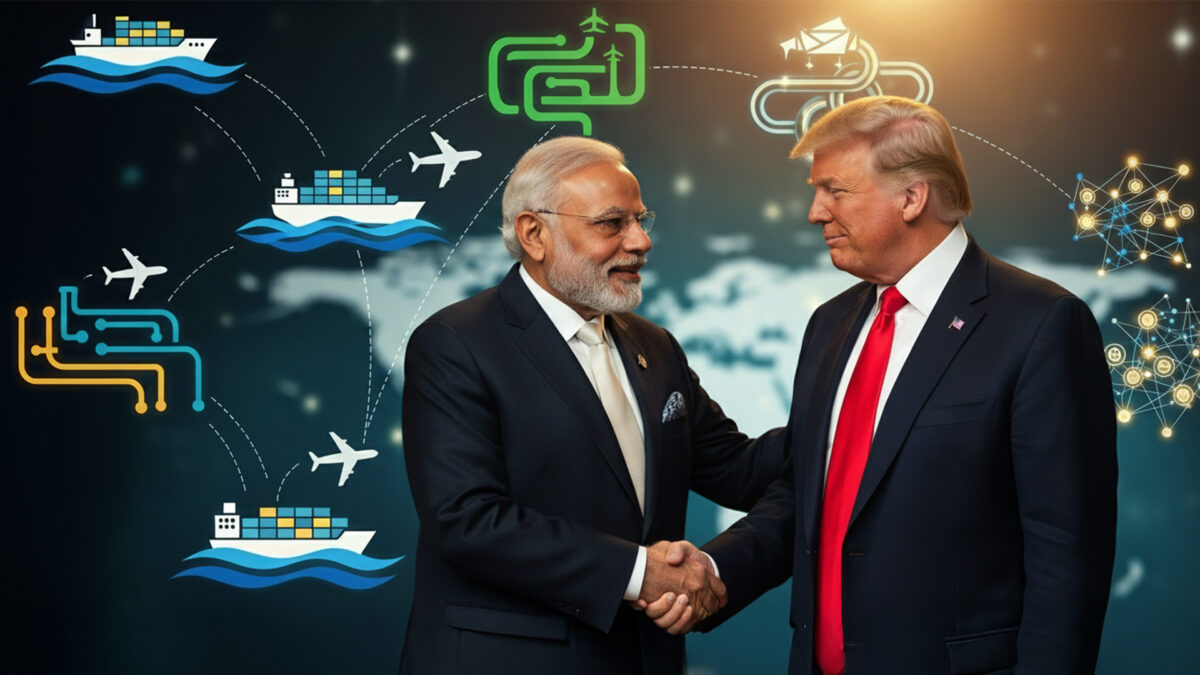
US, India ‘pretty near’ trade deal, tariffs could ease

US President Donald Trump said the United States and India are “pretty close” to finalising a trade deal that would benefit both countries. He made the remarks at the swearing-in of Sergio Gor as the US Ambassador to India, highlighting Gor’s strong ties with Prime Minister Narendra Modi.

Trump noted that US tariffs on Indian goods are currently high, mainly due to India’s earlier purchases of Russian oil. With those purchases now reduced, he indicated tariffs could be lowered in the future.

India’s Commerce Minister Piyush Goyal said trade talks are progressing well but cautioned that several sensitive issues still need resolution.

The proposed agreement aims to more than double bilateral trade, from around $191 billion currently to $500 billion by 2030. Analysts say a deal could improve market access for goods on both sides, though details on tariff cuts and timelines are yet to be finalised.

Also Read: Goldman Sachs turns bullish on India

Categories
Leaders

India Nears Top Three Globally, FM Sitharaman

India is steadily advancing toward becoming the third-largest economy in the world, Finance Minister Nirmala Sitharaman said, underlining the country’s impressive economic progress over the past decade.

Speaking at the Delhi School of Economics, she noted that India was the tenth-largest economy in 2014. Today, it ranks fifth globally, and with sustained growth, it is poised to move even higher, edging closer to joining the top three alongside the United States and China.

Sitharaman stressed that India’s growth is not just about numbers. An estimated 25 million people have been lifted out of multi-dimensional poverty in recent years, highlighting the social impact of economic development. Government reforms, infrastructure investments, and policies aimed at inclusive growth have all contributed to these achievements, she added.

The Finance Minister also pointed to significant improvements in India’s financial sector. Public sector banks are stronger today, with the long-standing twin balance sheet problem, which had strained both banks and corporate borrowers, largely resolved. This healthier banking environment is expected to boost investment, stimulate job creation, and support further economic expansion.

On fiscal management, Sitharaman noted that the government is on track to meet its fiscal deficit target of 4.4% of GDP (₹15.69 lakh crore) for FY 2025‑26, reflecting a commitment to balancing growth with fiscal responsibility. Analysts say that maintaining fiscal discipline while encouraging investment and consumption is critical to sustaining the momentum toward becoming a top-three economy.

India’s rise in global economic rankings carries broader implications. Achieving third-largest status would enhance the country’s international influence, increase foreign investment, and create more resources for sectors such as healthcare, education, and infrastructure.

Yet challenges remain: continued reforms, improved productivity, job creation, and careful navigation of global uncertainties, including inflation, commodity price volatility, and geopolitical risks, will be essential to secure this trajectory.

Sitharaman’s remarks underline that India’s growth strategy aims to combine economic scale with social progress, ensuring that prosperity reaches citizens across the country while strengthening the nation’s global standing.

Also Read: China lifts 24% US tariff, keeps 10%