Categories
Uncategorized

Airtel posts ₹8,167 cr Q1 profit, up 37%

Bharti Airtel has started the financial year on a strong note, with the telecom major reporting a 37.3% year-on-year jump in consolidated net profit to ₹8,167 crore for the April-June quarter of FY27. The performance was driven by higher-paying customers, stronger revenue, rising average revenue per user (ARPU) and continued growth across its India business.

The company’s consolidated revenue from operations rose 18.4% year-on-year to ₹58,539 crore in the first quarter. Revenue was also up 5.7% from ₹55,383 crore in the previous quarter, while net profit increased 11.5% sequentially from ₹7,325 crore.

The results underline a significant shift in Airtel’s strategy: instead of chasing subscriber numbers alone, the company is increasingly focusing on customers who generate higher revenue. This premiumisation of its subscriber base has helped Airtel improve its financial performance even in a highly competitive Indian telecom market.

A key indicator of this trend was Airtel’s ARPU, or average revenue per user. ARPU increased to ₹264 in Q1 FY27 from ₹250 in the same quarter last year and ₹257 in the previous quarter. The figure remains considerably higher than Reliance Jio’s reported ARPU of around ₹215.6.

For a telecom company, ARPU is closely watched because it shows how much revenue is being generated from each customer. Airtel’s continued improvement suggests that users are moving towards higher-value plans and services.

The strongest growth came from the postpaid segment. Airtel added a record one million postpaid customers during the quarter, taking its total postpaid subscriber base beyond 30 million. The company also added five million smartphone customers during the quarter.

Bharti Airtel Executive Vice-Chairman Gopal Vittal said the company’s postpaid strategy continued to produce strong results, with the latest quarter recording its highest-ever postpaid additions.

The company’s India business remained the main engine of growth. Revenue from India operations increased 9.7% year-on-year to ₹41,214 crore, compared with ₹37,584 crore a year earlier. The growth came from the continued premiumisation of its mobile customer base as well as momentum in its homes and enterprise businesses.

Mobile services generated ₹29,928 crore, accounting for about 73% of Airtel’s total revenue. India business net income rose to ₹7,261.5 crore from ₹5,292 crore in Q1 FY26.

Airtel’s subscriber base in India crossed 491.8 million by the end of June, up 12.8% from a year earlier. The company, however, remains behind market leader Reliance Jio, which had around 533.3 million subscribers.

The quality of Airtel’s customer base is also changing. Its smartphone data customer base increased by 21.1 million over the past year to 301.8 million. These customers now account for around 80% of Airtel’s India subscriber base.

Data usage is rising rapidly as well. Average data consumption per Airtel customer increased 27.7% year-on-year to 34.4 GB during the June quarter, compared with 26.9 GB a year earlier. The increase reflects growing dependence on mobile internet for video, social media, digital payments, work and other everyday services.

The improvement was not limited to revenue. Airtel’s consolidated earnings before interest, tax, depreciation and amortisation, or EBITDA, rose 19% year-on-year to ₹33,599 crore. Its consolidated EBITDA margin stood at 57.4%, while the India business delivered an EBITDA margin of 60.1%.

Airtel also made progress in reducing its debt burden. Net debt declined 35% to ₹81,852 crore in Q1 FY27 from ₹1.25 trillion a year earlier. Lower debt gives the company greater financial flexibility as it continues investing in network infrastructure, 5G and digital services.

The company spent around ₹13,386 crore on capital expenditure during the quarter, including ₹9,698 crore for its India operations. Such investments remain important as data consumption grows and telecom companies expand their 5G networks and capacity.

Airtel also increased its stake in Airtel Africa to more than 79% following a share-swap transaction. The move reflects the company’s confidence in Africa’s long-term growth prospects and adds another important component to its international operations.

However, the quarterly numbers were not entirely free of complications. Airtel recorded an exceptional charge of ₹353.4 crore related to a proposed settlement of a commercial dispute involving one of its subsidiaries. This was partly offset by a ₹389.8 crore benefit following a favourable order connected with business losses from earlier years.

Airtel’s latest earnings also come as competition in India’s telecom sector remains intense. With Reliance Jio continuing to lead in subscriber numbers, Airtel’s strategy is increasingly centred on improving customer value rather than simply expanding its user base.

The company’s focus on premium customers, postpaid growth, smartphone adoption and rising data consumption is helping it build a stronger revenue base. At the same time, investments in 5G, broadband, enterprise services and digital platforms could provide additional avenues for growth.


Categories
Corporate

Paytm delivers record EBITDA, profit climbs 79%

One97 Communications, the parent company of Paytm, has reported a strong start to FY27, posting a sharp rise in quarterly profit as its payments and financial services businesses continued to expand. The latest results reflect the fintech company’s growing operational strength and improving profitability in India’s rapidly evolving digital payments market.

For the quarter ended June 2026, Paytm reported a consolidated net profit of ₹185 crore, a 79 per cent increase from ₹103 crore recorded in the corresponding quarter last year. The company also posted revenue from operations of ₹2,060 crore, up 28 per cent year-on-year from ₹1,614 crore, driven by strong growth across its core businesses.

Paytm also achieved its highest-ever adjusted EBITDA, underlining its focus on sustainable and profitable growth. The company attributed the strong performance to higher merchant subscriptions, expanding financial services and improved operating efficiency.

The payments business remained the biggest contributor to growth during the quarter. Merchant payment devices, QR code services and subscription revenues continued to grow steadily, strengthening Paytm’s presence among millions of small businesses and retailers across India. The company said its expanding merchant ecosystem is helping generate recurring income while creating opportunities to offer additional financial products.

Another key growth engine was financial services distribution, including loans, insurance and wealth management products offered through partner financial institutions. Over the past few years, Paytm has steadily diversified its business beyond digital payments, positioning itself as a broader financial technology platform.

The company said the strategy of integrating payments, commerce and financial services is delivering positive results. Growth in higher-margin businesses, along with disciplined cost management, helped improve profitability despite continued investments in technology and customer acquisition.

Market analysts described the quarterly performance as another important milestone in Paytm’s turnaround journey. After facing regulatory challenges and restructuring its operations over the past year, the company has focused on strengthening compliance, improving efficiency and building more diversified revenue streams.

Brokerages responded positively to the earnings announcement, with several maintaining optimistic outlooks on the stock. Analysts highlighted the combination of strong revenue growth, expanding margins and improving earnings visibility as key reasons for their confidence. Many believe Paytm is entering a more stable growth phase backed by stronger business fundamentals.

The results also reflect the continued expansion of India’s digital payments ecosystem. Growing smartphone penetration, wider internet access and increasing adoption of Unified Payments Interface (UPI) transactions have accelerated the country’s shift towards cashless payments. As one of India’s leading fintech platforms, Paytm continues to benefit from these long-term structural trends.

Industry experts say the company’s merchant business remains one of its biggest strengths. Millions of merchants now rely on Paytm’s payment devices, QR codes and software solutions to manage daily transactions. These relationships also enable the company to cross-sell services such as credit, insurance and financial products, increasing customer engagement and revenue opportunities.

Despite the encouraging performance, analysts caution that competition in the fintech sector remains intense. Banks, payment companies and emerging fintech startups continue to invest aggressively in digital financial services. In addition, regulatory developments and evolving customer expectations will remain important factors shaping the industry.

Even so, Paytm’s latest results suggest the company is successfully balancing growth with profitability. Higher revenues, stronger operating margins and disciplined spending indicate that the business is becoming more resilient while continuing to invest in future opportunities.

As India’s digital economy continues to expand, Paytm appears well positioned to benefit from rising demand for digital payments, merchant solutions, financial services and fintech innovation. Its latest quarterly performance not only reflects stronger financial numbers but also signals increasing maturity in one of India’s leading digital financial platforms.

Also Read: Millions of WordPress sites under fresh cyber threat

Categories
Corporate

JioStar’s Q1 revenue climbs 14%

JioStar has reported a strong start to the financial year, posting ₹10,946 crore in revenue for the first quarter as the Indian Premier League (IPL) continued to fuel growth across its television and digital businesses. The media and entertainment company also recorded a sharp rise in operating profit, reflecting the success of its sports broadcasting strategy and expanding digital audience.

According to the company’s latest financial results, Q1 revenue grew 14% year-on-year, supported largely by advertising and subscription income generated during the IPL season. The tournament once again proved to be one of India’s biggest media events, attracting millions of viewers across television and streaming platforms.

JioStar’s operating EBITDA surged 307% year-on-year, highlighting improved operational efficiency and stronger monetisation of premium content. The company attributed the sharp jump in profitability to higher advertising revenue, increased subscriber engagement and disciplined cost management.

The quarter marked the first full reporting period after the formation of JioStar, created through the merger of Reliance Industries-backed Viacom18 and Disney Star’s India business. The integration has brought together some of India’s biggest television channels, digital streaming services and sports broadcasting rights under a single media network.

A major contributor to the company’s performance was its exclusive coverage of the IPL, one of the world’s most valuable cricket tournaments. The league continued to attract record viewership, helping JioStar strengthen its position across both linear television and digital streaming.

Advertising remained a key growth driver during the quarter. Brands across sectors, including consumer goods, automobiles, financial services and technology, increased spending to reach the IPL’s massive audience. The cricket tournament traditionally attracts some of the highest advertising rates in Indian media, making it a crucial revenue generator for broadcasters.

Subscription revenue also improved as viewers increasingly consumed premium sports and entertainment content through JioStar’s digital platforms. The company has been focusing on expanding its streaming ecosystem by offering live sports, movies, television shows and original programming to a growing base of users.

The results underline the importance of live sports broadcasting in India’s media landscape. Cricket, especially the IPL, continues to be one of the strongest drivers of television ratings, digital engagement and advertising revenue. As more consumers shift towards connected devices and mobile streaming, companies with premium sports rights are expected to benefit significantly.

The company’s financial performance also reflects broader trends in India’s rapidly evolving media industry. While traditional television remains an important platform, digital streaming is witnessing faster growth as audiences increasingly watch content on smartphones, tablets and smart TVs.

JioStar’s integrated approach allows advertisers to reach audiences across multiple platforms through a single network. This cross-platform strategy has become increasingly valuable as brands seek unified campaigns that combine television, digital video and live streaming.

The merger has also strengthened JioStar’s content portfolio, giving it access to a wide range of entertainment channels, regional programming, international content and major sporting events. This diversified offering is expected to help the company attract more subscribers while maintaining strong advertising demand throughout the year.

Media experts say the strong quarterly results demonstrate the commercial value of premium sports rights in India’s highly competitive entertainment market. With cricket remaining central to viewer engagement, broadcasters continue investing heavily in acquiring long-term media rights for marquee tournaments.

Looking ahead, JioStar is expected to focus on further integrating its operations, expanding digital offerings and increasing monetisation opportunities through advertising, subscriptions and premium content. Upcoming sporting events and festive-season programming are also likely to support audience growth in the coming quarters.

The company believes its combined television and digital ecosystem places it in a strong position to capitalise on changing consumer viewing habits. As audiences increasingly prefer watching content across multiple screens, JioStar aims to deliver a seamless entertainment experience while strengthening its leadership in India’s media and streaming market.

The robust first-quarter performance highlights how premium sports content continues to reshape India’s entertainment business. With IPL media rights, digital streaming, sports broadcasting and advertising revenue driving growth, JioStar has begun the financial year on a strong note. The results also signal growing confidence in India’s media sector, where live sports remain one of the biggest engines of audience engagement and business growth.

Also Read: Apple regains world’s most valuable company title

Categories
Corporate

Suzlon Energy Q4 revenue jumps 45%, profit slips 6%

Suzlon Energy reported a 6% decline in net profit for the fourth quarter even as the company posted strong revenue growth and record deliveries during the period.

The company reported a net profit of ₹1,114 crore for the January–March quarter, lower than the same period last year. However, revenue rose sharply by 45%, driven by strong business performance and higher turbine deliveries.

Suzlon said it recorded its highest-ever deliveries during the quarter, reflecting growing demand in the renewable energy sector. The company also reported a 39% rise in EBITDA, indicating stronger operational performance despite the decline in profit.

The mixed financial results drew investor attention, with the stock witnessing pressure in trading after the earnings announcement. While the increase in revenue and deliveries was seen as a positive sign, the drop in profit raised concerns among some investors.

The renewable energy sector has remained in focus due to increasing demand for clean energy projects and government efforts to expand sustainable power generation. Suzlon, one of India’s major wind energy companies, has been closely watched for signs of growth and business recovery.

Also Read: SEBI plans new rules for Options Trading

Categories
Corporate

Tata Steel Q3 profit soars to ₹2,700 cr on Dutch boost

Tata Steel reported a huge increase in its net profit for the third quarter (October–December 2025), reaching around ₹2,690–₹2,730 crore, up more than nine times from roughly ₹300 crore a year ago.

The company’s revenue grew about 6% year-on-year, reaching nearly ₹57,000 crore, helped by strong sales in India and higher steel deliveries. Domestic deliveries crossed 6 million tonnes, marking a record for the company.

A major reason for the profit surge was the turnaround at Tata Steel’s Netherlands unit, which moved from a loss last year to a healthy profit. However, the UK business continued to face challenges due to weak demand.

Tata Steel’s EBITDA rose nearly 39%, reaching over ₹8,300 crore, thanks to cost-cutting measures and better efficiency. The company saved around ₹3,000 crore in the quarter and ₹8,600 crore in the first nine months of the year.

Despite tough global steel markets, including competition from China and trade uncertainties, Tata Steel maintained strong performance. The company also reduced its net debt to about ₹81,834 crore, strengthening its financial position.

In India, while steel prices were slightly lower, higher production and deliveries kept profits steady. Overall, the results reflect robust domestic demand, improved margins, and operational efficiency across key units.

Also Read: AI stethoscopes boost early health screening

Categories
Corporate

JSW Steel Q3 net profit rises 2.4x to Rs 2,410 cr

JSW Steel Ltd reported a strong increase in its consolidated net profit for the third quarter of the 2025–26 fiscal year, surpassing market expectations. The company posted a net profit of Rs 2,410 crore for the quarter ending December 31, 2025, more than double the Rs 719 crore recorded in the same period last year. The growth was driven by higher steel sales volumes and the recognition of one-time tax benefits.

Revenue from operations rose to approximately Rs 45,200–45,990 crore, up around 10–11 percent year‑on‑year. Saleable steel sales increased roughly 14 percent to 7.64 million tonnes, while crude steel production grew about 6–7 percent. Strong domestic demand from construction, automotive, and other sectors supported this growth.

The profit surge was further aided by the recognition of deferred tax assets of about Rs 1,439 crore, linked to unabsorbed depreciation in Bhushan Power and Steel Ltd. This accounting adjustment significantly boosted reported earnings for the quarter.

On the operational side, consolidated EBITDA rose about 20 percent year‑on‑year to Rs 6,496 crore. Despite the increase, margins narrowed slightly compared with the previous quarter, reflecting pressure on steel prices and rising input costs.

Looking ahead, JSW Steel plans continued investment in capacity expansion, including a major greenfield project in Odisha and potential growth at its Dolvi plant in Maharashtra.

Also Read: Adani Group fully acquires IANS

Categories
Corporate

Adani’s H1 FY26 EBITDA hits ₹47,375 cr, capex surges

The Adani Group, India’s leading infrastructure and utilities conglomerate, reported strong financial performance for the first half of FY26, with record earnings and robust growth across its core businesses.

The portfolio’s half-year EBITDA reached an all-time high of ₹47,375 crore (USD 5.3 billion), pushing the trailing twelve months (TTM) EBITDA to ₹92,943 crore (USD 10.4 billion), up 11.2% year-on-year.

The Group’s infrastructure businesses, including utilities, ports, and incubated infrastructure projects under Adani Enterprises, accounted for 83% of H1 FY26 EBITDA, reflecting stable and long-term cash flows. Utilities like Adani Green Energy, Adani Power, Adani Total Gas, and Adani Energy Solutions, along with Adani Ports & SEZ, continued to perform strongly, demonstrating resilience amid a major capital expansion.

Adani’s H1 FY26 capex soared to ₹67,870 crore (USD 7.6 billion), bringing the total asset base to ₹6.77 lakh crore (USD 76 billion). The Group remains on track to achieve its FY26 capex target of ₹1.5 lakh crore, a figure equal to the portfolio’s total assets in FY19. Key expansions include the inauguration of the greenfield Navi Mumbai International Airport, new road projects in Bihar, and ropeway developments in Kedarnath.

The company maintained healthy financial discipline despite accelerated investments. Net debt-to-EBITDA stood at 3x, below the guided 3.5x–4.5x range, while cash reserves remained strong at ₹57,157 crore (USD 6.4 billion). Importantly, 52% of EBITDA now comes from AAA-rated domestic assets, highlighting the portfolio’s credit strength and investor appeal.

Operational highlights included a 49% year-on-year increase in Adani Green Energy’s capacity to 16.7 GW, a rise in port volumes at Adani Ports & SEZ to 244 MMT, and a 20% jump in Ambuja Cement’s sales to 35 MT. Adani Power added 4.5 GW of new power purchase agreements, targeting 42 GW capacity by 2032.

Commenting on the results, Group CFO Jugeshinder Singh said, “Our focus on disciplined execution, world-class operations, and strategic investments has delivered record performance. With rising AAA domestic ratings and strong cash generation, our infrastructure assets are increasingly attractive to global institutions.”

The Adani Group continues to emphasize sustainable growth, operational excellence, and long-term financial resilience, consolidating its position as a leader in India’s infrastructure landscape.

Also Read: TotalEnergies eyes ₹10,200 crore stake sale in Adani Green

Categories
Corporate

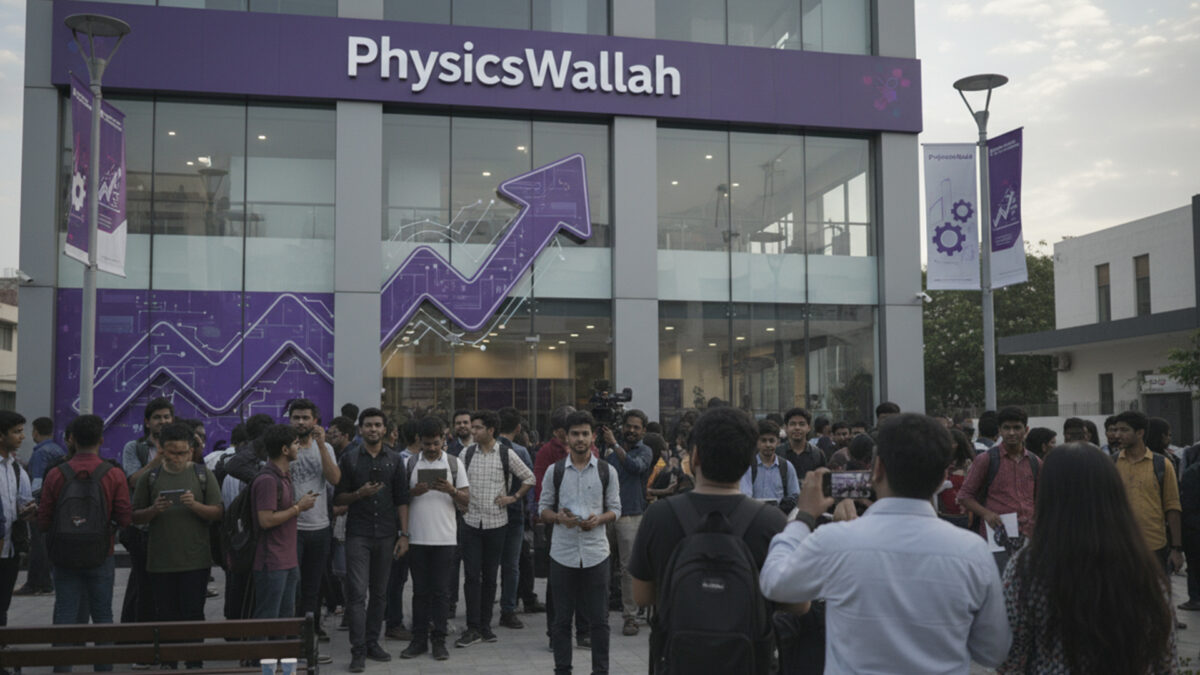
PhysicsWallah shares surge 33% on market listing day

Ed-tech firm PhysicsWallah made a strong debut on the Indian stock market on 18 November 2025, with shares listing at ₹145 on the NSE and ₹143 on the BSE, roughly 33 % above its ₹109 IPO price.

The IPO raised a total of around ₹3,480 crore, comprising a fresh issue of 28.45 crore shares worth ₹3,100.7 crore and an offer-for-sale (OFS) of 3.49 crore shares worth ₹380 crore. The price band was ₹103–₹109 per share, and the IPO was open from 11–13 November.

Institutional investors showed strong interest, with the Qualified Institutional Buyers (QIB) segment subscribed 2.7 times. Retail investors subscribed 1.06 times, while non-institutional investors saw weaker demand at 0.48 times.

PhysicsWallah plans to use the IPO proceeds to fund expansion of offline “Vidyapeeth” and hybrid “Pathshala” learning centres, enhance cloud and technology infrastructure, cover lease costs for existing centres, boost marketing (₹710 crore), and pursue acquisitions (₹941 crore).

The company’s financials show rapid revenue growth from FY 23 to FY 25 at a CAGR of 96.9 %, reaching ₹2,886.6 crore, while adjusted EBITDA grew 90.3 % to ₹432 crore. However, net losses widened to ₹243.3 crore in FY 25 from ₹84.1 crore in FY 23, and EBITDA margins slipped slightly to 15 %.

Analysts note that while the strong listing reflects investor confidence, challenges remain, including heavy competition in the ed-tech sector, high operating costs, and the need to sustain student enrolments to achieve profitability.

PhysicsWallah’s IPO listing has set the tone for other ed-tech firms considering public offerings, showing that investors are willing to back high-growth companies even if they are not yet profitable.

Also Read: Kotak Mahindra Bank up 1% before Nov 21 split meet

Categories
1 Minute-Read

LG Electronics India Q2 Profit Falls 27%

LG Electronics India reported a net profit of ₹389 crore for Q2 FY26, down 27% from ₹536 crore a year ago, as rising costs offset modest revenue growth.

Total revenue grew 1% to ₹6,174 crore, while expenses rose 3% to ₹5,729 crore, compressing margins. EBITDA stood at ₹547–548 crore, with a margin of 8.9%, down from 12.4% previously.

Segment-wise, Home Appliances & Air Solutions remained flat at ₹3,947 crore, and Home Entertainment rose 3% to ₹2,261 crore.

The company cited softer demand ahead of GST cuts but expects improvement in Q3 as festival-season sales and channel inventories stabilize.

Categories
Corporate

Adani Enterprises Q2 profit jumps 84% YoY to ₹3,199 crore

Adani Enterprises Ltd (AEL), the flagship of the Adani Group, reported consolidated EBITDA of ₹7,688 crore and profit before tax (PBT) of ₹2,281 crore for the first half of FY26, driven by strong growth in infrastructure and energy ventures.

The company’s Board also approved a ₹25,000 crore rights issue, marking one of the largest fundraises by the group in recent years. The capital infusion is expected to strengthen AEL’s balance sheet and support expansion in high-growth areas such as airports, data centers, green energy, and roads.

The first half of FY26 was marked by key milestones, including the inauguration of the greenfield Navi Mumbai International Airport and the completion of the company’s seventh road project. These achievements highlight its ability to execute complex, large-scale infrastructure projects on schedule, AEL said.

It added that the emerging core infrastructure portfolio spanning airports, data centers, and roads delivered an EBITDA of ₹5,470 crore during the half year, up 5% year-on-year. This segment now contributes 71% of the company’s consolidated EBITDA, underlining its growing importance within the overall portfolio.

“With disciplined execution and strategic diversification, Adani Enterprises continues to strengthen its position as India’s leading incubator of transformative infrastructure and energy businesses,” said Gautam Adani, Chairman of the Adani Group. “The inauguration of the Navi Mumbai International Airport marks a defining moment in India’s infrastructure story and reinforces AEL’s role as a national growth catalyst.”

AEL’s collaboration with Google on India’s largest AI data centre and its progress in green energy place the company at the forefront of the country’s tech-driven sustainability push. He added that AEL aims to build globally competitive businesses that deliver enduring value and strengthen India’s self-reliance.

Over the years, AEL has successfully incubated and scaled several businesses that are now independently listed entities, including Adani Ports & SEZ, Adani Energy Solutions, Adani Power, Adani Green Energy, Adani Total Gas, and Adani Wilmar. The company’s current portfolio of next-generation businesses, including the green hydrogen ecosystem, airports, data centers, roads, copper, and petrochemicals, is seen as the next phase of value creation for the group.

With a diversified portfolio and a proven record of project execution, AEL said it remains well-positioned to deliver sustainable growth while contributing to India’s infrastructure and energy transformation.

Also Read: Adani Ports Q2 Profit Up 29% as Logistics, Marine Shine