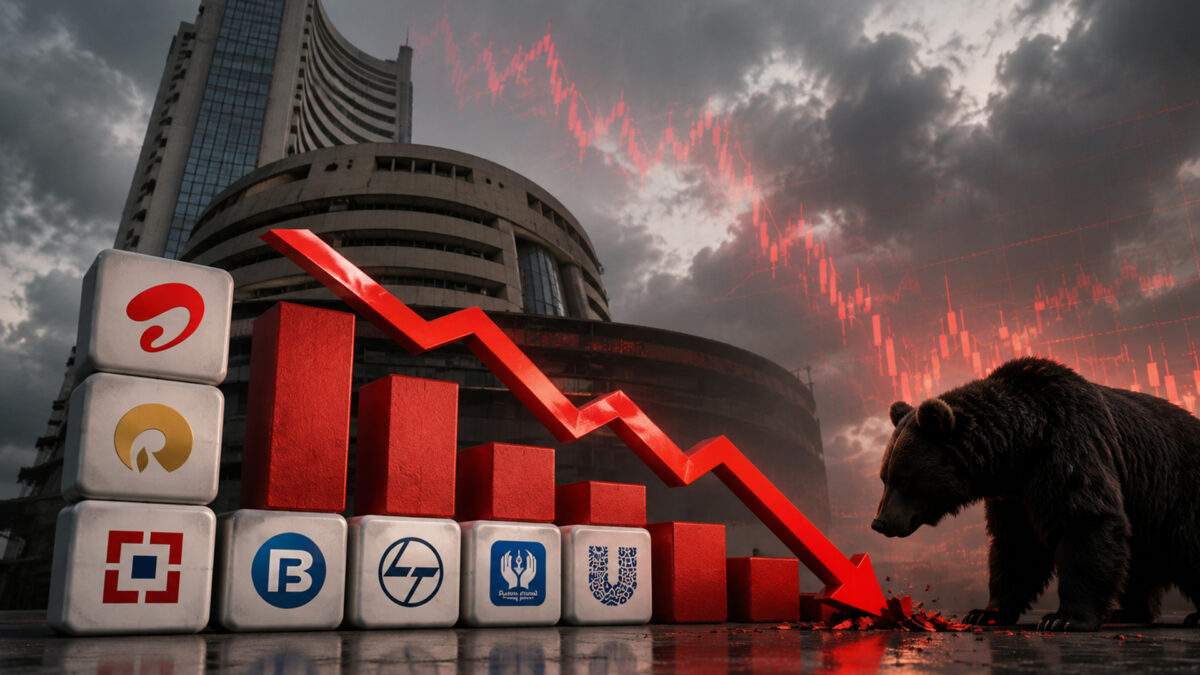
Seven of India’s 10 most-valued listed companies saw their combined market capitalisation decline by around ₹1.13 lakh crore last week, as the broader equity market remained under pressure and investor sentiment turned cautious.
Bharti Airtel and Reliance Industries accounted for the biggest erosion in value, with both companies losing more than ₹40,000 crore each. The decline came as benchmark indices extended their losses for a third consecutive week amid concerns over global interest rates, geopolitical uncertainty and volatility linked to the new closing auction session.
The BSE Sensex fell 276.32 points, or 0.35 per cent, during the week, while the NSE Nifty declined 76.35 points, or 0.31 per cent. Although the market staged a strong recovery on Friday, driven by buying in IT stocks following positive global technology cues, the late-week gains were not enough to prevent both benchmarks from ending lower.
Bharti Airtel recorded the biggest decline in market valuation among the top 10 companies. Its market capitalisation fell by ₹40,500.85 crore to ₹11,74,462.30 crore.
Reliance Industries followed closely, losing ₹40,056.32 crore in market value. Its market capitalisation stood at ₹17,38,119.27 crore at the end of the week. Despite the erosion, Reliance retained its position as India’s most-valued company.
HDFC Bank was the third-largest loser among the top companies. Its market valuation declined by ₹11,558.35 crore to ₹11,09,600.70 crore. Bajaj Finance also witnessed significant erosion, with its market capitalisation falling by ₹10,086.05 crore to ₹6,70,535.57 crore.
Larsen & Toubro saw its market value decline by ₹6,473.45 crore to ₹5,55,987.49 crore. Life Insurance Corporation of India, or LIC, lost ₹3,162.50 crore, bringing its market capitalisation down to ₹5,32,817.81 crore.
Hindustan Unilever was the seventh company among the top 10 to see its valuation decline. Its market capitalisation fell by ₹1,550.73 crore to ₹4,72,361.83 crore.
The selling pressure was not, however, spread across all the leading companies. Three of the top 10 firms added to their market value during the week, led by Tata Consultancy Services.
TCS emerged as the biggest gainer, adding ₹16,643.20 crore to its market capitalisation. Its valuation rose to ₹8,48,079.71 crore. The IT major benefited from strong buying in technology stocks, which helped the broader market recover sharply towards the end of the week.
ICICI Bank was another major gainer. Its market valuation increased by ₹4,475.28 crore to ₹10,22,805.73 crore. State Bank of India also registered a gain, with its market capitalisation rising by ₹599.99 crore to ₹9,65,568.75 crore.
The contrasting performance of the top companies highlights the selective nature of the current market trend. While investors reduced exposure to several large companies across telecom, energy, banking, finance, infrastructure and consumer sectors, buying interest remained visible in IT and select banking stocks.
Market analysts attributed the cautious tone to a combination of global and domestic factors. Concerns about the direction of global interest rates have continued to influence equity markets, while geopolitical uncertainty has added another layer of risk for investors.
The introduction of a new closing auction session has also contributed to market volatility, according to Ajit Mishra, senior vice-president of research at Religare Broking. He said Indian equities were in a corrective phase as investors assessed these uncertainties.
The sharp recovery on Friday offered some relief. Strong buying in IT stocks, supported by positive global technology cues, helped the benchmarks recover during the final trading session. However, the gains could not erase the losses accumulated earlier in the week.
Despite the changes in individual market valuations, the order of India’s 10 most-valued companies remained unchanged. Reliance Industries continued to lead the list, followed by Bharti Airtel, HDFC Bank, ICICI Bank, State Bank of India, TCS, Bajaj Finance, Larsen & Toubro, LIC and Hindustan Unilever.
The weekly decline in market capitalisation underscores the sensitivity of large-cap stocks to changes in investor sentiment. For companies with very high valuations, even relatively modest movements in share prices can translate into thousands of crores being added to or wiped off their market value.
Global interest-rate expectations, geopolitical developments and movements in overseas technology stocks are likely to remain important factors for Indian equities in the near term.
The ₹1.13 lakh crore decline across seven heavyweight companies therefore offers a snapshot of the market’s current cautious mood. At the same time, the gains recorded by TCS, ICICI Bank and SBI show that investors have not completely stepped away from equities, but are increasingly being selective about where they deploy capital.