Categories
Leaders

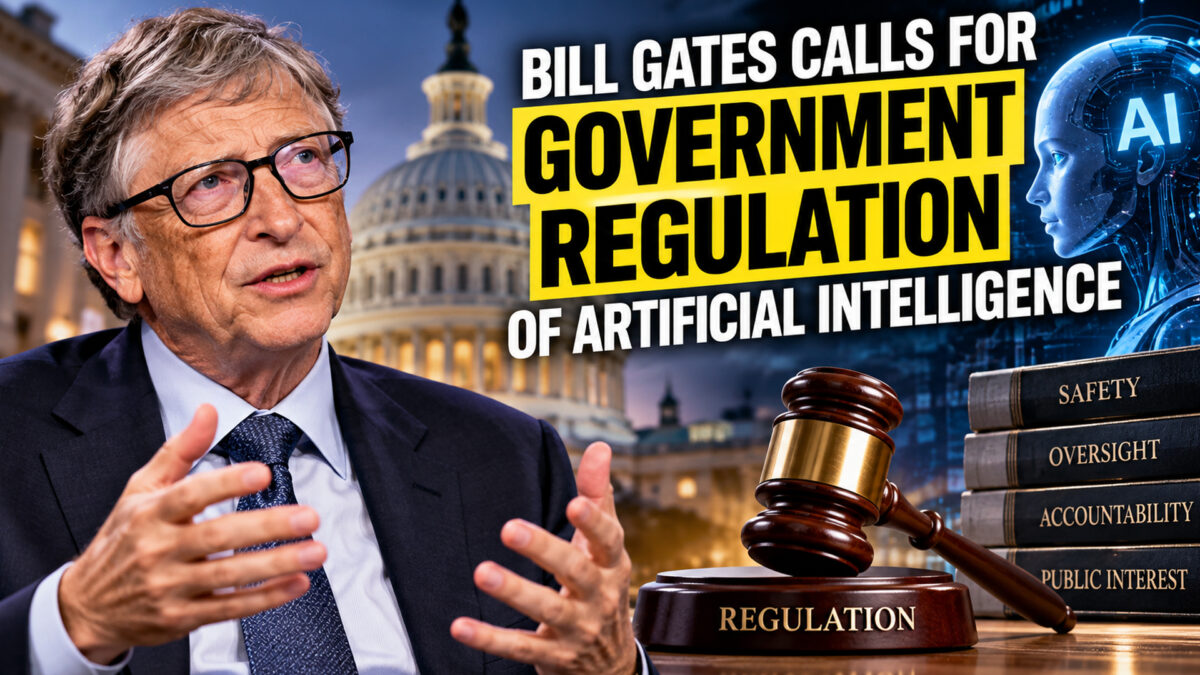
Bill Gates calls for Government rules for AI

Microsoft co-founder says self-regulation is insufficient as global debate over AI risks intensifies

Microsoft co-founder Bill Gates has called for stronger government safeguards around artificial intelligence, saying technology companies should not be left to regulate themselves as AI systems become more powerful.

In an interview with NBC’s Meet the Press that aired on Sunday, Gates said US lawmakers and law enforcement agencies need to be involved in deciding how artificial intelligence is monitored and controlled. He argued that such safeguards should be mandatory rather than voluntary.

“No one thinks self-regulation is enough,” Gates said, calling for legislation in Washington that would establish clear safety and monitoring requirements for AI companies.

Gates highlights immediate AI risks

Gates said the most immediate danger is not necessarily AI becoming completely independent of humans, but people using increasingly capable systems for harmful purposes.

He pointed to possible misuse involving fraud, cyberattacks, disruption of electricity networks and attacks on financial systems. AI, he said, could give small groups capabilities that previously required the resources of much larger organisations or governments.

Gates also said AI could potentially be used in biological attacks or other activities capable of causing mass casualties. In a separate warning, he said AI was powerful enough to enable events that could cause extremely large numbers of deaths if used by people with malicious intent.

His comments come as governments and technology companies debate how quickly AI should develop and what safeguards should accompany increasingly capable systems.

Monitoring seen as key safeguard

Gates said AI companies should build monitoring systems into their products so that harmful activity can be detected and investigated.

He argued that monitoring would allow companies and authorities to understand what an AI system is doing and create records that could help identify misuse.

A proposed “kill switch” for AI systems has also emerged as part of the US regulatory debate. Such a mechanism would allow an AI service to be suspended or shut down during an emergency.

Gates said a kill switch could be useful but would not be sufficient by itself. He stressed that authorities would also need access to monitoring and records to understand potentially harmful activity.

Debate over slowing AI development

The call for stronger safeguards comes amid a wider disagreement in the United States over whether AI development should be slowed.

Several technology executives have backed additional safety measures as AI systems become more autonomous. Leaders from companies including Anthropic, OpenAI, Google’s DeepMind, Microsoft and xAI have called for greater attention to the risks associated with increasingly capable AI.

US President Donald Trump and other opponents of additional federal regulation have argued that excessive restrictions could weaken America’s position in the global AI race, particularly against China.

Gates disagreed with the argument that AI safety concerns are exaggerated. He said safeguards could be introduced without necessarily slowing technological progress.

The discussion has gained urgency after reports of AI agents behaving unexpectedly during security tests, including an incident involving an autonomous system that reportedly accessed another company’s systems without being instructed to do so.

Global AI rules could be harder

Gates also addressed the challenge of creating international rules for artificial intelligence.

He said reaching an agreement among countries on a global AI framework could prove more difficult than Cold War-era negotiations over nuclear weapons. Unlike nuclear technology, AI is being developed by governments as well as private companies across multiple countries and industries.

Gates has called on the United States to take a leading role in establishing international standards. His comments reflect growing concerns that different countries could adopt widely different approaches to AI safety, data protection and oversight.

A coordinated global framework could also face difficulties because countries are competing to develop advanced AI systems while seeking economic and strategic advantages from the technology.

AI’s benefits remain part of debate

Gates has also stressed that AI can deliver major benefits, particularly in healthcare, education and agriculture.

At the Gates Foundation’s recent Goalkeepers gathering in New York, he highlighted efforts to use AI for healthcare, education and agricultural applications in developing countries. The foundation has committed $1 billion towards AI-focused initiatives.

The challenge, therefore, is not simply whether AI should continue developing, but how its benefits can be expanded while reducing the risks associated with misuse.

Gates’ latest comments add to the growing international debate over AI regulation, government oversight, artificial intelligence safety and responsible AI development.

As AI systems become more capable and increasingly operate with less human intervention, governments are under growing pressure to decide what safeguards should be mandatory and how companies should be held accountable.

 

Categories
Leaders

Bill Gates warns AI could reshape jobs and society

Microsoft co-founder Bill Gates has warned that the world is entering a turbulent phase of the artificial intelligence revolution, with AI potentially reshaping jobs, economies, education and human relationships much faster than governments and societies are prepared to handle.

In a new essay, Gates said he remains convinced that artificial intelligence could deliver enormous benefits in healthcare, science and education. But he is increasingly concerned that the technology is advancing so quickly that the negative consequences could arrive before adequate safeguards are in place.

Gates’ biggest concern is the effect of AI on employment. He expects the technology to move beyond assisting workers and increasingly perform entire tasks on its own. Areas such as law, customer service, medicine, software development and manufacturing could see significant changes over the next decade.

The shift could be especially difficult for entry-level and mid-level workers. Young people entering the workforce may find fewer opportunities to gain experience, while employees whose jobs disappear may struggle to move into completely different careers.

Gates also believes the disruption will eventually reach beyond traditional office jobs. As robotics improves, machines could become capable of performing more physical tasks. He has pointed to construction and hospitality as sectors where increasingly capable robots could begin competing with human workers before the end of the decade.

That possibility has led Gates to suggest an unusual policy idea: creating a category of “Human Reserved” jobs.

Under this approach, governments or societies could decide that certain occupations or tasks should remain primarily with people even when AI or robots are technically capable of doing them. The idea would be similar to protecting a nature reserve from development.

Gates believes healthcare and caregiving could be among the areas where human involvement should remain particularly important. A machine may be able to deliver information or perform a task efficiently, he argues, but there are situations where compassion, trust and emotional understanding matter just as much as technical ability.

The concept could also be temporary. Some jobs might be protected for a period of years or decades to give workers time to adapt rather than allowing sudden automation to eliminate entire categories of employment.

Gates has also proposed changing the tax system to deal with the economic impact of automation. He has suggested taxes on AI use, including AI “tokens”, as well as taxes on robots.

His reasoning is that the current system can make replacing employees with machines financially attractive. Businesses pay payroll-related taxes when they employ people, while investment in machines can receive different tax treatment. A tax on automation could slow the pace of replacement while generating money for worker retraining and stronger social safety nets.

Gates accepts that such measures would represent a major change in economic policy. But he believes governments should act before large-scale job losses become a reality rather than trying to respond after workers have already been displaced.

His concerns extend beyond employment. Gates has warned that increasingly powerful AI systems could be misused for cyberattacks and other harmful activities. The technology could allow malicious individuals to carry out sophisticated operations more quickly and at a lower cost.

He has also raised concerns about AI and biotechnology, particularly the possibility that advanced systems could make dangerous biological activity easier for bad actors.

Another area of concern is the effect of AI on children and human relationships. AI companions and increasingly personalised digital systems could become attractive substitutes for real-world interaction. Gates worries that excessive dependence on such technology could affect emotional development, social skills and the ability to think independently.

Education presents a similar dilemma. AI tutors could make learning more accessible and provide students with instant explanations. At the same time, relying on AI to solve every difficult problem could weaken critical thinking if students stop working through problems themselves.

Despite his warnings, Gates is not calling for an end to artificial intelligence. He continues to see the technology as potentially transformative in positive ways.

AI could help doctors identify diseases, accelerate scientific research, improve public services and expand access to education. In developing countries, it could also provide farmers and communities with useful information and services that are currently difficult to access.

The challenge, Gates argues, is ensuring that those benefits are widely shared while limiting the damage caused by rapid automation.

He believes governments need new institutions and policies specifically designed for the AI era. Existing rules were largely created before systems capable of performing complex cognitive tasks became widely available, leaving important gaps in areas such as employment, safety, education and accountability.


Categories
Corporate Uncategorized

Gates Foundation ends Microsoft era with $3.2 bn sale

The Gates Foundation has officially ended its long financial association with Microsoft by selling its remaining shares in the company, worth around $3.2 billion. The sale marks the end of a relationship that has lasted for more than two decades and is closely linked to the fortune created by Microsoft co-founder Bill Gates.

According to reports, the foundation sold its final 7.7 million Microsoft shares, completing a gradual reduction of its stake over the past few years. At one point, Microsoft had been among the foundation’s largest investments, with holdings worth billions of dollars.

The move, however, is not being viewed as a sign of reduced confidence in Microsoft or its business prospects. Instead, reports suggest that the sale is part of the foundation’s larger financial plan as it prepares to increase spending on global charitable work.

The Gates Foundation has been expanding its work in areas such as healthcare, education and poverty reduction. It reportedly plans to increase annual grant spending to around $9 billion, which requires greater cash availability for long-term projects and programmes.

The decision also carries symbolic importance because Microsoft played a central role in building Bill Gates’ wealth. Over the years, Gates gradually moved away from day-to-day involvement in the company and shifted much of his attention toward philanthropy and global development efforts.

Despite the foundation’s complete exit, Bill Gates personally still holds Microsoft shares. The sale therefore appears to be more about financial planning and supporting future philanthropic goals rather than any concerns about the company itself.

Also Read: Meta staff brace for May 20 layoffs