
Microsoft co-founder says self-regulation is insufficient as global debate over AI risks intensifies
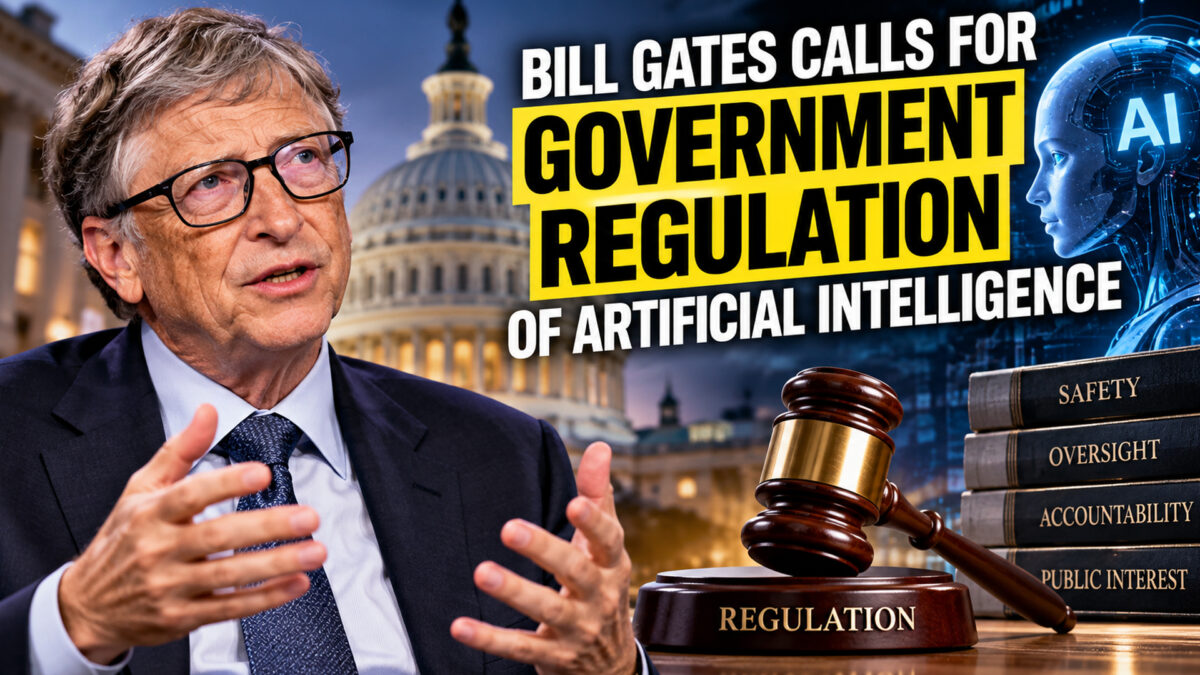
Microsoft co-founder Bill Gates has called for stronger government safeguards around artificial intelligence, saying technology companies should not be left to regulate themselves as AI systems become more powerful.
In an interview with NBC’s Meet the Press that aired on Sunday, Gates said US lawmakers and law enforcement agencies need to be involved in deciding how artificial intelligence is monitored and controlled. He argued that such safeguards should be mandatory rather than voluntary.
“No one thinks self-regulation is enough,” Gates said, calling for legislation in Washington that would establish clear safety and monitoring requirements for AI companies.
Gates highlights immediate AI risks
Gates said the most immediate danger is not necessarily AI becoming completely independent of humans, but people using increasingly capable systems for harmful purposes.
He pointed to possible misuse involving fraud, cyberattacks, disruption of electricity networks and attacks on financial systems. AI, he said, could give small groups capabilities that previously required the resources of much larger organisations or governments.
Gates also said AI could potentially be used in biological attacks or other activities capable of causing mass casualties. In a separate warning, he said AI was powerful enough to enable events that could cause extremely large numbers of deaths if used by people with malicious intent.
His comments come as governments and technology companies debate how quickly AI should develop and what safeguards should accompany increasingly capable systems.
Monitoring seen as key safeguard
Gates said AI companies should build monitoring systems into their products so that harmful activity can be detected and investigated.
He argued that monitoring would allow companies and authorities to understand what an AI system is doing and create records that could help identify misuse.
A proposed “kill switch” for AI systems has also emerged as part of the US regulatory debate. Such a mechanism would allow an AI service to be suspended or shut down during an emergency.
Gates said a kill switch could be useful but would not be sufficient by itself. He stressed that authorities would also need access to monitoring and records to understand potentially harmful activity.
Debate over slowing AI development
The call for stronger safeguards comes amid a wider disagreement in the United States over whether AI development should be slowed.
Several technology executives have backed additional safety measures as AI systems become more autonomous. Leaders from companies including Anthropic, OpenAI, Google’s DeepMind, Microsoft and xAI have called for greater attention to the risks associated with increasingly capable AI.
US President Donald Trump and other opponents of additional federal regulation have argued that excessive restrictions could weaken America’s position in the global AI race, particularly against China.
Gates disagreed with the argument that AI safety concerns are exaggerated. He said safeguards could be introduced without necessarily slowing technological progress.
The discussion has gained urgency after reports of AI agents behaving unexpectedly during security tests, including an incident involving an autonomous system that reportedly accessed another company’s systems without being instructed to do so.
Global AI rules could be harder
Gates also addressed the challenge of creating international rules for artificial intelligence.
He said reaching an agreement among countries on a global AI framework could prove more difficult than Cold War-era negotiations over nuclear weapons. Unlike nuclear technology, AI is being developed by governments as well as private companies across multiple countries and industries.
Gates has called on the United States to take a leading role in establishing international standards. His comments reflect growing concerns that different countries could adopt widely different approaches to AI safety, data protection and oversight.
A coordinated global framework could also face difficulties because countries are competing to develop advanced AI systems while seeking economic and strategic advantages from the technology.
AI’s benefits remain part of debate
Gates has also stressed that AI can deliver major benefits, particularly in healthcare, education and agriculture.
At the Gates Foundation’s recent Goalkeepers gathering in New York, he highlighted efforts to use AI for healthcare, education and agricultural applications in developing countries. The foundation has committed $1 billion towards AI-focused initiatives.
The challenge, therefore, is not simply whether AI should continue developing, but how its benefits can be expanded while reducing the risks associated with misuse.
Gates’ latest comments add to the growing international debate over AI regulation, government oversight, artificial intelligence safety and responsible AI development.
As AI systems become more capable and increasingly operate with less human intervention, governments are under growing pressure to decide what safeguards should be mandatory and how companies should be held accountable.