
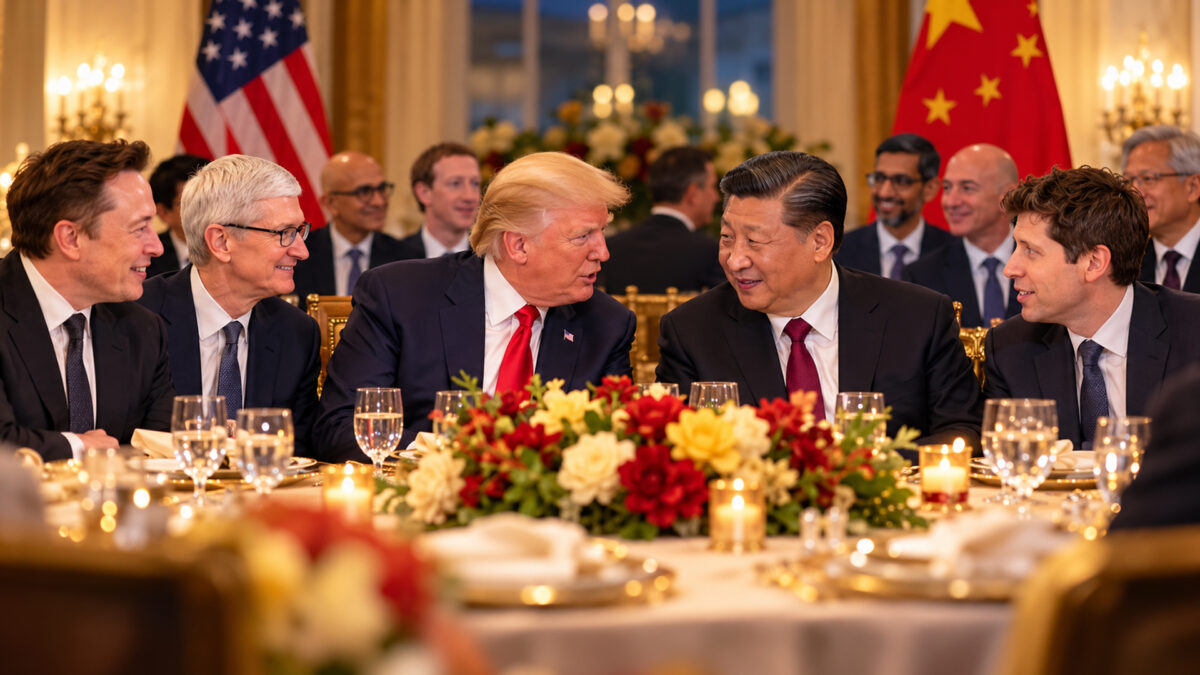
US President Donald Trump hosted Chinese President Xi Jinping at a White House state dinner, bringing together senior US officials, technology executives and some of the world’s most prominent business leaders. The September 24 dinner came during Xi’s three-day visit to Washington and followed talks between the two leaders on trade, artificial intelligence, Taiwan and other areas of tension.
The guest list stood out for the number of technology leaders in attendance. Tesla and SpaceX chief Elon Musk, Apple chairman Tim Cook and OpenAI CEO Sam Altman were among the prominent names at the dinner. Nvidia CEO Jensen Huang, Amazon founder Jeff Bezos, Meta CEO Mark Zuckerberg, Microsoft CEO Satya Nadella and Google’s Sundar Pichai were also invited.
Musk and Huang were seated at the head table with Trump, Xi and their wives, Melania Trump and Peng Liyuan. AMD CEO Lisa Su and Cook were also among those seated close to the two presidents. The presence of leaders from companies at the centre of the global AI and semiconductor industries gave the dinner a strong technology focus.
The wider guest list included executives from finance, manufacturing, pharmaceuticals, aerospace and consumer industries. JPMorgan Chase CEO Jamie Dimon, BlackRock CEO Larry Fink, Goldman Sachs CEO David Solomon, Citigroup CEO Jane Fraser, Pfizer CEO Albert Bourla, Boeing CEO Kelly Ortberg and General Motors CEO Mary Barra were among the invited business leaders.
The dinner followed a day of meetings between Trump and Xi as Washington and Beijing sought to manage tensions in their relationship. Trade remains a major issue, with both countries dealing with tariffs, supply-chain concerns and restrictions affecting strategic industries.
Artificial intelligence was another important area in the discussions. The US and China are competing for leadership in advanced AI, while American restrictions on exports of high-end chips and technology to China remain a major point of contention. The presence of executives from Nvidia, AMD, Google, Microsoft, OpenAI and other technology companies underscored the business importance of those discussions.
The guest list also highlighted the growing role of private technology companies in US economic and strategic policy. AI companies and semiconductor firms have become increasingly important to questions involving national security, computing infrastructure and technology exports.
Chinese business leaders, however, were largely absent from the dinner. Xi’s delegation instead included senior government and economic officials, including Vice Premier He Lifeng, Commerce Minister Wang Wentao and other officials involved in trade and economic policy.
The difference in representation was notable. While more than 30 American business leaders attended, China’s delegation was dominated by government officials rather than corporate executives. Analysts cited by CNA said the absence of Chinese CEOs highlighted the different roles played by business and government in the two countries’ economic systems.
Trump’s dinner also carried considerable diplomatic symbolism. Xi’s visit was his first trip to Washington in more than a decade and marked the second meeting between the two leaders this year. Their discussions come as both governments attempt to stabilise relations while continuing to disagree over trade, Taiwan, technology and other strategic issues.
During the dinner, Trump described the visit as an honour and spoke about the long history of US-China relations. Xi said the two countries had reached a common understanding on several issues and called for both sides to act as responsible major powers.
The two countries also agreed to extend their existing trade arrangement by two months, while China would continue supplying rare earth materials to the US and current tariff levels would remain in place. The arrangement provides temporary continuity as negotiations continue.
The White House dinner therefore brought together two very different groups: senior Chinese political and economic officials and a large representation of America’s corporate leadership. The contrast reflected the broader nature of the Trump-Xi meeting, where diplomacy, trade policy and technology interests were closely connected.
The presence of Musk, Cook, Altman, Huang, Bezos, Zuckerberg, Nadella and Pichai also put the technology sector at the centre of attention. Their companies are directly affected by US-China trade policy, semiconductor restrictions and the global race to develop artificial intelligence.
While the dinner offered a high-profile display of engagement, several major issues between Washington and Beijing remain unresolved. The state dinner provided a setting for diplomacy and business visibility, but the longer-term direction of US-China trade and technology relations will depend on negotiations beyond the White House event.