Categories
Corporate

Sensex rose 150 points, Nifty stayed above 23,500

Indian equity benchmark indices opened higher on Thursday, supported by positive global cues and buying in select heavyweight stocks. The BSE Sensex gained around 150 points to hover near the 75,100 mark, while the NSE Nifty traded above 23,500 during early deals.

Market sentiment improved after strong overnight gains in US technology stocks and positive trends across Asian markets. GIFT Nifty had also indicated a firm start for Dalal Street ahead of the opening bell.

Among the top gainers on the Sensex were Bharti Airtel, Tata Steel, JSW Steel, Mahindra & Mahindra and Larsen & Toubro, driven by buying interest in telecom, metal and infrastructure shares. On the losing side, Infosys, HCLTech, Nestle India and Titan witnessed selling pressure.

Investors also tracked quarterly earnings announcements and company-specific developments. Bharti Airtel remained in focus after reporting strong earnings, while metal stocks benefited from improving global commodity sentiment.

Despite the positive momentum, analysts said concerns over rising crude oil prices and weakness in the Indian rupee continued to limit gains. Brent crude remained above $107 per barrel amid geopolitical tensions in West Asia, while the rupee stayed under pressure against the US dollar due to foreign institutional investor outflows.

Also Read: India’s CPI inflation rises to 3.48% in April

Categories
Corporate

Sensex up 50 points, Nifty ends above 23,400

Indian stock markets ended slightly higher on Wednesday, where the BSE Sensex rose 50 points to close at 74,609, while the NSE Nifty gained 33 points to settle above the 23,400 mark. Markets witnessed sharp swings during the session as investors tracked rising crude oil prices, rupee weakness and global geopolitical tensions.

Metal and commodity stocks led the recovery on Dalal Street. Asian Paints emerged among the top gainers with a rise of over 4%, while Tata Steel and Adani Enterprises also posted strong gains. Stocks such as Adani Ports, Bharti Airtel and Bharat Electronics attracted buying interest during the session.

On the other hand, IT and auto stocks remained under pressure. Infosys, Tech Mahindra and Mahindra & Mahindra were among the major losers, limiting the broader market rally. TCS and Sun Pharma also ended lower.

Sector-wise, metal stocks outperformed the market, with the Nifty Metal index seeing strong gains. Consumer durable, oil & gas and infrastructure shares also ended in positive territory. However, weakness in banking and technology stocks capped overall gains.

Meanwhile, the Indian rupee touched another record low against the US dollar during the day, weighed down by rising oil prices and foreign fund outflows.

Analysts said markets remained cautious despite the recovery, mainly because of uncertainty around global crude oil prices and continued foreign investor selling. Concerns linked to tensions in West Asia and their possible impact on inflation and fuel costs also kept investors on edge.

Also Read: General Motors lays off 600 IT employees

Categories
Corporate

Sensex gains over 200 points, Nifty reclaims 23,450

Indian stock markets opened in a volatile range on Wednesday after four consecutive sessions of heavy losses, with benchmark indices attempting a modest recovery amid mixed global cues. The BSE Sensex rose over 200 points in early trade, while the NSE Nifty reclaimed the 23,450 mark, supported by easing crude oil prices and a slightly stronger rupee.

Investor sentiment, however, remained cautious due to continued geopolitical tensions in West Asia and persistent foreign institutional investor (FII) selling. Market volatility stayed elevated, with India VIX, the market’s fear indicator,  rising during the session.

Among sectoral performers, metal stocks emerged as the top gainers, supported by renewed buying interest in commodity-linked counters. Pharma and FMCG shares also witnessed selective buying as investors preferred defensive sectors amid uncertainty. Chemical stocks too traded in positive territory during the day.

On the losing side, banking, IT and auto stocks remained under pressure, dragging overall market sentiment. Realty shares also saw weakness as investors booked profits after recent gains. Analysts said concerns over global growth, inflation and elevated oil prices continued to weigh on sectors sensitive to economic activity.

The market recovery came after a steep selloff in the previous session, when the Sensex had plunged more than 1,450 points and the Nifty slipped below 23,400. Traders said bargain buying at lower levels and stable Asian markets helped domestic equities recover partially on Wednesday.

Also Read: India eases royalty rules for oil and gas firms

Categories
Corporate

Afcons wins ₹7,544 cr Croatia rail project

Indian infrastructure company Afcons Infrastructure has secured a major international breakthrough by winning a railway project in Croatia worth about ₹7,544 crore.

The project involves rebuilding an existing railway line and constructing a second track on the Dugo Selo–Novska route. It will also include electrification, signalling and telecom upgrades to modernise the corridor and improve rail connectivity in the region.

The contract, awarded by Croatian authorities, is valued at around €677 million and is expected to be one of Afcons’ largest overseas projects so far. The work is scheduled to be completed over several years and marks a significant expansion of the company’s global presence.

Afcons, headquartered in Mumbai, is part of the Shapoorji Pallonji Group. The company is a major player in infrastructure development, with expertise in railways, metro systems, bridges, tunnels, ports, marine structures, roads and energy-related projects.

The latest win is being seen as a strong step forward for Indian engineering companies in Europe, highlighting their ability to compete for large-scale infrastructure contracts in developed markets.

Following the announcement, the company’s stock also saw positive market reaction, reflecting investor confidence in its global growth strategy.

Also Read: Jewellers to meet PMO over gold buying concerns

Categories
Corporate

Iran conflict may slow India’s growth to 6.7%

India’s economic growth could slow to 6.7 percent in the current financial year due to rising global oil prices, weak consumer demand and uncertainty caused by the Iran conflict, according to a report by BMI, a Fitch Solutions company.

The report said escalating tensions in West Asia and higher crude oil prices are creating fresh challenges for the Indian economy. Since India imports a large portion of its crude oil requirements, any sharp increase in oil prices directly impacts inflation, import costs and government spending.

BMI warned that the recent surge in crude oil prices could increase fuel and transportation costs across sectors, putting pressure on businesses as well as household spending. Higher inflation may also reduce consumer demand, affecting overall economic activity.

The report noted that India’s growth had received support in recent years from tax cuts, strong government spending and infrastructure projects. However, that support is now beginning to fade, while global economic uncertainty continues to rise.

Economists said higher oil prices could also widen India’s current account deficit and put pressure on the rupee. Rising import bills may affect fiscal stability if crude prices remain elevated for a long period.

Despite the expected slowdown, India is still projected to remain one of the world’s fastest-growing major economies. Analysts believe government infrastructure spending, manufacturing growth and strong domestic demand could continue supporting the economy in the medium term.

The report comes at a time when global markets are closely watching developments in West Asia, particularly tensions involving Iran and disruptions in oil supply chains. Financial markets have already turned volatile due to fears of prolonged geopolitical instability.

BMI said India’s growth outlook will largely depend on global crude oil trends, inflation control measures and the government’s ability to maintain economic momentum amid external challenges.

Also Read: Rupee crashes to 95.50 mark against dollar

Categories
Corporate

Sensex falls over 450 points, Nifty slips below 23,700

Indian stock markets traded lower on Tuesday as weak global signals, rising crude oil prices and foreign investor selling hurt market sentiment. The BSE Sensex fell more than 450 points in early trade, while the NSE Nifty slipped below the 23,700 mark.

IT stocks led the decline, with Infosys, TCS, HCLTech and Tech Mahindra falling sharply during the session. Concerns over slowing global demand and weakness in international technology markets dragged the sector lower. The Nifty IT index was among the worst-performing sectoral indices of the day.

Investors also remained cautious because of rising tensions in the Middle East and increasing crude oil prices. Analysts said higher oil prices could raise inflation concerns for India and affect company earnings in the coming months.

Despite the weak market, a few stocks managed to post gains. ONGC and Oil India were among the top gainers as higher crude oil prices boosted sentiment in energy shares. Banking stocks such as SBI also saw buying interest and helped limit deeper losses in the market.

The broader market remained under pressure, with more stocks declining than advancing on both the BSE and NSE. Foreign institutional investors continued to sell Indian equities, adding to market volatility.

Several stocks remained in focus during the day. Shares of investment platform Groww attracted attention after reports said existing investors may sell stakes worth around Rs 4,750 crore through block deals. Dr Reddy’s and Waaree Energies also witnessed active trading.

Also Read: Noel Tata votes against key reappointments at Tata Trust

Categories
Corporate

Royal Enfield becomes world’s third strongest auto brand

Royal Enfield has achieved a major global milestone by becoming the world’s third strongest automotive brand, ranking ahead of luxury names like Audi and Ferrari.

The recognition reflects how the iconic Indian motorcycle brand has grown from a domestic favourite into a globally admired name among biking enthusiasts. Royal Enfield is known for its strong customer loyalty, unique identity and growing international presence helped it secure the high ranking.

Over the years, Royal Enfield has built a strong emotional connection with riders through its retro-style motorcycles, riding culture and community-focused events. Popular models such as the Classic 350, Hunter 350 and Himalayan have attracted both young riders and long-distance touring enthusiasts across different markets.

The company’s success is also linked to its ability to modernise while keeping its classic identity intact. Though the motorcycles retain their vintage-inspired design, the brand has improved performance, comfort and technology to appeal to global consumers.

Royal Enfield’s rise shows how Indian brands are beginning to compete confidently on the world stage, not just through affordability but through strong brand value and customer experience. The growing popularity of mid-sized motorcycles internationally has also worked in the company’s favour.

Owned by Eicher Motors, Royal Enfield has steadily expanded into Europe, Latin America and Southeast Asia in recent years. The company has increased exports, opened international showrooms and strengthened its premium positioning globally.

The ranking is being seen as a proud moment for the Indian automotive industry, especially since Royal Enfield managed to outperform several globally established luxury brands in overall brand strength.

Also Read: Nvidia CEO tells graduates to learn from failure

Categories
Corporate

Aramco profits jump 20% despite middle east conflict

Saudi Aramco reported a 20% rise in profits, driven by higher crude oil prices and stable export operations despite ongoing conflict and tensions in the Middle East.

The company said earnings improved in the latest quarter as global oil prices climbed due to fears of supply disruption linked to regional instability. Strong demand for crude oil also supported revenue growth.

A key factor behind the performance was Aramco’s ability to maintain exports through alternative routes, including its East-West pipeline. This helped the company avoid major disruptions even as tensions increased around the Strait of Hormuz, a critical global oil shipping route.

The Strait of Hormuz handles a large share of the world’s oil shipments, and any instability in the region often leads to market uncertainty. However, Aramco’s infrastructure allowed it to keep supply flowing smoothly.

Higher oil prices also played a major role in boosting earnings. When crude prices rise, producers like Aramco earn more per barrel, which directly improves profitability even if production levels remain unchanged.

However, experts warned that continued instability in the Middle East could still create volatility in global energy markets. Any escalation in conflict could impact shipping routes and lead to sudden price fluctuations.

Also Read: Jio IPO to be fully fresh issue

Categories
Corporate

Jio IPO to be fully fresh issue

Reliance Industries has changed the structure of the upcoming IPO of Jio Platforms, deciding that it will now be a pure fresh issue with no offer-for-sale component.

In simple terms, this means existing investors will not sell any shares during the IPO. Instead, all the money raised from the public will go directly into the company to support its future growth plans.

Earlier discussions had included the possibility of some early investors selling a part of their stake to take profits. But that plan has now been dropped. Sources say differences over valuation and pricing expectations played a role in the decision.

The move is aimed at making the IPO more stable and focused on long-term growth rather than short-term exits. It also avoids putting extra selling pressure on the stock when it lists.

Jio Platforms, which is a major part of Reliance’s digital business, runs one of India’s largest telecom networks and a wide range of digital services. The IPO is expected to attract strong interest from global and domestic investors.

By removing the stake sale portion, Reliance is signalling confidence in the company’s long-term potential. At the same time, early investors will not get immediate cash returns, suggesting they are staying invested for future value growth.

Also Read: Gautam Adani connects AI growth to energy infrastructure

Categories
Corporate

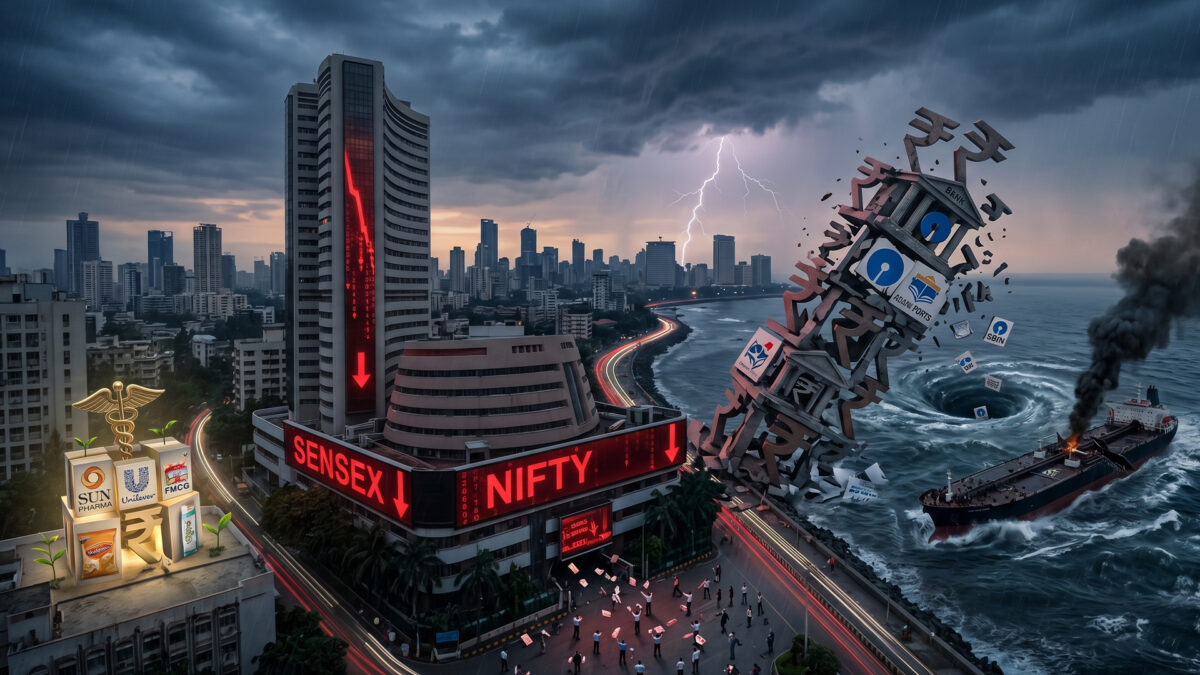
Sensex tanks 1,300 points, Nifty slips below 23,800

Indian stock markets witnessed heavy selling pressure on Monday as rising crude oil prices and renewed tensions in West Asia shook investor confidence. The BSE Sensex plunged nearly 1,300 points, while the NSE Nifty slipped below the 23,800 mark amid broad-based losses across sectors.

The sharp decline came after crude prices crossed $105 per barrel following fresh uncertainty over US-Iran peace talks. Investors worried that higher oil prices could increase inflation, weaken the rupee and raise costs for businesses and consumers in India.

Among the biggest losers were aviation, banking and consumer stocks. Shares of InterGlobe Aviation, which operates IndiGo, fell sharply on concerns over rising aviation fuel costs. Banking stocks such as State Bank of India and IndusInd Bank also came under pressure due to weak market sentiment and profit-booking.

Jewellery and retail stocks including Titan Company declined after concerns emerged over slowing consumer demand and higher import costs linked to rising crude oil prices.

However, oil exploration and energy companies moved higher as crude prices surged globally. Shares of Oil and Natural Gas Corporation and Oil India gained during the session as investors expected stronger earnings from higher oil realisations.

The Indian rupee weakened against the US dollar during trading, adding to concerns over imported inflation. Analysts said foreign investors also remained cautious due to global geopolitical uncertainty and volatile commodity prices.

Also Read: NTPC eyes huge nuclear power project in Bihar