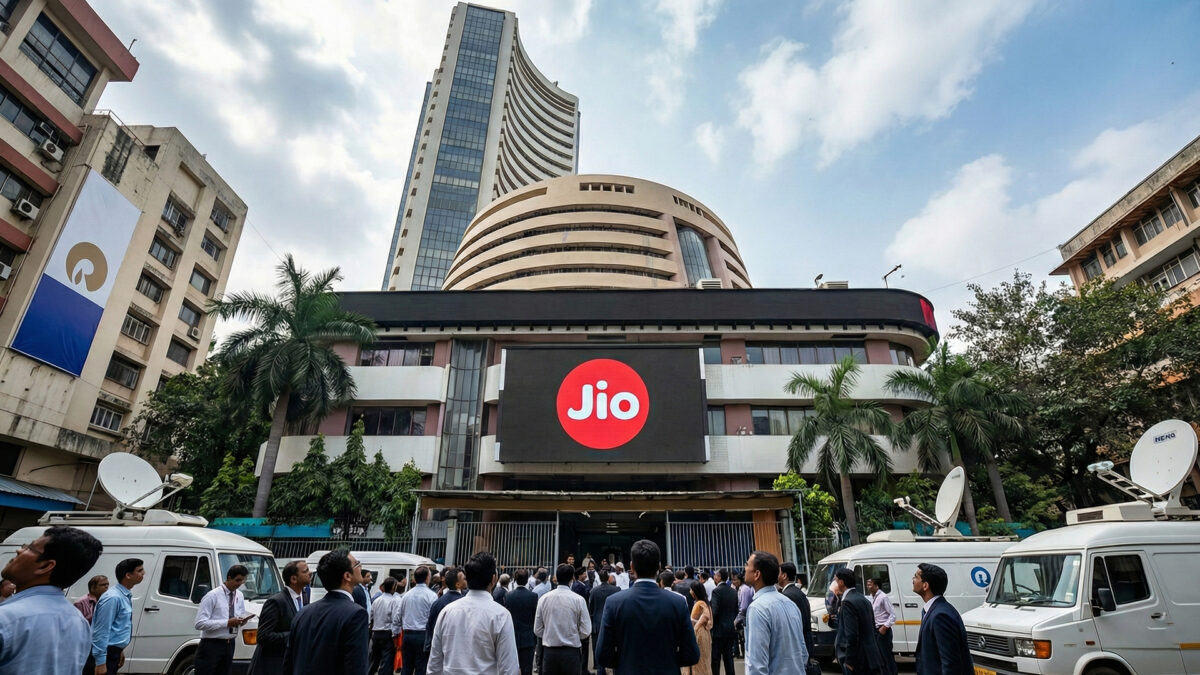
Jio Platforms is set to make its much-awaited stock market debut on Wednesday, October 28, with a strong grey market premium (GMP) raising expectations of substantial listing gains. The ₹30,213-crore initial public offering (IPO), backed by billionaire Mukesh Ambani’s Reliance Industries, attracted overwhelming investor demand, putting the telecom and digital services company in the spotlight ahead of its listing on the National Stock Exchange (NSE) and Bombay Stock Exchange (BSE).
While the grey market points to a potentially strong debut, market experts are advising investors to look beyond the first day’s gains. Analysts believe Jio Platforms’ position in India’s digital economy, its profitability and opportunities in artificial intelligence (AI), enterprise services and broadband could support long-term wealth creation.
The central question for investors is whether to book profits on listing day or retain their allotted shares for future growth.
Jio IPO GMP signals potential 22% listing gains
Jio Platforms’ grey market premium stood at around ₹250 per share on October 26, according to reported market data. Against the upper end of the IPO price band of ₹1,119, this indicated an estimated listing price of approximately ₹1,369, representing a potential premium of 22.34%.
At this indicative price, investors allotted one lot of 12 shares could see their holdings rise from ₹13,428 to ₹16,428. That translates into an estimated gain of ₹3,000 before taxes and transaction costs.
However, the GMP is an unofficial indicator and does not guarantee the actual listing price. Grey market premiums can change quickly depending on investor sentiment, broader market conditions and expectations surrounding the debut. The final opening price will be determined by demand and supply on the stock exchanges.
Investors should therefore treat the estimated gains as a possible scenario rather than an assured return.
Record demand puts Jio IPO in focus
The Jio Platforms IPO closed its subscription window on October 23 after attracting bids worth several times the shares offered. The issue was subscribed 22.19 times overall, according to exchange data, reflecting substantial demand across investor categories.
Qualified institutional buyers led the response, subscribing to their reserved portion approximately 70.55 times. The non-institutional investor category was subscribed around 14 times, while the retail investor portion received bids for approximately 2.72 times the shares reserved for it.
The offering attracted attention not only because of its size but also because of Jio’s established presence in India’s telecommunications market. The company’s extensive customer base and role in the country’s digital expansion made it one of the most closely watched IPOs of the year.
The issue comprised 27 crore fresh equity shares, with no offer-for-sale component. The company plans to use up to ₹27,500 crore of the proceeds to repay or prepay borrowings of its subsidiary, Reliance Jio Infocomm.
The company has several potential growth avenues beyond mobile connectivity. These include JioFiber and JioAirFiber, enterprise technology services, cloud computing and AI-related offerings. Rising data consumption and possible telecom tariff increases could also support revenue growth.
These opportunities, however, will depend on execution, competition and the company’s ability to turn investments into sustainable earnings.
Jio Platforms valuation and financial performance
At the final issue price of ₹1,119 per share, Jio Platforms is valued at approximately ₹10.3 lakh crore. According to analyst estimates cited by Moneycontrol, the valuation represents around 34.3 times its FY26 price-to-earnings ratio and 14.8 times its enterprise value-to-EBITDA ratio.
The valuation reflects the company’s established business as well as expectations of future growth. Investors will need to assess whether its earnings can expand sufficiently to justify the price at which the shares begin trading.
Jio’s financial performance provides part of the investment case. Its revenue from operations rose to approximately ₹1.46 lakh crore in FY26 from ₹1.28 lakh crore in FY25. Net profit increased to ₹30,049 crore from ₹26,109 crore over the same period, while earnings before interest, taxes, depreciation and amortisation (EBITDA) rose to ₹76,255 crore from ₹64,170 crore.
These figures indicate growth in both revenue and profitability, although future performance will remain sensitive to operating costs, regulatory developments and competition.
Risks investors should not ignore
Despite strong subscription figures and positive GMP signals, Jio Platforms shares are not without risks. Telecom regulation, spectrum costs, cybersecurity threats, technological disruption and competitive pressure could affect its financial performance.
Investors who buy after listing may also face the risk of paying a higher price than IPO allottees. If the stock opens sharply higher, some investors could book profits, leading to volatility in early trading.
For existing allottees, the decision to sell or hold should depend on their investment horizon, financial objectives and tolerance for risk rather than GMP alone.
Jio Platforms‘ October 28 debut will provide the market’s first direct assessment of its publicly traded valuation. A strong opening could reward IPO allottees, but the company’s longer-term performance will depend on earnings growth, innovation and its ability to strengthen its position in India’s expanding digital economy.