Categories
Corporate

Sensex rises above 750 points, Nifty crosses 23,400

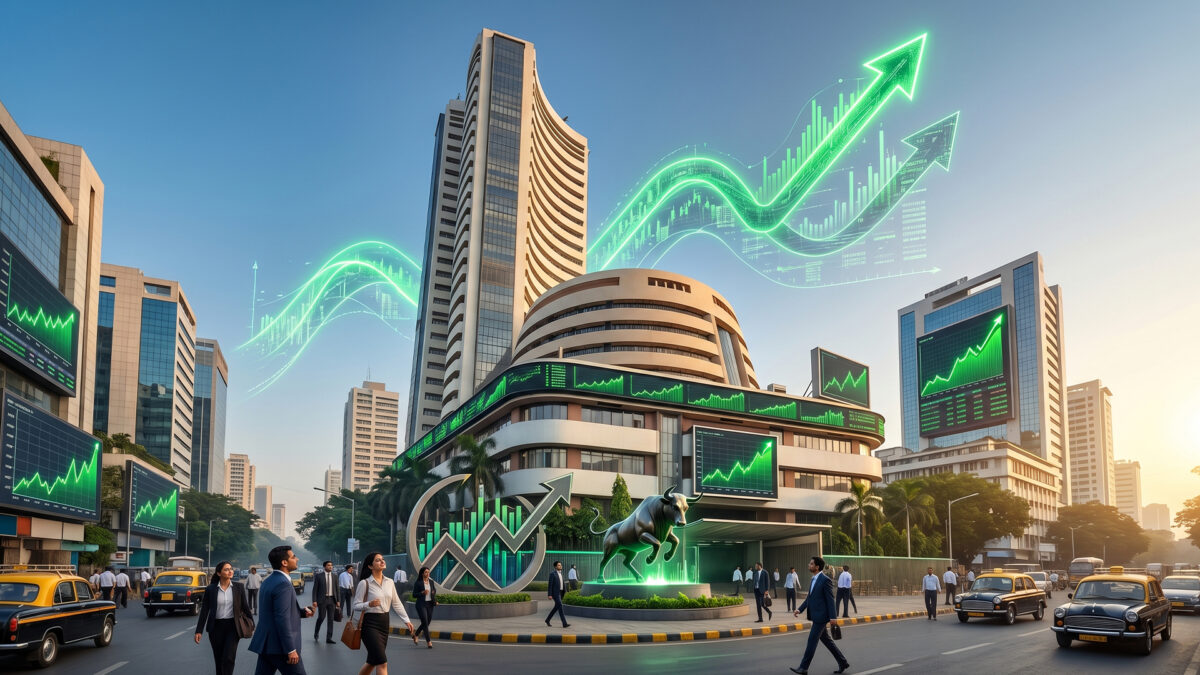
Indian stock markets began Friday’s session on a strong note, buoyed by positive global signals and improving investor confidence. The BSE Sensex climbed nearly 750 points almost eyeing the 1,000 mark in early trade, while the NSE Nifty 50 crossed the 23,400 mark, registering gains of more than one percent.

Market participants attributed the rally to a combination of favorable global developments, including expectations of improved diplomatic relations in the Middle East, declining crude oil prices, and strength in major international equity markets. A firmer Indian rupee also contributed to improved investor confidence, particularly among foreign institutional investors.

Banking and financial stocks emerged as the primary drivers of the rally. Shares of ICICI Bank, Kotak Mahindra Bank and Axis Bank witnessed significant buying interest in early trade. The automobile sector also remained in focus, with Mahindra & Mahindra posting notable gains. Metal stocks advanced on expectations of improved global demand and stable commodity prices.

It was noted that lower crude oil prices are particularly beneficial for the Indian economy, as the country imports a substantial portion of its energy requirements. Reduced energy costs can help ease inflationary pressures and support corporate profitability across sectors.

Despite the broad-based rally, the information technology sector displayed relative weakness. Stocks such as HCLTech and LTIMindtree traded lower as investors remained cautious about the outlook for global technology spending. FMCG major ITC also witnessed mild selling pressure during the opening session.

Market breadth remained positive, with advancing stocks significantly outnumbering declining shares on both major exchanges. Traders indicated that the upbeat sentiment was supported by strong global market performances and expectations of continued economic resilience.

Experts, however, advised investors to remain cautious amid ongoing uncertainties related to global interest rates and geopolitical developments. They emphasized the importance of focusing on fundamentally strong companies and maintaining a diversified portfolio.

Also Read: SEBI proposes pay disclosure norms for AMCs

Categories
Corporate

Sensex falls 150 points, Nifty slips below 23,200

Indian equity markets closed lower on Thursday after a volatile trading session, with investors reacting to escalating tensions in West Asia and a sharp rise in global crude oil prices.

The BSE Sensex ended 151 points lower, while the NSE Nifty closed below the 23,200 mark. Markets opened sharply lower after reports of fresh US military strikes on Iran raised fears of disruptions to global energy supplies and pushed Brent crude oil prices above $95 per barrel.

Both benchmark indices initially declined nearly 0.6% in early trade. However, buying in select banking and healthcare stocks helped the market recover a significant portion of its losses during the day. At one point, the Sensex had rebounded more than 600 points from its intraday low before losing momentum in the final hours of trading.

Technology stocks were among the biggest losers. Major IT companies, including Infosys, came under selling pressure amid concerns that rising US inflation and the possibility of further interest rate hikes could affect technology spending. Auto, real estate, cement and PSU bank stocks also traded weak, while banking, private financial, pharmaceutical and healthcare shares showed relative strength.

Investor sentiment remained cautious as markets assessed the impact of higher oil prices on inflation and economic growth. India, one of the world’s largest crude oil importers, could face increased import costs if prices remain elevated. The Indian rupee weakened during the session, while demand for government bonds also softened as traders factored in inflationary risks.

Global markets reflected a similar risk-off mood. Asian equities opened lower following the latest developments in the US-Iran conflict, while US stock futures also declined. Investors are increasingly worried that prolonged geopolitical tensions could trigger sustained energy price shocks and force central banks around the world to keep interest rates higher for longer.

Also Read: Zee Entertainment to raise ₹2,300 cr through securities issue

Categories
Corporate

Cognizant AI tool drives $200 mn in sales

IT services major Cognizant has revealed that an internally developed artificial intelligence platform has helped generate nearly $200 million in new business by improving the way the company identifies sales opportunities and connects employees with client requirements.

The platform, known as WorkFabric, was developed under the leadership of Cognizant CEO Ravi Kumar S and is designed to analyse large volumes of organisational data. Using AI, the system maps employee skills, project experience, client interactions and business requirements to help teams identify potential opportunities and respond more effectively to customer needs.

According to the company, WorkFabric acts as an internal intelligence network that enables employees to quickly locate subject matter experts, relevant project information and potential solutions for clients. By bringing together data that is often scattered across different systems, the platform helps improve collaboration and decision-making across the organisation.

Cognizant said the AI-powered system has already contributed to approximately $200 million in new business opportunities. Company executives noted that the technology has improved productivity by reducing the time required to find expertise and prepare proposals for clients.

The platform analyses information from multiple internal sources, including employee profiles, project databases and client engagement records. AI algorithms then identify patterns and recommend potential connections between client requirements and available talent within the company.

Industry experts view the initiative as an example of how large technology firms are increasingly using artificial intelligence not only for customer-facing applications but also to improve internal operations and business development. Many companies are investing heavily in AI tools that can enhance efficiency, automate routine tasks and uncover new revenue opportunities.

Cognizant’s announcement comes as global IT services firms continue to accelerate AI adoption amid growing demand for digital transformation solutions. The company believes platforms such as WorkFabric can provide a competitive advantage by helping employees access knowledge more quickly and respond faster to changing client needs.

Also Read: Noida International Airport ready for commercial take-off

Categories
Corporate

Zee Entertainment to raise ₹2,300 cr through securities issue

Zee Entertainment Enterprises Ltd. (ZEEL) has approved a plan to raise at least ₹2,300 crore through the issuance of securities, a move aimed at strengthening its balance sheet and supporting future growth initiatives. The announcement was welcomed by investors, with the company’s shares gaining in market trade following the board’s approval.

In a regulatory filing, Zee said its board had cleared a fundraising proposal through eligible instruments, subject to shareholder and regulatory approvals. The company has not disclosed the final structure of the issue but indicated that the proceeds would be used for strategic and business requirements.

The fundraising decision comes as Zee continues to focus on improving operational performance and expanding its presence in India’s highly competitive media and entertainment sector. The company has been working to enhance profitability, strengthen cash flows and invest in digital growth opportunities amid changing consumer viewing habits.

Market participants reacted positively to the announcement, viewing the capital raise as a step towards improving the company’s financial flexibility. Zee shares rose after the board meeting, reflecting investor confidence in the company’s plans to reinforce its financial position.

This additional capital could provide Zee with greater room to pursue strategic investments, content development and technology upgrades. The funds may also help the broadcaster strengthen its digital business and compete more effectively in the rapidly evolving streaming and entertainment market.

The fundraising plan comes at a time when media companies are increasingly investing in original content, digital platforms and audience engagement strategies to attract viewers and advertisers. Industry experts believe access to fresh capital will help Zee navigate the competitive landscape and capitalise on emerging opportunities.

Zee remains one of India’s leading media networks, operating television channels, digital platforms and content production businesses across multiple languages and markets. The company has been pursuing a transformation strategy focused on operational efficiency and long-term value creation.

Also Read: FSB issues AI rules for financial firms

Categories
Corporate

SpaceX IPO buzz grows as valuation nears $500 bn

Speculation surrounding a potential initial public offering (IPO) of SpaceX has intensified after the Elon Musk-led company was valued at nearly $500 billion in recent private market transactions, reinforcing its position as one of the world’s most valuable privately held companies.

Investor interest in SpaceX has surged as the company continues to expand its dominance in the commercial space sector through satellite internet services, rocket launches and government contracts. The latest valuation reflects growing confidence in the company’s long-term growth prospects and technological leadership.

Despite rising market expectations, SpaceX has maintained that it has no immediate plans to go public. Elon Musk has repeatedly stated that the company will consider an IPO only when its financial performance becomes more predictable, particularly for its ambitious Starship programme and satellite internet business, Starlink.

Industry analysts believe Starlink could eventually be separated and listed independently before a broader SpaceX public offering. The satellite internet division has emerged as a major revenue driver for the company, providing broadband services to millions of users across the world and generating significant investor interest.

SpaceX has transformed the global space industry through reusable rocket technology, reducing launch costs and increasing the frequency of missions. The company has also secured major contracts from NASA, the US government and commercial customers, strengthening its revenue base and market position.

The possibility of a future IPO has attracted attention from investors worldwide, including in India, where interest in global technology and space-related companies continues to grow. However, since SpaceX remains privately held, retail investors currently have limited opportunities to gain direct exposure to the company.

Also Read: Cognizant AI tool drives $200 mn in sales

Categories
Corporate

Sensex slides over 350 points, Nifty falls below 23,150

Indian stock markets came under pressure on Thursday as investors reacted nervously to rising tensions in the Middle East and a sharp jump in crude oil prices. The BSE Sensex dropped more than 350 points, while the NSE Nifty slipped below 23,150, with concerns growing over the potential economic impact of the escalating conflict involving Iran and the United States.

Market sentiment weakened after reports suggested that Iran moved to disrupt shipping through the strategically important Strait of Hormuz following US military strikes. The development raised fears of supply disruptions in global energy markets, pushing crude oil prices higher and increasing concerns about inflationary pressures worldwide.

Higher oil prices are a major concern for India, one of the world’s largest crude oil importers. Analysts warned that a prolonged rise in energy costs could impact corporate profitability, widen the country’s trade deficit and put pressure on the rupee.

Information technology stocks bore the brunt of the selling pressure. HCL Technologies, Infosys, Tata Consultancy Services (TCS) and Tech Mahindra emerged among the top losers as investors trimmed exposure to export-oriented sectors amid global uncertainty. Selling was also witnessed in select automobile and consumer stocks.

However, the broader market showed pockets of resilience. Banking, pharmaceutical and healthcare counters attracted selective buying as investors shifted towards relatively defensive sectors. Some private banking stocks managed to limit losses, helping the indices recover partially from intraday lows.

Despite the sharp decline, analysts believe domestic market fundamentals remain relatively strong. However, they cautioned that near-term sentiment is likely to remain fragile until there is greater clarity on the Middle East situation and its impact on global energy supplies.

Market experts said investors are closely monitoring geopolitical developments and movements in crude oil prices. Any further escalation in the conflict could increase volatility across global financial markets. At the same time, attention remains on upcoming economic data and central bank commentary for clues on interest-rate trends.

Also Read: Zoho takes hardware leap with ‘Nathu La’ server

Categories
Corporate

Zoho takes hardware leap with ‘Nathu La’ server

Zoho Corporation has entered the hardware segment with the launch of ‘Nathu La’, a server designed and developed in India. The move marks a significant expansion for the software major as it seeks to strengthen India’s capabilities in data centre infrastructure and artificial intelligence computing.

The company said the new server has been built to address the growing demand for high-performance computing while reducing dependence on imported hardware. Nathu La is designed to support data centres, cloud services and AI workloads, sectors that require increasing computing power as businesses accelerate digital transformation.

According to Zoho, one of the key objectives behind the project is to lower the cost of running AI applications and data centres. The company believes locally designed hardware can offer better cost efficiency and help organisations manage rising infrastructure expenses associated with advanced computing.

The launch reflects Zoho’s broader vision of building a vertically integrated technology ecosystem. By expanding beyond software into hardware, the company aims to optimise performance across the technology stack while strengthening control over product development and innovation.

Company officials said the server was developed through in-house engineering efforts and aligns with India’s push for self-reliance in critical technology sectors. The initiative also supports the government’s emphasis on promoting indigenous design and manufacturing capabilities under various digital and electronics programmes.

Also Read: Meta, Reliance partner for AI data centre in Jamnagar

Categories
Corporate

Sensex picks up by 60 points, Nifty ends in red

Equity markets ended on a mixed note on Thursday with the BSE Sensex closing slightly higher while the NSE Nifty settled in the red amid cautious investor sentiment and sector-specific selling.

The BSE Sensex gained 64 points after a volatile trading session, supported largely by buying in heavyweight stocks, including Reliance Industries. In contrast, the NSE Nifty ended marginally lower as weakness in information technology, banking and financial stocks offset gains in select blue-chip shares.

Markets opened cautiously as investors tracked geopolitical tensions in West Asia, movements in crude oil prices and uncertainty surrounding the global economic outlook. Traders also remained focused on upcoming inflation data and policy signals from major central banks.

Reliance Industries was among the top contributors to the Sensex’s gains, attracting strong investor interest during the session. Buying in select energy and consumer-oriented stocks also helped support market sentiment. However, profit-booking in IT and financial counters restricted broader gains and weighed on the Nifty.

Investors continued to monitor developments in the Middle East and their potential impact on global oil supplies and inflation. Rising crude oil prices remain a key concern for India, which relies heavily on imports to meet its energy needs.

Foreign institutional investor activity and trends in global markets also influenced domestic equities. Market experts noted that investors preferred stock-specific opportunities rather than taking broad market positions, resulting in mixed performance across sectors.

The broader market showed a mixed trend, with selective buying seen in several mid-cap and small-cap stocks. Trading remained largely range-bound throughout the day as investors avoided aggressive bets amid prevailing uncertainties.

Also Read: Anthropic introduces Claude Fable 5 for public use

Categories
Corporate

Anthropic introduces Claude Fable 5 for public use

Artificial intelligence company Anthropic has launched Claude Fable 5, its most advanced AI model available to the public. The model is based on the company’s previously restricted Mythos platform and aims to offer powerful capabilities while maintaining strong safety protections.

Claude Fable 5 is built on the same foundation as Claude Mythos 5, an advanced AI system that was earlier accessible only to a select group of organisations through Anthropic’s Project Glasswing programme. Access to Mythos had been limited due to concerns about its ability to identify software vulnerabilities and perform sophisticated cybersecurity tasks.

According to Anthropic, Fable 5 offers significant improvements in coding, scientific research, reasoning, visual analysis and other knowledge-based tasks. The company says the model delivers stronger performance than previous versions of Claude and can handle more complex and long-duration assignments.

To address safety concerns, Anthropic has introduced several safeguards in Fable 5. The model is designed to restrict responses in sensitive areas such as cybersecurity, biology and chemistry. For certain high-risk requests, the system can automatically switch users to a less powerful but safer model, Claude Opus 4.8.

The release comes amid growing debate over the risks and benefits of increasingly capable AI systems. Earlier versions of Mythos reportedly demonstrated advanced vulnerability-discovery abilities that attracted attention from governments, cybersecurity experts and technology companies.

Anthropic said the model underwent extensive testing and safety evaluations before its public launch. The company believes the safeguards built into Fable 5 allow broader access to advanced AI capabilities while reducing the risk of misuse.

Also Read: Samsung bets big on AI TVs

Categories
Corporate

Adani Energy buys IntelliSmart in ₹3,050 cr smart meter deal

Adani Energy Solutions Ltd (AESL) has announced the acquisition of IntelliSmart Infrastructure Pvt Ltd, one of India’s largest smart metering companies, in a deal valued at approximately ₹3,050 crore. The transaction marks one of the biggest consolidations in the country’s rapidly expanding smart metering industry.

IntelliSmart is currently backed by the National Investment and Infrastructure Fund (NIIF) and Energy Efficiency Services Ltd (EESL). The company has emerged as a major player in India’s power distribution modernisation efforts, managing a large portfolio of smart meter projects across multiple states.

With the acquisition, Adani Energy Solutions will significantly strengthen its presence in the advanced metering infrastructure segment. The company said the deal aligns with its strategy of building a digitally enabled energy network and supporting the government’s push for power sector reforms.

Smart meters are designed to provide real-time monitoring of electricity consumption, improve billing efficiency, reduce power losses and enhance operational performance for electricity distribution companies. The technology is a key component of India’s efforts to modernise its power infrastructure and improve service delivery.

Following the acquisition, Adani Energy Solutions’ total smart meter portfolio is expected to expand substantially. The combined business will have the capability to serve millions of consumers across the country and participate in upcoming smart metering projects under government programmes.

The acquisition also reflects growing private-sector interest in digital energy infrastructure, an area that is attracting significant investments as utilities increasingly adopt technology-driven solutions.

Adani Energy Solutions said the acquisition will help create a larger and more efficient platform for delivering smart metering services while supporting India’s energy transition goals. Subject to regulatory approvals and customary closing conditions, the deal is expected to further strengthen the company’s position as a leading integrated energy infrastructure player in the country.

Industry experts view the transaction as a significant step in consolidating the smart metering market, which is expected to witness strong growth over the coming years. The government has been encouraging the deployment of smart meters as part of broader reforms aimed at improving the financial health and efficiency of power distribution companies.

Also Read: Mehli Mistry challenges removal from Tata Trusts