Categories
Corporate

Bajaj Auto Q1 profit soars 46%, stock gains 5%

Bajaj Auto began the financial year on a strong note, reporting a sharp rise in first-quarter earnings that exceeded market expectations. The impressive financial performance, supported by healthy vehicle sales, robust export demand and growing electric vehicle (EV) business, lifted investor sentiment and pushed the company’s shares up by nearly 5% during Wednesday’s trade.

For the April-June quarter (Q1 FY27), the leading two-wheeler and three-wheeler manufacturer posted a consolidated net profit of ₹3,226 crore, a 46% increase compared with ₹2,210 crore in the same period last year. Revenue from operations also recorded strong growth, rising 65% year-on-year to ₹21,689 crore, reflecting healthy demand across key markets.

The quarterly numbers were driven by higher vehicle dispatches, a better product mix and improved realisations. Bajaj Auto continued to benefit from rising demand for premium motorcycles, growing international sales and increasing contribution from its electric mobility portfolio.

The company’s export business remained one of the biggest contributors to growth. Demand improved across several overseas markets, particularly in Africa and Latin America, where economic activity has gradually strengthened. Higher export volumes not only boosted revenue but also helped offset slower growth in certain domestic segments.

Bajaj Auto has consistently maintained a strong international presence, exporting motorcycles and three-wheelers to more than 70 countries. The latest quarterly performance highlighted the importance of overseas markets in supporting the company’s long-term growth strategy.

The domestic business also delivered encouraging results. Consumer preference continued to shift towards premium motorcycles, benefiting Bajaj Auto’s higher-end brands such as Pulsar, KTM and Triumph. Sales of premium products contributed to improved profitability as customers increasingly opted for feature-rich motorcycles with better performance and technology.

Electric mobility emerged as another key growth driver during the quarter. The company’s Chetak electric scooter witnessed sustained demand across major cities, reflecting the growing acceptance of electric vehicles in India. Company executives indicated that customer demand remained stronger than available production capacity.

To meet rising demand, Bajaj Auto plans to increase Chetak production capacity from 50,000 units to 60,000 units per month in the coming months. The expansion is expected to help reduce waiting periods and strengthen the company’s position in India’s rapidly growing EV market.

Electric scooters and electric three-wheelers now account for nearly 30% of Bajaj Auto’s domestic revenue, underlining how quickly the company’s electric business has expanded. The company has also reaffirmed plans to introduce electric motorcycles by FY28, signalling its long-term commitment to sustainable mobility.

The strong earnings prompted several brokerage firms to reiterate positive ratings on the stock. Analysts believe Bajaj Auto is well placed to benefit from multiple growth opportunities, including export recovery, premiumisation of the domestic motorcycle market and rising adoption of electric vehicles.

Brokerages noted that the company’s diversified business model provides stability even when demand weakens in specific segments. A balanced mix of domestic and international sales, along with disciplined cost management and higher-margin premium products, is expected to support earnings in the coming quarters.

Investors responded positively to the earnings announcement, with Bajaj Auto shares gaining nearly 5% during intraday trading. Market experts said the stock rally reflected confidence in the company’s consistent execution, healthy financial position and ability to generate profitable growth despite intense competition in the automobile sector.

Industry observers also expect the broader Indian automobile market to benefit from improving rural demand, better financing availability and rising consumer preference for premium vehicles. These trends could further support Bajaj Auto’s performance in the months ahead.

Following the strong quarterly performance, brokerage firms retained their positive outlook on Bajaj Auto, citing sustained export recovery, rising premium motorcycle sales and steady growth in the electric vehicle segment. The company said it remains focused on expanding production capacity for its Chetak electric scooter while strengthening its presence in domestic and international markets. Investors will now watch whether Bajaj Auto can sustain this momentum in the coming quarters amid evolving market conditions and increasing competition in the automobile sector.

Also Read: Oil rally drags rupee to 96.36

Categories
Corporate

Sensex slides 600 points, Nifty drops below 24,050

Makets opened as a weak session on Wednesday, with benchmark indices Sensex and Nifty 50 falling sharply amid rising crude oil prices, geopolitical tensions in the Middle East and broad-based selling across sectors.

The BSE Sensex plunged more than 600 points during intra-day trade, while the NSE Nifty 50 slipped below the 24,050 mark. Investors remained cautious as concerns over higher inflation, slowing global growth and uncertainty in overseas markets prompted profit booking.

The sell-off was widespread, with banking, financial, pharmaceutical and public sector stocks taking the biggest hit. Broader markets also remained under pressure, reflecting weak investor sentiment.

A sharp rise in Brent crude oil prices, which climbed above $92 per barrel, was one of the biggest triggers behind the decline. India imports nearly 85% of its crude oil requirement, making higher oil prices a major concern for the economy. Rising fuel costs can push up inflation, widen the current account deficit and increase pressure on corporate earnings.

Adding to the uncertainty were escalating tensions in the Middle East, which have fuelled fears of disruptions in global energy supplies. Investors across world markets have turned risk-averse, preferring safer assets until there is more clarity on the geopolitical situation.

Sector-wise, Nifty PSU Bank, Pharma, Healthcare, Financial Services, Metal, FMCG, Oil & Gas and IT indices traded in the red. The automobile sector was among the few pockets that showed resilience, supported by buying in select large-cap stocks.

Among the top gainers, Axis Bank and Maruti Suzuki attracted investor interest and traded in positive territory despite the broader market weakness. Select auto stocks also outperformed as investors rotated towards quality large-cap companies.

On the other hand, Trent emerged among the biggest losers, while several PSU bank stocks, pharmaceutical companies and financial shares witnessed sharp declines. Heavy selling in these sectors dragged the benchmark indices lower throughout the session.

Market experts said investors are becoming increasingly cautious ahead of key domestic and global developments. Apart from crude oil prices and geopolitical tensions, the ongoing first-quarter earnings season is also influencing stock-specific movements.

Several companies are reporting their April-June quarter results this week, prompting investors to reassess valuations based on corporate performance and management commentary. While companies delivering strong earnings have seen selective buying, weaker outlooks have resulted in sharp corrections in several counters.

Foreign institutional investors (FIIs) also remained cautious, with volatile global markets limiting fresh investments into emerging economies such as India. Domestic institutional investors (DIIs) continued to provide some support through selective buying, but their purchases were insufficient to offset the broader selling pressure.

Analysts believe market volatility is likely to remain elevated over the next few sessions. Apart from corporate earnings, investors will closely monitor crude oil prices, global bond yields, US economic data and any fresh developments in the Middle East.

From a technical perspective, market experts say the 24,000 level on the Nifty remains an important support zone. If the index sustains below this level, selling pressure could intensify. However, a moderation in crude oil prices or easing geopolitical tensions could trigger a relief rally.

Despite the sharp decline, analysts advised long-term investors not to panic. They recommend staying focused on companies with strong fundamentals rather than reacting to short-term market volatility. Corrections, they say, often provide opportunities to accumulate quality stocks at better valuations.

For now, the mood on Dalal Street remains cautious. With rising oil prices, geopolitical uncertainty and earnings-related volatility dominating investor sentiment, markets are expected to remain sensitive to global cues in the coming days. The performance of heavyweight banking stocks, foreign fund flows and developments in the energy market will continue to dictate the near-term direction of the Sensex and Nifty.

Also Read: EU fines AliExpress €625 mn over unsafe product sales

Categories
Corporate

Sensex drops 238 points, Nifty slips below 24,200

Indian equity markets ended lower on Tuesday as investors remained cautious amid weak banking stocks, rising crude oil prices and mixed global cues. The BSE Sensex closed 238 points lower, while the NSE Nifty 50 settled below the crucial 24,200 mark, extending losses for another session as selling in financial stocks overshadowed gains in select IT and consumer shares.

The trading session remained volatile throughout the day, with benchmark indices swinging between gains and losses before ending in negative territory. Investors largely avoided aggressive buying as they awaited more corporate earnings and monitored global developments that could influence market sentiment.

The biggest drag on the market came from the banking sector. HDFC Bank remained under pressure after its June quarter earnings disappointed investors, particularly on margin expectations. Axis Bank also extended losses following its quarterly results, further weighing on benchmark indices due to the heavy weight these stocks carry in the Sensex and Nifty.

Among the day’s top losers were HDFC Bank, Axis Bank, Kotak Mahindra Bank, Sun Pharma and IndusInd Bank, reflecting broad weakness in financial and healthcare stocks.

On the positive side, buying interest in information technology and consumer stocks helped limit deeper losses. HCL Technologies emerged as one of the top gainers after attracting strong investor interest, while Asian Paints, Tech Mahindra and Nestle India also finished higher.

The top gainers during the session included HCL Technologies, Asian Paints, Tech Mahindra, Nestle India and Titan Company, supported by stock-specific buying and optimism around their business outlook.

The ongoing first-quarter earnings season continued to dominate market action. Companies reporting better-than-expected financial results witnessed buying interest, while those delivering weaker earnings faced sharp selling. Analysts expect this trend to continue over the coming weeks as more listed companies announce their quarterly performance.

Global cues also remained mixed. Asian markets traded cautiously as investors tracked geopolitical developments, inflation concerns and expectations around future interest rate decisions by major central banks. The uncertain global environment kept investors from taking large positions in domestic equities.

Another factor weighing on sentiment was the continued firmness in international crude oil prices. Higher crude prices remain a concern for India, which imports most of its oil requirements. Rising energy costs can fuel inflation, increase import bills and put pressure on corporate margins, making investors more cautious.

Foreign institutional investor (FII) activity also remained in focus. While domestic institutional investors continued to provide some support through selective buying, foreign investors largely stayed cautious amid global uncertainties and elevated market valuations.

The broader market showed relatively better resilience than the benchmark indices. Several mid-cap and small-cap stocks attracted buying interest as investors continued to look for companies with strong earnings potential and healthy long-term growth prospects.

Sector-wise, information technology and FMCG stocks outperformed, while banking, financial services and healthcare sectors remained under pressure. Realty and auto stocks witnessed mixed performance during the session.

Market experts believe Indian equities are currently in a consolidation phase after the strong rally witnessed over the past few months. According to analysts, investors are now looking for fresh triggers, including corporate earnings, macroeconomic data and global developments, before making aggressive investments.

Experts also noted that earnings from major private sector banks have raised concerns about margin pressures and moderating credit growth. However, they remain optimistic about the banking sector’s long-term outlook, citing India’s healthy economic growth, improving credit demand and stable financial system.

Investors are also closely monitoring domestic inflation, foreign fund flows, crude oil prices and government policy announcements for cues on market direction. Any easing in global uncertainties or stronger-than-expected earnings could help improve investor confidence in the coming weeks.

Looking ahead, analysts expect volatility to persist as markets continue to react to quarterly earnings, global market movements and commodity prices. Stock-specific action is likely to dominate trading until greater clarity emerges on corporate performance and the broader economic outlook.

Despite Tuesday’s decline, market participants remain constructive on India’s long-term growth story. Strong domestic consumption, continued infrastructure spending, improving corporate earnings and rising participation by retail investors are expected to provide support to the equity market over the medium term.

For now, however, caution continues to dominate Dalal Street. With heavyweight banking stocks under pressure and global uncertainties lingering, investors are expected to stay selective, focusing on fundamentally strong companies while awaiting clearer signals from earnings and macroeconomic trends.

Also Read: SBI Funds opens 7% higher, ESOP holders strike gold

Categories
Corporate

Paytm delivers record EBITDA, profit climbs 79%

One97 Communications, the parent company of Paytm, has reported a strong start to FY27, posting a sharp rise in quarterly profit as its payments and financial services businesses continued to expand. The latest results reflect the fintech company’s growing operational strength and improving profitability in India’s rapidly evolving digital payments market.

For the quarter ended June 2026, Paytm reported a consolidated net profit of ₹185 crore, a 79 per cent increase from ₹103 crore recorded in the corresponding quarter last year. The company also posted revenue from operations of ₹2,060 crore, up 28 per cent year-on-year from ₹1,614 crore, driven by strong growth across its core businesses.

Paytm also achieved its highest-ever adjusted EBITDA, underlining its focus on sustainable and profitable growth. The company attributed the strong performance to higher merchant subscriptions, expanding financial services and improved operating efficiency.

The payments business remained the biggest contributor to growth during the quarter. Merchant payment devices, QR code services and subscription revenues continued to grow steadily, strengthening Paytm’s presence among millions of small businesses and retailers across India. The company said its expanding merchant ecosystem is helping generate recurring income while creating opportunities to offer additional financial products.

Another key growth engine was financial services distribution, including loans, insurance and wealth management products offered through partner financial institutions. Over the past few years, Paytm has steadily diversified its business beyond digital payments, positioning itself as a broader financial technology platform.

The company said the strategy of integrating payments, commerce and financial services is delivering positive results. Growth in higher-margin businesses, along with disciplined cost management, helped improve profitability despite continued investments in technology and customer acquisition.

Market analysts described the quarterly performance as another important milestone in Paytm’s turnaround journey. After facing regulatory challenges and restructuring its operations over the past year, the company has focused on strengthening compliance, improving efficiency and building more diversified revenue streams.

Brokerages responded positively to the earnings announcement, with several maintaining optimistic outlooks on the stock. Analysts highlighted the combination of strong revenue growth, expanding margins and improving earnings visibility as key reasons for their confidence. Many believe Paytm is entering a more stable growth phase backed by stronger business fundamentals.

The results also reflect the continued expansion of India’s digital payments ecosystem. Growing smartphone penetration, wider internet access and increasing adoption of Unified Payments Interface (UPI) transactions have accelerated the country’s shift towards cashless payments. As one of India’s leading fintech platforms, Paytm continues to benefit from these long-term structural trends.

Industry experts say the company’s merchant business remains one of its biggest strengths. Millions of merchants now rely on Paytm’s payment devices, QR codes and software solutions to manage daily transactions. These relationships also enable the company to cross-sell services such as credit, insurance and financial products, increasing customer engagement and revenue opportunities.

Despite the encouraging performance, analysts caution that competition in the fintech sector remains intense. Banks, payment companies and emerging fintech startups continue to invest aggressively in digital financial services. In addition, regulatory developments and evolving customer expectations will remain important factors shaping the industry.

Even so, Paytm’s latest results suggest the company is successfully balancing growth with profitability. Higher revenues, stronger operating margins and disciplined spending indicate that the business is becoming more resilient while continuing to invest in future opportunities.

As India’s digital economy continues to expand, Paytm appears well positioned to benefit from rising demand for digital payments, merchant solutions, financial services and fintech innovation. Its latest quarterly performance not only reflects stronger financial numbers but also signals increasing maturity in one of India’s leading digital financial platforms.

Also Read: Millions of WordPress sites under fresh cyber threat

Categories
Corporate

SBI Funds opens 7% higher, ESOP holders strike gold

The stock market debut of SBI Funds Management Ltd., India’s largest asset management company, turned into a memorable day for many of its employees, with several becoming crorepatis after the company’s successful listing on the stock exchanges.

Shares of SBI Funds Management listed at a 7% premium over the issue price, reflecting strong investor interest in one of the country’s most anticipated initial public offerings (IPOs). However, the excitement eased as the trading session progressed, with the stock giving up most of its early gains before ending below its listing price amid profit booking.

Despite the volatile debut, the listing marked a significant milestone for the company and its employees. Many staff members who had received Employee Stock Ownership Plans (ESOPs) over the years saw the value of their holdings rise sharply, with several crossing the ₹1 crore mark for the first time.

For many employees, the listing represented more than just financial gains. It was the reward for years of contributing to the growth of one of India’s most successful mutual fund companies. Several current and former employees are now sitting on substantial wealth created through stock ownership, highlighting the long-term value of employee participation in growing businesses.

SBI Funds Management, the asset management arm of the State Bank of India (SBI), manages assets worth several lakh crore rupees and serves millions of investors across the country. Over the years, it has built a strong reputation in India’s rapidly expanding mutual fund industry through a wide range of equity, debt and hybrid investment products.

The IPO attracted healthy demand from institutional investors as well as retail participants, driven by the company’s strong market position, consistent financial performance and growing participation in mutual fund investments across India.

The positive listing initially reinforced investor confidence. However, like many recent IPOs, the stock witnessed profit booking soon after trading began. Market experts said some investors chose to lock in quick gains following the premium listing, resulting in the share closing below its opening level.

Brokerage firm Emkay Global Financial Services remains optimistic about the company’s long-term prospects despite the subdued closing. The brokerage believes the stock has up to 31% upside potential, citing SBI Funds Management’s leadership position, strong profitability, diversified product portfolio and robust distribution network.

Analysts also point to favourable long-term trends supporting the business. Rising financial awareness, increasing household participation in mutual funds and the steady growth of systematic investment plans (SIPs) continue to expand India’s asset management industry.

India’s mutual fund sector has witnessed remarkable growth over the past decade as more individuals shift from traditional savings options such as fixed deposits and gold to market-linked investment products. Industry experts believe this structural change will continue to benefit leading asset managers like SBI Funds Management.

The company’s extensive distribution network, supported by the State Bank of India’s nationwide branch presence, gives it a significant competitive advantage. This strong reach allows the company to access investors across both urban and rural markets, helping expand mutual fund penetration in the country.

Market analysts noted that while listing-day volatility is common, investors with a long-term horizon often focus more on business fundamentals than short-term price movements. They believe companies with strong earnings growth, experienced management and consistent inflows are better positioned to create long-term shareholder value.

The successful listing also underlines the growing importance of employee stock ownership in India’s corporate sector. ESOPs are increasingly being used by companies to reward employees, retain talent and align staff interests with long-term business performance.

For employees who have stayed with SBI Funds Management through years of expansion, the listing was both a financial milestone and a recognition of their contribution to the company’s journey. Many saw years of patient wealth creation translate into life-changing financial gains.

The listing comes at a time when the Indian IPO market continues to witness strong activity, with investors showing sustained interest in fundamentally strong companies across sectors. Although market volatility remains a concern, quality businesses with healthy growth prospects continue to attract capital.

Going forward, investors will closely monitor the company’s quarterly earnings, asset growth, profitability and inflows into mutual fund schemes to assess its long-term performance. Analysts expect the company’s leadership position and India’s growing investment culture to provide a solid foundation for future growth.

While the first trading session ended on a mixed note, the listing has already achieved one remarkable outcome, it transformed years of employee commitment into substantial wealth, making the debut memorable not just for investors, but also for hundreds of employees who shared in the company’s success.

Also Read: RBI swap window draws $20 bn inflows

Categories
Corporate

Sensex declines 250 points, Nifty breaches 24,200

On tuesday, the BSE Sensex dropped around 250 points, while the NSE Nifty 50 slipped below the 24,200 mark, extending the cautious trend seen in recent sessions.

Investors largely stayed on the sidelines ahead of more first-quarter earnings announcements, while rising crude oil prices and uncertainty over global economic developments also weighed on sentiment. The session remained volatile, with markets fluctuating between gains and losses before ending firmly in the red.

Banking stocks emerged as the biggest drag on the benchmarks. HDFC Bank continued to witness selling pressure after its June quarter earnings failed to impress investors, particularly due to concerns over net interest margins. Axis Bank also remained among the top losers after reporting its quarterly numbers, adding to the weakness in the financial sector.

Since banking stocks carry significant weight in the Sensex and Nifty, losses in these counters pulled the broader market lower despite gains in several other sectors.

On the brighter side, information technology stocks provided some support. HCL Technologies emerged as one of the top gainers after attracting investor interest, while Tech Mahindra also traded higher. Consumer major Asian Paints advanced on buying interest, helping restrict deeper losses in the benchmark indices.

Among the day’s top gainers were HCL Technologies, Asian Paints, Tech Mahindra, Nestle India and Titan Company. On the losing side, HDFC Bank, Axis Bank, Sun Pharma, Kotak Mahindra Bank and IndusInd Bank figured among the biggest laggards.

Market participants remained focused on the ongoing June quarter earnings season, which continues to drive stock-specific action. Companies reporting stronger-than-expected earnings have been rewarded with gains, while disappointing results have triggered sharp corrections. Analysts expect this trend to continue over the next few weeks as more listed companies announce their financial performance.

Global cues also remained subdued. Asian markets traded mixed as investors assessed geopolitical developments, inflation concerns and expectations regarding interest rate decisions by major central banks. The cautious global environment limited buying interest in Indian equities despite the country’s relatively strong economic outlook.

Another key factor influencing sentiment was the movement in crude oil prices. Brent crude continued to trade at elevated levels amid supply concerns linked to geopolitical tensions. Higher crude prices are closely watched by Indian investors as the country imports a significant portion of its oil requirements. Sustained increases in crude prices can raise inflationary pressures, widen the current account deficit and impact corporate profitability.

Foreign institutional investor (FII) activity also remained under scrutiny. While domestic institutional investors continued to provide support through selective buying, overseas investors have largely adopted a cautious approach due to global uncertainties and elevated market valuations.

The broader market, however, displayed relatively better resilience compared to frontline indices. Several mid-cap and small-cap stocks continued to attract buying interest, reflecting confidence in companies with strong earnings visibility and long-term growth prospects. Investors remained selective, preferring fundamentally strong businesses over broad-based market exposure.

Sector-wise, IT and consumer goods stocks outperformed, while banking, financial services and healthcare shares remained under pressure. Realty and auto stocks witnessed mixed trading during the session.

Analysts believe the Indian market is currently undergoing a consolidation phase after witnessing a strong rally over the past few months. They say investors are now looking for fresh triggers, particularly from corporate earnings, macroeconomic data and global developments, before taking aggressive positions.

According to market experts, earnings from large private banks have highlighted concerns over margin pressures and slower credit growth, leading investors to reassess valuations in the banking space. However, they maintain that the long-term outlook for the sector remains positive given India’s healthy economic growth and steady credit demand.

Market participants are also closely tracking domestic economic indicators, inflation trends, foreign fund flows and government policy announcements for further direction. Any improvement in global sentiment or easing in crude oil prices could support a recovery in equities.

Looking ahead, analysts expect market volatility to continue in the near term as investors react to quarterly earnings, global market movements and commodity price trends. Stock-specific action is likely to dominate trading until there is greater clarity on corporate performance and the broader economic outlook.

Also Read Banks drive strong start to India Inc earnings season

Categories
Corporate

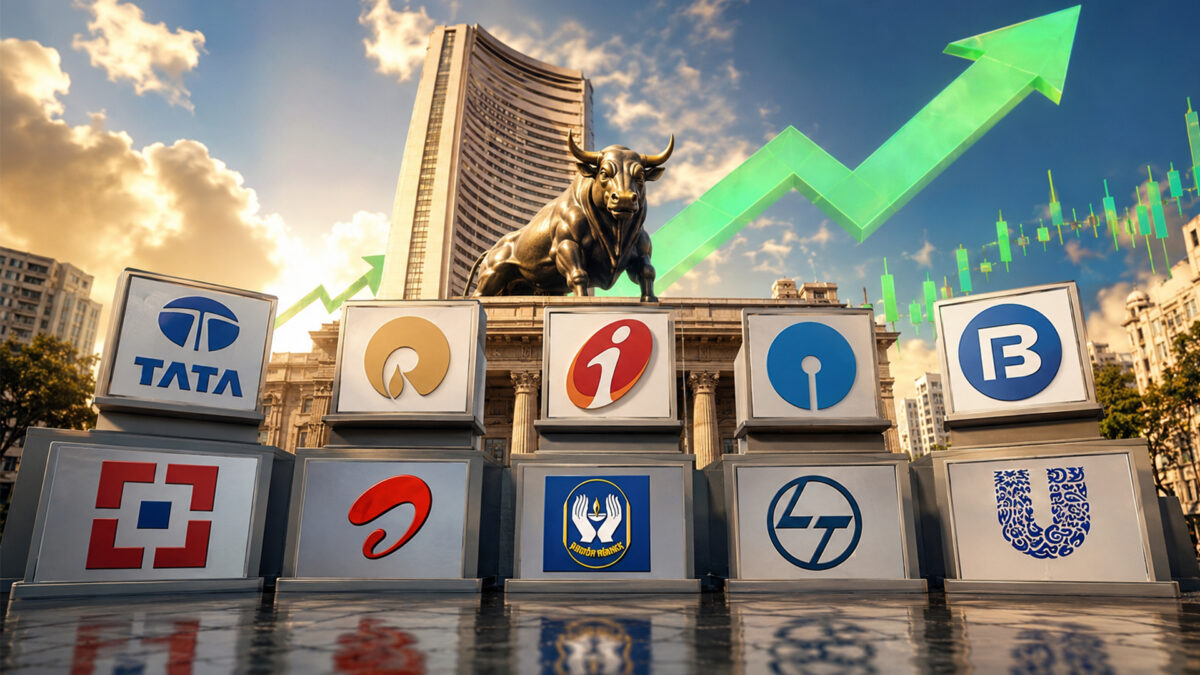
Top 5 firms add ₹1.54 lakh cr market value

India’s biggest listed companies delivered a strong performance on the stock market during the past week, with five of the country’s 10 most-valued firms together adding nearly ₹1.54 lakh crore to their combined market capitalisation. The rally was driven by robust investor interest in blue-chip stocks, with Tata Consultancy Services (TCS) emerging as the biggest wealth creator during the week.

The rise in market value reflects improving investor confidence in fundamentally strong companies despite continued global uncertainties. Healthy corporate earnings, sustained domestic investment and optimism around India’s economic outlook encouraged investors to increase their exposure to leading stocks across information technology, banking and energy sectors.

Among all the companies, TCS recorded the highest jump in market capitalisation. The IT giant added more than ₹72,000 crore to its valuation during the week, making it the biggest contributor to the overall gains. Investor sentiment towards the company improved after its quarterly earnings met market expectations and the management expressed confidence about stronger business momentum in the coming months. The company’s positive outlook reassured investors that demand for technology services is expected to remain resilient despite global economic challenges.

Private sector lender ICICI Bank also witnessed a significant rise in market value, adding more than ₹29,000 crore during the week. Strong financial performance, consistent loan growth and healthy asset quality continued to attract investor interest in the banking major. Financial stocks remained among the preferred choices for investors as expectations of sustained credit growth and stable profitability supported buying activity.

Reliance Industries, India’s most-valued listed company, also contributed to the rally by adding nearly ₹24,000 crore to its market capitalisation. The conglomerate continued to receive support from investors due to its diversified business portfolio spanning energy, retail and digital services. The company’s long-term growth prospects and continued investments in expanding businesses helped maintain positive market sentiment.

Other major gainers included Infosys and HDFC Bank, both of which registered healthy increases in their market valuations during the week. The gains in these companies reflected renewed confidence in India’s leading technology and financial services firms, which continue to remain favourites among both domestic and foreign institutional investors.

Together, these five companies added approximately ₹1.54 lakh crore to their combined market capitalisation, highlighting the strength of India’s large-cap stocks. Market experts believe that investors continue to favour companies with stable earnings, strong balance sheets and proven business models, especially at a time when global markets remain volatile.

However, the week was not positive for every company among India’s top-10 most-valued firms. Five other companies witnessed a decline in their market capitalisation as investors booked profits after recent gains. Despite these losses, the combined increase recorded by the top performers comfortably outweighed the decline, allowing the overall valuation of India’s leading listed companies to move higher.

The latest changes did not significantly alter the hierarchy of India’s biggest listed firms. Reliance Industries retained its position as the country’s most-valued company by market capitalisation. It continued to be followed by HDFC Bank, Bharti Airtel, ICICI Bank, State Bank of India, TCS, Bajaj Finance, Life Insurance Corporation of India (LIC), Larsen & Toubro (L&T) and Hindustan Unilever Ltd (HUL). These companies collectively account for a substantial share of India’s total stock market value and often influence the movement of benchmark indices.

Market capitalisation, commonly referred to as market cap, represents the total value of a company’s outstanding shares. It is calculated by multiplying the current share price by the total number of shares in circulation. A rise in market capitalisation generally indicates growing investor confidence and an increase in shareholder wealth, while a decline reflects weaker market sentiment or profit booking.

Analysts say the latest rally underlines the resilience of India’s equity markets, supported by strong domestic participation, steady inflows from institutional investors and optimism surrounding corporate earnings. Large-cap companies continue to attract investors because they are generally considered more stable during periods of market volatility.

The performance of TCS has been particularly encouraging for the information technology sector, which has faced pressure over the past year due to slower global technology spending. The company’s strong quarterly performance and optimistic guidance have renewed hopes that demand for digital transformation projects could improve in the coming quarters.

With the earnings season gathering pace and investors closely monitoring quarterly results, market participants expect stock-specific movements to remain high in the coming weeks. If corporate earnings continue to meet expectations and macroeconomic conditions remain supportive, India’s leading companies could continue to witness healthy investor interest, strengthening the country’s equity markets further.

Also Read: Sensex slides 440 points, Nifty ends below 24,250

Categories
Corporate

Sensex slides 440 points, Nifty ends below 24,250

The stock market ended lower on Monday as weak earnings from private banking majors and rising geopolitical tensions dampened investor sentiment, prompting broad-based selling across frontline stocks. The BSE Sensex fell 443 points, or 0.57 per cent, to close at 77,708.52, while the NSE Nifty50 slipped 96 points, or 0.40 per cent, to settle at 24,238, ending below the key 24,250 mark.

It was a volatile session for Dalal Street. The Sensex opened on a weak note and extended losses through the day, at one stage plunging nearly 800 points before recovering some ground during the final hour of trade. Despite the late pullback, the benchmarks ended firmly in negative territory, snapping their recent winning run.

The biggest pressure came from the banking pack after the latest June-quarter earnings from private lenders failed to excite investors. Shares of HDFC Bank, Axis Bank and Kotak Mahindra Bank witnessed heavy selling as the Street reacted to concerns over pressure on net interest margins and slower earnings growth. Since these lenders carry significant weight in the benchmark indices, their decline pulled the broader market lower.

Apart from disappointing corporate earnings, global developments also kept investors cautious. Escalating tensions in the Middle East, particularly involving the United States and Iran, pushed crude oil prices higher and raised concerns over inflationary pressures. Higher oil prices could increase India’s import bill and weigh on corporate profitability, prompting investors to reduce exposure to equities.

Among the Sensex constituents, HDFC Bank and Axis Bank emerged as the top losers, followed by Kotak Mahindra Bank, Maruti Suzuki, Infosys, TCS and Mahindra & Mahindra. Weakness in information technology and automobile stocks further added to the selling pressure as investors booked profits in several heavyweight counters.

On the positive side, a few stocks managed to buck the broader market trend. Trent was among the top gainers after attracting fresh buying interest, while NTPC and Power Grid Corporation advanced as investors shifted towards relatively defensive sectors. ICICI Bank also ended in the green after reporting a healthy set of quarterly earnings, helping cushion the losses in the banking space.

Sector-wise, banking and financial services witnessed the sharpest decline, with private lenders leading the losses. Realty stocks also remained under pressure. However, buying in power, metals and select oil and gas shares helped limit the overall damage. The broader market displayed resilience, with several mid-cap and small-cap stocks outperforming the benchmark indices despite the weakness in large-cap counters.

Market experts said Monday’s decline was largely driven by a combination of earnings disappointment and global uncertainty rather than any deterioration in domestic economic fundamentals. Investors remained cautious as they assessed the impact of higher crude oil prices, geopolitical tensions and mixed corporate earnings on the market outlook.

Foreign institutional investor activity also remained in focus. Analysts said global funds are likely to remain selective until there is greater clarity on international developments and the trajectory of corporate earnings. Domestic institutional investors, meanwhile, continued to provide support at lower levels, helping the market recover from its intraday lows.

Attention is now firmly on the ongoing June-quarter earnings season, which is expected to drive stock-specific action over the coming weeks. Several heavyweight companies are scheduled to announce their financial results this week, and investors will closely monitor management commentary for cues on demand trends, margins and future growth prospects.

Market participants will also keep an eye on crude oil prices, foreign fund flows and global economic developments, all of which could influence trading sentiment in the near term.

Although Monday’s decline interrupted the recent rally, analysts believe the broader market remains fundamentally strong. However, they expect volatility to stay elevated in the coming sessions as investors navigate earnings announcements and external risks. Until clearer signals emerge from both corporate India and global markets, traders are likely to remain cautious, while long-term investors may continue to use market dips to accumulate quality stocks.

Also Read: Gujarat tops NITI Aayog investment index

Categories
Corporate

Sensex tumbles over 450 points, Nifty slips below 24,250

Indian equity markets had a rough start to the week as investors turned cautious amid weak global signals, rising crude oil prices and uncertainty surrounding the ongoing earnings season. Heavy selling in banking and heavyweight stocks dragged the benchmark indices lower, with the BSE Sensex falling more than 450 points and the Nifty 50 slipping below the 24,250 mark during Monday’s trade.

The mood on Dalal Street remained subdued from the opening bell. Gift Nifty had already hinted at a weak start, and the selling intensified as the session progressed. Traders chose to trim their positions instead of making fresh bets, keeping the market under pressure throughout the day.

Among the biggest drags on the benchmarks were HDFC Bank and Reliance Industries, both of which witnessed sustained selling. Their decline, coupled with weakness in several financial and blue-chip stocks, pulled the Sensex and Nifty sharply lower. Profit booking in select counters also added to the pressure after the market’s recent gains.

On the brighter side, Axis Bank and ICICI Bank bucked the broader trend to emerge among the day’s top gainers. Buying interest in these banking stocks helped cushion some of the losses, although it was not enough to change the market’s overall direction. A few other quality stocks also attracted selective buying as investors looked for opportunities despite the broader weakness.

One of the biggest concerns for the market was the continued rise in global crude oil prices. Higher oil prices are closely watched by investors because they can push up inflation, increase India’s import bill and put pressure on corporate margins. With geopolitical tensions in parts of the world keeping energy markets on edge, traders preferred to adopt a cautious approach.

Investors also remained focused on the ongoing corporate earnings season. Several companies are scheduled to announce their April-June quarter results this week, and market participants are waiting to see whether earnings can justify current valuations. Any disappointment in corporate performance could keep volatility elevated in the near term.

Foreign institutional investor (FII) activity is another factor keeping traders on alert. While domestic institutional investors have continued to provide support to the market, overseas investors have been selective in their buying amid concerns over global growth, interest rates and geopolitical developments. Their investment decisions are expected to play an important role in determining the market’s near-term direction.

Sector-wise, banking and financial stocks accounted for a large part of the decline, while weakness in heavyweight companies amplified the fall in benchmark indices. However, some defensive stocks witnessed limited buying as investors looked for relatively safer options in an uncertain environment.

With corporate earnings, global developments and foreign investor activity remaining in focus, Dalal Street is expected to stay volatile in the near term. Investors will closely monitor these factors to gauge the next move in the BSE Sensex, Nifty 50 and the broader Indian stock market.

Despite the weak start, it is believed that the broader outlook for Indian equities remains tied to corporate earnings and global developments. If companies deliver stronger-than-expected quarterly numbers and foreign investors return as buyers, sentiment could improve. However, persistent strength in crude oil prices or any escalation in geopolitical tensions may continue to keep markets volatile.

Analysts believe investors should avoid reacting to one day’s decline and instead focus on fundamentally strong companies with healthy earnings prospects. Short-term volatility is likely to remain high, but stock-specific opportunities are expected to emerge as more companies report their quarterly performance.

Analysts say volatility may remain elevated as markets react to both macroeconomic developments and company-specific announcements. Traders are also watching whether the Nifty 50 can hold key support levels after slipping below 24,250, while the BSE Sensex is expected to remain sensitive to movements in banking and energy stocks. Any improvement in global sentiment could trigger selective buying in quality counters.

Also Read: JioStar’s Q1 revenue climbs 14%

Categories
Corporate

JioStar’s Q1 revenue climbs 14%

JioStar has reported a strong start to the financial year, posting ₹10,946 crore in revenue for the first quarter as the Indian Premier League (IPL) continued to fuel growth across its television and digital businesses. The media and entertainment company also recorded a sharp rise in operating profit, reflecting the success of its sports broadcasting strategy and expanding digital audience.

According to the company’s latest financial results, Q1 revenue grew 14% year-on-year, supported largely by advertising and subscription income generated during the IPL season. The tournament once again proved to be one of India’s biggest media events, attracting millions of viewers across television and streaming platforms.

JioStar’s operating EBITDA surged 307% year-on-year, highlighting improved operational efficiency and stronger monetisation of premium content. The company attributed the sharp jump in profitability to higher advertising revenue, increased subscriber engagement and disciplined cost management.

The quarter marked the first full reporting period after the formation of JioStar, created through the merger of Reliance Industries-backed Viacom18 and Disney Star’s India business. The integration has brought together some of India’s biggest television channels, digital streaming services and sports broadcasting rights under a single media network.

A major contributor to the company’s performance was its exclusive coverage of the IPL, one of the world’s most valuable cricket tournaments. The league continued to attract record viewership, helping JioStar strengthen its position across both linear television and digital streaming.

Advertising remained a key growth driver during the quarter. Brands across sectors, including consumer goods, automobiles, financial services and technology, increased spending to reach the IPL’s massive audience. The cricket tournament traditionally attracts some of the highest advertising rates in Indian media, making it a crucial revenue generator for broadcasters.

Subscription revenue also improved as viewers increasingly consumed premium sports and entertainment content through JioStar’s digital platforms. The company has been focusing on expanding its streaming ecosystem by offering live sports, movies, television shows and original programming to a growing base of users.

The results underline the importance of live sports broadcasting in India’s media landscape. Cricket, especially the IPL, continues to be one of the strongest drivers of television ratings, digital engagement and advertising revenue. As more consumers shift towards connected devices and mobile streaming, companies with premium sports rights are expected to benefit significantly.

The company’s financial performance also reflects broader trends in India’s rapidly evolving media industry. While traditional television remains an important platform, digital streaming is witnessing faster growth as audiences increasingly watch content on smartphones, tablets and smart TVs.

JioStar’s integrated approach allows advertisers to reach audiences across multiple platforms through a single network. This cross-platform strategy has become increasingly valuable as brands seek unified campaigns that combine television, digital video and live streaming.

The merger has also strengthened JioStar’s content portfolio, giving it access to a wide range of entertainment channels, regional programming, international content and major sporting events. This diversified offering is expected to help the company attract more subscribers while maintaining strong advertising demand throughout the year.

Media experts say the strong quarterly results demonstrate the commercial value of premium sports rights in India’s highly competitive entertainment market. With cricket remaining central to viewer engagement, broadcasters continue investing heavily in acquiring long-term media rights for marquee tournaments.

Looking ahead, JioStar is expected to focus on further integrating its operations, expanding digital offerings and increasing monetisation opportunities through advertising, subscriptions and premium content. Upcoming sporting events and festive-season programming are also likely to support audience growth in the coming quarters.

The company believes its combined television and digital ecosystem places it in a strong position to capitalise on changing consumer viewing habits. As audiences increasingly prefer watching content across multiple screens, JioStar aims to deliver a seamless entertainment experience while strengthening its leadership in India’s media and streaming market.

The robust first-quarter performance highlights how premium sports content continues to reshape India’s entertainment business. With IPL media rights, digital streaming, sports broadcasting and advertising revenue driving growth, JioStar has begun the financial year on a strong note. The results also signal growing confidence in India’s media sector, where live sports remain one of the biggest engines of audience engagement and business growth.

Also Read: Apple regains world’s most valuable company title