Categories
Beyond

India’s $5 trillion goal delayed, growth strong

The International Monetary Fund (IMF) says India’s economy continues to grow steadily, but the country may reach the $5 trillion GDP mark a year later than previously expected. The new estimate now points to fiscal year 2028‑29, instead of 2027‑28. The main reasons for the delay are a weaker rupee and slower growth in GDP when measured in dollar terms.

Despite the delay, India remains one of the fastest-growing major economies in the world. Strong domestic demand, robust consumer spending, and healthy growth in services and manufacturing are helping the economy stay on track. Inflation is also under control, which supports stable prices and living costs.

The IMF forecasts that India’s economy will grow by 6.6% in FY2025‑26 and 6.2% in FY2026‑27. Even with the $5 trillion milestone pushed back, the underlying growth story remains strong. Policymakers will need to focus on sustaining domestic growth, managing inflation, and keeping the rupee stable to maintain momentum.

Also Read: Deloitte report in Canada faces AI citation controversy

Categories
Beyond

Gold dips ₹450, silver down ₹700 ahead of Fed jitters

Gold prices eased on Thursday as traders booked profits following a steady rise over the past few sessions. On the Multi Commodity Exchange (MCX), December gold futures slipped around 0.36% to nearly ₹1,25,480 per 10 grams in early trade. Silver prices also softened, with futures hovering close to ₹1,60,950 per kg. The dip is largely seen as a temporary correction rather than a shift in trend.

The focus of global markets now shifts to the U.S. Federal Reserve, which is set to review its interest-rate policy next week. Investors are anticipating signals on whether the Fed will begin cutting rates in the coming months. Recent U.S. economic data, including slower retail sales and cooling inflation, has strengthened expectations of monetary easing, an outcome generally positive for gold.

A weaker U.S. dollar this week has also lent support to bullion, as a softer dollar makes gold more attractive for international buyers. However, analysts caution that the metal may continue to face short-term volatility depending on how the dollar and U.S. Treasury yields move ahead of the policy announcement.

In the domestic market, experts believe gold will trade within a narrow band. Key support levels lie around ₹1,24,350–₹1,23,580 per 10 grams, while resistance is expected near ₹1,25,850–₹1,26,500. Globally, support is estimated around $4,100 per ounce.

Traders see Thursday’s decline as a healthy pullback after recent gains, with the broader outlook remaining cautious but stable. The Fed’s commentary will be the next major trigger that could shape gold’s direction in the short term.

Also Read: Sensex tops 86,000, Nifty crosses 26,300

Categories
Beyond

Apollo Micro, IIT-Chennai, Navy partner for defence tech

Apollo Micro Systems (AMS) has entered into a three-way Memorandum of Understanding with IIT-Chennai and the Indian Navy’s Directorate General of Naval Armament Inspection (DGNAI) to fast-track the development of indigenous defence technologies. The agreement was formalised at the Swavalamban 2025 event in New Delhi on 25 November.

The partnership brings together three crucial strengths,  academic research, industrial manufacturing, and military operational expertise. Under the arrangement, IIT-Chennai will focus on research, conceptual design and technology development. Apollo Micro Systems will take these concepts forward by building prototypes, refining them for real-world use and enabling large-scale manufacturing. The DGNAI will guide the development with domain knowledge, oversee testing, and ensure compliance with military standards before any system is deployed.

The pact aims to address both current and future defence needs, especially in critical areas such as electronic-warfare systems, precision-guidance technologies, advanced control systems and high-energy armament solutions. Many of these innovations can later be adapted for the Army, Air Force and even space-related applications.

AMS’ leadership described the alliance as a powerful model for strengthening India’s defence ecosystem,  one that blends innovation from academia with industrial capability and operational insight. The company believes this partnership will support the country’s long-term goal of reducing dependence on imported defence technology.

The announcement generated strong market interest, with AMS shares rising around 5% after the MoU was made public, reflecting investor optimism about future defence orders and the company’s expanded role in the indigenisation push.

The collaboration is expected to accelerate the journey from lab-scale research to field-ready systems, reinforcing India’s efforts to build advanced, home-grown defence capabilities under the Aatmanirbhar Bharat mission.

Also Read: Adani Enterprises opens ₹24,930 crore rights issue

Categories
Beyond

India approves ₹7,280 cr plan to make rare-earth magnets

The Indian government has given the green light to a ₹7,280 crore plan to manufacture rare-earth permanent magnets domestically. These magnets are essential for electric vehicles, wind turbines, consumer electronics, aerospace, and defence equipment. The move is part of India’s strategy to reduce reliance on imports, particularly from China.

The scheme will support setting up integrated manufacturing units that cover the full production process, from refining rare-earth materials into metals, making alloys, to producing finished magnets. The total planned production capacity is 6,000 metric tons per year.

Currently, India imports most of these magnets. With demand expected to rise sharply by 2030 due to electric mobility and renewable energy growth, domestic production will help secure supply and strengthen technological independence.

Under the plan, ₹6,450 crore will be provided as sales-linked incentives to companies over five years, while ₹750 crore will fund capital support to set up factories. Up to five companies, domestic or international, will be selected through a competitive process, with each allowed to produce up to 1,200 metric tons annually.

The project is expected to take seven years: two years for factory setup and five years for production under the incentive scheme.

Experts say the initiative will not only reduce imports but also create jobs, strengthen India’s clean-energy and tech sectors, and support the country’s long-term goal of reaching net-zero emissions by 2070. By building this domestic capacity, India aims to meet growing demand, boost self-reliance, and strengthen its position in critical high-tech industries.

Also Read: Oil prices fall 1.5% as Ukraine backs peace deal

Categories
Beyond

Oil prices fall 1.5% as Ukraine backs peace deal

Oil prices slipped on Tuesday after Ukraine indicated it might support a US-backed framework for a peace deal with Russia. The move raised the possibility that Western sanctions on Russian energy could be relaxed, potentially allowing more Russian crude to enter global markets. This expectation put downward pressure on oil prices.

Brent crude, the global benchmark, fell about 1.4% to US$62.48 a barrel, while West Texas Intermediate (WTI) crude, the US benchmark, dropped 1.5% to US$57.95. These levels were the lowest since October 22, reflecting investor caution amid the news.

Analysts say that if sanctions on Russian energy are lifted, the global oil market could see a supply glut, which tends to lower prices. While the news of possible Ukrainian support for a peace deal sparked a drop, market participants remain cautious. Ukraine and Russia still have key differences to resolve, and uncertainty about the final terms of any agreement is keeping some investors wary.

In addition to supply concerns, oil traders are monitoring global demand signals. Economic factors, such as possible interest rate cuts by central banks, could affect consumption and offset some of the downward pressure from increased supply.

Overall, the oil market is balancing between optimism about a potential end to the war and the realities of ongoing geopolitical tensions. Investors are carefully watching developments in peace negotiations, changes in sanctions, and global economic indicators to gauge where prices might head in the coming weeks.

Also Read: Alphabet nears $4 trillion market on AI gains

Categories
Beyond

Gold rises to ₹1,27,050, silver up at ₹1,67,100

Gold and silver opened slightly higher on Wednesday, reflecting steady demand and positive global cues. The price of 24-carat gold moved up by ₹10, bringing it to ₹1,27,050 per 10 grams. Silver also saw a mild rise, gaining ₹100 to trade at ₹1,67,100 per kilogram.

The increase wasn’t dramatic, but it shows that buyers are slowly returning to precious metals as expectations grow that the US Federal Reserve may cut interest rates in December. Lower interest rates typically make gold more attractive since it becomes easier for investors to shift money into safe-haven assets.

In the 22-carat category, gold was priced at ₹1,16,460 per 10 grams. Rates varied slightly across major cities: Mumbai and Kolkata saw 24-carat gold at ₹1,27,050, while Chennai quoted a slightly higher price of ₹1,27,870.

Overall, the market remains cautious but optimistic, with traders watching global economic signals closely. Precious metals could see more movement in the coming weeks depending on how rate-cut expectations evolve.

Also Read: Sensex jumps 600+ points, Nifty crosses 26,050

Categories
Beyond

SEBI proposes changes to basic demat accounts

The Securities and Exchange Board of India (SEBI) has proposed changes to the framework governing Basic Services Demat Accounts (BSDA), a low-cost demat facility designed for small investors. The draft regulations aim to make account eligibility assessment fairer, more transparent, and easier to manage.

Under the proposed changes, delisted securities, shares removed from stock exchange trading will no longer be considered when calculating BSDA holdings. SEBI noted that delisted shares often lack a market price, making it difficult to assess their real value. Similarly, Zero Coupon Zero Principal (ZCZP) bonds, which are non-transferable and do not provide any principal or interest return, will be excluded from valuation. Including these instruments previously inflated an investor’s account value artificially, potentially disqualifying them from BSDA benefits.

For listed but illiquid securities, SEBI proposes using their last traded price for BSDA eligibility purposes. Promoter individuals holding securities will not be subject to these valuation changes.

Another key recommendation is to replace the current billing-cycle-based reassessment of BSDA eligibility with a uniform quarterly system-driven review, standardizing the process across investors. Additionally, SEBI has suggested allowing investors to provide required consents through authenticated methods beyond registered email IDs, making the process more convenient.

SEBI said these measures aim to simplify account management, improve financial inclusion, and ensure that low-cost demat services benefit genuine small investors. The regulator has invited public comments on the draft proposal until 15 December 2025.

With these changes, SEBI hopes to ensure that BSDA holders are evaluated based on active and real investments, rather than on securities that are non-tradable, illiquid, or have no market value, thereby improving transparency and usability of the system for retail investors.

Also Read: Bitcoin slides 21% in November, sparks concern

Categories
Beyond

Bitcoin slides 21% in November, sparks concern

Bitcoin, the world’s largest cryptocurrency, has plunged 21% in November, recording its steepest monthly decline since June 2022. The digital currency fell from around US$126,000 in early October to below US$81,000 by late November, shedding nearly a third of its value in just over a month.

The sell-off has been driven by several factors. Large outflows from crypto exchange-traded funds (ETFs) contributed heavily to the decline, with one fund alone seeing close to US$3 billion withdrawn this month. Such withdrawals signal reduced investor confidence and have added pressure on prices.

Forced liquidations of leveraged positions also played a major role. Many traders who had bet on Bitcoin’s rise with borrowed funds were forced to sell as prices dropped, triggering a cascade of selling across the market. Analysts note that this has intensified volatility, especially in a market where large holders, often called “whales,” can sway prices significantly.

Global economic uncertainty, particularly concerns about interest rates and regulatory policies, has further contributed to investor caution. High-risk assets such as cryptocurrencies are being sold off in favor of safer investments, adding to the downward pressure.

Despite strong gains over the past two years,  153% in 2023 and 122% in 2024,  this sudden correction underscores the volatile nature of the crypto market. Market experts suggest that while short-term losses may continue, long-term investors could view the current dip as a potential buying opportunity, provided they can tolerate high levels of risk.

Also Read: Trump’s “Gold Card” lets wealthy buy US residency

Categories
Beyond

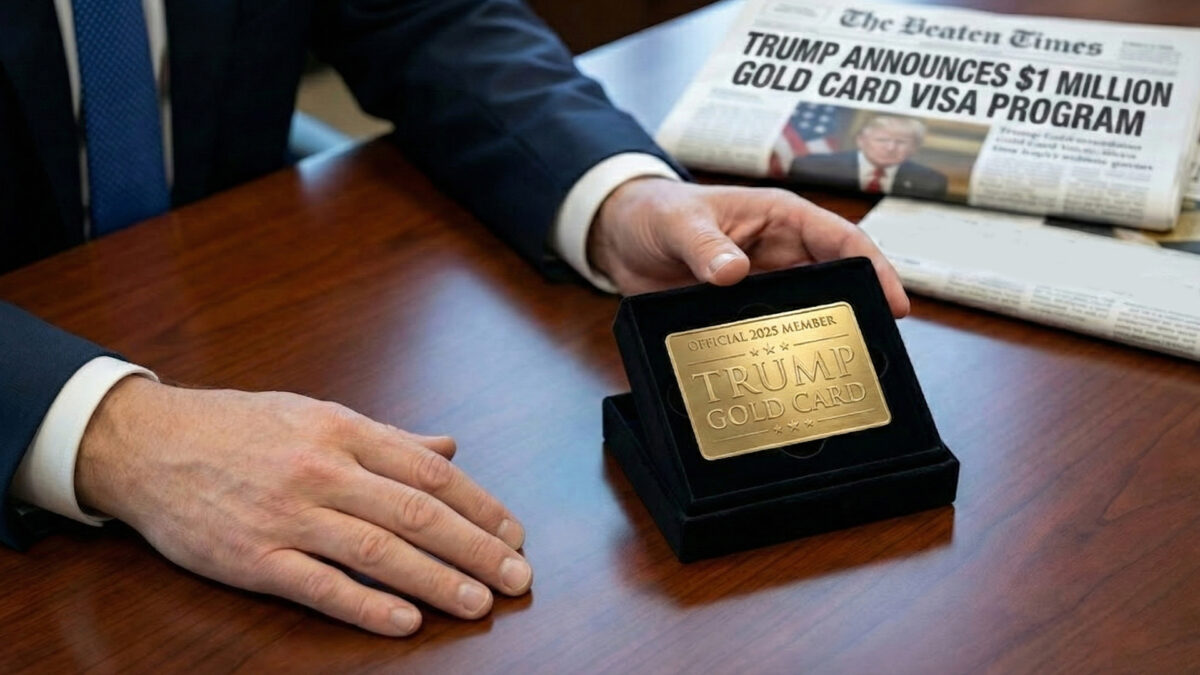
Trump’s “Gold Card” lets wealthy buy US residency

Donald Trump’s team is preparing a new “Gold Card” visa that could let wealthy foreigners secure US. permanent residency,  essentially a green card, by making a financial contribution to the U.S. government. The draft petition for the program is expected to be ready by December 18, 2025, giving prospective applicants a clear timeline to apply.

Under the plan, individuals must first pay a $15,000 non-refundable application fee. Once approved, they will need to make a $1 million gift to the US Treasury. Companies wishing to sponsor employees through the program would face higher costs, around $2 million per employee.

The Gold Card aims to provide a fast-track route to lawful permanent residency, possibly under existing visa categories such as EB‑1 or EB‑2. However, applicants will be subjected to rigorous checks, including verification of criminal records, tax filings, and the legal source of their funds. Those applying from outside the US would likely go through consular processing, while current residents may have options to adjust their status.

For the ultra-wealthy, a Platinum Card is also being considered. At $5 million, this version would allow holders to live in the US. for up to 270 days a year and enjoy favorable tax treatment on income earned abroad.

While supporters argue the program could inject billions into the US economy, critics say it essentially allows the super-rich to “buy” residency, favoring wealth over merit or traditional immigration paths. As the proposal moves through regulatory review, further details, including eligibility rules and application procedures, are expected to emerge.

The Gold Card is part of a broader push by Trump’s administration to attract high-net-worth individuals, while also generating revenue for the US Treasury and potentially stimulating economic growth.

Also Read: RBI may cut interest rates in December

Categories
Beyond

RBI may cut interest rates in December

The Reserve Bank of India (RBI) sees room to lower its key policy rate, the repo rate, in its December meeting. This comes as inflation is very low and the economy is growing steadily.

RBI Governor Sanjay Malhotra said recent data shows the central bank could consider a rate cut. Retail inflation rose just 0.25% in October, the lowest in years. Food prices are falling, and both manufacturing and services are showing growth.

Good rainfall this year has filled reservoirs, supporting crop sowing and keeping supply strong. The rupee has weakened slightly against the US dollar, but the RBI is focused on controlling volatility rather than targeting a specific level.

While the central bank sees space to cut rates, the final decision will be taken by the Monetary Policy Committee (MPC) in December. If rates are reduced, borrowing could become cheaper for businesses and individuals, supporting investment and economic growth.

Also Read: Google and Accel partner to boost India’s AI startups