Categories
Corporate

Amazon to cut 370 jobs at its European headquarters

Amazon has announced that it will cut 370 jobs at its European headquarters in Luxembourg. This is the largest round of layoffs the company has carried out at this office so far.

The job cuts will affect around 8.5 per cent of employees working at the Luxembourg location. Amazon currently has more than 4,300 staff there. The layoffs are expected to begin in early 2026, after talks with employee representatives and approval from local authorities, as required by European labour laws.

Earlier, Amazon had planned to cut up to 470 jobs. However, after discussions with worker unions and the Luxembourg government, the number was reduced to 370. The company has also agreed to provide severance pay and support to employees who lose their jobs. Amazon said this support goes beyond what is legally required.

Reports suggest that software engineers, technical teams and corporate staff will be among the most affected. Many technology companies are cutting jobs as they increase the use of artificial intelligence and automation to improve efficiency and reduce costs.

Amazon CEO Andy Jassy has said the company is trying to simplify its operations. Over the past year, Amazon has already laid off thousands of corporate employees worldwide as part of this strategy.

Despite the job cuts, Amazon said it will continue its operations in Luxembourg, which remains an important base for its European business. The company added that it will still hire for key roles where needed.

For many employees, the announcement has created uncertainty, especially for those who moved from other countries to work in Luxembourg. They may have limited time to find new jobs due to visa rules.

The move shows how even large global companies are changing their workforce plans as business priorities and technology continue to evolve.


Also Read: SEBI makes mutual funds cheaper for investors

Categories
Beyond

SEBI makes mutual funds cheaper for investors

The Securities and Exchange Board of India (SEBI) has announced new rules to make mutual funds cheaper and more transparent for investors. These rules will start from 1 April 2026.

One major change is that SEBI has cut the maximum fees mutual funds can pay for buying and selling shares. For regular stock trades, fees will drop from 0.12% to 0.06%, and for derivatives trades, from 0.05% to 0.02%. This will reduce the trading costs that affect investors’ returns.

SEBI is also changing how mutual fund costs are shown. Funds will now display a Base Expense Ratio, which includes main costs like fund management and running the fund. Other charges like taxes and stamp duties will be listed separately. This makes it easier for investors to see what they are paying for.

Another important change is that SEBI has removed the extra 0.05% fee that some funds charged when investors sold their units early. This will further lower hidden costs.

SEBI says these changes are meant to protect investors and make fees clearer, not just reduce them. Experts say the effect on costs will differ between funds, but overall, many investors are likely to benefit.

Also Read: B. Sairam appointed chairman of Coal India Limited

Categories
1 Minute-Read

Fiserv finalises StoneCastle acquisition

Fiserv has completed its acquisition of StoneCastle Cash Management, significantly enhancing its deposit and liquidity solutions for financial institutions.

The integration combines StoneCastle’s institutional deposit network with Fiserv’s core account processing, digital banking, and payment platforms, enabling banks to access broader funding options and improved cash management. The acquisition also supports digital asset services, including stablecoins and FIUSD solutions.

Regulatory approvals and customary closing conditions were met, and the deal aims to strengthen client relationships while providing innovative deposit liquidity alternatives for merchants. Financial terms of the acquisition were not disclosed.

Categories
Leaders

B. Sairam appointed chairman of Coal India Limited

B. Sairam has taken charge as the Chairman‑cum‑Managing Director (CMD) of Coal India Limited (CIL), India’s largest coal producer, effective 15 December 2025, according to a company filing. He succeeds Sanoj Kumar Jha, who had been holding the additional charge of the CMD post. The Ministry of Coal appointed Sairam for the role, which will continue until 31 March 2028, the date of his retirement, or until further orders, whichever comes first.

Sairam brings over three decades of experience in the coal and mining sector. Prior to this appointment, he served as the CMD of Northern Coalfields Ltd., a key subsidiary of Coal India. His career spans leadership roles in mine operations, project planning, logistics management, regulatory affairs, and rehabilitation programmes. Analysts expect his experience to be crucial as Coal India navigates challenges such as increasing domestic coal demand, operational efficiency, and environmental compliance.

Coal India Limited, a Maharatna public sector company under the Ministry of Coal, contributes significantly to India’s energy supply, producing more than 80% of the country’s coal. The company’s operations are critical for sustaining power generation and supporting industrial growth.

The appointment of Sairam comes at a time when the government is focusing on enhancing domestic coal production, reducing imports, and ensuring a stable supply for power plants. His leadership is anticipated to strengthen Coal India’s operational efficiency and align its growth with national energy objectives.

Also Read: Ford cancels $6.5 billion EV battery deal with LG

Categories
Corporate

Warner Bros rejects Paramount, pushes Netflix merger forward

Warner Bros Discovery has officially rejected a $108.4 billion takeover bid from Paramount Skydance, calling it risky and inadequately financed. In a letter to shareholders, the company’s board urged investors to turn down Paramount’s offer and instead approve the existing agreement with Netflix, which it described as a stronger, more secure deal.

Paramount had proposed an all-cash offer of $30 per share to acquire Warner Bros Discovery. While the bid appeared attractive in cash terms, the Warner Bros board highlighted concerns about its financing structure, noting that the deal was not fully secured and could be altered or withdrawn. This uncertainty, the board said, made the Paramount proposal inferior to Netflix’s binding offer.

Under the Netflix agreement, the streaming giant would acquire Warner Bros’ studios, the HBO Max service, and other assets for roughly $82–83 billion, including a combination of cash and Netflix stock. Warner Bros emphasized that the Netflix deal has solid financing and does not rely on uncertain outside funding, offering greater certainty to shareholders.

Paramount and its investors, which include the Ellison family and other backers, have argued that their all-cash bid offers immediate value and clarity to shareholders. Paramount has been actively reaching out to investors to press its case. However, Warner Bros cautioned that accepting the Paramount bid could trigger significant costs, including paying a breakup fee to Netflix if the current merger falls through, as well as potential debt and operational risks.

The board also noted that Paramount’s offer could lead to future restrictions on Warner Bros’ operations and financial stability, citing concerns over debt obligations and market conditions. The company stressed that shareholders should weigh these risks before making any decision.

No date has been announced for the shareholder vote on the Netflix deal, but analysts expect it could take place in spring or early summer 2026. Meanwhile, Warner Bros Discovery remains focused on completing the Netflix merger, which it believes offers the best long-term value and stability for shareholders and the company’s future growth.

Also Read: Nephrocare Health shares list at 7% premium over IPO price

Categories
Beyond

Gold at ₹1,34,520, silver climbs to ₹2,08,100

Gold and silver prices in India moved slightly higher in early trade on Thursday, December 18. The rise reflects steady demand and supportive global trends in the bullion market.

The price of 24-carat gold increased by ₹10, taking the rate to ₹1,34,520 per 10 grams in major cities such as Mumbai and Kolkata. In Delhi, 24-carat gold was quoted slightly higher at ₹1,34,670 per 10 grams. 22-carat gold also saw a marginal increase of ₹10 and was trading at around ₹1,23,310 per 10 grams in key markets.

Silver prices showed a stronger move compared to gold. The price of silver rose by ₹100, with one kilogram trading at ₹2,08,100 in Delhi, Mumbai and Kolkata. In Chennai, silver continued to trade at a premium compared to other cities.

Market participants said precious metal prices remain supported by global cues, including expectations around interest rates and ongoing geopolitical uncertainties. However, the day’s movement was limited, indicating cautious sentiment among investors.

As such, gold and silver continue to hold firm, with prices hovering near record levels despite small day-to-day fluctuations.

Also Read: India gains edge as exports beat US tariffs

Categories
Corporate

Sensex flat at opening, Nifty below 25,850

The markets opened on a subdued note on Thursday, with benchmark indices trading in a narrow range as investors remained cautious amid mixed global signals and the absence of strong domestic cues. The BSE Sensex was largely flat in early trade, while the Nifty50 slipped below the 25,850 mark, reflecting muted sentiment on Dalal Street.

At the opening bell, selling pressure was visible in the auto sector, which emerged as the key drag on the benchmarks. Shares of Maruti Suzuki and Mahindra & Mahindra declined, pulling the auto index lower. Weakness was also seen in select pharma stocks, with Sun Pharma among the early losers. Other stocks trading in the red included Tata Steel, NTPC, Kotak Mahindra Bank, and SBI Life Insurance, adding to the cautious tone.

However, losses were partly capped by gains in select banking and IT stocks. State Bank of India (SBI) opened higher, while IT majors Tata Consultancy Services (TCS) and Tech Mahindra traded with modest gains. Shriram Finance also saw early buying interest, providing some stability to the benchmarks.

Broader markets showed a softer trend, with mid-cap and small-cap stocks under pressure, indicating risk-averse positioning by investors at the start of the session. Market participants continued to track global market movements, foreign fund flows, and upcoming macroeconomic cues for direction.

Also Read: Sensex falls 120 points, Nifty slips below 25,850

Categories
Corporate

Nephrocare Health shares list at 7% premium over IPO price

Shares of Nephrocare Health Services Ltd. made a positive start on the stock market on Tuesday. The stock listed at around 7 percent above its IPO price, signalling steady investor confidence.

On the NSE, Nephrocare shares opened near ₹490, while on the BSE they listed at about ₹491.70. The IPO price was fixed at ₹460 per share. The listing was in line with market expectations and supported by stable overall market conditions.

The company’s ₹871-crore IPO saw strong interest from investors. The issue was subscribed more than 14 times. Institutional investors led the demand, showing confidence in the company’s long-term prospects. Participation from non-institutional investors was also healthy. Retail demand remained moderate.

Nephrocare Health Services is a leading provider of dialysis care in India. It operates under the NephroPlus brand. The company runs one of the largest organised dialysis networks in the country, with over 500 centres across India and a presence in select international markets. Its centres operate both within hospitals and as standalone units.

The IPO included a fresh issue of shares and an offer for sale by existing shareholders. Funds raised from the fresh issue will be used mainly to reduce debt, improve the balance sheet, and support the expansion of dialysis centres. A portion will also be used for general corporate needs.

Market experts said the steady listing reflects cautious optimism around healthcare service companies. Such businesses offer predictable demand and long-term growth potential. However, future performance will depend on execution, cost control, and the pace of expansion.

For investors who received shares, the listing delivered immediate gains. Going forward, the stock’s movement will be shaped by earnings growth, expansion plans, and broader market sentiment.Also Read: KSH International IPO subscribed 21% on day 2

Categories
1 Minute-Read

India gains edge as exports beat US tariffs

India’s exports to the United States rose over 22% in November, defying steep US tariffs imposed by the Trump administration.

Total exports reached their highest November level in a decade, easing fears of a tariff-driven slump. The rise gives India leverage in ongoing trade talks, reducing pressure to make immediate concessions.

Analysts say the resilient performance signals India’s economy can withstand trade tensions, potentially supporting calls to lower reciprocal duties.

This export growth strengthens New Delhi’s negotiating position with Washington amid stalled discussions on tariffs and trade barriers.

Categories
Corporate

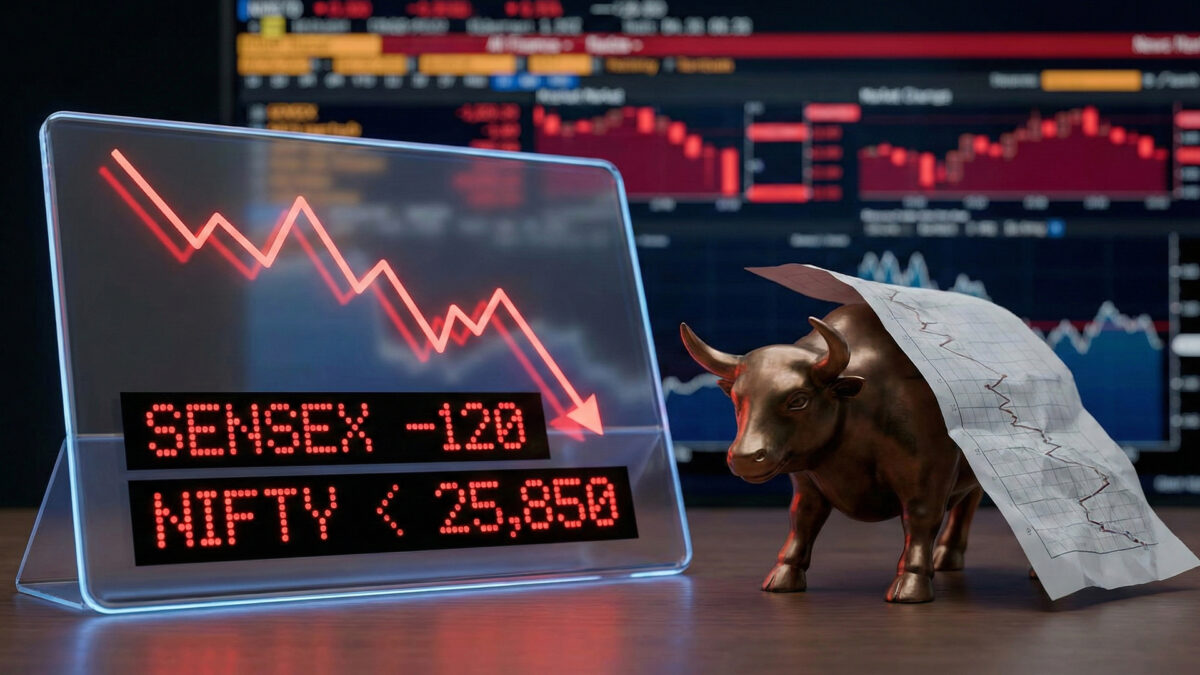
Sensex falls 120 points, Nifty slips below 25,850

The market ended lower on Wednesday, with both major indices closing in the red amid cautious investor sentiment. The BSE Sensex fell 120 points to close at 84,559, while the NSE Nifty 50 slipped below 25,850, settling at 25,818.

Leading the losses were key banking stocks, with HDFC Bank and ICICI Bank dragging the market down. Other prominent losers included Trent, Adani Ports, and Bajaj Finserv, which fell between 1% and 2% during the session. These declines outweighed gains in some segments, keeping the benchmarks under pressure.

On the positive side, public sector banks performed well, with the PSU Bank index rising around 1.2%. This was a rare bright spot amid a broad selloff. However, other sectors such as media, private banks, real estate, consumer durables, FMCG, and healthcare ended lower, reflecting a cautious mood among investors.

The weakness also extended to broader market indices. Mid-cap stocks fell approximately 0.5%, while small-cap stocks lost around 0.7%, indicating that the market pressure was not limited to the largest companies alone.

Market analysts attributed the decline to subdued global cues and ongoing concerns in the domestic financial sector. With major banking counters under pressure, investors appeared cautious, and buying momentum remained muted throughout the trading day.

Overall, the market showed a defensive tone, with losses concentrated in financial and consumer sectors, while select public sector banks provided limited support. Investors are expected to monitor upcoming earnings reports and global developments closely for market direction.

Also Read: Sensex slips 100 points, Nifty below 25,850