Categories
Beyond

Gold nears ₹1.53 lakh, silver tops ₹2.35 lakh

Gold and silver prices moved higher in domestic futures trading on February 18 as investors returned to bullion after the previous session’s fall.

On the Multi Commodity Exchange (MCX), gold contracts for April delivery climbed close to ₹1.53 lakh per 10 grams in early trade, gaining more than 1 per cent. Silver performed even better, rising over 2 per cent to trade above ₹2.35 lakh per kilogram. The rebound came after both metals had witnessed profit-booking and sharp corrections earlier.

In the international market, gold recovered from lower levels as investors continued to treat the metal as a safe-haven asset amid geopolitical tensions and uncertainty over the US Federal Reserve’s future rate decisions. Silver also bounced back in global trade, helping domestic prices strengthen.

Analysts said the current uptrend is being driven by bargain buying at lower levels and strong underlying demand. India’s ongoing wedding season has kept jewellery purchases steady, while recent data showing a sharp rise in gold and silver imports indicates robust consumption as well as investment interest.

However, market experts believe volatility will persist in the short term. Movements in the dollar index, global bond yields and fresh cues from international economic developments are likely to influence bullion prices. Any strengthening of the US currency could limit sharp gains.

Traders are therefore adopting a cautious strategy, preferring to buy on dips while booking profits at higher levels.

Also Read: Sensex dips 100+ points, Nifty slips under 25,800

Categories
1 Minute-Read

Indian Railways tests LNG-powered DEMU trains

Indian Railways has conducted trials of Diesel Electric Multiple Unit (DEMU) trains powered partly by liquefied natural gas (LNG), marking a step toward cleaner rail operations.

INOX India Limited supplied cryogenic LNG storage and regasification systems, allowing each 1,400 HP power car to run on a mix of diesel and LNG, replacing up to 40 % of diesel consumption.

The pilot trains completed successful runs at Sabarmati, Ahmedabad, with plans to expand LNG usage across more units. This initiative aims to reduce fuel costs and lower greenhouse gas emissions on regional routes.

Categories
1 Minute-Read

Apple adds video to podcasts

Apple is overhauling Apple Podcasts to include video, letting users watch and listen to episodes with picture-in-picture playback and offline downloads.

Launching this spring with iOS 26.4, iPadOS 26.4, and visionOS 26.4, the update uses HTTP Live Streaming (HLS) to support adaptive video and dynamic ads, including host-read spots. Apple partners with hosts like Acast, ART19, Omny Studio, Simplecast, and AdsWizz to simplify video distribution across devices.

With rising demand, 37% of U.S. adults watch video podcasts, Apple aims to keep creators and audiences on its platform while competing with YouTube, Spotify, and Netflix.

Categories
Corporate

Sensex surges 283 points, Nifty climbs above 25,800

The stock market ended Wednesday, on a positive note, with benchmark indices rising on strong sectoral support. The S&P BSE Sensex climbed 283 points to 83,734, while the Nifty50 closed above 25,800 at 25,819, extending a short-term recovery seen over recent sessions.

Investor optimism was driven by gains in metal producers, public sector banks, and select consumer stocks, which offset weakness in other sectors. Financial and metal shares led the upside, supporting a broader market rally. Both midcap and smallcap indices also ended higher, showing wider market participation.

Among the top performers, Tata Steel stood out with a notable rise, while PSU leaders like State Bank of India (SBI) and ITC posted solid gains. Axis Bank and Mahindra & Mahindra also saw healthy buying interest, reflecting renewed confidence in cyclical and industrial names.

However, gains were tempered by weakness in the IT sector. Stocks such as Infosys, Tech Mahindra, and HCL Technologies faced selling pressure, keeping the IT index below the broader market. Analysts noted that concerns over global growth and profit-taking in technology shares contributed to this underperformance.

The day began with a flat opening, but sectoral rotation helped indices pick up pace as the session progressed. Global markets provided mixed cues: Asian equities traded higher, while U.S. futures indicated modest gains. Crude oil prices and rupee movement kept traders cautious, prompting selective buying rather than broad-based exuberance.

Commodity movements also influenced specific sectors, with gold prices rebounding and select midcap stocks seeing intraday recoveries. Analysts said the market may consolidate near current levels in the coming sessions, with attention focused on sector-specific trends and global developments.

Also Read: YouTube faces global outage, millions affected

Categories
Leaders

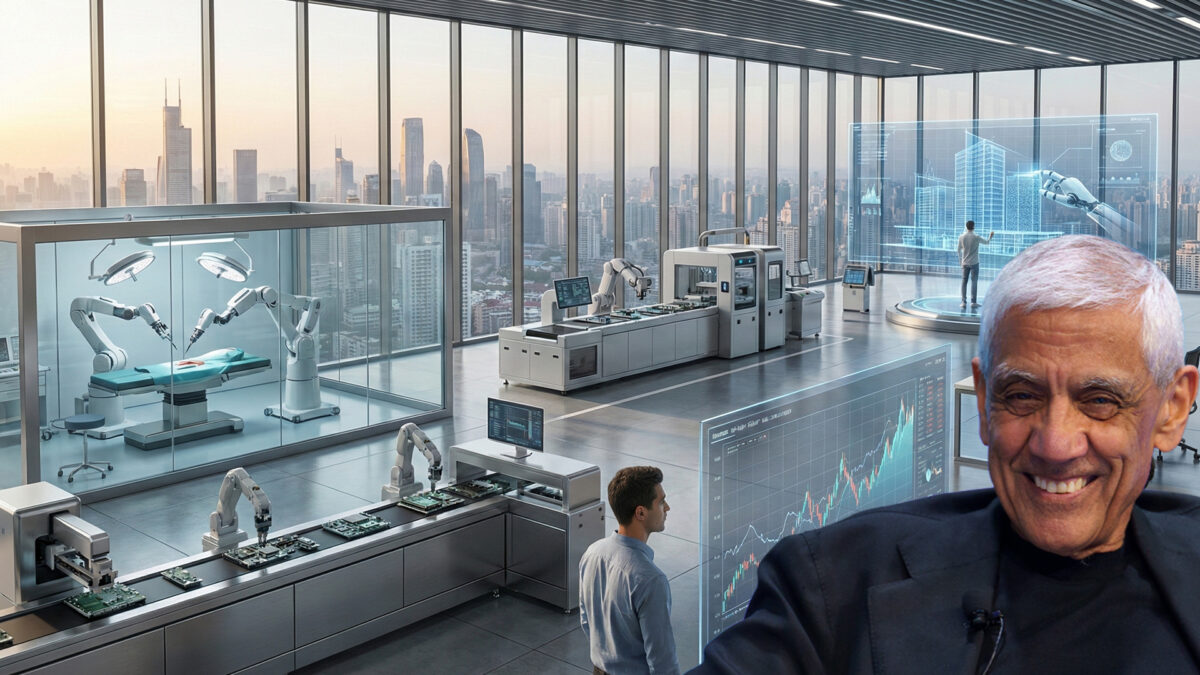
AI to reshape jobs, IT services at risk says Vinod Khosla

Artificial intelligence is approaching a major breakthrough, with Silicon Valley investor Vinod Khosla predicting artificial general intelligence (AGI) could arrive within two years. AGI refers to AI systems capable of performing nearly 80% of economically valuable jobs across sectors such as healthcare, engineering, finance, and education.

Khosla warned that traditional IT services and business process outsourcing (BPO) could largely vanish by 2030 as AI performs routine and complex tasks more efficiently. For India, this shift presents both a challenge and opportunity. With its talent pool and technical base, the country could pivot from labour-intensive outsourcing to high-value AI-driven solutions.

He added that large-scale AI adoption could make essential services like healthcare, education, legal advice, and entertainment cheaper or nearly free. However, Khosla cautioned that governments and institutions are underprepared for the speed of disruption, and the full impact will depend on policy and deployment choices.

His message highlights a future where AI transforms work, business models, and service access, urging economies reliant on traditional IT to rapidly adapt.

Also Read: PM Modi says India ready to lead global AI era

Categories
Beyond

AI and biologics set to transform India’s pharma Industry

India’s pharmaceutical industry is turning to artificial intelligence (AI) and biologic drugs to make medicine development faster, cheaper and more innovative.

Major companies are now using AI to study huge amounts of medical and scientific data. This helps them find new drug targets quickly, design better clinical trials and reduce the long trial-and-error process in research. As a result, the time and money needed to develop a new medicine can come down significantly. The move is important as Indian firms try to go beyond their traditional focus on low-cost generic medicines and enter the high-value innovation space.

At the same time, biologics and biosimilars are becoming a key growth area. These are complex medicines used to treat diseases such as cancer and autoimmune disorders and are in high demand globally. Indian companies are investing in this segment so they can capture a larger share of the global market while continuing to supply affordable generics.

Hyderabad is emerging as a major centre for this change. The city is seeing new investments in research facilities, global capability centres and AI-based healthcare technology. This is helping create skilled jobs and strengthening India’s position in life-sciences innovation.

Experts say AI can improve not only drug discovery but also manufacturing, supply chain planning and demand forecasting. This will make the industry more efficient and competitive worldwide.

However, some challenges remain. The sector needs more funding for research, faster regulatory approvals and a stronger system that rewards companies for developing new drugs. Industry leaders believe India must move from a low-cost model to an innovation-driven model to stay ahead globally.

Also Read: PM Modi says India ready to lead global AI era

Categories
1 Minute-Read

Former NPR host alleges Google cloned his voice

Veteran radio journalist David Greene has taken legal action against Google, claiming its AI feature in NotebookLM reproduced his recognisable on-air voice without consent.

Greene said the AI-generated presenter matches his rhythm, tone and speaking quirks so closely that friends assumed he had authorised its use. A forensic voice study submitted with the lawsuit reported a similarity of more than 50%. Google has dismissed the allegation, maintaining the audio was created using a professional voice actor.

The dispute highlights mounting concerns over how generative AI systems are trained and whether individuals have rights over their vocal identity in the rapidly evolving digital landscape.

Categories
Beyond

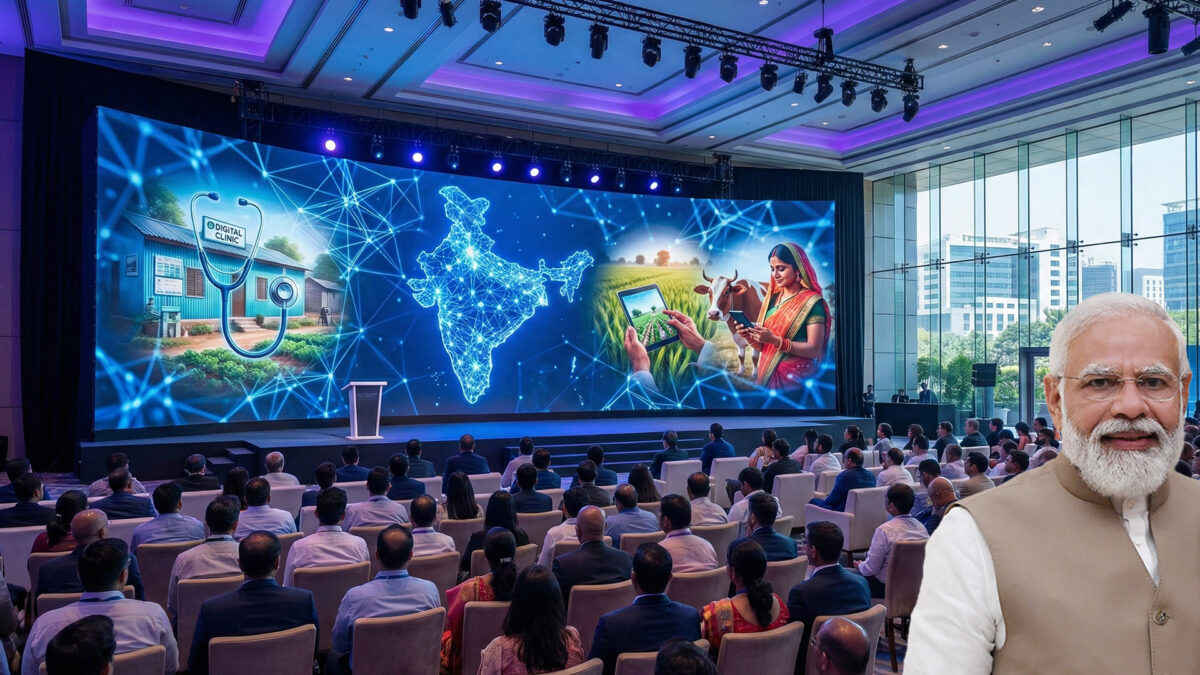
PM Modi says India ready to lead global AI era

Prime Minister Narendra Modi has positioned India as a major force in the rapidly evolving global artificial intelligence landscape, describing AI as a “civilisational inflection point” that will reshape economies, governance and daily life.

Speaking at the India AI Impact Summit, he said India’s AI strategy is built on inclusion, innovation and technological self-reliance, with a focus on ensuring that the benefits of the technology reach all sections of society. He underlined that AI should not remain in the hands of a few countries or corporations but must serve humanity at large.

The Prime Minister highlighted that India’s digital public infrastructure has created a strong foundation for developing affordable and scalable AI solutions. This model, he said, can support not only domestic growth but also offer pathways for other developing nations.

Addressing concerns over job losses, Modi said the emphasis is on skilling and reskilling the workforce to prepare for new opportunities in an AI-driven economy. Rather than replacing human effort, he noted, AI will enhance productivity and improve outcomes in sectors such as healthcare, agriculture, education and public service delivery.

He also pointed to India’s young talent pool, vibrant startup ecosystem and expanding computing capacity as key strengths that will help the country transition from being a technology adopter to a global technology creator.

Calling for responsible innovation, the Prime Minister stressed the importance of ethical, transparent and bias-free AI systems. He urged greater international cooperation to develop frameworks that ensure safety, trust and equitable access.

The summit brought together policymakers, industry leaders and researchers from across the world, reflecting India’s ambition to shape the global AI agenda while using the technology as a tool for inclusive growth and social transformation.

Also Read: Adani Ports ties up with Marseille Fos for IMEC corridor

Categories
Beyond

Rupee gains 5 paise in early trade, hits 90.67 per dollar

The Indian rupee appreciated by 5 paise to 90.67 against the US dollar in early trading on Wednesday, helped by easing global crude oil prices and fresh buying by foreign institutional investors (FIIs).

The domestic currency opened stronger at the interbank foreign exchange market and briefly touched 90.60 per dollar before trimming some of its gains. It had ended the previous session 2 paise higher at 90.72.

Forex dealers said the fall in international oil prices supported the rupee as it reduces India’s import burden and lowers demand for the US currency. At the same time, renewed foreign fund inflows into Indian markets improved liquidity and boosted sentiment in the forex market.

Despite the early strength, the rupee could not hold on to its peak levels due to a stronger dollar overseas and a muted trend in domestic equities, which weighed on investor confidence. The dollar index remained firm against major global currencies, capping sharp gains in the local unit.

Market participants expect the rupee to trade in a narrow range in the near term, as global factors continue to drive currency movements. Fluctuations in crude oil prices, the direction of foreign capital flows and the performance of Indian stock markets are likely to remain key triggers.

Also Read: Gold at ₹1.51 lakh, silver at ₹2.34 lakh

Categories
Beyond

Gold at ₹1.51 lakh, silver at ₹2.34 lakh

Gold has declined about 16% to nearly ₹1.51 lakh per 10 grams from its recent highs, while silver has crashed around 38% from close to ₹3.8 lakh to about ₹2.34 lakh per kg. The correction, instead of triggering a rush to jewellery stores, has led to cautious sentiment as buyers expect prices to soften further before making purchases.

In the physical bullion market, gold in Delhi was quoted at around ₹1.57 lakh per 10 grams, down about 1.4%, while silver slipped over 2% to nearly ₹2.45 lakh per kg. Futures on the Multi Commodity Exchange (MCX) also mirrored the weak trend, reflecting subdued participation from both retail investors and traders.

Jewellers across major cities have reported low footfall despite the price drop. According to trade sources, customers are tracking the market closely but postponing purchases in the hope of a deeper correction. The sharp volatility seen after months of record-breaking rallies has made buyers cautious and more price-sensitive.

The fall in domestic prices follows weak global cues. A stronger US dollar, profit-booking after the earlier surge, easing geopolitical tensions and thin Asian market volumes have reduced the safe-haven demand for precious metals. These factors have collectively put pressure on bullion rates.

Analysts believe the current decline comes after an extraordinary rally through 2025 and early 2026, when both gold and silver scaled historic highs. The ongoing slide is being viewed as a phase of consolidation rather than a long-term reversal.

Also Read: Sensex drops 100 pts, Nifty slips below 25,700