Categories
Technology

Samsung launches EMI plans from ₹33 a day

Samsung India has introduced a new financing programme aimed at making home appliances more affordable, allowing customers to purchase products through EMIs starting from ₹33 per day.

The offer is available under the company’s Samsung Finance+ platform and covers a wide range of products including refrigerators, washing machines, air conditioners and microwaves. Samsung said the scheme is being launched across more than 8,000 retail stores nationwide.

To attract buyers, the company is also offering a ₹1,000 cashback for a limited period on eligible purchases made through the financing option.

Samsung said the approval process has been designed to be quick and simple. Customers can apply digitally at stores using basic KYC documents such as Aadhaar and PAN cards, with approvals expected in just a few minutes.

The move comes at a time when financing options are becoming increasingly important in India’s consumer durables market. Many families now prefer smaller monthly instalments instead of paying the full amount upfront, especially for expensive products such as air conditioners and refrigerators.

The launch is also timely as summer demand typically boosts sales of cooling appliances. Easy EMI options may encourage more households to upgrade older machines or buy premium models with smart features.

Samsung’s newer appliance range includes connected devices that offer mobile app control, energy monitoring and automation features.

Also Read: China blocks Meta’s $2 billion Manus deal

Categories
Beyond

China blocks Meta’s $2 billion Manus deal

Meta’s plan to buy artificial intelligence startup Manus for $2 billion has been blocked by Chinese authorities, dealing a blow to the tech giant’s efforts to strengthen its AI business.

The decision shows how sensitive AI technology has become, with governments increasingly treating it as a strategic asset rather than just another business sector.

Meta had hoped the acquisition would help it move faster in the global AI race. Manus has attracted attention for building advanced AI systems that can perform tasks such as research, planning and customer support with limited human input.

For Meta, the startup was seen as a valuable opportunity to add both technology and talent at a time when competition is intensifying with rivals such as Google, Microsoft and OpenAI.

Chinese regulators reportedly opposed the deal on national security and foreign investment grounds. The move suggests Beijing is becoming more cautious about allowing promising domestic AI companies or their technology to come under foreign ownership.

Even though Manus had links outside mainland China, authorities appear to have taken a broad view of the company’s strategic importance.

For Meta, the setback is more than a lost acquisition. It means the company may now need to spend more time and money building similar capabilities internally or searching for other partnerships.

Chief Executive Mark Zuckerberg has made AI one of Meta’s top priorities, investing heavily in smart assistants, business tools, advertising technology and future digital platforms.

Also Read: UltraTech posts strong Q4, announces ₹240 dividend

Categories
Beyond

Rupee drops 24 paise to 94.39 against dollar

The Indian rupee came under pressure on April 28, 2026, slipping 24 paise to 94.39 against the US dollar, as higher oil prices and cautious global sentiment weighed on the domestic currency.

The rupee opened weaker at 94.35, compared with the previous close of 94.15, and extended losses during early trade.

Currency dealers said the sharp rise in crude oil prices was the main reason behind the fall. Brent crude traded above $109 per barrel as tensions in West Asia continued to keep energy markets on edge. For India, which depends heavily on imported oil, higher crude prices usually mean more demand for dollars to pay import bills, putting pressure on the rupee.

There was also regular month-end dollar buying from importers and oil companies. Businesses that make overseas payments often purchase dollars near the end of the month, and that added to the rupee’s weakness.

Global factors also played a role. The US dollar remained firm, while several Asian currencies traded lower as investors stayed cautious amid geopolitical tensions and uncertainty over interest rate decisions by major central banks.

Traders said the rupee’s losses were partly contained by likely intervention from state-run banks, which are often seen selling dollars when volatility rises sharply. This helped prevent a steeper decline in the domestic unit.

Meanwhile, Indian equity markets remained volatile during the session, giving little immediate support to the rupee. Foreign investment flows were also in focus, as continued outflows can weigh on the currency.

Also Read: Sensex rebounds by 250 points, Nifty reclaims 24,050

Categories
Beyond

Gold falls to ₹1,53,700, Silver slips to ₹2,59,900

Gold prices edged lower in the domestic bullion market on April 28, 2026, while silver also declined slightly, reflecting cautious sentiment and weak global trends.

According to market data, the price of 24-carat gold fell ₹10 to ₹1,53,700 per 10 grams, while 22-carat gold slipped to around ₹1,40,900 per 10 grams in major cities. Silver prices declined ₹100 to ₹2,59,900 per kilogram in the physical market.

The marginal fall in precious metal prices comes amid softer international bullion prices and investor caution ahead of major central bank policy decisions this week. Global gold prices remained under pressure as traders monitored inflation concerns and expectations that the US Federal Reserve may keep interest rates unchanged.

Rising crude oil prices have also become a key factor for bullion markets. Higher oil rates can fuel inflation fears, which generally support gold as a hedge. However, they can also strengthen expectations of prolonged higher interest rates, limiting upside in non-yielding assets like gold.

In India, jewellers said retail demand remains mixed, with consumers closely watching price movements after recent volatility. Buyers continue to prefer staggered purchases rather than aggressive fresh buying at elevated levels.

City-wise rates varied slightly depending on local taxes and logistics. In Delhi, 24-carat gold traded near ₹1,53,150 per 10 grams, while Mumbai and Kolkata remained close to ₹1,53,000 levels. Chennai prices were marginally higher.

Also Read: Sensex rebounds by 250 points, Nifty reclaims 24,050

Categories
Beyond

Crude oil tops $107 as Hormuz tensions soar

Global crude oil prices have surged sharply, with Brent crude crossing the $107 per barrel mark, after fresh tensions in the Middle East and the collapse of diplomatic talks between the United States and Iran.

The rally came as peace negotiations between the two countries reportedly stalled, with no agreement reached on reopening or securing the Strait of Hormuz. The waterway is one of the world’s most important oil shipping routes, and ongoing restrictions there have significantly reduced global supply.

According to market reports, Brent crude futures climbed to around $107.97 per barrel during intraday trading, marking a multi-week high. At the same time, US stock futures slipped, reflecting broader market uncertainty linked to rising energy costs and geopolitical risk.

The main trigger for the price surge has been continued disruption in the Strait of Hormuz, where shipping activity remains limited due to escalating tensions and security concerns. The strait normally handles a large share of global oil shipments, and any blockage or slowdown immediately impacts global supply chains.

Adding to market anxiety, diplomatic efforts involving mediators such as Pakistan reportedly failed to make progress, and no new round of talks has been confirmed. This has reduced expectations of an immediate resolution, pushing traders to price in tighter supply conditions.

Also Read: Adani Green to invest ₹15,000 cr in battery storage push

Categories
Corporate

Sensex rises 640 points, Nifty reclaims 24,000

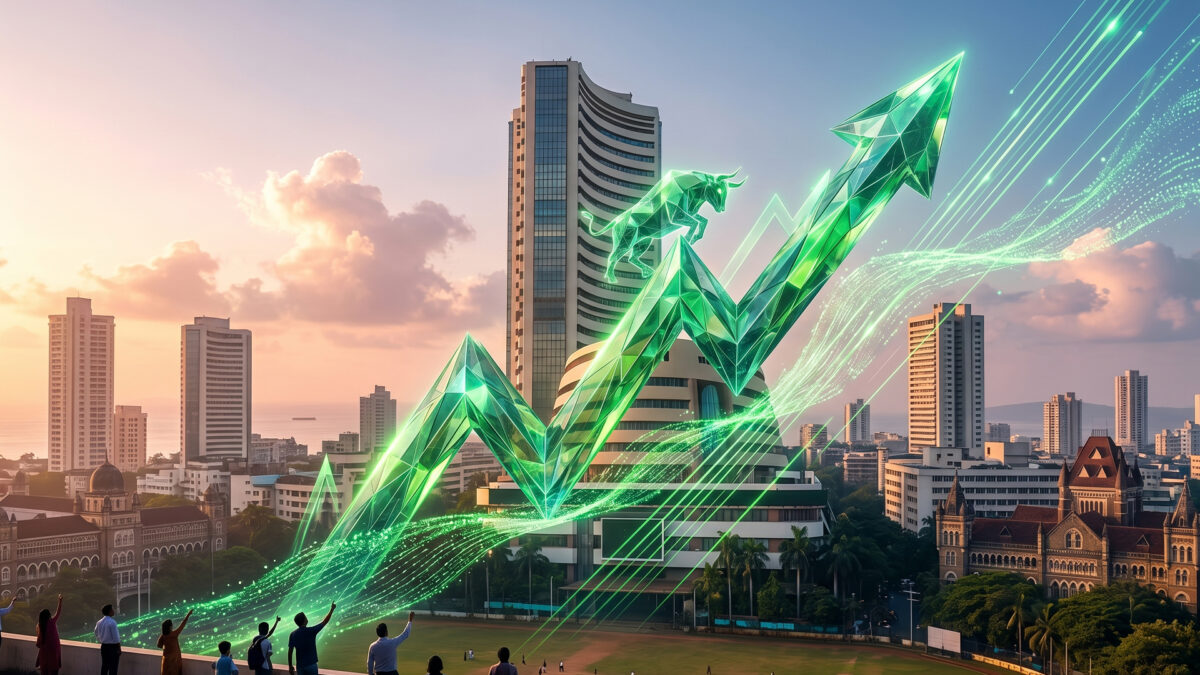
Indian stock markets ended higher on Monday, as the Sensex gained about 639 points to close at 77,303, while the Nifty 50 rose nearly 190 points to settle around 24,092, snapping a three-day losing streak.

The positive opening was driven by strong cues from GIFT Nifty, which indicated a gap-up start ahead of trading. Buying interest sustained through the session, although volatility remained due to global uncertainties and foreign fund outflows.

Market strength was largely supported by heavyweight stocks. Reliance Industries, ICICI Bank, HDFC Bank, and TCS were among the top gainers, contributing significantly to the index rally. Banking and IT stocks attracted fresh buying, helping lift overall sentiment.

Broader markets also participated in the recovery, with midcap and smallcap stocks showing healthy gains. This indicated wider participation beyond frontline index stocks, adding strength to the overall market rebound.

However, not all sectors ended in the green. Some FMCG and pharmaceutical stocks witnessed profit booking and emerged among the top losers during the session. Defensive sectors remained under mild pressure as investors rotated into financials and energy stocks.

Despite the positive close, foreign institutional investors (FIIs) continued to remain net sellers, which kept sentiment cautious. Persistent outflows from FIIs have been one of the key concerns for domestic equity markets in recent sessions.

Global factors also influenced trading. Elevated crude oil prices and geopolitical tensions continued to weigh on investor sentiment, raising concerns about inflation and currency stability. The rupee remained under watch amid fluctuating global risk appetite.

Also Read: NTPC plans ₹25,000 cr nuclear project in Bihar

Categories
Corporate

Wipro buyback may bring short-term gains

Wipro’s proposed share buyback could offer an attractive short-term opportunity for investors, with brokerages estimating possible returns of 8% to 14% over the next two to three months.

The IT company has announced a ₹15,000 crore buyback at ₹250 per share, a price higher than where the stock was recently trading in the market. This premium has drawn interest from investors looking for quick gains.

In a buyback, a company purchases its own shares from shareholders, usually at a fixed price. It is often seen as a way of rewarding investors and returning surplus cash.

Market experts said retail investors may benefit the most because buyback offers usually have a separate reservation category for small shareholders. This improves their chances of getting shares accepted under the offer.

However, analysts noted that final returns will depend on several factors, including the share price before the record date, the number of shares accepted in the buyback and market movement during the offer period.

If acceptance levels remain strong, investors could see healthy gains in a relatively short time.

The buyback is also being viewed as a positive signal from the company, suggesting management confidence despite a challenging environment for the IT sector.

Global technology spending has remained cautious, with clients delaying decisions and controlling budgets. In that backdrop, returning cash to shareholders is being seen as a supportive move.

Wipro shares have remained in focus since the announcement, with investors now watching for the record date and detailed timeline of the process.

Also Read: Samsung wins Global awards for coral reef project

Categories
Corporate

Samsung wins Global awards for coral reef project

Samsung has won multiple international awards for a unique environmental project that uses Galaxy smartphones to help restore coral reefs and protect ocean life.

The company’s initiative combines mobile technology with conservation efforts, showing how everyday devices can be used for real-world environmental impact.

At the centre of the project is Samsung’s “Ocean Mode”, a special camera feature designed for underwater photography. It helps users capture clearer images beneath the surface by improving colour balance and reducing blur caused by water movement.

Samsung said the feature allows researchers, divers and local communities to use smartphones instead of expensive underwater cameras to monitor reef conditions.

The company’s coral reef restoration programme, called “Coral in Focus”, was recognised at international award platforms for innovation and sustainability. A documentary linked to the project also received honours for highlighting marine conservation work.

Samsung is running the initiative with environmental partners and marine scientists, including Seatrees and researchers from the University of California San Diego.

Together, they use Galaxy phones to take underwater images of coral reefs. These images are then turned into 3D models that help experts study reef damage, track recovery and plan restoration efforts.

The programme is active in several parts of the world, including Fiji, Indonesia, Costa Rica, the Galápagos Islands and the United States.

Samsung said thousands of coral fragments have already been planted through the initiative, helping rebuild damaged reef systems.

Coral reefs are among the most important ecosystems on Earth. Though they cover only a small part of the ocean floor, they support a large share of marine biodiversity and provide food and income for millions of people.

Scientists have warned that rising sea temperatures, pollution and overfishing are putting reefs at serious risk globally.

Also Read: Sanjay Jamuar named CEO of Delhi Metro global arm

Categories
1 Minute-Read

Trump hosts Crypto event as meme coin crashes

US President Donald Trump hosted leading investors of his $TRUMP cryptocurrency at Mar-a-Lago in Florida, holding an exclusive event for top token holders. Reports said around 297 investors attended, with some invited to a VIP gathering.

The event came even as the meme coin has lost more than 95 percent of its value from earlier highs. Critics questioned the ethics of Trump’s links to crypto businesses while holding office. Supporters said the gathering reflected continued interest from wealthy backers.

Retail investors, however, have suffered heavy losses as the token’s value sharply declined.

Categories
Corporate

KPMG to cut 10% of US audit partners

KPMG is set to reduce its US audit partner ranks by about 10%, in a restructuring move that comes after years of unsuccessful efforts to encourage voluntary early retirements.

The decision will affect roughly 100 partners in the firm’s US audit division. According to reports, some partners had already opted for voluntary exit schemes, but the numbers fell short of what the firm needed to rebalance its leadership structure.

KPMG said the cuts are not linked to individual performance. Instead, the firm is focusing on aligning the size of its audit partnership with the actual needs of its business. The goal is to better match staffing levels with client demand and improve overall efficiency in the audit practice.

Partners impacted by the decision are expected to receive financial exit packages along with support to transition into other roles or opportunities outside the firm. Managing directors within the audit division will not be affected by this round of reductions.

The move is part of a broader restructuring trend within the Big Four accounting firms, which have been adjusting their workforce after pandemic-era hiring increases and slower-than-expected staff turnover. Many firms have faced challenges in balancing workforce size with changing market conditions.

Also Read: India’s forex reserves rise above $703 bn