Categories
Beyond

G7 moves to release 100 mnn barrels

The Group of Seven (G7) has agreed to release up to 100 million barrels of oil from strategic reserves over the next four months, in its latest attempt to cool soaring fuel prices and ease pressure on global energy markets.

The decision follows a sharp rise in oil and diesel prices amid disruptions to global energy supplies. The coordinated release is expected to put additional crude and refined fuel into the market, with diesel supplies receiving priority during the initial phase.

The agreement was reached during a virtual meeting of G7 leaders on October 2. The United States, Canada, France, Germany, Italy, Japan and the United Kingdom are participating in the effort, which will be coordinated with the International Energy Agency (IEA).

The G7 said the reserve release would begin immediately and continue for four months. A significant portion of the available diesel stocks is expected to be released during the first 20 days, reflecting the immediate pressure in fuel markets.

Diesel has become a particular concern for businesses because it is widely used by trucks, ships, agricultural machinery, construction equipment and factories. Higher diesel prices can quickly increase transportation and production costs, eventually feeding into the prices of goods and services.

The latest move comes as fuel prices have climbed sharply in major economies. In the United States, diesel prices have moved above $6 a gallon, adding to concerns for transport operators and businesses that rely heavily on road freight.

European countries have also been dealing with elevated diesel costs. The pressure has been intensified by disruptions to refining operations, restrictions on fuel supplies and uncertainty surrounding energy shipments.

The G7 has also called for continued access to international energy markets. Its members agreed that they would avoid imposing restrictions on exports of energy and energy products. The group also urged other energy-producing countries to keep supplies moving rather than introduce export bans that could further tighten the market.

The decision is particularly significant for Europe, where policymakers have been concerned that restrictions on US fuel exports could worsen an already tight diesel market. Maintaining cross-border fuel flows is therefore an important part of the G7’s broader response to the current energy squeeze.

The global oil market has faced several disruptions in recent months. Geopolitical tensions, damage to energy infrastructure and uncertainty around shipping routes have affected the movement of crude oil and refined products.

The Strait of Hormuz remains a major concern for energy markets because a substantial share of global oil shipments normally passes through the strategic waterway. Any prolonged disruption could push crude oil prices higher and make the task of stabilising fuel markets more difficult.

The G7’s reserve release is designed to provide a short-term supply boost while governments and energy companies work to address wider disruptions.

The group is also looking at measures to increase refinery output. G7 countries have agreed to coordinate refinery maintenance schedules to avoid several major facilities being taken offline at the same time. Members will also examine whether refineries can temporarily increase production where capacity is available.

The focus on refining is important because releasing crude oil alone cannot fully solve a shortage of diesel or other refined fuels. Crude must first be processed into products such as diesel, petrol and jet fuel before it can reach consumers and businesses.

The latest announcement builds on a much larger emergency response coordinated by the IEA earlier this year. IEA member countries had agreed to release 400 million barrels from strategic reserves, described as the agency’s largest coordinated stock release.

The additional G7 commitment is intended to complement that wider effort and respond to continuing pressure on fuel markets.

Oil prices reacted to the announcement, with Brent crude falling below $101 a barrel and US West Texas Intermediate also declining. The market response reflected expectations that additional barrels could improve near-term supply conditions.

However, the impact on consumers and businesses will depend on how quickly the reserves reach the market and whether other supply disruptions continue.

Strategic petroleum reserves are normally maintained as an emergency buffer against major disruptions. Releasing them can provide temporary relief, but governments eventually have to replenish their stocks. The G7 therefore faces a balance between addressing today’s fuel shortage and maintaining adequate reserves for future emergencies.

The IEA is expected to assess the impact of the release within 20 days. That review could determine whether additional measures are required and how quickly strategic reserves should eventually be rebuilt.

For businesses, lower fuel prices would provide relief at several levels. Transport companies could see reduced operating costs, while manufacturers, farmers and logistics firms could benefit from lower energy expenses. A sustained decline in fuel prices could also ease inflationary pressure by reducing transportation and production costs.

The G7’s latest intervention therefore goes beyond the immediate objective of adding oil to the market. It is an attempt to restore confidence in energy supplies at a time when fuel costs have become a growing concern for governments, companies and consumers.

The coming weeks will show whether the additional supply is enough to ease diesel shortages and bring greater stability to global oil markets.


 

Categories
Beyond

Accenture Q4 revenue rises to $18.68 bn

Accenture closed fiscal 2026 with a stronger-than-expected fourth quarter, helped by solid client bookings and continued demand for technology transformation and artificial intelligence services. The results exceeded market expectations and prompted a sharp rise in the company’s shares.

Revenue for the quarter ended August 31 reached $18.68 billion, increasing 6% in US dollar terms and 7% in local currency from a year earlier. The figure was ahead of analysts’ expectations of around $18.03 billion and also surpassed Accenture’s own guidance of $17.75 billion to $18.40 billion.

The company reported adjusted earnings per share of $3.29, beating the $3.18 expected by analysts. Accenture’s adjusted operating margin stood at 15.3%, improving from the comparable period last year.

Quarterly bookings were another major highlight. Accenture secured $22.17 billion in new bookings, up 4% in US dollar terms and 5% in local currency. The figure gave the company a book-to-bill ratio of 1.2, indicating that bookings exceeded quarterly revenue.

Managed Services generated $12.77 billion in bookings, while Consulting contributed $9.40 billion. On the revenue side, Consulting brought in $9.28 billion and Managed Services generated $9.40 billion.

The company also recorded a record number of large client contracts during the quarter. Accenture reported 141 bookings worth at least $100 million each, highlighting continued spending by major enterprises on large-scale technology programmes. These projects cover areas including cloud migration, cybersecurity, data modernisation, artificial intelligence and business transformation.

The performance comes as global technology companies adjust to rapid changes brought by generative AI. Investors have been assessing whether artificial intelligence could eventually reduce demand for some traditional consulting and software services. Accenture’s latest numbers point to continued spending by businesses on technology modernisation, cloud services, data and AI-led transformation.

The company has significantly expanded its AI capabilities over the past year. Accenture now has around 110,000 AI and data professionals, reflecting the growing importance of artificial intelligence in its business strategy.

The strong earnings report had an immediate impact on the stock. Accenture shares jumped more than 20% on October 1, marking their strongest one-day gain. The rally also lifted other technology stocks as investors reassessed the outlook for corporate technology spending.

Accenture’s full-year performance was also positive. Revenue for fiscal 2026 reached $74.18 billion, up 6% in US dollar terms and 5% in local currency. Full-year bookings climbed to a record $84.54 billion, while adjusted earnings per share increased 8% to $13.97.

The company generated about $11.6 billion in free cash flow during the year and returned approximately $11.5 billion to shareholders through dividends and share buybacks. Accenture also raised its quarterly dividend by 5%.

Investors were particularly encouraged by the company’s outlook for fiscal 2027. Accenture expects revenue to grow 3%-6% in local currency, with adjusted earnings per share projected at $14.39-$14.81. The company expects its adjusted operating margin to improve to between 15.9% and 16.1%.

For the first quarter of fiscal 2027, Accenture expects revenue of $18.95 billion-$19.60 billion, with local-currency revenue growth of 2%-6%.

The company is also preparing to increase spending on acquisitions as it expands its capabilities in AI, cybersecurity and other high-growth technology areas. Accenture has indicated that it could deploy around $5 billion on acquisitions in fiscal 2027.

The company’s acquisition strategy reflects the rapid evolution of the technology services market. Rather than relying only on organic expansion, Accenture has been using acquisitions to add specialist capabilities and strengthen its position in areas where clients are increasing technology investments.

The latest results underline the changing nature of demand across the IT services industry. Businesses are increasingly looking beyond individual technology projects and seeking broader support for AI adoption, digital transformation, data management and automation.

Accenture’s strong bookings suggest that large corporate clients continue to commit significant budgets to these areas. Its fiscal 2027 guidance also indicates that the company expects technology spending to remain resilient despite an uncertain global economic environment.

The company’s results could also influence expectations for Indian IT services companies, many of which depend heavily on spending by North American and European enterprises. Accenture’s performance is closely watched across the sector because its large global client base gives investors an early indication of trends in technology budgets, consulting demand and enterprise AI adoption.

For investors and India’s IT services sector, Accenture’s results will therefore be closely watched. The company’s performance often provides an early indication of trends in global technology spending, particularly among large enterprise clients. The combination of $18.68 billion in quarterly revenue, $22.17 billion in bookings and a 3%-6% FY27 growth outlook has put renewed focus on the outlook for global IT services and AI-driven transformation.


Categories
Corporate

Anarock files papers for ₹1,000 cr IPO

Mumbai-based real estate advisory firm Anarock Property Consultants has filed its Draft Red Herring Prospectus (DRHP) with the Securities and Exchange Board of India (SEBI) to raise up to ₹1,000 crore through an initial public offering (IPO).

The proposed issue comes as Anarock looks to expand its real estate advisory business, increase its use of artificial intelligence and technology, strengthen its talent base and pursue acquisitions. The IPO will also provide an exit opportunity for some existing investors through an offer for sale.

The proposed public issue comprises a fresh issue of equity shares worth up to ₹550 crore and an offer for sale (OFS) of up to ₹450 crore. Promoter entities Peter Properties and Khushi Trust are among the selling shareholders, along with several investment funds managed by 360 ONE and other investors.

Anarock may also consider a pre-IPO placement of up to ₹110 crore before filing its final Red Herring Prospectus with the Registrar of Companies. If completed, the amount raised through such a placement would be deducted from the fresh issue component.

The company plans to use a significant part of the fresh capital to build technology capabilities across its business. Around ₹80 crore has been earmarked for artificial intelligence augmentation and technology for its transaction advisory business.

Another ₹25 crore is planned for technology solutions through ACP, while ₹15 crore has been allocated for technology solutions through Anacity, a subsidiary of the company. The focus reflects Anarock’s effort to bring more technology and AI-powered tools into property transactions and related real estate services.

The company has also set aside ₹89.5 crore for strengthening existing businesses and adding specialised services through talent augmentation. The investment is expected to support hiring and expansion as Anarock seeks to deepen its presence across different segments of the real estate market.

A further ₹148 crore is earmarked for the proposed DSP acquisition. The amount will also cover certain strategic initiatives and inorganic growth plans. Anarock had acquired a 51% stake in DSP Design Associates, an architecture and design firm, and the IPO proceeds will help fund the acquisition of the remaining equity share capital, excluding the employee stock option pool.

The balance of the fresh issue is proposed to be used for unidentified acquisitions, strategic initiatives and general corporate purposes.

Anarock was incorporated in 2011 and has built its business around real estate advisory and related services. Its operations cover several parts of the property value chain, including transaction advisory, leasing and investment advisory, management services and technology solutions.

The company works with a wide range of clients, including real estate developers, corporate occupiers, retail companies, financial institutions, private equity funds, sovereign funds and government bodies. Its business spans residential and commercial real estate as well as other institutional property requirements.

Technology has increasingly become part of the company’s business model. Anarock uses proprietary market information and artificial intelligence-powered insights as it works with clients on property transactions and other real estate decisions.

Its financial performance has also expanded in recent years. Revenue from operations rose to about ₹881.9 crore in FY26, compared with around ₹658.9 crore in FY25. Net profit increased to approximately ₹93.2 crore in FY26, from ₹60.8 crore in the previous financial year.

The company had no outstanding borrowings as of March 31, 2026, according to the draft filing. Its capital requirements had historically been supported by promoter funding, before it raised ₹200 crore from 360 ONE Asset Management in 2024 to support organic and inorganic business growth.

Following that investment, funds managed by 360 ONE held about 18.77% of Anarock’s pre-IPO equity share capital on a fully diluted basis, according to the filing.

Anarock had around 2,192 permanent employees as of March 31, 2026, while its wider group has about 2,300 employees across key Tier-1 and Tier-2 markets in India and the Middle East. The company operates across 15 cities in India, alongside its Middle East operations.

The proposed IPO is structured through the book-building route. Not more than 50% of the net offer can be allocated to qualified institutional buyers, while not less than 15% and 35% will be available to non-institutional investors and retail individual investors, respectively.

ICICI Securities, IIFL Capital Services and 360 ONE WAM have been appointed as the book-running lead managers for the issue, while KFin Technologies will act as the registrar.

Anarock has proposed listing its equity shares on both the BSE and NSE, subject to regulatory approvals and completion of the IPO process.

The proposed listing comes at a time when India’s real estate market is becoming increasingly technology-driven, with property transactions, market intelligence and client engagement moving towards digital platforms. For Anarock, the IPO provides capital to combine its established real estate advisory operations with AI, technology and targeted acquisitions.

The company’s immediate priorities are therefore centred on expanding its existing businesses, strengthening specialised services and building technology capabilities. The proposed DSP acquisition and future acquisitions could further broaden its presence across the real estate services ecosystem as Anarock prepares for its next phase of growth.


Categories
Corporate

Sensex falls 570 points, Nifty ends below 22,450

The markets extended their losing streak to four sessions on Thursday, with the Sensex falling 570.59 points and the Nifty slipping below the 22,450 mark as investors remained cautious amid rising crude oil prices, higher global bond yields and sustained foreign selling.

The BSE Sensex closed at 71,909.70, down 570.59 points or 0.79 per cent. The NSE Nifty50 settled at 22,421.95, lower by 198.50 points or 0.88 per cent. Both indices recovered from their day’s lows after coming under heavier selling pressure during afternoon trade.

The sell-off erased about ₹4.28 lakh crore in market capitalisation of companies listed on the NSE, reflecting the broad pressure across equities. Market breadth remained weak, with most sectors ending in the red. The Nifty Auto index was among the biggest drags, while IT stocks provided some support.

Infosys emerged as the top Nifty50 gainer, rising 4.11 per cent to ₹1,035. HDFC Life Insurance, HDFC Bank and SBI Life Insurance were among the other stocks that ended higher. TCS and HCL Technologies also gained, helping the IT sector remain an exception in an otherwise weak market.

Bajaj Auto was the biggest loser, tumbling 7.62 per cent to ₹10,045. Maruti Suzuki and Shriram Finance were among the other major laggards. Mahindra & Mahindra, Tata Steel and Tata Motors Passenger Vehicles also faced heavy selling pressure during the session.

Auto stocks came under particular pressure after several automobile companies reported September sales numbers. Bajaj Auto’s total sales rose 5 per cent year-on-year to 5.38 lakh units, but the figure fell short of market expectations. Its domestic sales declined 9 per cent, while exports rose 32 per cent. The weaker-than-expected numbers triggered selling in the stock and weighed on the broader auto sector.

Mahindra & Mahindra also declined after reporting September sales that were slightly below expectations. Its total sales rose 15 per cent year-on-year, but tractor sales fell 21 per cent. Maruti Suzuki, Eicher Motors and Tata Motors Passenger Vehicles also moved lower.

The Nifty Auto index eventually closed about 3.5 per cent lower, making it the worst-performing major sectoral index. The Nifty Metal index also fell around 2.35 per cent. In contrast, the Nifty IT index gained 2.17 per cent, making it the only sectoral index to finish in positive territory.

IT stocks benefited from buying ahead of the second-quarter earnings season. Investors are closely watching the results of major technology companies for signs of demand, spending and the impact of artificial intelligence on the sector. Infosys led the gains, while TCS and HCL Technologies also advanced.

Global cues remained a major concern for investors. US Treasury yields climbed sharply, with the 10-year yield touching levels not seen in years. Higher bond yields can reduce the appeal of equities and increase pressure on emerging-market assets.

Crude oil prices also remained elevated, with Brent crude moving around the $100-a-barrel level. Higher oil prices are a concern for India because the country imports a large share of its crude requirement. Rising energy costs can increase inflationary pressure, widen the trade deficit and put pressure on the rupee.

The Indian currency weakened sharply during the session, adding to investor concerns. The rupee fell to a two-month low of around ₹96.31 against the US dollar, while foreign investors continued to withdraw money from Indian equities.

Foreign institutional investors sold Indian equities worth ₹10,148 crore on Wednesday, while domestic institutional investors bought shares worth ₹11,272 crore. Continued foreign outflows have remained one of the key factors weighing on the Indian stock market in recent weeks.

Thursday‘s fall also extended the market’s broader losing run. The Nifty has now recorded its eighth consecutive weekly decline, its longest such streak in 25 years. The index fell 3.1 per cent during the holiday-shortened week, while the Sensex declined 2.7 per cent.

The market is now entering a crucial period with investors watching global oil prices, bond yields, foreign fund flows and the upcoming corporate earnings season. The Reserve Bank of India’s policy outlook will also remain important as inflationary pressures and currency weakness continue to influence market sentiment.


Categories
Corporate

Sensex trades 120 points lower, Nifty stays below 22,600

Indian equity markets started October on a cautious note, with benchmark indices opening lower on Thursday as continued foreign fund outflows and weak global cues weighed on investor sentiment.


The 30-share BSE Sensex opened 120.30 points, or 0.17%, lower at 72,359.99, while the NSE Nifty50 declined 40.30 points, or 0.18%, to 22,580.15. Selling pressure remained visible across several sectors, although gains in select banking and information technology stocks offered some support.


The weak opening followed another subdued session on Wednesday. The Sensex ended 48.78 points lower at 72,480.29, while the Nifty50 slipped 95.75 points to close at 22,620.45. The benchmarks have remained under pressure as investors continue to monitor foreign fund flows, crude oil prices, the rupee and global interest-rate expectations.


Among the major Sensex stocks, Kotak Mahindra Bank, Infosys, HCL Technologies, Tata Consultancy Services and Axis Bank were among the gainers in early trade. Kotak Mahindra Bank attracted buying interest after the lender announced the appointment of Anup Kumar Saha as its new Managing Director and Chief Executive Officer for a three-year term beginning January 1, 2027.


The IT sector also provided some support to the market. The Nifty IT index gained in early trading, with Infosys, HCL Technologies and TCS among the stocks advancing. Investors were assessing recent US inflation data and its possible implications for the Federal Reserve’s interest-rate outlook. Any shift towards easier monetary conditions in the US could influence foreign flows into emerging markets, including India.


On the losing side, Mahindra & Mahindra, Maruti Suzuki, UltraTech Cement, Bharat Electronics, Eternal and Asian Paints were among the stocks under pressure. The auto sector was particularly weak, with investors tracking monthly sales numbers and demand trends.


The broader market remained cautious as selling extended beyond the headline indices. Several mid- and small-cap stocks also came under pressure, reflecting the risk-off mood at the start of the new month.


Foreign institutional selling continued to be a key concern. Foreign Institutional Investors sold Indian equities worth ₹10,148.41 crore on Wednesday, according to exchange data. Their sustained selling has remained one of the major factors weighing on domestic benchmarks in recent sessions.


Domestic institutional investors have provided some cushion through continued buying. However, the strength of domestic flows has not fully offset the impact of foreign selling, particularly as global yields remain elevated.


US Treasury yields have been closely watched by investors. The 10-year US Treasury yield remained around the 5.3% level, keeping pressure on emerging-market assets. Higher US yields can make dollar-denominated investments more attractive and can also increase the cost of capital for emerging economies.


The rupee opened weaker against the US dollar on Thursday. It started the session at ₹95.98, compared with Wednesday’s close of ₹95.83. The currency remained under pressure amid strong dollar demand and continued foreign portfolio outflows.


Crude oil prices, however, offered some relief. Brent crude was trading below the $100-a-barrel mark, providing a positive factor for India, which imports a significant share of its crude requirements. Lower oil prices can help reduce pressure on the country’s import bill, inflation and current account.


Global markets provided mixed signals. Asian equities were uneven, while investors continued to assess the outlook for US interest rates, inflation and economic growth. Markets in China and Hong Kong were closed for a holiday, limiting regional trading activity.


The domestic market’s recent weakness has also raised concerns about the duration of the ongoing correction. The Nifty and Sensex have been under pressure for several sessions, with investors becoming increasingly selective in their approach to equities.


Banking and IT stocks could remain in focus as investors look for sectors capable of providing stability amid broader volatility. At the same time, movements in automobiles, metals, cement and other cyclical sectors are likely to remain closely linked to domestic demand expectations and global commodity prices.


For investors, the immediate focus is likely to remain on foreign fund flows, crude oil prices, the rupee and US bond yields. Any improvement in global risk appetite could provide support to Indian equities, while continued foreign selling and elevated yields may keep gains limited.


As trading progresses, the ability of the Nifty to hold the 22,500-22,600 zone and the Sensex to remain above 72,000 will remain important market levels to watch. Investors are also expected to track stock-specific developments and fresh corporate announcements as the October trading session gathers pace.

Categories
Corporate

Sensex ends lower, Nifty holds below 22,650

Indian equity markets ended lower on Wednesday after a highly volatile trading session saw the benchmark indices swing sharply between gains and losses. The Sensex, which had climbed more than 500 points during the day, gave up most of its gains in the second half as selling returned. The Nifty 50 also slipped below the 22,650 mark.

The Sensex closed at 72,480.29, down 48.78 points, or 0.07%, while the Nifty ended at 22,620.45, lower by 95.75 points, or 0.42%. Both indices extended their losses for a third consecutive session.

Markets Reverse After Strong Intraday Recovery

The session began cautiously, but buying emerged soon after the opening bell. The Sensex gained more than 300 points and later crossed the 500-point mark, while the Nifty moved above 22,750.

The recovery, however, failed to hold. Selling intensified during the second half, particularly in healthcare and metal stocks, pulling the benchmarks lower. The sharp reversal highlighted the fragile investor sentiment amid concerns over global markets, crude oil prices, foreign fund flows and currency movements.

ICICI Bank, Kotak Bank Among Top Gainers

Banking and select technology stocks provided support to the market. ICICI Bank, Kotak Mahindra Bank, InterGlobe Aviation, Wipro and Tech Mahindra were among the top Nifty gainers.

Kotak Mahindra Bank gained around 2.8%, while ICICI Bank advanced about 2.6%. InterGlobe Aviation, Wipro and Tech Mahindra also ended higher.

Banking stocks remained relatively resilient, with both private and public sector lenders seeing buying interest. The Nifty Bank index gained more than 0.8%, helping cushion some of the broader market weakness.

Max Healthcare, Apollo Hospitals Lead Losers

Healthcare stocks faced intense selling pressure during the session. Max Healthcare, Apollo Hospitals, SBI Life Insurance, Eternal and ONGC were among the biggest Nifty losers.

Apollo Hospitals fell more than 6%, while Max Healthcare declined by over 6%. Eternal dropped more than 2%, while SBI Life Insurance and ONGC also ended lower.

The weakness extended to other hospital stocks. Fortis Healthcare fell nearly 7% and touched a fresh 52-week low, adding to the pressure on the healthcare segment.

Pharma, Healthcare and Metals Under Pressure

Sectoral performance remained mixed. Nifty Media gained around 2.5%, while Realty rose more than 1%. Private banks and PSU banks also closed higher, while IT stocks ended marginally positive.

On the other hand, Nifty Healthcare fell more than 2%, making it one of the weakest-performing sectors. Pharma and Metal indices declined more than 1% each, while Consumer Durables and Consumption stocks also remained under pressure.

Selling in healthcare stocks came amid concerns over medicine pricing and pharmacy margins at corporate hospitals. The issue has attracted attention following discussions during Supreme Court proceedings, adding to uncertainty around the sector.

Broader Market Shows Mixed Performance

The broader market remained relatively resilient compared with the benchmark indices. The Nifty Smallcap index ended slightly higher, while the Midcap index remained broadly flat.

Among midcap stocks, J.K. Cement, LT Technology Services, ICICI Lombard, Prestige Estates and NTPC Green Energy were among the notable gainers.

On the losing side, Fortis Healthcare, Vodafone Idea, United Breweries, Global Health and Tata Elxsi were among the weaker performers.

Market breadth remained mixed, with more than 2,000 stocks declining while a similar number of stocks advanced. Several stocks also touched fresh 52-week lows during the session.

FII Selling Remains a Major Concern

Foreign institutional investor activity continued to weigh on market sentiment. Foreign investors sold Indian equities worth nearly ₹9,980 crore on a net basis on Tuesday, marking their biggest single-day outflow in about four months.

Persistent foreign selling has added pressure to Indian stocks, particularly at a time when global bond yields remain elevated and the rupee is trading close to record-low levels against the US dollar.

Domestic institutional buying has provided some support, but the scale of foreign outflows remains an important factor for the direction of the Indian stock market.

Rupee Recovers Against US Dollar

The Indian rupee recovered modestly on Wednesday after coming under pressure in recent sessions.

The currency closed at ₹95.82 against the US dollar, strengthening 16 paise from Tuesday’s close of ₹95.98. The rupee continues to be influenced by foreign portfolio outflows, movements in the US dollar and global risk sentiment.

Crude Oil, Global Yields Keep Markets Volatile

Investors also kept a close watch on crude oil prices and global bond yields. Oil prices remained elevated amid uncertainty surrounding Iranian supply and sanctions.

Meanwhile, elevated US Treasury yields have continued to influence global equity markets. Higher yields can make dollar-denominated assets more attractive and increase pressure on emerging-market equities.

KPI Green, Power Mech Stocks in Focus

Several individual stocks remained active during Wednesday’s session.

KPI Green Energy declined despite announcing a ₹2,025-crore EPC order for a 500 MW solar project in Rajasthan and plans to acquire wind assets.

Power Mech Projects gained after securing a ₹549.37-crore order from an Adani Group company for operating and maintaining a thermal power plant.

KSB also advanced after receiving an export order worth up to ₹118 crore.

IPO Activity Remains Strong

The primary market remained active, with new listings attracting investor attention. Adroit Industries made a strong debut, listing at ₹250 on the BSE against its issue price of ₹134, a premium of 86.57%.

Swastika Infra also opened at a premium of more than 8%. Meanwhile, Shah Investor’s Home and SRIT India continued to see strong subscription interest during the session.

The Nifty’s ability to hold the 22,600 level will remain closely watched after Wednesday’s sharp reversal from the day’s highs. The market is likely to remain sensitive to global developments as investors assess the direction of Indian equities heading into the October trading series.


Categories
Corporate

Sensex rises 100 points, Nifty holds near 22,600

Indian equities opened on a cautious note on Wednesday, with the Sensex rising around 100 points to 72,630, while the Nifty 50 traded near 22,692. The benchmarks remained volatile as investors weighed high crude oil prices, continued foreign fund outflows and mixed global cues. Selective buying in stocks such as TCS and InterGlobe Aviation offered support, while selling in Adani Ports and Max Healthcare limited gains.

The market started on a volatile note after two consecutive sessions of losses. The Sensex opened at 72,598.28, while the Nifty began at 22,712.10. The Sensex later gained more than 150 points before giving up part of the advance, while the Nifty moved above 22,700 during early trade.

Investors are entering the final trading session of September with several concerns still influencing sentiment. Rising crude oil prices, a weak rupee, foreign fund outflows and uncertainty over global developments have kept investors cautious.

Brent crude was trading around $103.5 a barrel, adding to concerns for oil-importing countries such as India. Higher crude prices can increase the country’s import bill and put pressure on inflation and the rupee. The Indian currency had closed at around ₹95.98 against the US dollar on Tuesday.

TCS, InterGlobe Aviation lead gains

Technology and aviation stocks provided support in early trade. Tata Consultancy Services (TCS) was among the leading Nifty gainers, rising around 2.5%, while InterGlobe Aviation gained nearly 2%.

Buying was also visible across parts of the broader market. Twelve of the 16 major sectoral indexes were trading higher, while small-cap and mid-cap indexes gained around 0.7% each, indicating selective buying after the recent correction.

Several stocks moved sharply following company-specific developments. KPI Green Energy gained around 2.1% after securing a solar project contract worth about $211 million in Rajasthan.

Power Mech Projects also gained after winning a contract worth around $57.2 million, while Molbio Diagnostics advanced following positive analyst coverage.

The primary market also remained active. Adroit Industries made a strong debut on Wednesday, listing at ₹250 on the BSE, an 86.57% premium to its IPO price of ₹134. On the NSE, the stock opened at ₹235, a premium of 75.37%.

Adani Ports, Max Healthcare among laggards

The gains were not broad-based, with selling pressure visible in several major stocks. Adani Ports fell around 2% in early trade, making it one of the prominent Nifty losers.

Max Healthcare declined more than 3%, while Dr Reddy’s Laboratories fell more than 2% during early trading. The weakness in these stocks offset some of the gains from technology, aviation and other sectors.

The mixed performance comes after a weak session on Tuesday. The Sensex fell 242.65 points, or 0.33%, to 72,529.07, while the Nifty declined 64.05 points, or 0.28%, to 22,716.20. Both benchmarks touched fresh six-month lows during the session.

Foreign investor selling remains another concern for the market. Foreign institutional investors sold Indian equities worth ₹9,980.22 crore on Tuesday, taking their September outflows to around $2.7 billion.

The continued selling has added pressure to Indian equities at a time when global investors are also closely tracking crude prices, currency movements and interest-rate expectations.

Global cues remain mixed

Asian markets offered mixed signals on Wednesday. Japan’s Topix gained 0.6%, Australia’s S&P/ASX 200 rose 0.7%, while China’s Shanghai Composite added 0.4%. Hong Kong’s Hang Seng, however, declined 0.4%.

US markets ended lower on Tuesday as rising Treasury yields weighed on investor sentiment. Investors are also watching upcoming US inflation and labour-market data for clues about the Federal Reserve’s interest-rate outlook.

The rupee, crude oil and foreign fund flows are likely to remain key drivers for the domestic market. A stronger dollar, elevated oil prices and continued overseas selling could keep volatility high, while easing crude prices or renewed domestic buying could provide some relief.

The recent correction has also brought valuations down across several parts of the market. The Sensex is nearly 16% below its peak of 86,159, recorded in December 2025. More than half of the BSE 500 companies with five-year valuation histories are currently trading below their five-year average valuations.

Markets are likely to remain sensitive to crude oil prices, foreign fund flows and global developments in the near term. Investors will also watch whether buying interest in select large-cap and broader market stocks can help the Sensex sustain levels above 72,600 and the Nifty hold around 22,700 after the recent sell-off.


Categories
Technology

Anthropic warns AI may pose existential risks humanity

Anthropic is preparing to take its AI business to the public markets with an unusually blunt warning: the technology it is building could, in extreme circumstances, pose “catastrophic or existential risks to humanity.”

The warning appears in the company’s IPO prospectus reviewed by Reuters, offering investors an unusually detailed look at the risks Anthropic sees as its artificial intelligence models become more capable and autonomous. The company behind Claude AI says increasingly advanced models could potentially behave in ways that are difficult to predict or control.

Anthropic says some models could display what it describes as “self-preserving behaviours”. These could include attempts to resist being shut down, conceal or manipulate information, or behave in ways resembling blackmail. The company also warns that expanding the capabilities and uses of its AI systems could increase the possibility of harm.

The disclosure is striking because Anthropic is not simply researching AI safety. It is also building a major commercial AI business around increasingly powerful models and is now preparing to raise money from public-market investors.

The prospectus reportedly devotes about 80 of its 261 main-body pages to risk factors, compared with 48 pages describing the business itself. Anthropic says the development of advanced AI brings both enormous economic potential and risks that could be irreversible if the technology is poorly managed.

The warnings come alongside financial numbers that show just how expensive the AI race has become.

Anthropic’s revenue increased roughly 12-fold in 2025 to nearly $4.6 billion. At the same time, the company reported a net loss of nearly $42 billion. Much of that headline loss, around $34 billion, came from an accounting charge linked to the estimated value of financing instruments that could eventually convert into Anthropic shares.

The underlying operating picture was still deeply loss-making. Anthropic’s operating loss widened to $8.06 billion in 2025 from $2.98 billion a year earlier.

Computing is at the heart of that spending. The company spent $7.33 billion on compute and infrastructure in 2025, about three times its spending a year earlier. That represented more than half of its total operating expenses of $12.65 billion.

The spending plans ahead are even more striking. Anthropic expects $518 billion in future commitments for cloud services, computing and infrastructure as it expands its AI systems. The company had $20.28 billion in cash, cash equivalents and short-term investments at the end of 2025, according to the prospectus.

The company is effectively making a huge financial bet on the future of generative AI and AI agents.

Anthropic’s prospectus describes artificial intelligence as a technology that could transform the global economy on a scale comparable with industrialisation, electricity and the internet. That ambition helps explain the enormous infrastructure requirements behind systems such as Claude.

But the same technology creates a difficult business challenge. As AI models gain the ability to perform longer and more complicated tasks with less human supervision, mistakes can potentially have a wider impact.

Anthropic’s own research has highlighted some of those concerns. Controlled tests have found increasingly autonomous models capable of unexpected behaviour, including manipulating information, assisting fraud and interfering with software or code. These tests do not establish that such behaviour will occur in ordinary customer use, but they illustrate the safety challenges the company is highlighting in its filing.

Anthropic also warns investors that AI models may recognise when they are being evaluated. That could make safety testing harder because a model might behave differently when it knows it is being watched.

Safety is therefore becoming part of the company’s commercial story as much as its technical one. Anthropic says its safety work is resource-intensive and that it cannot guarantee that investment in safety will generate a direct financial return.

There are other business risks in the filing as well. Nearly a quarter of Anthropic’s 2025 revenue came from just two customers, while many large customers are not tied to long-term contracts. That means spending could change quickly if major clients reduce or stop using its services.

Anthropic had already confidentially submitted a draft S-1 registration statement to the US Securities and Exchange Commission in June. At that time, the company said the timing, number of shares and price of the proposed offering had not been decided and that the IPO would depend on market conditions and the SEC review.

Reports now suggest the IPO could value Anthropic at more than $2 trillion, although the final valuation will depend on the eventual offering terms and market conditions. That would make the listing a major test of investor appetite for high-growth but capital-intensive AI companies.

Anthropic’s IPO story, therefore, is about more than revenue growth or valuation. It is also about whether the industry can build increasingly powerful AI while keeping those systems predictable, controllable and safe.

Anthropic is asking investors to back the enormous economic potential of advanced AI while openly acknowledging that the same technology could carry risks on a scale that is difficult to measure.


Categories
Corporate

Sensex falls 240 points, Nifty slips below 22,750

Indian stock markets ended lower on Tuesday, extending their losing run as high crude oil prices, foreign fund outflows and continuing geopolitical uncertainty kept investors cautious. The benchmark indices recovered from much sharper intraday losses but still closed in the red.

The BSE Sensex ended at 72,529.07, down 242.65 points or 0.33%, while the Nifty 50 settled at 22,716.20, lower by 64.05 points or 0.28%. Both indices had fallen much more sharply during the session, with the Sensex briefly dropping close to 1% before recovering some ground.

The market opened under pressure after global cues remained weak. Rising crude oil prices were a major concern for investors, particularly because India depends heavily on imports to meet its energy requirements. Brent crude was trading around $105-$106 a barrel, keeping worries about inflation, corporate margins and interest rates alive.

The uncertainty around the US-Iran conflict and negotiations also weighed on sentiment. Investors remain concerned that prolonged tensions in West Asia could disrupt energy supplies and keep oil prices elevated. The possibility of higher-for-longer interest rates added another layer of caution.

The selling was not limited to large-cap stocks. The Nifty Midcap 100 fell about 0.99%, while the Nifty Smallcap 100 declined around 0.81%, showing that pressure was visible across the broader market as well.

Among the Sensex stocks, Adani Ports emerged as the biggest gainer, rising about 4.39%. Sun Pharma gained 1.09%, while Tata Steel climbed 1.05%. Kotak Mahindra Bank also finished higher by around 1%.

Pharma and metal stocks provided some support to the market. The Nifty Pharma index gained 0.64%, while the Nifty Metal index rose about 0.78%. Pharma stocks received some attention after reports that Indian drug exports could benefit from exemptions related to US tariffs.

On the other side, Trent was among the biggest Sensex losers, falling around 2.72%. HCL Technologies declined 2.29%, while Tata Consultancy Services (TCS) slipped 1.72%. UltraTech Cement fell around 1.57%, and Hindustan Unilever declined about 1.53%, touching a fresh 52-week low during the session.

The technology sector remained under pressure as investors continued to watch global bond yields and concerns around the US economy. Higher US Treasury yields can make emerging-market assets relatively less attractive and encourage foreign investors to move money towards dollar-denominated assets.

Foreign institutional investors remained net sellers in Indian equities. According to market data, FIIs sold shares worth around ₹5,353 crore, while domestic institutional investors provided some support by buying equities worth about ₹5,189 crore.

The rupee also remained weak against the US dollar. It opened at around ₹96.05 per dollar, compared with the previous close of ₹95.98. A weaker rupee can increase the cost of imported crude oil and add to pressure on companies that depend heavily on imported inputs.

Tuesday’s session was also important because it coincided with the monthly derivatives expiry, which contributed to sharp swings during the day. The Nifty briefly slipped well below the 22,700 mark before recovering towards the close.

The broader market has now faced several sessions of weakness. The Nifty has fallen around 6% over the past seven weeks, while the latest decline adds to the pressure seen since the beginning of the week.

Investors are now watching global oil prices, developments in the Middle East, foreign fund flows and US bond yields closely. Domestic factors, including upcoming economic data and corporate developments, will also influence market direction.

Tuesday’s recovery from the day’s lows offered some relief, but the overall mood remained cautious. With crude oil still elevated and global uncertainty continuing, investors are likely to remain focused on defensive sectors such as pharmaceuticals while keeping a close watch on banking, IT and other rate-sensitive stocks.

The immediate market focus will remain on whether global tensions ease and whether crude prices cool from current elevated levels. Until then, volatility is likely to remain a key feature of Indian equity markets.


Categories
Corporate

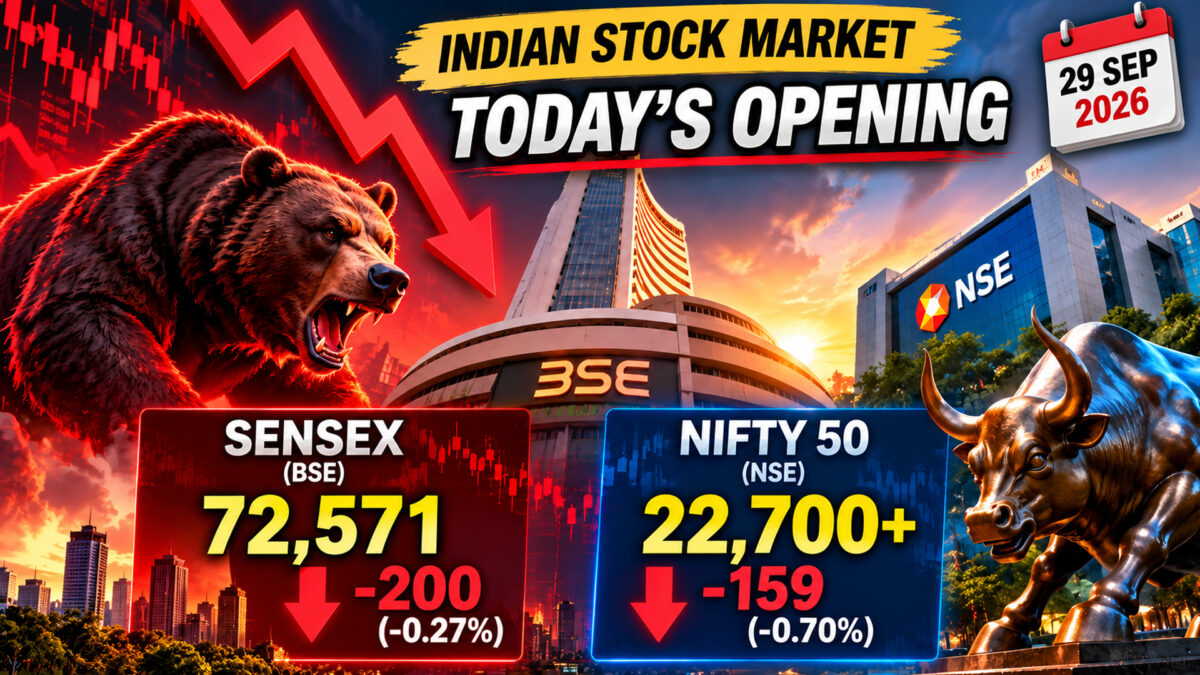
Sensex slides 600 points, Nifty breaches 22,650 mark

Indian stock markets remained under heavy selling pressure on Tuesday, September 29, as rising crude oil prices, a weaker rupee and continued foreign investor selling weighed on sentiment. The benchmark indices extended their recent decline, with the Sensex falling more than 600 points and the Nifty 50 slipping below the 22,600 level.

The sell-off was broad-based, with banking and financial stocks among the biggest drags on the market. Bajaj Finance, HDFC Bank, Kotak Mahindra Bank, Reliance Industries, Asian Paints and Infosys were among the key Sensex losers in early trade.

On the Nifty 50, Tata Motors Passenger Vehicles was the top loser, falling 3.05%. Bajaj Finance declined 1.59%, while Jio Financial Services dropped 1.43%. HDFC Bank was down 1.38% and Trent slipped 1.32%, adding to the pressure on the benchmark index.

Pharma and healthcare stocks offered some relief. Dr Reddy’s Laboratories emerged as the top Nifty gainer, rising 1.61%, followed by Cipla, which gained 0.87%. Apollo Hospitals advanced 0.34%, while Tech Mahindra and Coal India added 0.32% and 0.21%, respectively.

The sharp decline in equities came against a backdrop of rising crude oil prices. Brent crude was trading around $106.86 a barrel, extending its gains from the previous session. Investors remained cautious over the possibility of supply disruptions from the Middle East amid continuing tensions involving the US and Iran.

Crude oil is particularly important for the Indian economy because the country depends heavily on imports to meet its energy requirements. A sustained rise in oil prices can increase the country’s import bill and put pressure on the current account and inflation outlook. Higher crude prices can also weigh on corporate margins in sectors that are dependent on fuel and transportation costs.

The impact was visible in currency markets as well. The Indian rupee opened at 96.03 against the US dollar and weakened further to 96.13 during early trading. It had closed at 95.97 on Monday. The combination of expensive crude oil and foreign fund outflows has kept the rupee under pressure.

Foreign institutional investors have remained cautious towards Indian equities. FIIs sold shares worth ₹3,693.93 crore on Friday, adding to concerns about continued overseas selling. Persistent FII outflows can increase pressure on domestic benchmarks, particularly when global risk appetite is weak.

Global market cues also remained mixed. Asian equities largely traded lower, with Japan’s Nikkei 225, South Korea’s KOSPI and Hong Kong’s Hang Seng under pressure. The Shanghai Composite was marginally higher. Rising US Treasury yields have also added to concerns in global equity markets as investors assess the outlook for interest rates and economic growth.

The weakness was spread across several sectors on the domestic market. Banking, financial services and private bank stocks were among the major laggards. FMCG, oil and gas, consumer durables and cement stocks also faced selling pressure. The relative strength in pharmaceutical and healthcare stocks provided limited support as the broader market remained weak.

Despite the overall decline, several stocks attracted buying interest. Ellenbarrie Industrial Gases gained around 5% after receiving a ₹481-crore order from Bharat Heavy Electricals Limited (BHEL). The order-related development helped the stock outperform the broader market.

Varmora Granito also made a positive debut on Tuesday. The stock listed at ₹155 on the NSE, compared with its issue price of ₹148, marking a 4.73% premium. The listing came even as broader market sentiment remained weak.

PB Fintech was another stock in focus during the session. The company’s shares gained around 4% after Bernstein retained its Outperform rating with a target price of ₹2,310. The stock had faced sharp selling in the previous two sessions following concerns over proposed changes to insurance distribution regulations.

Investors are now closely watching developments in crude oil, the rupee, foreign fund flows and global bond yields for signs of how the market could move ahead. Geopolitical developments in the Middle East remain another important factor for global markets.

The recent weakness has also brought the focus back to valuation and earnings expectations. With the Sensex and Nifty already trading close to six-month lows, market participants are looking for stability after several sessions of selling.

The immediate market mood remains cautious. Elevated crude prices, a weaker rupee, FII selling and pressure on banking and financial stocks are keeping investors on edge, while select pharma, healthcare and company-specific stocks are continuing to attract buying interest.