
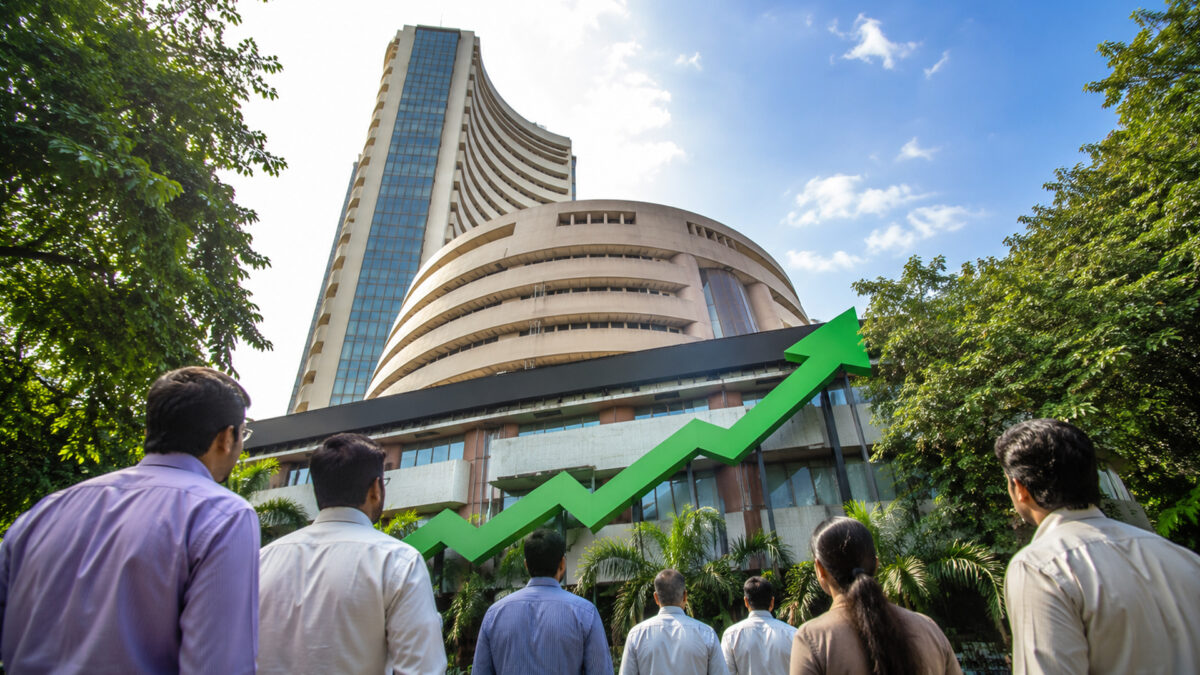
Indian equities opened on a cautious note on Wednesday, with the Sensex rising around 100 points to 72,630, while the Nifty 50 traded near 22,692. The benchmarks remained volatile as investors weighed high crude oil prices, continued foreign fund outflows and mixed global cues. Selective buying in stocks such as TCS and InterGlobe Aviation offered support, while selling in Adani Ports and Max Healthcare limited gains.
The market started on a volatile note after two consecutive sessions of losses. The Sensex opened at 72,598.28, while the Nifty began at 22,712.10. The Sensex later gained more than 150 points before giving up part of the advance, while the Nifty moved above 22,700 during early trade.
Investors are entering the final trading session of September with several concerns still influencing sentiment. Rising crude oil prices, a weak rupee, foreign fund outflows and uncertainty over global developments have kept investors cautious.
Brent crude was trading around $103.5 a barrel, adding to concerns for oil-importing countries such as India. Higher crude prices can increase the country’s import bill and put pressure on inflation and the rupee. The Indian currency had closed at around ₹95.98 against the US dollar on Tuesday.
TCS, InterGlobe Aviation lead gains
Technology and aviation stocks provided support in early trade. Tata Consultancy Services (TCS) was among the leading Nifty gainers, rising around 2.5%, while InterGlobe Aviation gained nearly 2%.
Buying was also visible across parts of the broader market. Twelve of the 16 major sectoral indexes were trading higher, while small-cap and mid-cap indexes gained around 0.7% each, indicating selective buying after the recent correction.
Several stocks moved sharply following company-specific developments. KPI Green Energy gained around 2.1% after securing a solar project contract worth about $211 million in Rajasthan.
Power Mech Projects also gained after winning a contract worth around $57.2 million, while Molbio Diagnostics advanced following positive analyst coverage.
The primary market also remained active. Adroit Industries made a strong debut on Wednesday, listing at ₹250 on the BSE, an 86.57% premium to its IPO price of ₹134. On the NSE, the stock opened at ₹235, a premium of 75.37%.
Adani Ports, Max Healthcare among laggards
The gains were not broad-based, with selling pressure visible in several major stocks. Adani Ports fell around 2% in early trade, making it one of the prominent Nifty losers.
Max Healthcare declined more than 3%, while Dr Reddy’s Laboratories fell more than 2% during early trading. The weakness in these stocks offset some of the gains from technology, aviation and other sectors.
The mixed performance comes after a weak session on Tuesday. The Sensex fell 242.65 points, or 0.33%, to 72,529.07, while the Nifty declined 64.05 points, or 0.28%, to 22,716.20. Both benchmarks touched fresh six-month lows during the session.
Foreign investor selling remains another concern for the market. Foreign institutional investors sold Indian equities worth ₹9,980.22 crore on Tuesday, taking their September outflows to around $2.7 billion.
The continued selling has added pressure to Indian equities at a time when global investors are also closely tracking crude prices, currency movements and interest-rate expectations.
Global cues remain mixed
Asian markets offered mixed signals on Wednesday. Japan’s Topix gained 0.6%, Australia’s S&P/ASX 200 rose 0.7%, while China’s Shanghai Composite added 0.4%. Hong Kong’s Hang Seng, however, declined 0.4%.
US markets ended lower on Tuesday as rising Treasury yields weighed on investor sentiment. Investors are also watching upcoming US inflation and labour-market data for clues about the Federal Reserve’s interest-rate outlook.
The rupee, crude oil and foreign fund flows are likely to remain key drivers for the domestic market. A stronger dollar, elevated oil prices and continued overseas selling could keep volatility high, while easing crude prices or renewed domestic buying could provide some relief.
The recent correction has also brought valuations down across several parts of the market. The Sensex is nearly 16% below its peak of 86,159, recorded in December 2025. More than half of the BSE 500 companies with five-year valuation histories are currently trading below their five-year average valuations.
Markets are likely to remain sensitive to crude oil prices, foreign fund flows and global developments in the near term. Investors will also watch whether buying interest in select large-cap and broader market stocks can help the Sensex sustain levels above 72,600 and the Nifty hold around 22,700 after the recent sell-off.