
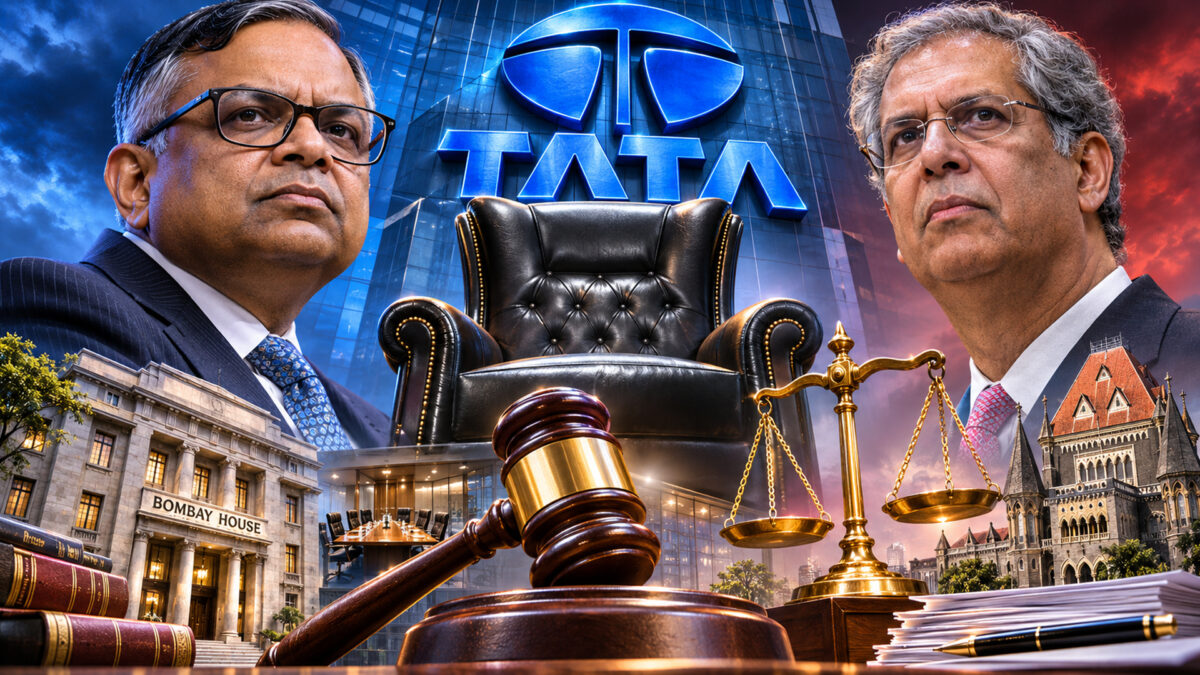
The leadership dispute at the Tata Group has moved to the Bombay High Court, with two prominent Tata Trusts challenging the reappointment of N Chandrasekaran as chairman of Tata Sons for another five-year term. The legal action has intensified differences between Tata Trusts chairman Noel Tata and the board of the group’s holding company, bringing corporate governance, shareholder rights and the conglomerate’s future under scrutiny.
The Sir Dorabji Tata Trust (SDTT) and the RD Tata Trust (RDTT) have filed separate petitions against Tata Sons and six of its directors, seeking to declare the September 17 board resolution approving Chandrasekaran’s reappointment invalid. The trusts have also sought a combined Rs 65 crore in damages, along with 18% annual interest.
The Bombay High Court is scheduled to hear the matter on November 27. The petitions have been filed ahead of an important Tata Sons board meeting scheduled for November 30, making the legal proceedings particularly significant for the group’s immediate leadership and decision-making.
At the heart of the dispute is Article 121 of Tata Sons’ Articles of Association, which governs voting requirements for certain board decisions. The trusts argue that Chandrasekaran’s reappointment did not receive the necessary affirmative votes from their nominated directors and that the chairman’s casting vote could not be used to overcome the disagreement.
The controversy dates back to August, when Chandrasekaran informed the Tata Sons board that he would not seek another term after his existing tenure ended on February 20, 2027. The trusts accepted his decision and supported the process of identifying a successor.
However, at the September 17 board meeting, Chandrasekaran reportedly changed his position and expressed his willingness to continue for another five years, from February 2027 to February 2032.
The proposal received support from most board members. However, the two directors nominated by Tata Trusts were divided. Noel Tata opposed the reappointment, while Venu Srinivasan supported it. Chandrasekaran recused himself from the discussion, and independent director Harish Manwani, who chaired the proceedings, exercised a casting vote to approve the resolution.
The trusts maintain that this procedure violated Article 121. Their argument is that the affirmative support of a majority of the trust-appointed directors was mandatory and that a casting vote could not substitute for this requirement. They have asked the court to declare the resolution invalid and restrain Tata Sons from acting on it.
Tata Sons, however, maintains that the board followed the applicable governance rules and that the resolution was validly passed.
The legal battle is significant because of the ownership structure of Tata Sons. Tata Trusts collectively hold around 66% of the company’s equity, making them its largest shareholder. The holding company oversees the interests of the sprawling Tata Group, which has businesses across automobiles, information technology, steel, aviation, telecommunications and consumer products.
The trusts have traditionally played an influential role in guiding the group’s long-term direction. Noel Tata assumed leadership of Tata Trusts following the death of Ratan Tata in October 2024.
The current disagreement has raised questions about the balance of power between the company’s board and its controlling charitable shareholders. While the board is responsible for business decisions, the trusts believe their rights under the Articles of Association must be protected.
The petitions also seek to prevent the chairman of future board meetings from using a casting vote when the two trust-appointed directors disagree on resolutions requiring their affirmative support.
The dispute has also exposed divisions within Tata Trusts over the decision to approach the court.
The resolutions authorising legal action were approved by a majority of trustees. Noel Tata, his son Neville Tata and Bhaskar Bhat supported the move, while vice-chairmen Vijay Singh and Venu Srinivasan opposed it.
The disagreement has now moved beyond the Tata Sons boardroom. Singh and Srinivasan have separately approached Maharashtra’s Charity Commissioner, seeking an examination of the decision to initiate legal proceedings.
Their concerns relate to the scope of the legal action, the use of charitable trust funds and the possible consequences for Tata Sons’ regulatory obligations. They have argued that the litigation should not interfere with the company’s responsibility to comply with regulatory requirements.
This development adds another dimension to the dispute, as the trusts themselves are divided over how their shareholder interests should be protected.
The proposed stock market listing of Tata Sons is another major issue contributing to the differences between the two sides.
The Reserve Bank of India (RBI) had classified Tata Sons as an upper-layer non-banking financial company (NBFC), bringing it under stricter regulatory requirements, including a listing obligation. The deadline for compliance expired in September 2025.
Tata Sons has maintained that it must address the regulatory requirements, while Tata Trusts has expressed reservations about the proposed listing.
A public listing could significantly change the ownership structure and regulatory framework of the holding company. It could also affect the way the trusts exercise their influence over the group.
The November 30 board meeting is expected to consider important matters relating to the company’s future direction, including steps connected with the listing process. This is why the trusts have sought urgent interim protection against the use of casting votes on contentious resolutions.
The present confrontation is not the first major leadership dispute in the Tata Group. The conglomerate witnessed a prolonged legal battle following the removal of Cyrus Mistry as chairman in 2016. The dispute eventually reached the Supreme Court, which upheld Tata Sons’ decision.
The latest disagreement, however, centres on the interpretation of the company’s Articles of Association and the rights of its controlling shareholders.
Both sides have appointed prominent legal representatives. Senior advocate Abhishek Manu Singhvi is representing the Tata Trusts, while senior advocate Harish Salve is representing Tata Sons and the other respondents.
Chandrasekaran’s current tenure ends on February 20, 2027. If the September resolution remains valid, he will continue as executive chairman until February 2032.
The Bombay High Court’s consideration of the petitions could have implications for the group’s leadership, boardroom voting procedures and the relationship between Tata Sons and its charitable shareholders.