
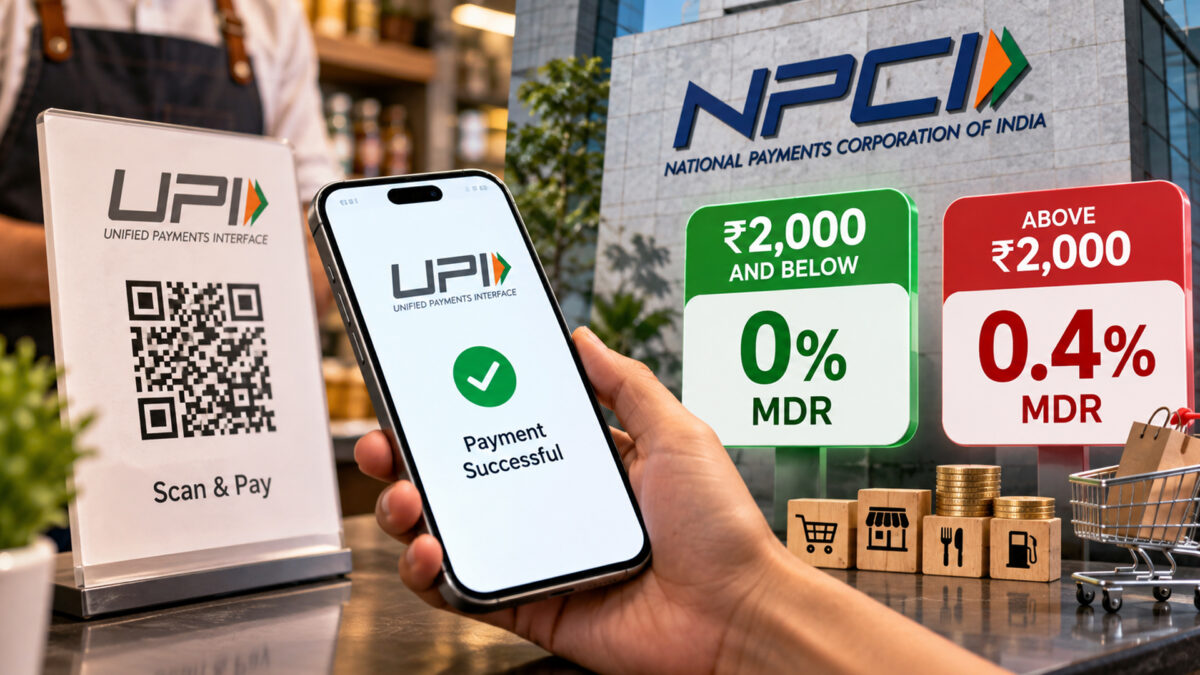
The National Payments Corporation of India (NPCI) has clarified that the upcoming 18% Goods and Services Tax (GST) on the Merchant Discount Rate (MDR) will not make most UPI payments more expensive for small merchants.
The clarification came after reports raised concerns that GST on UPI transactions above ₹2,000 could increase the cost of digital payments for small shopkeepers, vendors and other businesses.
NPCI said the 18% GST will not be charged on the full value of a UPI payment. It will apply only to the MDR, which is a payment-processing fee charged on certain merchant transactions. The new MDR framework will take effect from October 15.
Under the revised rules, a 0.4% MDR will apply to specified person-to-merchant (P2M) UPI transactions above ₹2,000. The fee will be capped at ₹300 for transactions of ₹75,000 and above. The merchant, rather than the customer, bears the MDR.
The key point for everyday UPI users is that payments of up to ₹2,000 will continue to have zero MDR. NPCI said more than 96% of UPI merchant transactions fall within this limit, meaning the vast majority of transactions will remain outside the new MDR framework.
Person-to-person UPI transfers will also remain completely free, regardless of the amount being transferred. Payments to eligible small merchants covered under the zero-MDR framework will continue without the fee as well.
The GST calculation is another important distinction.
If a customer makes a ₹10,000 UPI payment to a merchant, the 0.4% MDR would amount to ₹40. The 18% GST would then be calculated on the ₹40 MDR, which comes to ₹7.20. The GST is therefore not 18% of the ₹10,000 transaction.
In effect, the merchant’s total payment-processing cost would be ₹47.20 in this example, subject to the applicable rules. The customer should not be charged an additional UPI fee simply because the payment is above ₹2,000.
GST-registered businesses can also claim input tax credit on the GST paid on MDR, subject to the normal GST rules. This allows eligible businesses to adjust the tax paid on the payment-processing service against their output tax liability.
NPCI said merchants receiving up to ₹1 lakh a month through UPI will not be liable to pay MDR. This exemption is intended to protect smaller businesses and keep low-value digital payments affordable.
There is, however, a narrower group of merchants that has prompted questions. Some businesses may have annual turnover below the GST registration threshold but receive more than ₹1 lakh a month through UPI. Such merchants may not qualify for the small-merchant MDR exemption and may also be unable to claim input tax credit if they are not registered under GST.
The issue has attracted attention because UPI has become a major part of India’s retail payment system. From roadside vendors and neighbourhood shops to restaurants and large retailers, businesses increasingly depend on QR-code payments.
The new MDR framework marks a shift from the long-standing zero-MDR model for UPI. The government and NPCI have said the change is intended to create a revenue stream for the digital payments ecosystem while protecting small-value transactions.
MDR is not a government tax. It is a fee distributed among participants in the payments ecosystem, including banks and payment service providers, to support the operation and expansion of UPI.
The government has also maintained that the new structure will not affect ordinary consumers using UPI. The change is focused on selected merchant payments rather than person-to-person transfers.
Some industry groups and businesses, however, have raised concerns about the additional cost for merchants handling larger UPI transactions. Retailers and payment-intensive businesses have questioned whether even a small fee could affect businesses operating on thin margins.
The distinction between the transaction value and the MDR is therefore central to the latest debate. A ₹5,000 or ₹10,000 UPI payment does not attract an 18% GST on its entire value. The tax applies only to the MDR charged on an eligible merchant transaction.
The new rules will also introduce different MDR rates for certain categories. Specified sectors such as railways, telecom services, insurance and fuel will have a concessional flat MDR of ₹5 on eligible transactions above ₹2,000.
For consumers, the immediate takeaway is simple: UPI remains free for person-to-person transfers, payments up to ₹2,000 and eligible small merchants. The new charge mainly affects specified higher-value merchant transactions from October 15.
NPCI’s latest clarification is aimed at clearing confusion before the new UPI MDR system takes effect. While the framework introduces a new cost for some merchants, the regulator says the impact will remain limited for most small businesses and everyday digital payments.