
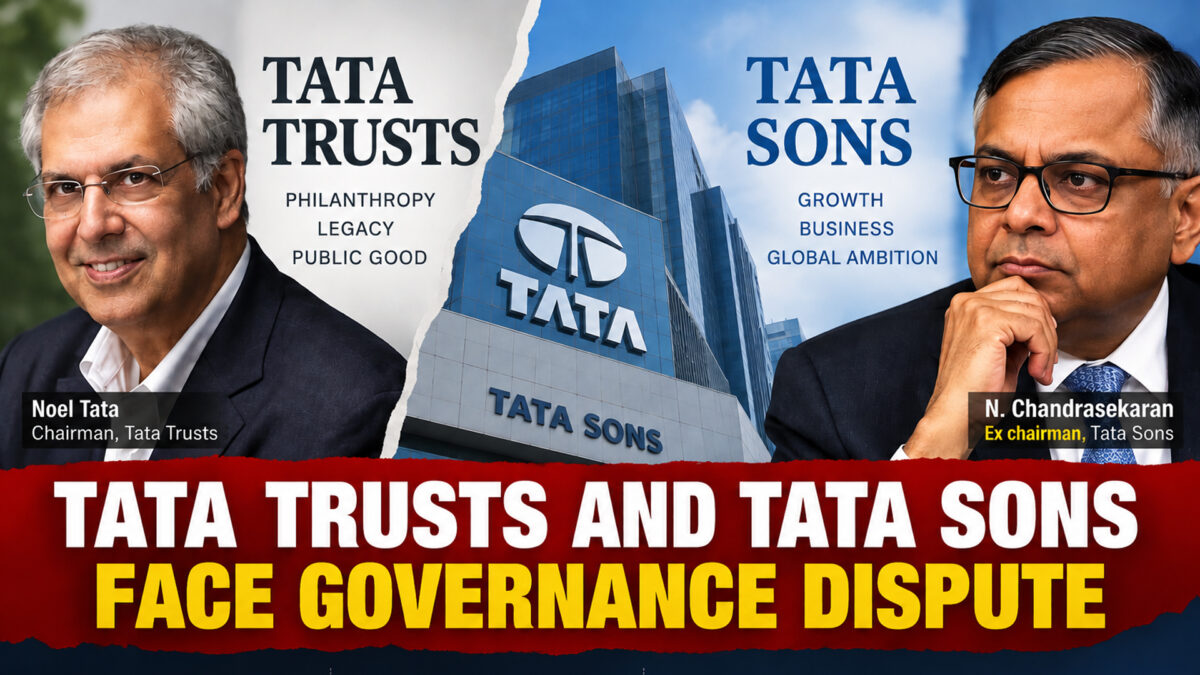
Tata Group is facing a major governance debate over the future of Tata Sons, its principal holding company. At the centre of the dispute is whether Tata Sons should become a publicly listed company and how the group should manage its relationship with Tata Trusts.
Senior advocate Harish Salve, who is advising Tata Sons chairman N Chandrasekaran, has backed the case for a public company structure. He has argued that Tata Sons needs to comply with regulatory requirements and that a listed structure could provide greater transparency.
The disagreement comes after the Reserve Bank of India rejected Tata Sons’ request to give up its registration as an Upper Layer Core Investment Company (CIC). The decision has increased pressure on Tata Sons to consider a stock market listing.
Tata Sons had sought to surrender its registration after arguing that it no longer met the conditions requiring it to remain registered as a CIC. The company had repaid its borrowings in 2019. However, the RBI’s position is that Tata Sons continues to meet the regulatory criteria because several companies in which it holds significant stakes have borrowings.
The regulatory status is important because companies classified as upper-layer CICs are subject to additional oversight. The framework also includes requirements relating to governance, capital and risk management.
A public listing could therefore become one route for Tata Sons to address the regulatory requirement. The issue, however, is complicated by the company’s unusual ownership structure.
Tata Trusts collectively hold about 66% of Tata Sons. The trusts have historically played a central role in the Tata Group and have special rights under the company’s Articles of Association.
The trusts have opposed a Tata Sons listing and have argued that alternatives should be examined. Their position is linked to concerns about preserving the long-standing structure and purpose of the Tata Group.
Tata Sons, meanwhile, has to consider its regulatory obligations as well as the interests of its shareholders. A decision to list would involve significant changes to the company’s ownership structure and could bring its shares into public markets for the first time.
The disagreement has also extended to the appointment of Tata Sons chairman N Chandrasekaran. The company’s board has backed his continuation as chairman. Tata Trusts have raised objections to the process and the wider governance arrangements.
The issue has highlighted a larger question about how Tata Sons should be governed when its major stakeholders do not agree on important decisions.
Salve has argued that a company cannot operate effectively if its key stakeholders remain locked in a prolonged disagreement. He has also maintained that directors have a legal duty to act in the interests of the company rather than represent the interests of individual shareholders.
That principle could become important as the dispute develops. Tata Sons has a large and diverse portfolio, with stakes in businesses spanning information technology, automobiles, steel, aviation, consumer products and financial services.
The holding company owns significant interests in some of India’s biggest businesses. These include Tata Consultancy Services, Tata Motors, Tata Steel and Air India.
The value of Tata Sons therefore extends well beyond its own balance sheet. Decisions taken at the holding-company level can have implications for the wider Tata Group and its listed companies.
The proposed listing would also have implications for the Tata Trusts. A public offering could dilute their ownership depending on the structure and size of the issue. It could also introduce a much wider group of shareholders into the governance of Tata Sons.
The Tata Sons IPO has consequently become a sensitive issue. A listing could improve public disclosure and create a market value for the holding company. At the same time, it would mark a major change from the group’s traditional ownership model.
The Shapoorji Pallonji Group, which owns around 18.4% of Tata Sons, has supported the possibility of a listing. Its position adds another dimension to the shareholder discussions.
The Reserve Bank’s regulatory decision has now made the question more urgent. Tata Sons has also challenged the regulatory position, while the RBI has taken steps to protect its position in any potential legal proceedings.
The company therefore faces several issues at the same time — regulatory compliance, shareholder rights, board governance and the future ownership structure.
A final decision on the Tata Sons listing has not yet been announced. The company and its shareholders will need to consider the legal and regulatory requirements alongside the long-standing governance framework of the Tata Group.
The dispute is ultimately about more than an IPO. It raises questions about how one of India’s most influential business groups should balance its traditional trust-led ownership model with the demands of modern corporate governance and regulation.
As discussions continue, the Tata Group’s next steps will determine whether Tata Sons remains privately held or moves towards becoming a publicly traded company.