Categories
Corporate

AirTrunk enters India with Lumina acquisition

Global data centre company AirTrunk has officially entered India after acquiring Lumina CloudInfra, a move that signals growing international confidence in the country’s fast-expanding digital economy.

The deal gives AirTrunk an immediate foothold in one of the world’s most promising technology markets, where demand for cloud services, artificial intelligence and digital storage is rising rapidly. Financial details of the acquisition have not been disclosed.

AirTrunk, backed by global investment firm Blackstone, is known as one of the leading hyperscale data centre operators in the Asia-Pacific region. By acquiring Lumina CloudInfra, the company gains access to ongoing projects, local market knowledge and a strong development pipeline in India.

Lumina has a presence in major cities such as Mumbai, Chennai and Hyderabad,  all important hubs for technology, finance and internet infrastructure. Reports suggest the acquisition includes around 600 megawatts of planned capacity, giving AirTrunk a ready-made platform for future expansion.

For India, the deal highlights how strongly the country is being viewed as a long-term digital growth market. Rising smartphone use, increasing internet consumption, online businesses, streaming platforms and AI adoption are all driving the need for large-scale data centres.

These facilities are critical to the digital economy. They store data, power cloud computing, support businesses, and enable technologies people use every day,  from banking apps and e-commerce to video calls and entertainment platforms.

Industry experts say India’s data centre sector is expected to grow significantly in the coming years, helped by government support, 5G rollout and increasing demand from global technology firms. As companies process more data and rely more on AI tools, the need for stronger infrastructure is only expected to rise.

For AirTrunk, the acquisition is more than just market entry. It is a strategic bet on India’s future role in the global technology ecosystem. Instead of building operations from the ground up, the company has chosen a faster route by buying an established local player.

Also Read: 24-year-old builds ₹1 cr startup in 4 months

Categories
Corporate

Sensex falls 760 points, Nifty below 24,400

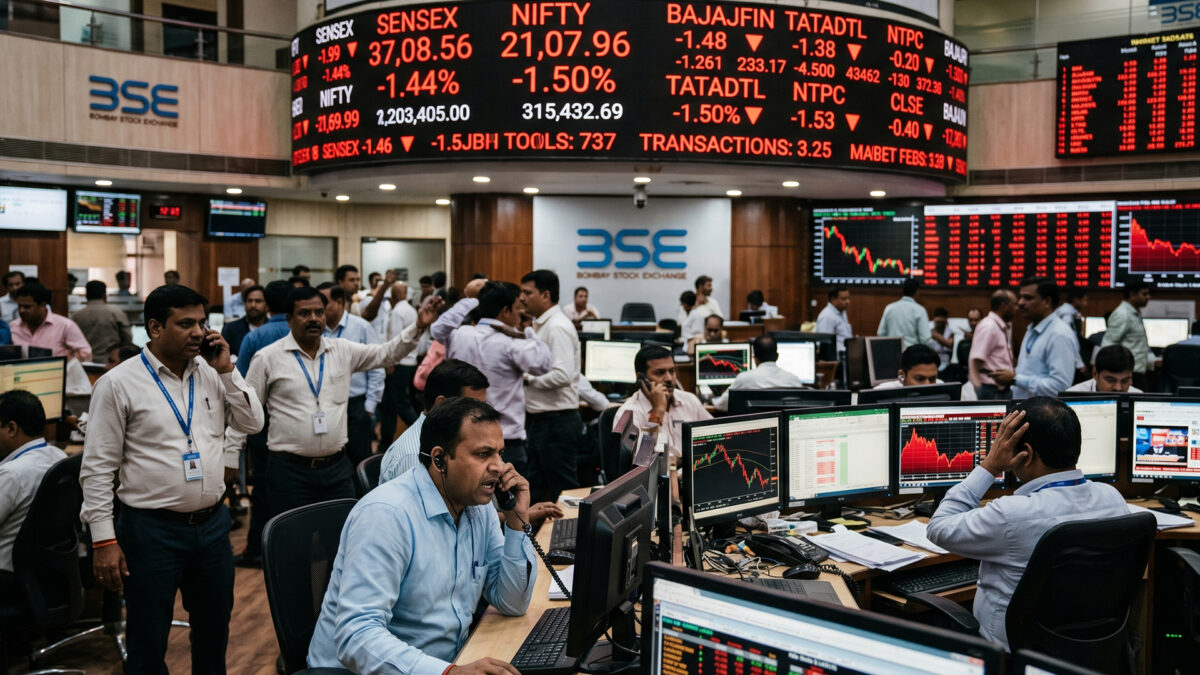
Indian stock markets closed sharply lower on Tuesday, as the BSE Sensex dropped 760 points to settle at 78,516, while the NSE Nifty slipped below the 24,400 level.

Technology stocks led the decline after HCLTech gave a weaker-than-expected business outlook. Its shares fell sharply, triggering selling across the sector. Infosys and Tata Consultancy Services (TCS) also came under pressure, dragging benchmark indices lower.

Investors remained cautious amid rising geopolitical tensions linked to developments involving the United States and Iran. Concerns over crude oil prices also weighed on sentiment, as higher oil costs can increase inflation and widen India’s import bill.

Banking and financial shares traded mixed through the session, while profit booking after the recent rally added to market pressure. Traders chose to lock in gains after three straight days of advances.

Despite the broad sell-off, some heavyweight stocks provided support. Reliance Industries saw buying interest, while select industrial and mid-cap counters also remained firm. Their gains helped limit deeper losses in the benchmark indices.

Market experts said volatility may continue in the near term as investors track global tensions, oil prices, foreign fund flows and quarterly earnings announcements. Upcoming results from major companies are expected to influence market direction in the coming sessions.

Broader markets showed resilience compared to frontline indices, with selective buying in mid-cap and small-cap shares. This suggests domestic investors are still looking for opportunities despite uncertainty in global markets.

Analysts believe that if crude prices stabilise and global tensions ease, Indian markets could recover. However, continued weakness in technology stocks and foreign investor selling may keep sentiment cautious in the short term.

Also Read: YouTube lets users turn off shorts

Categories
Corporate

1,570 organisations hit by SystemBC malware

A large cybercrime operation linked to the ransomware gang The Gentlemen has infected at least 1,570 organisations worldwide, according to new cybersecurity research. The discovery has raised fresh concerns over the growing scale of ransomware attacks targeting businesses.

Security researchers found that the infections were connected to a command-and-control server used by SystemBC, a malware tool commonly used to gain remote access to hacked systems. Once inside, attackers can move through networks, steal data and install ransomware or other malicious software.

Most of the identified victims are believed to be companies rather than individuals. The highest number of infections were reported in the United States, followed by the United Kingdom and Germany, showing that major business hubs were among the key targets.

Researchers linked the activity to an affiliate of The Gentlemen, a ransomware-as-a-service group that surfaced in 2025. Such groups provide ransomware tools to partners, who then carry out attacks in return for a share of ransom payments.

The gang has quickly gained attention for targeting multiple operating systems, including Windows, Linux, NAS storage devices and VMware ESXi servers. This allows attackers to hit a wide range of corporate environments, from office networks to data centres.

Experts say the group also uses double-extortion tactics. In these attacks, criminals first steal sensitive data before encrypting files, then demand payment to unlock systems and prevent the leaked release of stolen information.

Researchers warned that the actual number of victims could be much higher, as many organisations may not yet know they have been compromised or may choose not to report attacks publicly.

Also Read: Zen Tech jumps 11% on licence win

Categories
Corporate

Zen Tech jumps 11% on licence win

Zen Technologies shares surged sharply after the company secured a government licence to manufacture arms and weapon systems, lifting investor sentiment and driving strong buying in the stock.

The defence technology company’s shares rose as much as 11% during trade, extending their recent rally. Over the past month, the stock has climbed around 33%, making it one of the stronger performers in the defence space.

Zen Technologies said it has received approval under the Arms Act, allowing it to manufacture 12.7mm, 23mm, 30mm and 40mm cannons. These systems are widely used in air defence, naval operations and anti-drone applications.

The development is seen as an important milestone for the company, which has so far been known mainly for defence training simulators and combat solutions. With this licence, Zen Tech can now expand into weapons manufacturing and tap larger opportunities in India’s defence sector.

Investors responded positively as the approval opens a new business segment and strengthens the company’s long-term growth story. The stock has also gained more than 17% in the last five trading sessions, showing continued momentum after the announcement.

Zen Technologies has benefited from India’s push for defence self-reliance and higher local manufacturing.

Also Read: Renewables meet global electricity demand in 2025

Categories
Corporate

Tata Steel to deploy low-carbon technology at Jamshedpur plant

Tata Steel has announced a major step in its transition toward cleaner and low-carbon steel production by partnering with SMS Group to introduce advanced green steelmaking technology at its Jamshedpur plant.

The company has signed definitive agreements with Paul Wurth S.A., a subsidiary of SMS Group, to implement the world’s first EASyMelt technology. This system will be installed at Tata Steel’s “E” Blast Furnace in Jamshedpur as a pilot industrial demonstration project.

The new technology is designed to significantly reduce carbon emissions in the steelmaking process. According to the plan, it could cut CO₂ emissions by more than 50% compared to the current operations of the furnace. The system works by combining electrical assistance and syngas-based smelting, allowing existing blast furnace infrastructure to operate more efficiently and with lower environmental impact.

Tata Steel said the project represents an important milestone in its long-term sustainability journey. The company aims to achieve net-zero carbon emissions by 2045 and sees this collaboration as a key step toward that goal. Officials said the focus is on upgrading existing facilities rather than building entirely new systems, making the transition more practical and scalable.

The partnership follows earlier collaboration between Tata Steel and SMS Group, which began in 2023 with a memorandum of understanding to explore decarbonisation in ironmaking. After detailed studies, both companies agreed to move ahead with a phased implementation of the technology.

Tata Steel’s leadership said the shift toward low-carbon steelmaking will depend on innovation, strong partnerships, and modernisation of traditional production systems. SMS Group also highlighted that the project is a significant milestone in bringing next-generation steel technology into real industrial use.

The initiative is part of a broader global push in the steel industry to reduce emissions, as steel production is one of the largest industrial sources of carbon dioxide. By upgrading existing blast furnaces instead of replacing them entirely, Tata Steel aims to balance environmental goals with operational efficiency.

The Jamshedpur project is expected to serve as a model for future decarbonisation efforts across other plants, potentially influencing how steel is produced in India and globally in the coming years.

Also Read: RBI partially withdraws curbs on rupee trades

Categories
Corporate

Nestle India profit rises 27%, revenue grows 23%

Nestle India has reported a strong set of financial results for the quarter ending March 2026, with a sharp rise in profit and revenue driven by steady demand for its packaged food products.

The company’s consolidated net profit increased by 27% year-on-year to ₹1,111 crore, compared to ₹873 crore in the same period last year. Revenue from operations also grew significantly by 23%, reaching around ₹6,748 crore, up from ₹5,504 crore a year earlier. The results exceeded market expectations, reflecting strong performance across key product categories.

Nestle India said the growth was supported by higher consumer demand and increased sales volumes across its major brands, including chocolates, noodles, and beverages. The company also benefited from stronger market penetration and continued focus on premium products.

Along with the earnings, the company announced a final dividend of ₹5 per share for the financial year 2025–26. The record date for determining eligible shareholders has been set, and the payout reflects Nestle’s consistent approach to rewarding investors.

Management highlighted that the performance was driven by double-digit volume growth and increased investment in advertising and brand building. The company also reported healthy margins, supported by efficient cost management and disciplined execution.

In addition, Nestle India achieved its highest-ever domestic sales during the quarter, showing strong consumer demand in the Indian market. Growth was seen across all major product groups, indicating broad-based strength rather than reliance on a single segment.

Following the results, investor sentiment turned positive, with the stock reacting strongly in the market. Analysts noted that the earnings performance signals improving consumption trends and sustained strength in the fast-moving consumer goods (FMCG) sector.

Also Read: UltraTech crosses 200 MTPA capacity mark

Categories
Corporate

Sensex drops nearly 300 points, Nifty slips below 24,500

Indian equity markets opened lower on April 22, 2026, as selling pressure across sectors weighed on investor sentiment. Both benchmark indices ended in the red, with the BSE Sensex falling around 292 points to close near 78,981, while the Nifty50 declined about 84 points to settle close to 24,492.

The session remained weak throughout the day, with early losses extending into mid-trade as global cues stayed mixed and investors continued to book profits after recent gains. Broader weakness was visible across banking, IT, and select large-cap stocks, which dragged the indices lower despite occasional buying in metals and power stocks.

Among heavyweight drags, IT stocks came under pressure, with names like HCL Technologies and Infosys contributing to the decline. Financial stocks also showed softness, adding to the downside momentum in the benchmarks. Market sentiment was further cautious due to global uncertainty and fluctuating crude oil prices.

However, the market was not entirely negative across the board. Select stocks such as ABB India witnessed strong buying interest, emerging as one of the top performers during intraday trade. Power and metal indices also saw intermittent strength, providing some cushion against broader losses.

On the global front, mixed Asian cues and cautious trading in US futures added to investor hesitation. GIFT Nifty signals earlier in the day had also indicated a weak opening, which aligned with the subdued performance seen in domestic markets.

Overall, the broader market tone remained cautious, with investors focusing on stock-specific action ahead of corporate earnings updates and global macroeconomic developments. Market experts suggest that near-term volatility may persist as traders react to global geopolitical developments, interest rate expectations, and crude oil fluctuations.

Also Read: UltraTech crosses 200 MTPA capacity mark

Categories
Corporate

UltraTech crosses 200 MTPA capacity mark

UltraTech Cement has crossed a major milestone by taking its production capacity beyond 200 million tonnes per annum (MTPA), making it the world’s largest cement company outside China.

The achievement comes after the company started operations at new grinding units in Uttar Pradesh, Jharkhand and Andhra Pradesh. With these additions, UltraTech’s India capacity has moved above 200 MTPA, while its global capacity now stands at over 205 MTPA.

The milestone reflects the company’s rapid growth over the past few years. UltraTech had a capacity of around 100 MTPA in 2019 and has doubled that number in less than seven years through expansion projects, plant upgrades and acquisitions.

The company is part of the Aditya Birla Group and is already India’s largest cement manufacturer. By crossing the 200 MTPA mark, it has now strengthened its position among the biggest cement players in the world.

Industry experts say the company’s growth has been supported by rising demand for cement across India. Construction activity in housing, roads, railways, factories and public infrastructure projects has created strong demand for building materials.

As the government continues to invest heavily in infrastructure and urban development, cement demand is expected to remain healthy in the coming years.

UltraTech has also expanded by acquiring regional players, helping it build a wider manufacturing and distribution network across the country.

Analysts believe the larger scale gives the company several advantages, including lower production costs, stronger market reach and better pricing power.

The milestone is also being seen as a sign of India’s growing industrial strength, with a domestic company reaching a manufacturing scale comparable to global leaders.

Despite already crossing 200 MTPA, UltraTech is not slowing down. The company has announced plans to further increase capacity to around 240 MTPA over the next few years.

Also Read: OnePlus Ace 6 Ultra to launch with gaming controller

Categories
Corporate

Sensex jumps 750 points, Nifty settles above 24,550

Indian stock markets closed sharply higher on Tuesday, extending gains for a third straight session, as improving global sentiment and lower crude oil prices boosted investor confidence.

The BSE Sensex jumped 753 points, or 0.96%, to close at 79,273.33, while the Nifty 50 rose 211 points, or 0.87%, to settle at 24,576.60. Both benchmark indices ended at their highest levels in several weeks.

The rally was mainly driven by optimism around possible peace talks between the United States and Iran, which helped ease concerns over geopolitical tensions in the Middle East. Falling crude oil prices also supported sentiment, especially for India, which depends heavily on oil imports.

Among the top gainers on the Sensex were ICICI Bank, Bajaj Finance, Nestle India, HUL and Axis Bank, which saw strong buying interest through the session. Nestle India gained after reporting better-than-expected quarterly earnings, while financial stocks benefited from renewed investor confidence.

On the losing side, HCL Tech, Infosys, TCS, Tech Mahindra and Wipro ended lower, as IT stocks remained under pressure due to concerns over global demand and cautious outlooks from the technology sector.

Broader markets also ended in positive territory. Midcap and smallcap indices advanced, indicating buying support across sectors beyond heavyweight stocks. More shares rose than fell on the BSE, reflecting healthy market breadth.

Also Read: Vedanta sets May 1 for demerger

Categories
Corporate

OnePlus Ace 6 Ultra to launch with gaming controller

OnePlus is getting ready to launch the OnePlus Ace 6 Ultra, a new smartphone aimed at mobile gamers, along with a dedicated gaming controller that can turn the device into a handheld-style console.

The company has confirmed that both products will be introduced in China on April 28.

The highlight of the launch is the new gaming controller, which is designed to attach to the phone for a more immersive gaming experience. It includes physical buttons, shoulder triggers and side grips, giving users better control than standard touchscreen gaming.

The accessory is expected to appeal to players of fast-paced shooting, racing and action games, where quick response times and physical controls can make a big difference.

OnePlus has also designed the controller to support extra cooling accessories, helping reduce heat during long gaming sessions. This is especially useful for users who spend extended time playing graphics-heavy games.

The Ace 6 Ultra itself is expected to come with powerful hardware. Reports suggest the phone may feature a high refresh rate OLED display, a flagship-level processor and a large battery for longer gameplay and everyday use.

These features indicate that OnePlus is positioning the device as a serious option for gaming enthusiasts, while still offering the benefits of a regular smartphone.

The launch reflects a wider trend in the mobile industry, where brands are increasingly focusing on gaming performance. As smartphone processors become more powerful, companies are trying to turn phones into all-in-one entertainment devices.

Instead of buying a separate gaming handheld, users may soon be able to use their phones for both communication and console-style gaming.

The target audience for OnePlus are younger consumers and competitive mobile gamers, especially in markets where esports and online gaming continue to grow rapidly.

So far, the company has only announced the launch for China, and there is no confirmation yet on global availability.

Also Read: Jio Financial falls 4% after weak Q4 profit