
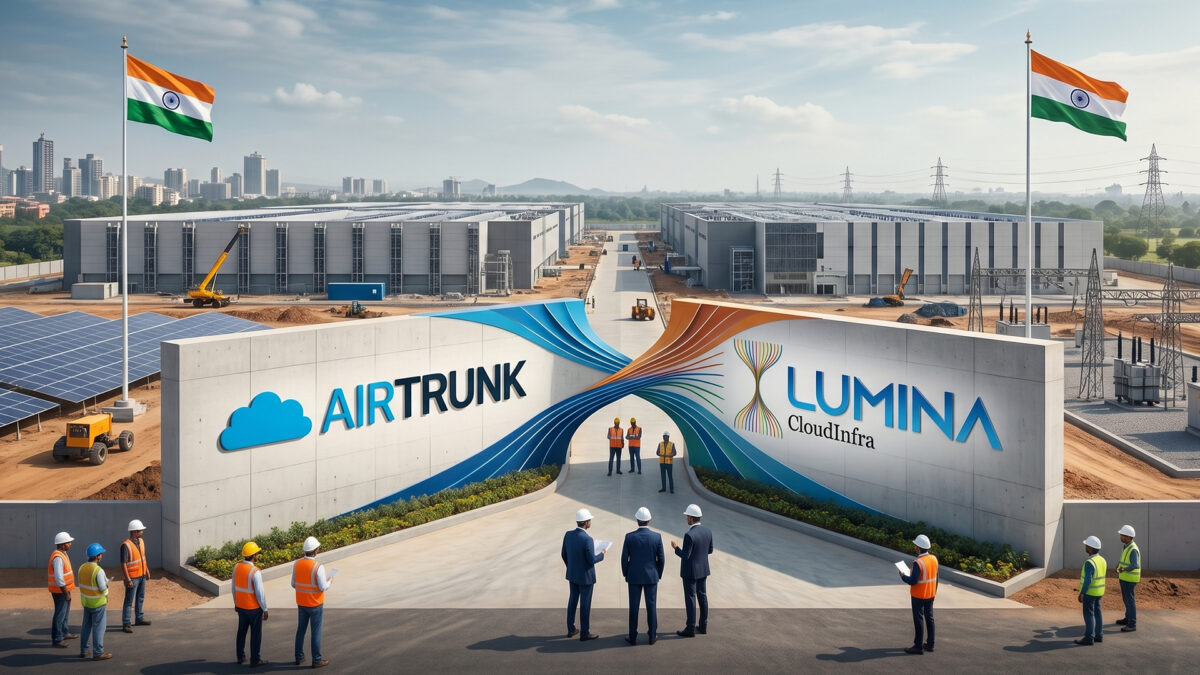
Global data centre company AirTrunk has officially entered India after acquiring Lumina CloudInfra, a move that signals growing international confidence in the country’s fast-expanding digital economy.
The deal gives AirTrunk an immediate foothold in one of the world’s most promising technology markets, where demand for cloud services, artificial intelligence and digital storage is rising rapidly. Financial details of the acquisition have not been disclosed.
AirTrunk, backed by global investment firm Blackstone, is known as one of the leading hyperscale data centre operators in the Asia-Pacific region. By acquiring Lumina CloudInfra, the company gains access to ongoing projects, local market knowledge and a strong development pipeline in India.
Lumina has a presence in major cities such as Mumbai, Chennai and Hyderabad, all important hubs for technology, finance and internet infrastructure. Reports suggest the acquisition includes around 600 megawatts of planned capacity, giving AirTrunk a ready-made platform for future expansion.
For India, the deal highlights how strongly the country is being viewed as a long-term digital growth market. Rising smartphone use, increasing internet consumption, online businesses, streaming platforms and AI adoption are all driving the need for large-scale data centres.
These facilities are critical to the digital economy. They store data, power cloud computing, support businesses, and enable technologies people use every day, from banking apps and e-commerce to video calls and entertainment platforms.
Industry experts say India’s data centre sector is expected to grow significantly in the coming years, helped by government support, 5G rollout and increasing demand from global technology firms. As companies process more data and rely more on AI tools, the need for stronger infrastructure is only expected to rise.
For AirTrunk, the acquisition is more than just market entry. It is a strategic bet on India’s future role in the global technology ecosystem. Instead of building operations from the ground up, the company has chosen a faster route by buying an established local player.
Also Read: 24-year-old builds ₹1 cr startup in 4 months