Categories
Corporate

Sensex rises 640 points, Nifty reclaims 24,000

Indian stock markets ended higher on Monday, as the Sensex gained about 639 points to close at 77,303, while the Nifty 50 rose nearly 190 points to settle around 24,092, snapping a three-day losing streak.

The positive opening was driven by strong cues from GIFT Nifty, which indicated a gap-up start ahead of trading. Buying interest sustained through the session, although volatility remained due to global uncertainties and foreign fund outflows.

Market strength was largely supported by heavyweight stocks. Reliance Industries, ICICI Bank, HDFC Bank, and TCS were among the top gainers, contributing significantly to the index rally. Banking and IT stocks attracted fresh buying, helping lift overall sentiment.

Broader markets also participated in the recovery, with midcap and smallcap stocks showing healthy gains. This indicated wider participation beyond frontline index stocks, adding strength to the overall market rebound.

However, not all sectors ended in the green. Some FMCG and pharmaceutical stocks witnessed profit booking and emerged among the top losers during the session. Defensive sectors remained under mild pressure as investors rotated into financials and energy stocks.

Despite the positive close, foreign institutional investors (FIIs) continued to remain net sellers, which kept sentiment cautious. Persistent outflows from FIIs have been one of the key concerns for domestic equity markets in recent sessions.

Global factors also influenced trading. Elevated crude oil prices and geopolitical tensions continued to weigh on investor sentiment, raising concerns about inflation and currency stability. The rupee remained under watch amid fluctuating global risk appetite.

Also Read: NTPC plans ₹25,000 cr nuclear project in Bihar

Categories
Corporate

Wipro buyback may bring short-term gains

Wipro’s proposed share buyback could offer an attractive short-term opportunity for investors, with brokerages estimating possible returns of 8% to 14% over the next two to three months.

The IT company has announced a ₹15,000 crore buyback at ₹250 per share, a price higher than where the stock was recently trading in the market. This premium has drawn interest from investors looking for quick gains.

In a buyback, a company purchases its own shares from shareholders, usually at a fixed price. It is often seen as a way of rewarding investors and returning surplus cash.

Market experts said retail investors may benefit the most because buyback offers usually have a separate reservation category for small shareholders. This improves their chances of getting shares accepted under the offer.

However, analysts noted that final returns will depend on several factors, including the share price before the record date, the number of shares accepted in the buyback and market movement during the offer period.

If acceptance levels remain strong, investors could see healthy gains in a relatively short time.

The buyback is also being viewed as a positive signal from the company, suggesting management confidence despite a challenging environment for the IT sector.

Global technology spending has remained cautious, with clients delaying decisions and controlling budgets. In that backdrop, returning cash to shareholders is being seen as a supportive move.

Wipro shares have remained in focus since the announcement, with investors now watching for the record date and detailed timeline of the process.

Also Read: Samsung wins Global awards for coral reef project

Categories
Corporate

Samsung wins Global awards for coral reef project

Samsung has won multiple international awards for a unique environmental project that uses Galaxy smartphones to help restore coral reefs and protect ocean life.

The company’s initiative combines mobile technology with conservation efforts, showing how everyday devices can be used for real-world environmental impact.

At the centre of the project is Samsung’s “Ocean Mode”, a special camera feature designed for underwater photography. It helps users capture clearer images beneath the surface by improving colour balance and reducing blur caused by water movement.

Samsung said the feature allows researchers, divers and local communities to use smartphones instead of expensive underwater cameras to monitor reef conditions.

The company’s coral reef restoration programme, called “Coral in Focus”, was recognised at international award platforms for innovation and sustainability. A documentary linked to the project also received honours for highlighting marine conservation work.

Samsung is running the initiative with environmental partners and marine scientists, including Seatrees and researchers from the University of California San Diego.

Together, they use Galaxy phones to take underwater images of coral reefs. These images are then turned into 3D models that help experts study reef damage, track recovery and plan restoration efforts.

The programme is active in several parts of the world, including Fiji, Indonesia, Costa Rica, the Galápagos Islands and the United States.

Samsung said thousands of coral fragments have already been planted through the initiative, helping rebuild damaged reef systems.

Coral reefs are among the most important ecosystems on Earth. Though they cover only a small part of the ocean floor, they support a large share of marine biodiversity and provide food and income for millions of people.

Scientists have warned that rising sea temperatures, pollution and overfishing are putting reefs at serious risk globally.

Also Read: Sanjay Jamuar named CEO of Delhi Metro global arm

Categories
Corporate

JK Cement wins Rajasthan Limestone mine bid

JK Cement has emerged as the preferred bidder for the Maliyakheri Limestone Block-I in Chittorgarh, Rajasthan, giving the company access to an important raw material source for its cement business.

The company received confirmation after a government e-auction and has informed stock exchanges about the development. The limestone block is located in Rajasthan, one of India’s key cement-producing states known for rich mineral reserves.

Limestone is the main ingredient used in cement manufacturing, making mining rights highly valuable for companies in the sector. By securing its own source, JK Cement is expected to reduce dependence on outside suppliers and improve long-term cost control.

Industry experts said captive limestone mines help cement makers manage raw material costs more efficiently, especially at a time when fuel, freight and input expenses remain volatile.

The new mine is also expected to support JK Cement’s future expansion plans by ensuring stable supply for production growth in the years ahead.

JK Cement is one of India’s leading cement companies with a presence in grey cement, white cement and wall putty segments. The company has been steadily expanding capacity to meet rising demand from housing, infrastructure and construction projects.

Analysts said the latest bid win is a positive strategic move, even if the immediate financial impact may be limited. Over time, access to owned mineral reserves can strengthen margins and improve operational efficiency.

The company will now move to complete regulatory approvals, clearances and lease formalities before mining activity can begin.

The development comes as cement companies continue to focus on expansion and raw material security to stay competitive in a fast-growing market.

Also Read: Sun Pharma to buy Organon for $11.75 bn

Categories
Corporate

Sun Pharma to buy Organon for $11.75 bn

Sun Pharmaceutical Industries has announced plans to acquire US-based healthcare company Organon in a $11.75 billion deal, making it one of the biggest overseas acquisitions by an Indian company and the largest by an Indian pharma firm.

The acquisition is expected to significantly strengthen Sun Pharma’s global presence and diversify its product portfolio. Organon has a strong business in women’s health, biosimilars and established medicines, with operations across more than 140 countries.

Sun Pharma said the deal supports its long-term growth strategy and will help it expand in high-potential global healthcare segments. Industry experts believe Organon’s established brands and international reach can provide steady revenue growth for the Indian drugmaker.

The combined business is expected to have wider global reach, stronger product offerings and improved scale in key markets such as the US, Europe and emerging economies.

The transaction has been approved by the boards of both companies and is expected to close after regulatory and shareholder clearances.

Investors reacted positively to the announcement, with Sun Pharma shares gaining in early trade. Analysts said the acquisition reflects the growing confidence of Indian pharmaceutical companies in making large global bets.

Also Read: Trump hosts Crypto event as meme coin crashes


Categories
Corporate

Sensex surges 600 points, Nifty reclaims 24,000

Indian stock markets bounced back strongly on Monday, with the Sensex climbing more than 600 points and the Nifty moving above the 24,000 mark, as investors returned to equities after recent losses. Relief over easing tensions in the Middle East and hopes of stability in crude oil prices helped improve sentiment.

The BSE Sensex was trading above 77,100 during the session, while the NSE Nifty hovered around 24,050. Broader markets also joined the rally, with midcap and smallcap stocks posting healthy gains.

Buying was seen across several sectors, with pharma, IT and metal shares leading the recovery. Investors also picked quality stocks that had corrected sharply in recent sessions.

Among the biggest gainers, Sun Pharma jumped sharply after announcing a major overseas acquisition. The stock emerged as one of the top performers of the day. Infosys, Adani Ports, Mahindra & Mahindra, and Eternal also traded higher as buying momentum picked up across frontline counters.

However, not all stocks participated in the rally. Axis Bank remained under pressure after its recent quarterly earnings disappointed investors. Paytm also slipped as concerns around regulatory issues continued to weigh on sentiment. Shriram Finance and a few private banking names were also among the laggards.

Market experts said Monday’s rally was driven by a mix of bargain buying and improving global cues after last week’s volatility. Investors were encouraged by signs that geopolitical tensions may cool, reducing worries over a spike in oil prices.

Still, analysts warned that markets could remain sensitive in the near term. Crude oil prices are still elevated, and any sharp rise could impact inflation, the rupee and corporate margins in India.

Also Read: SEBI proposes overhaul of stockbrokers’ net worth norms

Categories
Corporate

KPMG to cut 10% of US audit partners

KPMG is set to reduce its US audit partner ranks by about 10%, in a restructuring move that comes after years of unsuccessful efforts to encourage voluntary early retirements.

The decision will affect roughly 100 partners in the firm’s US audit division. According to reports, some partners had already opted for voluntary exit schemes, but the numbers fell short of what the firm needed to rebalance its leadership structure.

KPMG said the cuts are not linked to individual performance. Instead, the firm is focusing on aligning the size of its audit partnership with the actual needs of its business. The goal is to better match staffing levels with client demand and improve overall efficiency in the audit practice.

Partners impacted by the decision are expected to receive financial exit packages along with support to transition into other roles or opportunities outside the firm. Managing directors within the audit division will not be affected by this round of reductions.

The move is part of a broader restructuring trend within the Big Four accounting firms, which have been adjusting their workforce after pandemic-era hiring increases and slower-than-expected staff turnover. Many firms have faced challenges in balancing workforce size with changing market conditions.

Also Read: India’s forex reserves rise above $703 bn


Categories
Corporate

Reliance Q4 eyes on Jio, retail growth

Reliance Industries is set to announce Q4 FY26 results, with investors expecting a mixed performance.

Strong growth in Reliance Jio and Reliance Retail is likely to support revenue through subscriber additions, higher ARPU, store expansion and better margins.

However, weakness in the oil-to-chemicals and upstream energy businesses may pressure profits due to higher crude prices, freight costs and supply disruptions.

Markets are also watching for a final dividend announcement and updates on the proposed Jio Platforms IPO. Reliance’s commentary may influence broader market sentiment.

Categories
Corporate

₹56,000 cr value wiped out as Infosys shares slide

Infosys shares saw a sharp fall on Friday, wiping out nearly ₹56,000 crore in market value, after investors reacted negatively to the company’s cautious growth outlook for the next financial year.

Despite reporting healthy quarterly earnings, the IT major came under heavy selling pressure as the market focused on future concerns rather than past performance. The stock dropped around 6–7 per cent during the session, making Infosys one of the biggest losers on Dalal Street.

Infosys reported a strong March quarter, with consolidated net profit rising around 21 per cent year-on-year to ₹8,501 crore. Revenue also posted steady growth, showing resilience in a challenging global business environment.

However, investors were disappointed by the company’s FY27 revenue growth guidance of 1.5 per cent to 3.5 per cent in constant currency terms. Analysts said the forecast suggests that global demand remains weak and clients are still cautious about spending on technology projects.

The company said business decisions by clients continue to be slower because of macroeconomic uncertainty and geopolitical tensions. While demand for artificial intelligence and digital transformation services remains encouraging, overall market visibility is still mixed.

The fall in Infosys shares also dragged the broader IT sector lower. Other technology stocks came under pressure as investors worried that slower growth could continue across the industry. The Nifty IT index has already seen losses this week after mixed earnings and cautious commentary from several companies.

Brokerages gave mixed reactions after the results. Some maintained confidence in Infosys’ long-term strengths, citing its strong balance sheet, global client base and leadership in digital services. Others turned more cautious, warning that near-term growth may remain under pressure.

Also Read: Infosys gives ₹51.75 cr stock grant to CEO Salil Parekh

Categories
Corporate

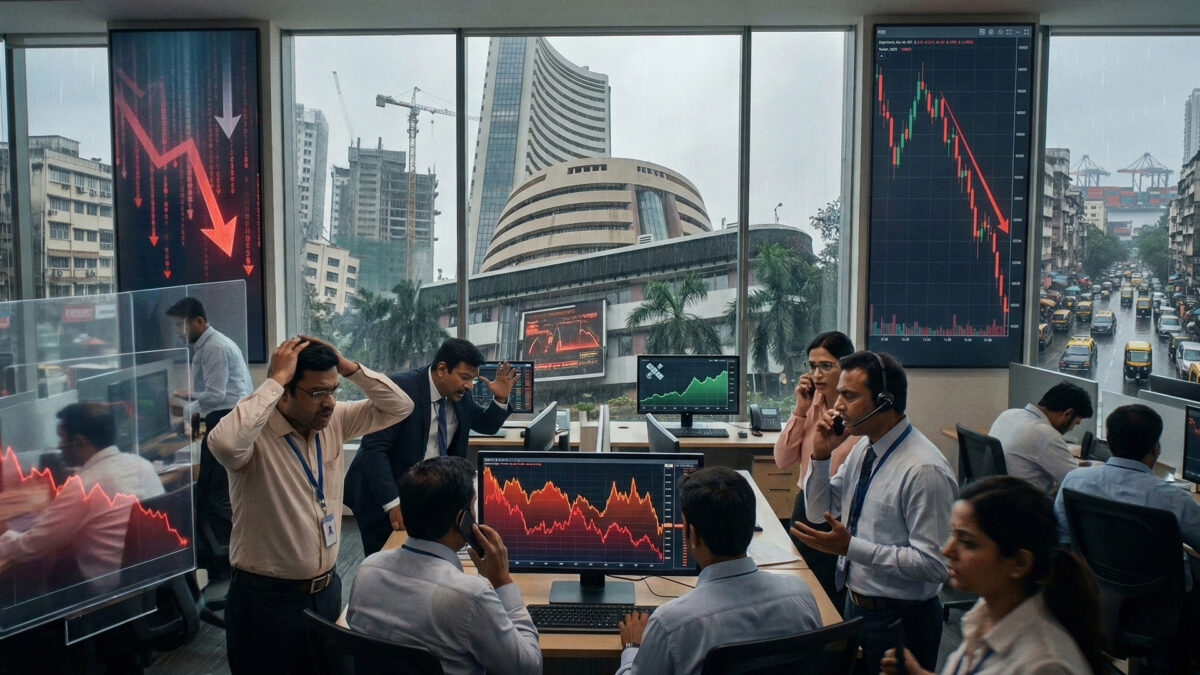
Sensex sinks 1,000 points, Nifty ends below 23,900

Indian stock markets witnessed a heavy sell-off on Friday, with the Sensex tumbling around 1,000 points and the Nifty slipping below 23,900, as rising crude oil prices and weakness in IT stocks unsettled investors.

The BSE Sensex closed down 999.79 points at 76,664.21, while the NSE Nifty50 lost 275.10 points to end at 23,897.95. It was the third straight day of losses for the benchmark indices.

Markets remained weak throughout the trading session, with selling pressure seen across sectors. Investor sentiment turned cautious after crude oil prices surged due to fresh tensions in West Asia. Higher oil prices are a concern for India because they can increase inflation, widen the trade deficit and affect corporate margins.

IT stocks were among the biggest losers of the day after disappointing earnings outlooks from some large companies. Infosys remained under pressure after giving a muted growth forecast, while HCL Tech also saw selling after recent quarterly results failed to impress the Street.

Reliance Industries, another heavyweight stock, also dragged the indices lower as investors remained cautious ahead of its earnings announcement. Pharma and energy shares too saw weakness in selective counters.

Among the top losers in the broader market were Infosys, HCL Tech, Reliance Industries, Sun Pharma and Adani Energy Solutions. Their decline added significant pressure on benchmark indices because of their large market weight.

Despite the broad fall, a few stocks managed to end higher. Nestle India gained after posting strong quarterly earnings, while Indian Energy Exchange (IEX) also advanced on the back of better-than-expected results.

Market volatility increased sharply during the day, showing nervousness among traders. Analysts said investors are closely watching crude oil prices, geopolitical developments and the ongoing earnings season for further direction.

Foreign investor activity also remained cautious, adding to pressure on domestic equities. Many traders chose to reduce risk exposure ahead of the weekend amid uncertain global cues.

Also Read: Zerodha closes Zero1 creator platform