Categories
Corporate

India Plans ₹7,000 Cr Boost for Rare-Earth Magnets

India is set to triple incentives for rare-earth magnet manufacturing to nearly ₹7,000 crore ($788 million), aiming to reduce reliance on China and secure critical material supply for electric vehicles, wind energy, and defence.

The expanded PLI scheme, awaiting Cabinet approval, will support around five manufacturers through investment and production incentives. Rare-earth magnets, vital for EV motors and renewable technologies, are currently dominated by China, which controls about 90% of global refining.

To ensure a steady input supply, foreign miners such as Lynas Rare Earths (Australia), Rainbow Rare Earths (UK), and Iluka Resources have assured the government of rare-earth oxide availability under the plan.

This initiative aligns with India’s broader strategy to build supply-chain resilience and boost domestic capacity in clean-tech manufacturing.

Also Read: Sensex falls 100 pts, Nifty below 25,750

Categories
Corporate

ED Seizes ₹3,000 Crore Reliance Group Assets

The Enforcement Directorate (ED) has attached assets worth over ₹3,000 crore belonging to the Anil Ambani-led Reliance Group, escalating its investigation into alleged money-laundering and diversion of bank funds.

The action covers more than 40 properties across Mumbai, Delhi, Noida, Pune, Hyderabad, Chennai, and Thane. The list includes commercial assets, land parcels, and Ambani’s Pali Hill residence in Mumbai.

According to the agency, the attachment follows a probe into Reliance Home Finance Ltd (RHFL) and Reliance Commercial Finance Ltd (RCFL). Both firms reportedly received loans of over ₹5,000 crore from Yes Bank between 2017 and 2019, a large portion of which was allegedly routed through shell or connected entities in the form of “round-tripping.”

Investigators say several loans were sanctioned and disbursed on the same day, often without proper documentation or collateral. Many recipient firms were financially weak or inactive, indicating possible misrepresentation and internal control lapses.

The ED has also extended its investigation to Reliance Communications Ltd (RCOM) and related companies, citing suspected fund diversion of about ₹13,000 crore. Some of these funds were allegedly moved through fixed deposits and mutual funds before returning to group-linked entities.

Officials said proceeds from the attached assets will help recover public money lost through these transactions. More attachment orders are expected as the money trail is traced.

Also Read: Gold at ₹1.21 Lakh, Silver at ₹1.49 Lakh as Dollar Weakens

Categories
Corporate

Gold at ₹1.21 Lakh, Silver at ₹1.49 Lakh as Dollar Weakens

Gold prices edged higher on Monday as a weaker U.S. dollar and steady physical demand supported sentiment in the bullion market. On the Multi Commodity Exchange (MCX), December gold futures rose 0.39% to ₹1,21,708 per 10 grams, while silver futures gained 0.69% to ₹1,49,307 per kilogram.

Analysts said a softer dollar made gold more attractive to buyers holding other currencies, while stable domestic spot demand provided additional support. However, recent comments from U.S. Federal Reserve officials hinting at a cautious stance on rate cuts have capped major gains, prompting some profit booking in global markets.

Market experts see key support for gold at ₹1,20,600 and ₹1,19,800, with resistance levels at ₹1,22,000 and ₹1,22,700. For silver, support lies at ₹1,47,000 and ₹1,45,500, while resistance is expected near ₹1,50,000 and ₹1,51,500.

Traders said gold may remain range-bound in the short term as investors await further economic cues from the US and upcoming inflation data. Despite near-term volatility, the underlying sentiment remains positive due to geopolitical risks and sustained central bank buying, keeping gold an attractive hedge for institutional and retail investors alike.

Also Read: Sensex falls 100 pts, Nifty below 25,750

Categories
Corporate

Sensex falls 100 pts, Nifty below 25,750

Indian stocks traded with high volatility on Monday, opening slightly lower as investors took profits after a strong rally in October. Weakness in private banks and FMCG shares pulled the markets down, though positive quarterly results and encouraging auto sales data helped limit the fall.

The mood in global markets also stayed cautious. A stronger U.S. dollar and the Federal Reserve’s cautious outlook on interest rate cuts made investors less willing to take risks.

On Friday, Indian markets had already ended lower for the second day in a row as traders booked profits following mixed corporate earnings. Financial stocks, especially HDFC Bank and ICICI Bank, faced pressure after the market regulator tightened some eligibility rules.

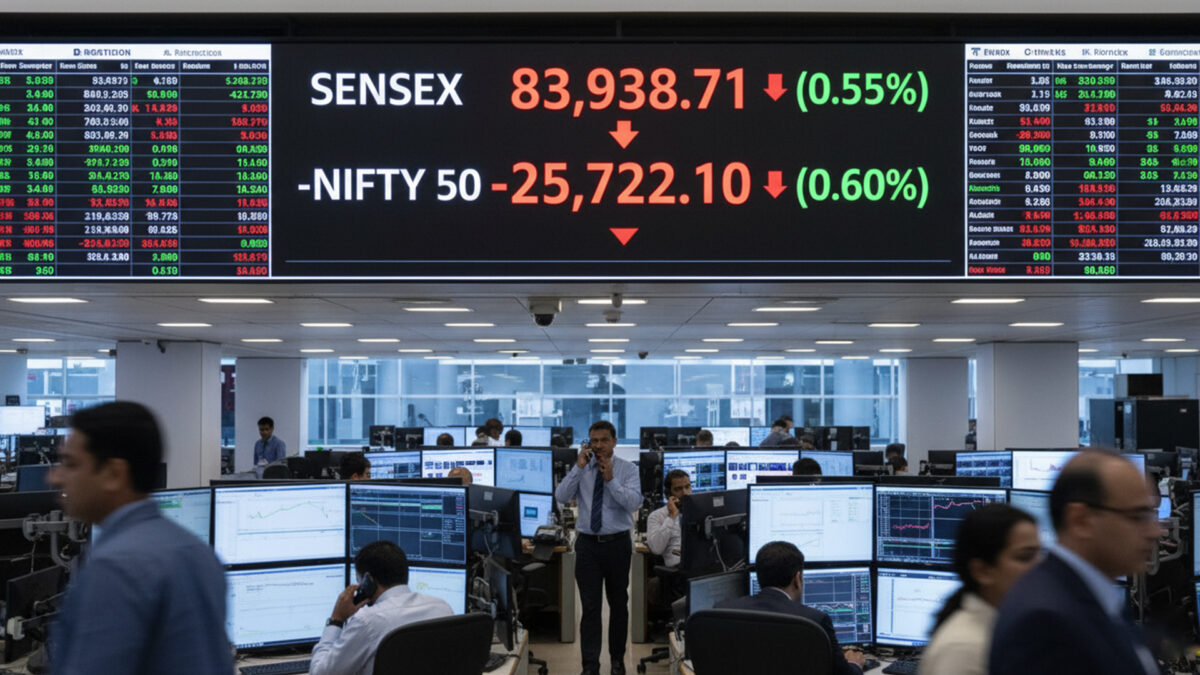
At close on Friday, the Sensex had fallen 465.75 points (0.55%) to 83,938.71, while the Nifty 50 lost 155.75 points (0.60%) to end at 25,722.10.

Analysts said the market could stay choppy in the short term as investors look for direction from global cues, crude oil prices, and upcoming earnings reports.

Categories
Corporate

Titagarh Rail Systems Secures ₹2,481 Crore Mumbai Metro Contract

Titagarh Rail Systems Ltd (TRSL) announced on Friday that it has secured a contract worth about ₹2,481 crore from the Mumbai Metropolitan Region Development Authority (MMRDA) for work on the Mumbai Metro Line 5 project.

The contract covers the design, manufacture, supply and commissioning of 132 metro coaches, along with comprehensive signalling, telecommunication systems, platform screen doors, depot machinery, and five years of maintenance support.

The scope of TRSL’s assignment spans both Phase 1 (Kapur Bawdi to Kasheli to Dhamankar Naka) and Phase 2 (Dhamankar Naka to Bhiwandi to Kalyan APMC) of the Line 5 corridor, according to company statements.

The order also includes signalling for roughly 24.9 kilometres of track and telecommunication systems across 16 stations.

TRSL Vice Chairman and Managing Director Umesh Chowdhary said the contract underscores the company’s growing strength in delivering end-to-end metro rail solutions, adding that manufacturing will be done at their advanced Passenger Rail Systems facility in Uttarpara near Kolkata.

This award represents TRSL’s second major order for the Mumbai Metro network, following an earlier mandate for Line 6, signalling the firm’s rising profile in India’s metro manufacturing and systems market.

Analysts say the contract strengthens India’s domestic rail-coach and metro-systems ecosystem, aligning with the “Make in India” policy and reducing reliance on imports for high-technology transit systems.

TRSL’s manufacturing facility will deliver the rakes with stainless-steel car bodies and modern interiors, according to disclosures.

From a strategic standpoint, the deal provides TRSL with large-scale, long-term visibility in the urban transit segment, where orders are increasingly comprehensive, covering rolling stock, signalling and system integration.

Given the five-year maintenance component, the contract also locks in service revenue beyond delivery.

However, execution will carry challenges.

Delivering 132 coaches in line with strict technical and safety standards, integrating signalling and control systems across the corridor, and managing project timelines under the metro development schedule are all complex undertakings.

Market watchers note that delays or cost overruns remain risks in large infrastructure-equipment contracts.

For TRSL, the contract may bolster its order book substantially and enhance investor confidence.

But the company must deliver on quality, timely production, and maintenance performance to convert the opportunity into long-term business advantage.

Also Read: Nvidia CEO Completes $1 Billion Share Sale

Categories
Corporate

Nvidia CEO Completes $1 Billion Share Sale

Nvidia Corporation Chief Executive Officer Jensen Huang has completed a pre-arranged stock sale that has taken his total proceeds above $1 billion, according to regulatory disclosures and media reports.

The final transaction of 25,000 shares, reported this week, marks the conclusion of a plan adopted in March to sell as many as 6 million shares during the year.

Huang began executing the share sale in late June, when the value of the stake involved was around $865 million.

Since then, Nvidia’s stock price has climbed more than 40 percent, driven by soaring demand for artificial intelligence processors and the company’s expanding dominance in the semiconductor industry.

The timing coincides with Nvidia reaching a historic milestone: becoming the first company to hit a $5 trillion market capitalization in late October.

The share sale was conducted under a predetermined trading plan—commonly known as a Rule 10b5-1 plan—which allows executives to sell shares at preset intervals and prices, reducing the risk of insider trading accusations.

While the scale of the sale is sizable, analysts note that Huang continues to hold a substantial stake in the company, keeping his long-term interests aligned with Nvidia’s growth trajectory.

Investor reaction to the disclosure has been measured. The planned nature of the sale and the continued strength of Nvidia’s business have helped ease concerns that the transaction signals any loss of confidence in the company’s future.

However, the magnitude of the sale has drawn attention to the broader pattern of insider profit-taking among executives of companies driving the AI boom.

The timing of the transaction also reflects the extraordinary momentum behind Nvidia’s stock.

The company’s graphics processing units (GPUs) have become the backbone of the AI revolution, powering everything from cloud computing to advanced research applications.

Nvidia’s dominant position in the chip market has propelled its valuation to record heights, making it one of the world’s most valuable companies.

Some analysts suggest that Huang’s sale represents prudent personal financial management, given the company’s meteoric rise.

Others view it as part of a trend among technology executives seeking to diversify their holdings amid volatile market conditions.

Despite these differing perspectives, most agree that Huang’s continued ownership stake underscores his confidence in Nvidia’s long-term prospects.

For the company, the share sale coincides with a period of aggressive expansion and innovation.

Nvidia is deepening its investments in AI software ecosystems, cloud infrastructure, and next-generation chips while facing intensifying competition from rivals such as AMD and Intel.

The completion of Huang’s planned sale brings to a close one of the largest insider transactions in the company’s history.

It also highlights the balancing act facing tech leaders navigating historic market valuations—maintaining investor confidence while managing personal holdings responsibly.

As Nvidia continues to redefine the semiconductor landscape, Huang remains firmly at the center of one of the most transformative growth stories in the global technology sector.

Also Read: Google, Reliance Announce Free AI Pro Access

Categories
Corporate

Narayana Health Acquires UK Hospital Chain

Bengaluru-based Narayana Health has made a landmark move into the international healthcare arena by acquiring the UK-based Practice Plus Group Hospitals (PPG) in a deal valued at approximately ₹2,200 crore (GBP 188.78 million).

The acquisition gives Narayana full control of Practice Plus Group, the fifth-largest private hospital network in the UK, which operates 12 hospitals and surgical centres, boasting around 330 in-patient and outpatient beds.

According to disclosure filings, PPG generates the bulk of its revenues—approximately 93 percent—from contracts with the UK’s publicly funded National Health Service (NHS), with a focus on orthopaedics, ophthalmology, and general surgery.

In announcing the deal, Narayana’s founder-chairman Dr. Devi Prasad Shetty said the acquisition aligns with the company’s mission to deliver accessible, high-quality healthcare at scale

“The acquisition of Practice Plus Group hospitals and surgical centres is an incredibly exciting step for Narayana Health,” he said, noting that both organisations share a vision of serving patients who are “in between” those who can afford high-end private care and those who only have access to basic services.

PPG Chief Executive Jim Easton welcomed the move, saying the UK operations would benefit from Narayana’s operational expertise and human-centric approach to care.

Analysts say the acquisition is significant on multiple fronts. It marks Narayana Health’s first major foray into the mature UK healthcare market, giving the Indian group exposure to the advanced private care sector and a steady revenue stream linked to NHS contracts.

The deal also strengthens Narayana’s standing among India’s healthcare providers, elevating its global footprint and positioning it for further international expansion.

From a strategic perspective, the acquisition provides Narayana with several tangible benefits.

The UK assets bring modern surgical centres specialising in high-volume, high-margin treatments; access to skilled clinical personnel and infrastructure; and a foothold in a regulated, high-income market that can complement its core operations in India and the Caribbean.

The acquisition also allows Narayana to leverage its digital and efficiency-driven care model in a new geography, building on its earlier international presence through its facility in the Cayman Islands.

However, execution will carry its share of challenges. Integrating cross-border operations, aligning clinical quality and cost structures, and navigating UK regulatory and healthcare market dynamics will demand strong governance and local management capability.

Market watchers suggest that ensuring seamless assimilation of UK practices into Narayana’s large and diverse ecosystem will be critical to realising the anticipated synergies.

For investors and stakeholders, the acquisition signals Narayana’s intent to transform from a domestic budget-care pioneer into a global multi-specialty healthcare player.

It underscores the growing maturity of India’s healthcare sector and its leading firms’ readiness to look outward for expansion.

As the deal moves toward closure, attention will turn to how Narayana positions its UK business within its broader strategy, how quickly operational and financial benefits accrue, and whether this marks the beginning of further international investment.

Also Read: Hindustan Unilever Faces Tax Demand of ₹1,986 Crore

Categories
Corporate

Hindustan Unilever Faces Tax Demand of ₹1,986 Crore
India’s largest fast-moving consumer goods company, Hindustan Unilever Ltd. (HUL), has received a tax demand of ₹1,986.25 crore (about $226 million) from the Income Tax Department for the financial year 2020–21, the company disclosed in a regulatory filing on October 31, 2025.

The assessment order, issued by the Assistant Commissioner of Income Tax, Central Circle 5(2) in Mumbai, was made under Section 143(3) read with Section 144C(13) of the Income Tax Act, 1961, and was accompanied by a notice of demand under Section 156.

According to HUL’s filing, the tax demand arises primarily from transfer-pricing adjustments involving related-party payments, as well as challenges to certain depreciation claims and valuations related to inter-group transactions.

In its disclosure, HUL stated that the order will have “no material impact on the financials, operations or other activities of the company.”

The firm said it intends to appeal before the appropriate appellate authority within the permissible time frame, indicating its intent to contest the demand.

Tax authorities in India have in recent years tightened scrutiny on transfer-pricing compliance, especially for multinational companies whose Indian subsidiaries engage in financial transactions with overseas affiliates.

HUL’s case highlights this growing regulatory focus, as the core of the dispute centers around how related-party transactions were valued and how depreciation was computed on certain assets.

Analysts note that while the amount of nearly ₹2,000 crore is significant in absolute terms, HUL maintains a robust balance sheet and consistent cash flow generation, lending credibility to its assertion that the demand will not materially affect its business.

However, such litigation processes can be lengthy, potentially leading to additional legal costs, interest accruals, or penalties, depending on the appeal’s outcome.

Market observers also suggest that large tax claims of this nature may weigh temporarily on investor sentiment and increase regulatory vigilance across the wider FMCG industry.

Also Read: Maruti Suzuki Q2 Net Profit Rises 7% to ₹3,293 Crore

Categories
Corporate

Apple Posts All-Time Revenue High in India as iPhone Demand Surges

Apple Inc. recorded an all-time revenue high in India during the September quarter, driven chiefly by robust iPhone demand and an expanding retail and manufacturing footprint in the country.

CEO Tim Cook told analysts the company set revenue records in “dozens of markets,” and singled out India for achieving an all-time revenue milestone as the company closed fiscal 2025 with one of its strongest quarters.

Industry shipment figures and market estimates show the scale behind the headline.

Apple shipped an estimated 4.9 million iPhones to India in the July–September period, the highest quarterly volume the company has delivered to the market to date, accounting for roughly 9 percent of global iPhone volumes in the quarter.

This surge in shipments coincided with strong pre-bookings for the iPhone 17 series, which industry trackers reported were significantly higher than the prior cycle and helped push both unit and revenue growth.

Apple’s annual sales momentum in India has been building for several quarters.

Earlier in the year, Bloomberg reported that Apple’s annual sales in India had already climbed to nearly $9 billion in the previous fiscal year, underscoring the company’s rapid ascension in what has become one of its most important growth markets.

Analysts say the combination of premium device demand, finance and trade-in offers, and a wider spread of newer models has made iPhones more accessible to a growing segment of Indian consumers.

The company’s strategy in India extends beyond product launches.

Apple has been steadily deepening its retail presence with new stores and authorized reseller expansions, while ramping up local assembly and sourcing — a move aligned with New Delhi’s push to encourage domestic electronics manufacturing.

Recent policy steps, including rationalization of import duties on certain smartphone components, have also been cited by industry participants as helping to lower the cost structure for manufacturers and speed the localisation of production.

These structural shifts have helped insulate supply and supported the company’s ability to meet increased festive-season demand.

Market watchers caution that while the headline of “all-time revenue” signals a meaningful milestone, sustaining the momentum will require continued attention to price segmentation, after-sales service, and supply chain resilience.

Competitors in the Indian smartphone market are responding with their own mid- to premium-tier offerings, and macroeconomic variables such as consumer credit conditions and currency swings remain potential headwinds.

For now, Apple appears to be enjoying a purple patch in India: record shipments, rising market share, and the company’s strongest quarter in several major markets.

With the festive season still underway and additional product cycles ahead, executives and resellers alike are forecasting further gains as Apple leverages retail expansion, financing options, and deeper local sourcing to convert demand into revenue.

Also Read: Adani Group’s ACC Cement Q2 Profit Surges 460% YoY to Rs 1,119 Crore

Categories
Corporate

Adani Group’s ACC Cement Q2 Profit Surges 460% YoY to Rs 1,119 Crore

ACC Cement Ltd, part of the Adani Group, posted a sharp rise in profitability for the second quarter of fiscal year 2025-26, supported by strong volume growth and a significant one-time gain from land sales.

The company reported consolidated profit after tax of approximately ₹1,119 crore for the quarter, compared with about ₹200 crore in the same period last year, marking a profit jump of roughly 460 per cent.

Revenue from operations increased nearly 30 per cent year-on-year to about ₹5,896 crore.

A portion of the profit surge came from a one-time gain of around ₹369 crore realised through the sale of land and assets at the company’s Thane facility earlier this year, which was recognised in the second-quarter results.

Operational metrics also reflected strong momentum.

ACC recorded its highest-ever quarterly output, with cement and related product volumes reaching 10 million tonnes, up from 8.6 million tonnes a year earlier.

Revenue from cement and allied services rose 26 per cent to ₹5,519 crore, while its ready-mix concrete business grew 56 per cent year-on-year to ₹453 crore.

Earnings before interest, taxes, depreciation and amortisation (EBITDA) nearly doubled, rising to approximately ₹846 crore from ₹436 crore in the same quarter last year, and margins improved from 9.4 per cent to 14.3 per cent.

Industry reports noted that the company benefited from favourable sector dynamics, including sustained demand from infrastructure and housing projects.

ACC’s integration into the wider Adani Group ecosystem continues to offer supply-chain advantages, with efficiencies in logistics and energy sourcing contributing to lower operating costs and improved margins.

In addition to internal efficiencies, analysts pointed to improving pricing conditions in key markets and a higher share of premium cement products as contributing factors to revenue growth.

The company remains debt-free, and regulatory filings indicate that its net worth improved during the quarter.

While the exceptional profit increase was partly driven by the non-recurring land-sale gain, analysts emphasised that underlying business performance also strengthened meaningfully, supported by cost control measures, sales volume expansion and increased contribution from value-added products.

ACC stated that it will continue to focus on logistical optimisation, operational efficiencies and widening its premium product portfolio to sustain growth.

The results place ACC among the stronger performers in the domestic cement sector during the quarter, at a time when many peer companies have reported volume-driven growth supported by infrastructure spending and stable cement pricing.

Also Read: Maruti Suzuki Q2 Net Profit Rises 7% to ₹3,293 Crore