Categories
Corporate

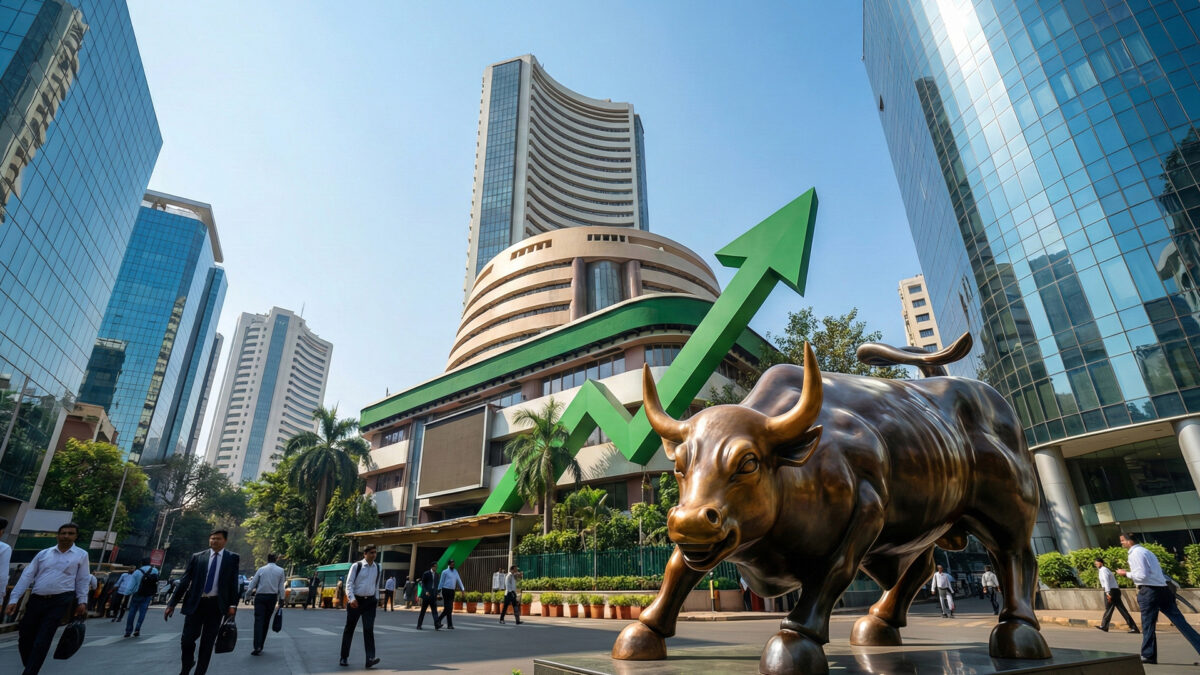
Sensex rises 200 points , Nifty at 25,550

On  Thursday, the BSE Sensex touched 82,440 at the start of trade, while the NSE Nifty 50 opened around 25,552, slightly higher than Wednesday’s close of 25,482. Early trading was supported by GIFT Nifty futures, which signaled firm demand, and by gains in Asian markets following strong performances from US tech stocks.

Among the early movers, Bajaj Auto, HCL Technologies, Tata Steel, Shriram Finance, and TCS saw buying interest, helping lift the market. At the same time, heavyweight counters such as Reliance Industries, State Bank of India (SBI), and Adani Ports faced mild selling pressure, which kept the overall gains in check.

Sector-wise, metals, autos, and IT led the upside, while financials and energy stocks lagged. Traders noted that volatility remained, especially among large-cap stocks, as participants weighed domestic economic cues against global developments.

Analysts said the market remained range-bound, with selective buying supporting the rally but broader participation cautious. They emphasized that the direction in the coming sessions will depend on global trends, domestic macroeconomic data, and sector-specific movements.

Also Read: Tata Sons puts off Chandrasekaran reappointment call

Categories
1 Minute-Read

Jeep India’s Wrangler Willys ’41 returns at ₹70.31 lakh

Jeep India has relaunched the Wrangler Willys ’41 at ₹70.31 lakh (ex-showroom) in limited numbers. The SUV is based on the Rubicon variant and features a distinctive ‘41 Green’ paint shade, special decals and cosmetic elements inspired by the original 1941 Willys.

It continues to be powered by a 2.0-litre turbo-petrol engine paired with an automatic transmission and retains its full off-road capability.

Due to its high on-road price, the model will attract a hefty monthly EMI for buyers choosing finance, depending on the loan amount, tenure and interest rate, positioning it as a niche lifestyle vehicle in India.

Categories
Corporate

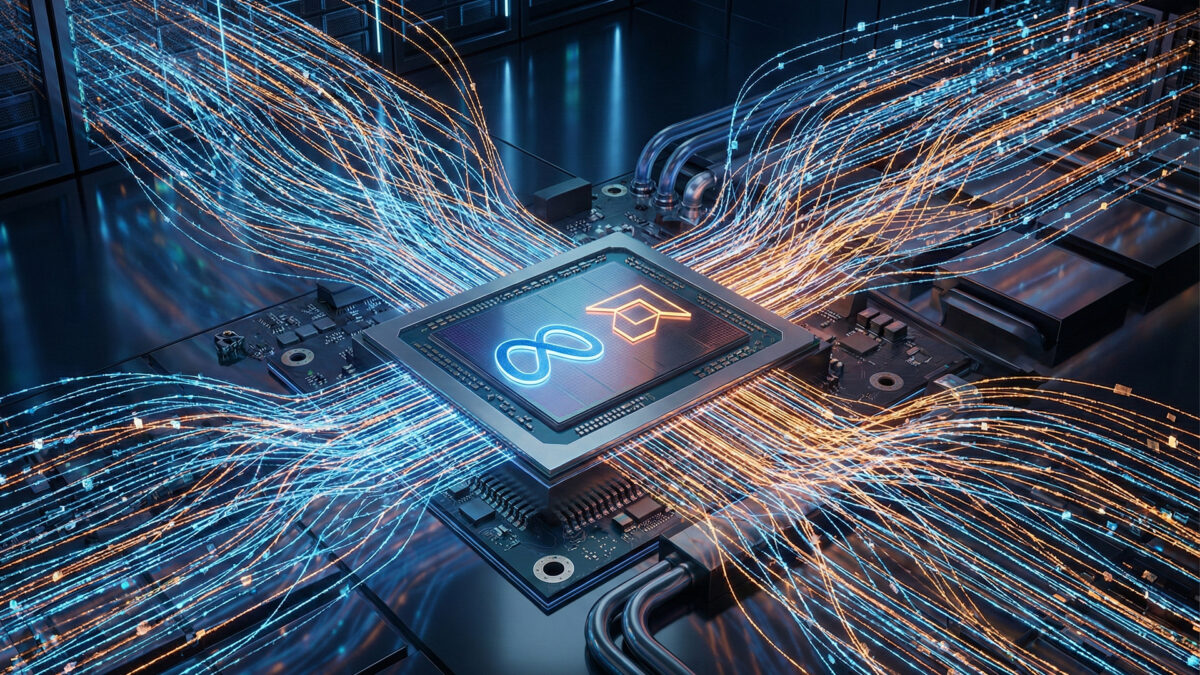
Meta–AMD seal AI chip deal

Meta has signed a major long-term agreement with semiconductor firm AMD to supply advanced artificial intelligence (AI) chips for its growing data-centre operations, marking a significant shift in the social media giant’s hardware strategy. The deal is expected to reduce Meta’s heavy dependence on Nvidia, currently the dominant supplier of AI processors.

Under the partnership, AMD will provide its latest AI accelerators and supporting infrastructure, which will be used to train and run large-scale AI models across Meta’s platforms, including Facebook, Instagram and WhatsApp. The move comes as the company rapidly expands its AI capabilities for content recommendations, advertising, generative AI tools and its metaverse projects.

Meta has been investing billions of dollars in AI infrastructure, and chip costs have become one of its biggest expenses. By diversifying its suppliers, the company aims to improve efficiency and gain stronger bargaining power in a market where demand for high-performance AI hardware has surged.

For AMD, the agreement represents a major opportunity to challenge Nvidia’s dominance in the fast-growing AI chip sector. The company has been positioning its latest processors as a competitive alternative, focusing on performance, energy efficiency and open software ecosystems that allow customers greater flexibility.

The announcement comes at a time when investors are closely watching whether the massive spending on AI infrastructure will translate into long-term revenue growth.

The deal is expected to roll out over several years, with AMD’s chips gradually integrated into Meta’s global data-centre network. Both companies said the partnership would help accelerate innovation and support the next generation of AI-driven services.

Also Read: Paramount enters Warner Bros. deal race against Netflix

Categories
Technology

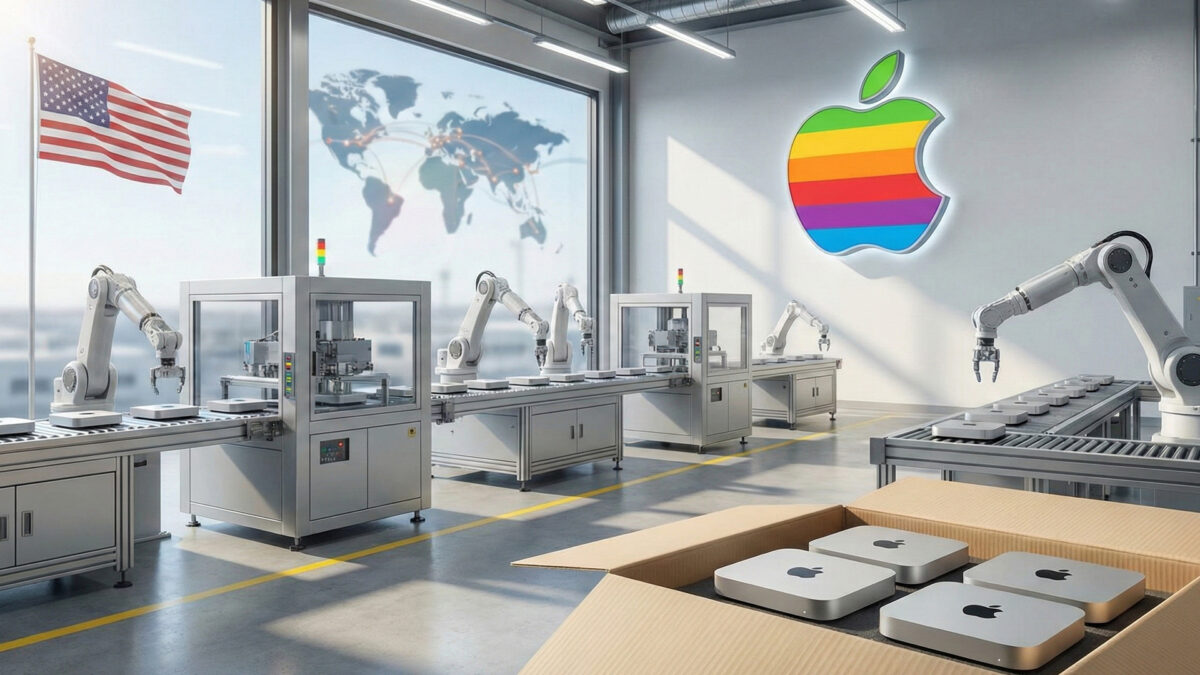
Apple shifts Mac Mini production to the US

Apple will start making its Mac Mini desktop computers in the United States later this year, in a major change to its global production strategy. The devices will be assembled at the company’s expanded manufacturing facility in Houston, which is already being used to produce advanced artificial intelligence servers.

The move is part of Apple’s broader plan to invest about $600 billion in the US. The investment is aimed at strengthening local manufacturing, building a stronger supply chain and creating jobs. The Houston expansion is expected to generate thousands of new roles and will also house a training centre to help workers learn advanced manufacturing skills.

Chief executive Tim Cook said the company remains strongly committed to the future of American manufacturing. He noted that production of AI servers at the same facility has already started earlier than planned. Apple has also been increasing the number of components it sources from US suppliers, including chips made at multiple plants across the country.

The decision comes as Washington continues to push for more domestic production. Tariff threats during the tenure of Donald Trump had encouraged several global technology firms to consider shifting some manufacturing to the US to reduce dependence on imports.

However, most of Apple’s products will still be made in Asia. The US plant will initially focus mainly on meeting domestic demand. The Mac Mini is a smaller and less complex product compared with devices like the iPhone, making it easier to assemble locally.

The new project will double Apple’s manufacturing space in Houston and support its long-term goal of building a stronger ecosystem for high-end technology production in the US. The company has already made progress under its American manufacturing programme by sourcing billions of dollars’ worth of US-made chips and launching training initiatives for smaller manufacturers.

Also Read: Canva buys two startups to boost AI, animation

Categories
1 Minute-Read

Haryana recovers ₹578 cr in IDFC First Bank fraud in 24 hrs

Haryana CM Nayab Singh Saini announced that the entire ₹578 crore lost in a fraud involving IDFC First Bank has been recovered within 24 hours. The fraud, reported in Haryana, triggered an immediate response from state police and cybercrime teams, who tracked the money trail and froze multiple accounts.

He praised the quick coordination between banking officials and law-enforcement agencies, calling it a major success in tackling financial crime.

He assured that strict action would be taken against those involved and said the case shows Haryana’s strong cyber-security and rapid response system to protect public and institutional funds.

Categories
Beyond

Venezuela oil flows to India despite US crackdown

Venezuela is sending large volumes of crude oil to India again, with multiple supertankers heading towards Indian refineries, even as the United States steps up action against ships linked to the sanctioned trade.

The renewed flow signals a comeback for Venezuelan oil in India after years of disruption caused by US sanctions. Indian refiners, which had earlier reduced purchases, are now receiving cargoes through long-haul shipments routed via complex logistics networks. These cargoes are typically transported by very large crude carriers (VLCCs), allowing suppliers to move substantial volumes in a single voyage.

However, the trade faces growing scrutiny. In a recent enforcement move, US forces boarded a Venezuela-linked oil tanker in the Indian Ocean as part of Washington’s wider crackdown on what it calls illicit oil shipments. The operation reflects tighter monitoring of vessels suspected of helping Caracas bypass sanctions through opaque ownership structures, ship-to-ship transfers and disabled tracking systems.

The US has been targeting such networks since late 2025, warning that even international waters will not shield sanctioned cargoes from action. The move highlights the geopolitical risks surrounding the revived oil trade and could complicate logistics, insurance and payments for buyers.

For India, the return of Venezuelan crude offers an opportunity to diversify supplies and access heavier grades that are well-suited for complex refineries. It also helps processors optimise costs at a time of volatile global prices. But refiners remain cautious, as any tightening of enforcement could disrupt deliveries or raise compliance risks.

Venezuela, which holds some of the world’s largest oil reserves, has been trying to rebuild exports despite sanctions that have sharply curtailed its output and market access. India was once among its biggest customers, and the latest shipments suggest both sides are testing ways to restore that trade.

Also Read: Nvidia plans AI laptop chips launch in 2026

Categories
Technology

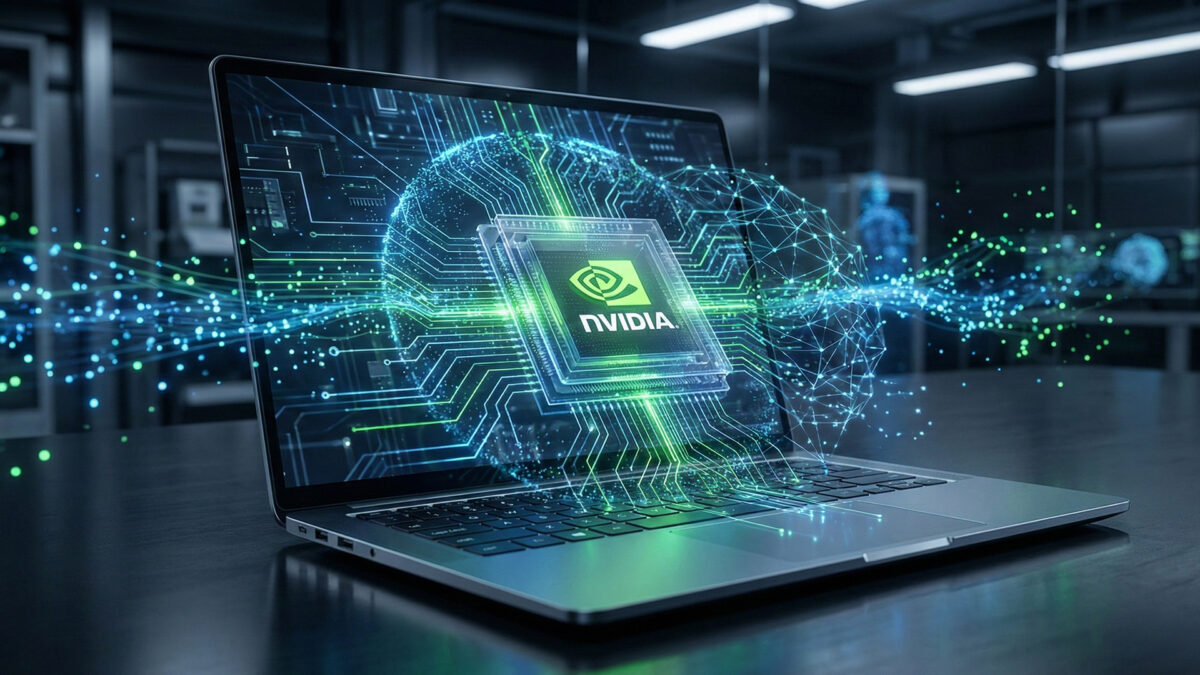
Nvidia plans AI laptop chips launch in 2026

Nvidia is preparing to launch a new range of artificial-intelligence-focused laptop chips in the first half of 2026, marking a major expansion beyond its traditional graphics processor business.

The upcoming processors are expected to be built on Arm architecture and will combine CPU and GPU functions into a single chip. This integrated design aims to deliver high performance while using less power, making it suitable for thin and lightweight laptops.

The new platform is being developed to run advanced AI features directly on the device. This means tasks such as real-time translation, content creation, smart assistants and image processing can work faster without depending heavily on cloud computing. Running AI locally also improves data privacy and reduces latency.

With this move, Nvidia will enter the laptop CPU market and compete more directly with long-time PC chip leaders Intel and AMD. The launch is expected to be part of a broader industry shift toward so-called AI PCs, computers designed to handle artificial intelligence workloads on the device itself.

The chips are also likely to benefit from Nvidia’s strong AI software ecosystem, which is widely used by developers and enterprises. This could make it easier for laptop manufacturers to introduce AI features in their products.

For the PC industry, the entry of Nvidia into the CPU space could reshape competition by adding a powerful new player with deep expertise in AI computing. For Nvidia, it represents a strategic step toward becoming a full-platform computing company rather than just a GPU supplier.

While the company has not announced an exact launch date, industry reports suggest that laptops powered by these processors could begin appearing in the market sometime in 2026.

Also Read: US hits Indian solar imports with 126% duty

Categories
Beyond

US hits Indian solar imports with 126% duty

The United States has imposed a preliminary countervailing duty of up to 126% on solar cell imports from India, alleging that Indian manufacturers benefited from government subsidies that gave them an unfair pricing advantage in the American market.

The decision follows an investigation by the US Department of Commerce into whether Indian solar producers received financial support that allowed them to sell their products at lower prices than domestic manufacturers in the US. The probe found that multiple subsidy programmes, including incentives linked to manufacturing and export promotion, enabled Indian firms to undercut American competitors.

The duties are provisional and will be reviewed before a final determination is made. However, the move is expected to significantly impact Indian solar exports to the US, one of the key overseas markets for the country’s renewable energy equipment.

The tariff varies by company, with some exporters facing the full 126% levy. If confirmed in the final ruling, the measure could sharply reduce the price competitiveness of Indian solar cells and modules in the US market.

The development comes at a time when India and the US are engaged in negotiations to deepen trade ties, and it could become a contentious issue in bilateral discussions. Industry observers say the decision may disrupt supply chains and slow the growth of India’s solar manufacturing sector, which has been expanding under government-backed production-linked incentive (PLI) schemes.

Indian exporters have argued that the support they receive is aimed at building domestic manufacturing capacity and is consistent with global clean energy goals. They also point out that India is an important player in the global transition to renewable energy and that trade restrictions could raise costs for solar deployment.

The US International Trade Commission will now examine whether the imports have caused material injury to American manufacturers. A final decision on the duties is expected later this year.

Also Read: Rupee stands flat at 90.94 vs dollar

Categories
Beyond

Gold at ₹1.61 lakh, Silver near ₹2.85 lakh

Gold prices in India rose further on Wednesday, February 25, 2026, with the precious metal holding above the ₹1.60-lakh mark, while silver traded close to ₹2.85 lakh per kilogram in the futures market. The gains were supported by firm global trends, a weaker rupee and continued safe-haven demand.

On the Multi Commodity Exchange (MCX), gold futures inched up by about ₹10 to trade around ₹1,61,790 per 10 grams, maintaining the strong levels seen earlier this week. In the physical market, retail prices also remained elevated across major cities. Silver futures, however, showed mild volatility and were last quoted at around ₹2,84,900 per kg, slightly lower by about ₹100 from the previous close.

In the domestic bullion market, 24-carat gold continued to trade at premium levels in key centres such as Delhi, Mumbai, Chennai, Kolkata and Bengaluru. The average retail price of 24K gold stayed above ₹1.61 lakh per 10 grams, while 22K gold hovered around ₹1.48 lakh. City-wise variations were marginal, reflecting a broadly uniform trend across the country.

The rise in gold prices is largely in line with firm international markets, where persistent geopolitical tensions and uncertainty over global trade policies have boosted demand for safe-haven assets. A softer rupee against the US dollar has further pushed up domestic bullion rates, making imports costlier and supporting local prices.

Silver, though slightly down in the day’s trade on MCX, continued to remain at historically high levels in the physical market, tracking strength in industrial demand and global price momentum.

Market experts say investors are increasingly turning to gold as a hedge against volatility in equities and currency movements. The sustained rally is also being closely watched by jewellers and retail buyers, as high prices may influence demand ahead of the upcoming wedding and festive season.

Also Read: Sensex rises 560 points to 88,200, Nifty climbs to 25,580

Categories
Corporate

Anthropic lets employees sell up to $6 bn in shares

AI company Anthropic has launched a major share sale for its employees and former staff, allowing them to sell up to $5–6 billion worth of company stock. The move lets workers access some of the value they have helped create without waiting for an IPO or company sale.

The share sale is based on a valuation of around $350 billion, close to the level from Anthropic’s recent $30 billion funding round, which valued the company at roughly $380 billion. This reflects strong investor confidence in the company’s AI technology and growth.

Only employees who have worked at Anthropic for at least a year can participate. The shares will be sold to outside investors, not the company itself, and the total amount sold will depend on how many staff choose to take part.

This type of secondary stock sale is increasingly common among high-value tech startups. It allows employees to cash out some of their equity while keeping the company private. Similar plans have been used by companies like Stripe, SpaceX, and OpenAI to reward employees and retain talent in competitive AI and tech markets.

Anthropic has grown rapidly, attracting major investments and expanding its AI products and customer base. By letting employees sell shares now, the company gives them an early opportunity to benefit financially from their work, something usually only possible after a public listing or company acquisition.

Company officials have not publicly commented on the details of the share sale, and the final terms may change as the process continues.

Also Read: Amazon opens second-largest Asia office in Bengaluru