
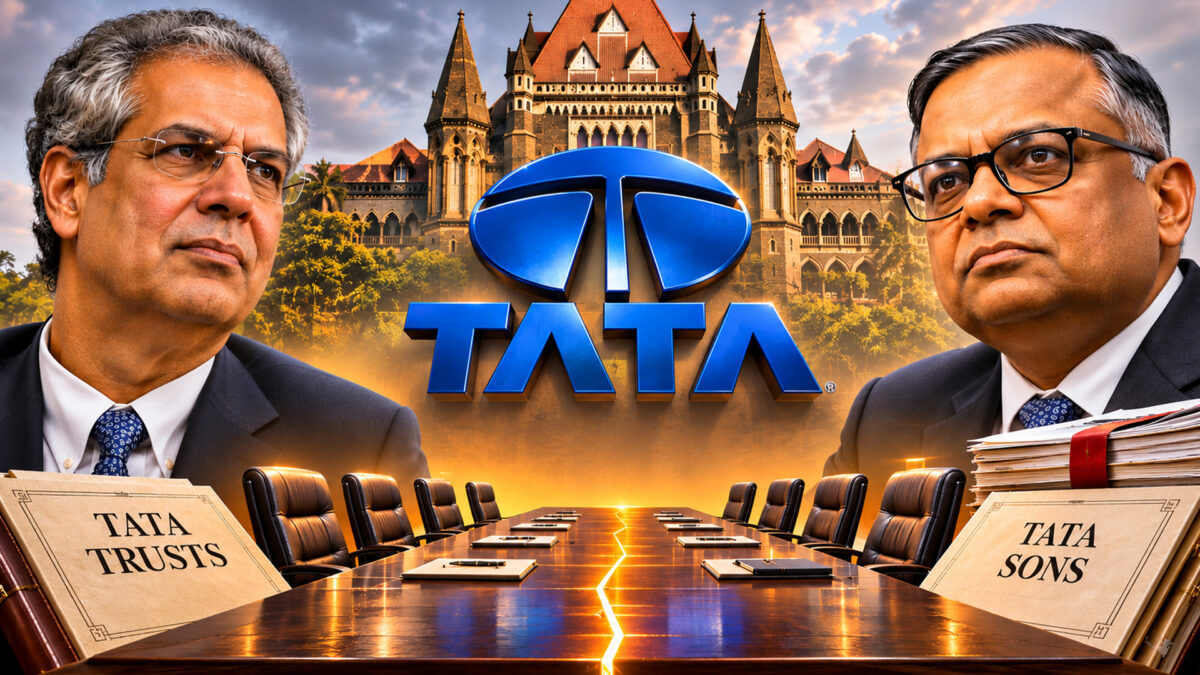
Tata Sons has filed caveats in the Bombay High Court and the Supreme Court, strengthening its legal position amid an escalating dispute with Tata Trusts over the reappointment of N Chandrasekaran as executive chairman. The move comes a day after the Bombay High Court declined to grant interim relief to two Tata trusts challenging the company’s decision to give Chandrasekaran a third five-year term.
The caveats were filed on Saturday, November 28, following the High Court’s November 27 order allowing Tata Sons to proceed with its scheduled board meeting on November 30. Through these filings, the company has ensured that it will have an opportunity to present its arguments if the trusts approach either court seeking to challenge the latest order.
A caveat is a preventive legal measure through which a party requests the court not to pass an order on an application without first hearing its side. In this case, Tata Sons appears to be preparing for a possible appeal by the Sir Dorabji Tata Trust (SDTT) and the RD Tata Trust (RDTT), which have challenged Chandrasekaran’s reappointment.
The legal dispute centres on a September 17 board resolution that approved Chandrasekaran’s appointment for another five-year term. The two trusts have argued that the resolution was not passed in accordance with Article 121 of Tata Sons’ Articles of Association (AoA), which lays down specific voting requirements involving directors nominated by Tata Trusts.
The disagreement emerged during the September board meeting, when Tata Trusts chairman Noel Tata opposed Chandrasekaran’s reappointment, while fellow nominee director Venu Srinivasan supported it. The two directors were divided, resulting in a tie. Harish Manwani, who presided over the meeting, subsequently exercised his casting vote in favour of Chandrasekaran’s reappointment.
The trusts have questioned the validity of this decision. Their position is that Article 121 requires an affirmative vote from a majority of the trust-nominated directors appointed under Article 104B of the company’s Articles of Association. According to their interpretation, a chairman’s casting vote cannot replace this mandatory approval when the two nominee directors disagree.
Tata Sons, however, maintains that the resolution was validly passed and that the casting vote was exercised in accordance with the company’s governing provisions. The interpretation of these articles has therefore become central to the ongoing corporate governance dispute.
The two trusts approached the Bombay High Court on November 26, filing separate suits against Tata Sons and six of its directors. Apart from challenging Chandrasekaran’s reappointment, they sought immediate intervention to prevent the company from acting on the September resolution.
They also requested the court to restrain the chairman from exercising a casting vote during the November 30 board meeting if the two trust-nominated directors remained divided. The trusts further sought to defer the meeting and prevent the board from passing resolutions without the affirmative votes required under the company’s Articles of Association.
However, Justice Abhay Ahuja of the Bombay High Court declined to grant the requested interim protection on Friday after hearing arguments from both sides. The court allowed the November 30 meeting to proceed as scheduled but made it clear that any decisions taken would remain subject to the final outcome of the pending proceedings.
The court also directed Tata Sons and the other respondents, including the directors named in the suits, to file their reply affidavits. The matter has been listed for further hearing in January 2027, with reports indicating January 21 as the next date.
The financial claims made by the trusts add another dimension to the dispute. The Sir Dorabji Tata Trust has sought Rs 50 crore in damages from Tata Sons, while the RD Tata Trust has claimed Rs 15 crore. Both have also sought annual interest of 18 per cent on their respective claims.
Meanwhile, the November 30 board meeting assumes importance beyond the question of Chandrasekaran’s reappointment. The proposed listing of Tata Sons is also among the significant issues surrounding the company’s future. The Reserve Bank of India (RBI) has classified Tata Sons as an upper-layer non-banking financial company (NBFC-UL), bringing it under regulatory requirements that include a mandatory listing.
The RBI’s listing requirement has been a contentious issue, with Noel Tata favouring a restructuring of the holding company to avoid an initial public offering (IPO). Tata Sons, meanwhile, has indicated the need to address regulatory requirements within the prescribed timelines. The company is required to inform the RBI by December 12 about its compliance with the listing requirement.
The latest court order therefore allows Tata Sons to continue with its planned board proceedings, although the possibility of further legal intervention remains. The caveats filed in both courts also indicate that the company is preparing for any fresh challenge that the trusts may initiate.
The dispute has brought differences over corporate governance, boardroom voting rights and the future direction of the Tata Group’s holding company into sharper focus. With Tata Trusts collectively holding a 66 per cent stake in Tata Sons, the disagreement carries considerable significance for the group’s ownership and decision-making structure.
For now, the November 30 meeting can go ahead, but its decisions will remain subject to the court’s final ruling. The next phase of the legal proceedings is expected to determine how the company’s Articles of Association should be interpreted and whether the September reappointment resolution can withstand judicial scrutiny.
The caveats may ensure that Tata Sons gets a hearing before any immediate judicial intervention, but they do not settle the underlying dispute. The final outcome will depend on the court’s examination of the competing interpretations of the company’s governance rules.