
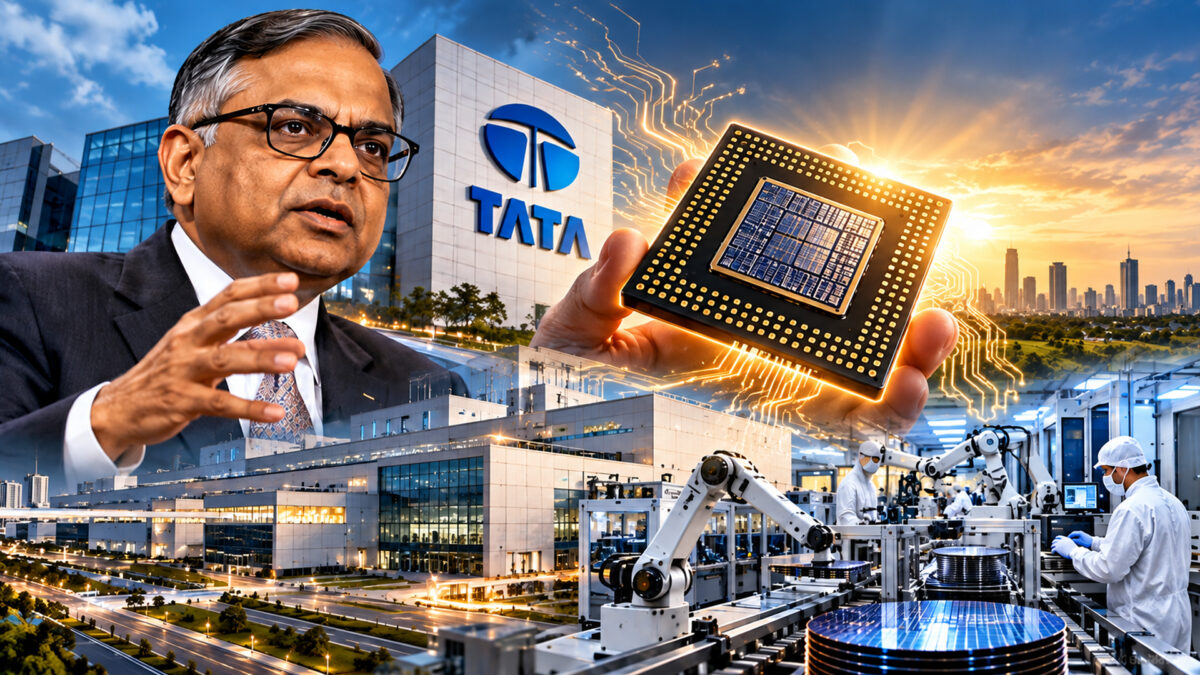
India has an opportunity to strengthen its position in the global semiconductor industry, but achieving that ambition will require sustained investment, technological partnerships and patience. Tata Sons Chairman N Chandrasekaran believes the country has the talent, domestic demand and industrial potential to build a stronger semiconductor manufacturing ecosystem, even if the returns take time to materialise.
Chandrasekaran said Tata Group’s semiconductor investments should be viewed in the context of India’s long-term requirements rather than short-term financial returns. He emphasised that semiconductors would play an increasingly important role in the country’s economic development as businesses and consumers depend more heavily on technology.
His comments come as India steps up efforts to develop domestic semiconductor manufacturing capabilities and reduce its dependence on overseas suppliers. Semiconductors are essential components in smartphones, computers, automobiles, telecommunications equipment, industrial machinery and artificial intelligence infrastructure. Reliable access to these chips is becoming increasingly important as countries seek greater control over critical technologies and supply chains.
Tata Group is investing in semiconductor manufacturing as part of its broader expansion into advanced manufacturing and electronics. Its plans include a semiconductor fabrication plant in Gujarat and an assembly and testing facility in Assam, two projects aimed at developing different stages of the chip production process.
Tata Electronics is investing approximately ₹91,000 crore in a proposed semiconductor fabrication facility in Gujarat in partnership with Taiwan-based Powerchip Semiconductor Manufacturing Corporation. The project is expected to strengthen India’s ability to manufacture semiconductor wafers and support the country’s ambitions to become a more significant player in the global chip industry.
The group is also investing ₹27,000 crore in a semiconductor assembly and testing facility at Jagiroad in Assam. The facility will focus on outsourced semiconductor assembly and testing, commonly known as OSAT, which involves preparing chips for use in electronic products.
Developing both fabrication and assembly capabilities could help India participate in more stages of the semiconductor supply chain. However, building a competitive industry will require more than large capital investments. Access to technology, specialised equipment, skilled workers, reliable infrastructure and a stable customer base will be equally important.
Chandrasekaran’s views underline the need to evaluate semiconductor investments over a longer period. Manufacturing chips requires substantial upfront capital, and businesses may take years to establish production capabilities, secure customers and achieve commercial scale. The sector therefore demands a commitment that extends beyond immediate financial targets.
India’s large domestic market offers an important advantage. Automobile manufacturers, electronics companies, telecommunications providers and data centre operators require semiconductors for a growing range of products and services. Rising demand for artificial intelligence, connected devices and advanced electronics could create further opportunities for chip manufacturers.
Nevertheless, domestic demand alone will not guarantee success. Semiconductor companies must produce chips that meet customer requirements, remain commercially competitive and maintain consistent quality. International partnerships can help Indian manufacturers access technical expertise, manufacturing experience and established industry practices.
The objective is to create a sustainable semiconductor ecosystem rather than simply establish factories. This will require developing local suppliers, training a specialised workforce, strengthening logistics and encouraging closer cooperation between manufacturers, technology companies and research institutions.
Chandrasekaran has also highlighted the importance of resilience as businesses face geopolitical tensions, cyberattacks and supply-chain disruptions. Companies that focus only on short-term efficiency may struggle when critical components become unavailable or production facilities are forced to shut down.
Disruptions involving essential materials, including magnets used in vehicle manufacturing, demonstrate how shortages in one part of the supply chain can affect entire industries. Cyberattacks that disrupt manufacturing operations can also result in significant production losses, highlighting the financial consequences of vulnerabilities in interconnected industrial systems.
For the semiconductor industry, these risks are particularly significant. Chip production depends on specialised equipment, advanced materials and complex international supply networks. Developing domestic capabilities could give India greater flexibility in sourcing critical components, although international trade and technology partnerships will remain necessary.
India’s semiconductor programme is part of a wider strategy to expand electronics manufacturing, attract investment and move towards higher-value industrial production. A stronger domestic industry could create opportunities for engineers, technicians, suppliers and technology companies while supporting sectors that depend on electronic components.
The challenge now is to translate investment commitments into operational facilities, reliable production and sustained commercial demand. Execution, access to technology, infrastructure readiness and workforce development will determine how quickly India can establish itself as a competitive semiconductor manufacturing destination.
The semiconductor push represents a long-term strategic investment in an industry expected to remain central to the global economy. Chandrasekaran’s message is that building these capabilities requires patience and a clear understanding of India’s future needs.
As India seeks a larger role in the global semiconductor supply chain, the progress of Tata’s projects will be an important test of the country’s ability to turn its market potential, technical talent and industrial investment into lasting manufacturing strength.