Categories
Beyond

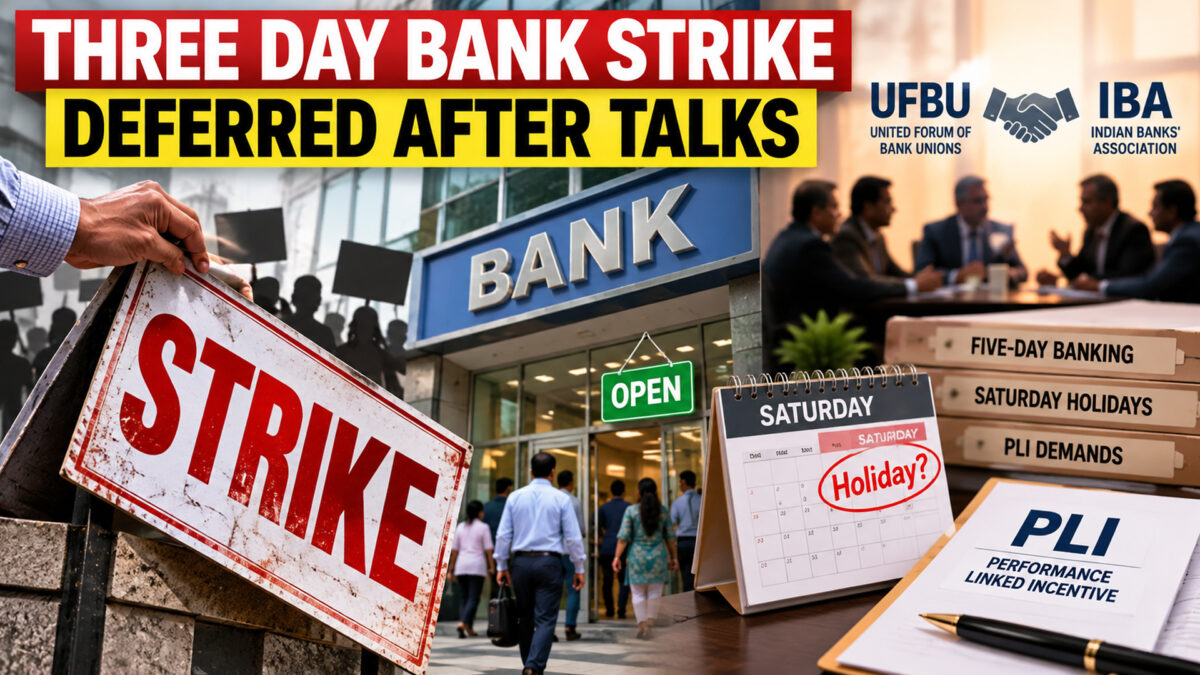
Three day bank strike deferred after talks

The planned three-day nationwide bank strike from September 28 to 30 has been deferred after bank unions and the Indian Banks’ Association (IBA) reached an understanding following talks on Sunday.

The decision means customers will not face the widespread branch closures that had been expected this week. Banks are set to continue normal operations, including during the period leading up to the half-yearly closing on September 30.

The United Forum of Bank Unions (UFBU) had called the strike over several long-standing demands of bank employees and officers. The key issues include a five-day banking week, pension-related benefits and changes to the Performance Linked Incentive (PLI) scheme.

The decision to defer the strike came after the IBA agreed to take up some of the demands for further discussion. While the immediate industrial action has been avoided, there is no final settlement on the issues raised by the unions.

The demand for a five-day banking week has been at the centre of the unions’ campaign.

At present, banks are closed on Sundays and the second and fourth Saturdays of every month. The first and third Saturdays are generally working days.

Bank unions want all Saturdays to become holidays, effectively giving employees a Monday-to-Friday working week.

Under the latest understanding, the IBA and UFBU will set up a high-level committee to examine the proposal. The committee will study the issue and consider possible ways forward before further discussions.

This means customers should not expect an immediate change in the existing bank holiday calendar.

The two sides have also agreed to discuss the Performance Linked Incentive scheme for officers in Scale IV and above.

Bank unions have raised concerns about the existing structure and are seeking changes. The IBA will examine the matter and discuss possible modifications with the employee representatives.

Other pending issues from previous rounds of talks are also expected to be considered.

The UFBU’s decision to defer the strike came after these assurances from the IBA, giving both sides more time to work towards a broader understanding.

The proposed strike was not limited to working days.

Bank unions have also been seeking changes in pension-related benefits, a uniform dearness allowance formula for pensioners and an option for employees covered under the National Pension System to move to the Old Pension Scheme.

The unions had previously held a nationwide strike on September 11 as part of their campaign.

The latest three-day strike was planned as a further escalation after discussions failed to resolve the outstanding issues.

The strike episode also took an unexpected turn over the weekend.

Public sector banks and regional rural banks were asked to operate on Sunday, September 27, ahead of the proposed strike. The move was intended to reduce the impact of a possible three-day shutdown and ensure that essential banking work was completed before the September 30 half-yearly closing.

The Reserve Bank of India had permitted banks, offices, currency chests and certain ATM-linked branches to remain operational on Sunday.

However, with the strike deferred following Sunday’s talks, the decision to work on the weekly holiday became a talking point among employees and on social media.

Memes and reactions circulated online after employees worked on Sunday only for the planned strike to be called off hours later.

For customers, the immediate impact is limited. Banks will remain open during September 28-30, subject to individual banks’ operational arrangements.

Customers can continue to use branch services as well as ATMs, internet banking, mobile banking and UPI for routine transactions.

The decision also removes the possibility of a prolonged interruption during the half-yearly closing period, when banks handle a large volume of accounting, reconciliation and regulatory work.

However, the deferment should not be viewed as the end of the dispute.

The proposed committee on the five-day banking week, along with discussions on PLI and other employee demands, will determine the next stage of negotiations between bank unions and the IBA.

The outcome of the upcoming discussions will be important for both bank employees and customers as the industry considers how its working arrangements could evolve.
 

Categories
Beyond

Bank strike may disrupt services for five days

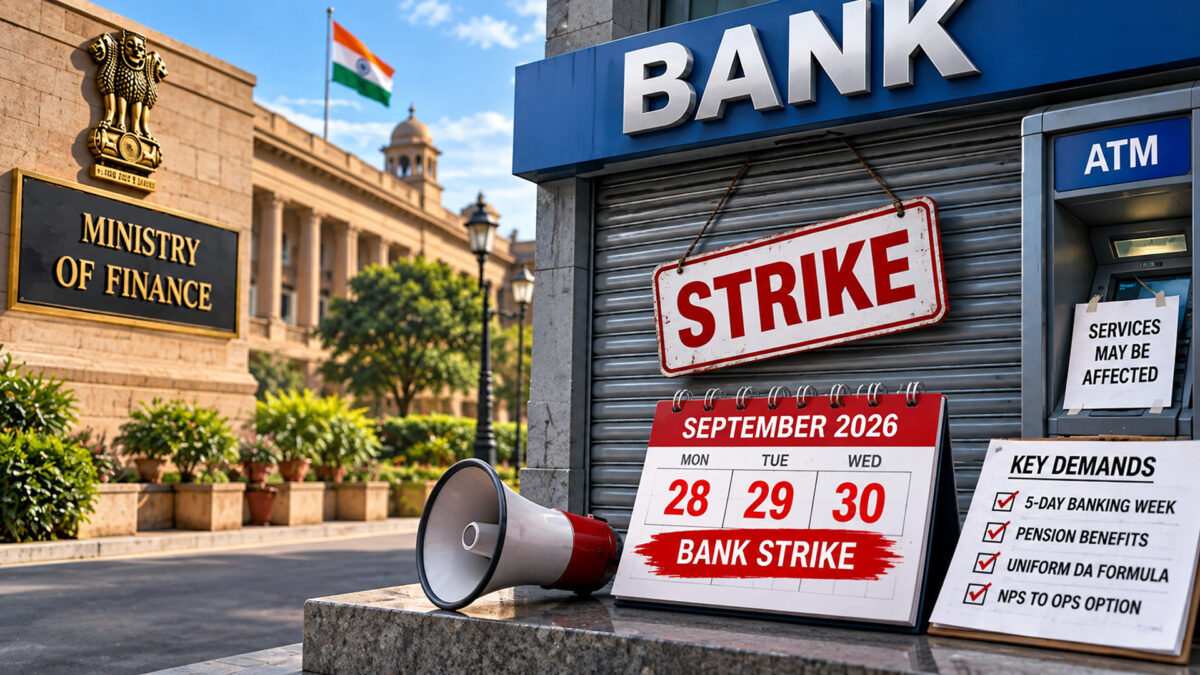
Bank customers may need to finish important branch-related work early next week as bank employee unions have called a three-day nationwide strike from September 28 to 30.

The strike comes immediately after the September 26-27 weekend, raising the possibility of disruption to regular branch services for five consecutive days. However, this does not necessarily mean that every bank branch will remain closed throughout the five-day period. Digital banking, ATMs and other essential services are expected to remain available.

The United Forum of Bank Unions (UFBU), an umbrella body representing seven bank employee and officer unions, has called the strike. The unions have been pressing for the introduction of a five-day banking week, along with several other demands related to employees and pensioners.

The five-day workweek remains the main issue behind the latest strike call. The demand has been pending since the 2024 wage settlement, and unions have been seeking its early implementation. They have also raised concerns over performance-linked incentives and other service-related matters.

Other demands include pension updation, a uniform dearness allowance formula for pensioners and an option for employees covered under the National Pension System (NPS) to move to the Old Pension Scheme. The unions have also raised several pending wage and service-related issues.

The latest strike follows a nationwide one-day bank strike on September 11, which affected over-the-counter banking services, cash transactions and cheque clearances in several parts of the country. The impact was uneven, with some cities seeing relatively normal operations while disruptions were reported in states and smaller cities.

With another strike approaching, the government has started preparing for possible disruption. The Department of Financial Services under the Finance Ministry is scheduled to meet the chiefs of public sector banks, regional rural banks, the Indian Banks’ Association and NABARD to review contingency arrangements.

The meeting is expected to focus on maintaining essential banking services and reducing inconvenience to customers during the strike. The timing is particularly important because the strike coincides with the end of the half-year, a period when banks handle additional accounting and reporting work.

Major banks have already begun alerting customers.

State Bank of India (SBI) has advised customers to complete important branch-related transactions before the strike dates. The bank has also said it is making arrangements to keep essential services running during the disruption.

Union Bank of India has similarly issued an advisory asking customers to plan important banking work in advance. Customers are encouraged to use digital channels wherever possible during the strike period.

Customers should therefore consider completing work that requires a physical branch visit before September 28. This could include certain cash transactions, cheque-related work, document submission and other services that cannot be completed digitally.

The situation is different for online banking users. Internet banking, mobile banking, UPI and ATMs are expected to continue operating, although customers could still experience delays in some services depending on the bank and the nature of the transaction.

The five-day period does not mean that the entire banking system will stop functioning. Branch operations are the area most likely to face disruption because of the strike. Customers can continue to use digital payment systems and other automated channels for routine transactions.

The unions had issued their strike notice earlier and held discussions with the government and the Indian Banks’ Association. Conciliation efforts have taken place, but the issue of a five-day banking week has remained unresolved. The UFBU has indicated that it will continue with the strike unless there is concrete progress on its demands.

The banking unions represent a large section of bank employees and officers, meaning the strike could have a noticeable impact on public sector bank operations. The effect, however, may differ from one location to another depending on participation and the availability of alternative banking channels.

The current strike programme also extends beyond September. The unions have announced further industrial action, including a continuous strike from October 26, as part of their broader campaign over their demands.

The immediate priority is to avoid leaving urgent branch work until the last moment. Routine payments and money transfers can largely be handled through UPI, mobile banking, internet banking and ATMs, but services requiring staff assistance may face delays.

The September 28-30 strike is therefore expected to create the most visible disruption at bank branches, while digital banking services should continue to provide an alternative for everyday transactions. Government officials, banks and unions will continue discussions as the strike approaches, leaving open the possibility of developments before the scheduled action.