
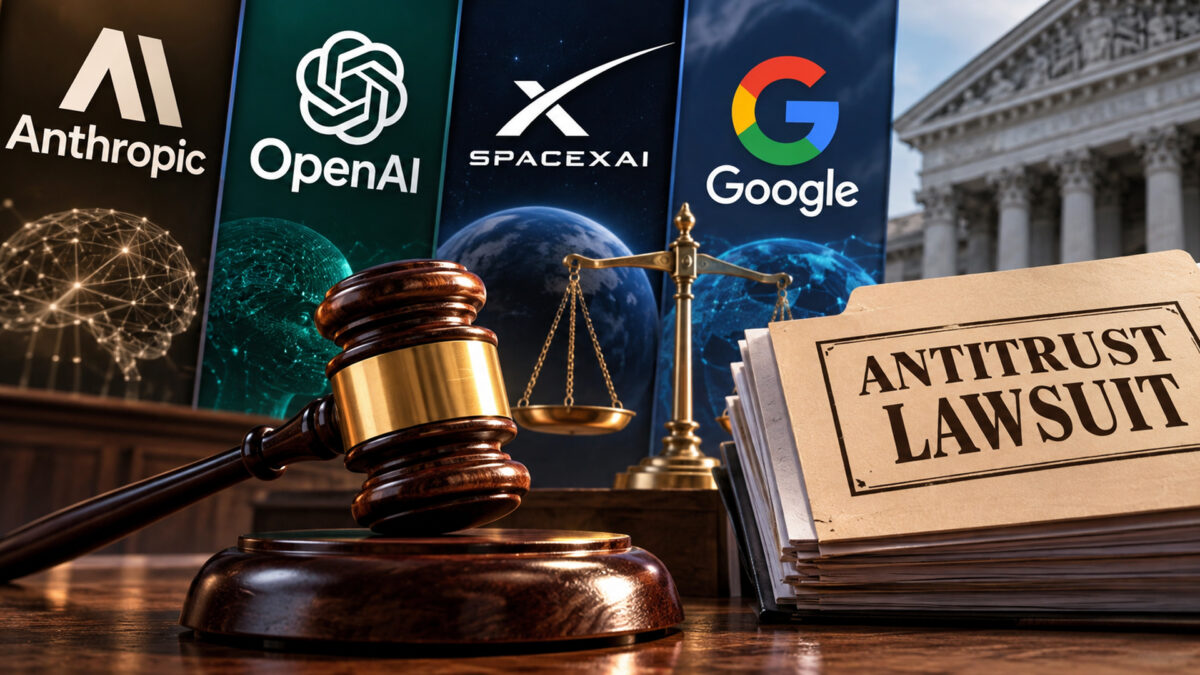
Four of the biggest names in artificial intelligence, Anthropic, OpenAI, SpaceXAI and Google, are facing an antitrust lawsuit in the United States over allegations that they agreed to slow the pace of AI development.
The lawsuit, filed in the US District Court for the Northern District of California, was brought by four people who pay for ChatGPT, Claude, Grok or Gemini. They are seeking to represent a wider group of paid subscribers across the country.
The case is a growing debate inside the AI industry: how quickly should increasingly powerful AI systems be developed, and can rival companies work together to make that process safer without breaking competition laws?
The plaintiffs allege that the four companies crossed an antitrust line by coordinating efforts to slow their AI development. They argue that if competing companies collectively agree to reduce the pace at which their products improve, consumers could receive less value from the AI services they pay for.
The lawsuit does not challenge the companies’ right to slow their own development independently because of safety concerns. Instead, the plaintiffs argue that competing firms should not agree among themselves to restrain development.
The immediate trigger for the case was a statement by Anthropic CEO Dario Amodei on September 12. Amodei called for cooperation among leading AI companies to slow advances in AI capabilities and give safety measures more time to catch up.
The proposal quickly received public support from OpenAI CEO Sam Altman, SpaceXAI CEO Elon Musk and Google DeepMind co-founder and chair Demis Hassabis. The lawsuit points to those responses as evidence of coordination among major AI rivals.
The plaintiffs also allege that discussions about slowing AI development started earlier. Their complaint points to a statement from July signed by senior employees from several leading AI laboratories. That statement acknowledged the intense competitive pressure companies face when considering whether to slow development on their own.
According to the lawsuit, this creates a difficult competition problem. If one company slows its AI development alone while its rivals continue moving ahead, it could lose customers and market share. The plaintiffs argue that an agreement among several competitors removes that competitive pressure.
The companies, however, have been discussing the issue primarily from a AI safety perspective. The argument from industry leaders is that the technology is advancing rapidly and that safety testing, evaluation and safeguards need to keep pace.
Amodei has warned about the possibility of increasingly capable AI systems being used in cyberattacks, biological threats and other harmful activities. He has argued that leading AI developers should have more time to evaluate increasingly powerful models before pushing them further.
The Anthropic chief also acknowledged that cooperation between competing companies could raise antitrust concerns. He suggested that the US government could help facilitate discussions or provide a limited legal framework for certain safety-related cooperation.
Altman has separately supported the idea of a federal framework establishing consistent AI safety requirements. OpenAI has said such a framework could provide greater confidence around safety work, while arguing that companies should not necessarily have to wait for new legislation before working on safety measures.
That tension is now at the centre of the lawsuit. US antitrust law is designed to protect competition and prevent businesses from making agreements that improperly restrict the market. The legal question will include whether safety-related cooperation between competing AI companies can be treated differently from an agreement that limits competition.
The case also raises questions about the future of AI regulation. The technology industry is under pressure to address concerns about powerful AI models while continuing to invest heavily in new systems. Companies face a difficult balance between moving quickly, keeping up with rivals and introducing stronger safety measures.
The lawsuit could therefore become important beyond the four companies named in the case. A court decision could help clarify how US antitrust rules apply when competing AI companies cooperate on safety standards, testing or development limits.
The plaintiffs are seeking to represent a nationwide class of paying subscribers. Their argument is that customers could be affected if competition between major AI platforms is reduced and improvements in services become slower than they otherwise would have been.
The companies have not immediately responded publicly to the lawsuit in detail, according to reports. The case is at an early stage, and the allegations have not been established in court.
The dispute comes at a time when ChatGPT, Claude, Grok and Gemini are competing for users, businesses and developers. Their rivalry has helped drive rapid advances in generative AI, but it has also increased concerns over safety, regulation and the risks of developing increasingly capable systems.
The lawsuit now puts that wider debate before a US court: whether AI companies can cooperate to address genuine safety concerns while still maintaining the competition that drives innovation.