Categories
Corporate

Sensex falls 240 points, Nifty slips below 22,750

Indian stock markets ended lower on Tuesday, extending their losing run as high crude oil prices, foreign fund outflows and continuing geopolitical uncertainty kept investors cautious. The benchmark indices recovered from much sharper intraday losses but still closed in the red.

The BSE Sensex ended at 72,529.07, down 242.65 points or 0.33%, while the Nifty 50 settled at 22,716.20, lower by 64.05 points or 0.28%. Both indices had fallen much more sharply during the session, with the Sensex briefly dropping close to 1% before recovering some ground.

The market opened under pressure after global cues remained weak. Rising crude oil prices were a major concern for investors, particularly because India depends heavily on imports to meet its energy requirements. Brent crude was trading around $105-$106 a barrel, keeping worries about inflation, corporate margins and interest rates alive.

The uncertainty around the US-Iran conflict and negotiations also weighed on sentiment. Investors remain concerned that prolonged tensions in West Asia could disrupt energy supplies and keep oil prices elevated. The possibility of higher-for-longer interest rates added another layer of caution.

The selling was not limited to large-cap stocks. The Nifty Midcap 100 fell about 0.99%, while the Nifty Smallcap 100 declined around 0.81%, showing that pressure was visible across the broader market as well.

Among the Sensex stocks, Adani Ports emerged as the biggest gainer, rising about 4.39%. Sun Pharma gained 1.09%, while Tata Steel climbed 1.05%. Kotak Mahindra Bank also finished higher by around 1%.

Pharma and metal stocks provided some support to the market. The Nifty Pharma index gained 0.64%, while the Nifty Metal index rose about 0.78%. Pharma stocks received some attention after reports that Indian drug exports could benefit from exemptions related to US tariffs.

On the other side, Trent was among the biggest Sensex losers, falling around 2.72%. HCL Technologies declined 2.29%, while Tata Consultancy Services (TCS) slipped 1.72%. UltraTech Cement fell around 1.57%, and Hindustan Unilever declined about 1.53%, touching a fresh 52-week low during the session.

The technology sector remained under pressure as investors continued to watch global bond yields and concerns around the US economy. Higher US Treasury yields can make emerging-market assets relatively less attractive and encourage foreign investors to move money towards dollar-denominated assets.

Foreign institutional investors remained net sellers in Indian equities. According to market data, FIIs sold shares worth around ₹5,353 crore, while domestic institutional investors provided some support by buying equities worth about ₹5,189 crore.

The rupee also remained weak against the US dollar. It opened at around ₹96.05 per dollar, compared with the previous close of ₹95.98. A weaker rupee can increase the cost of imported crude oil and add to pressure on companies that depend heavily on imported inputs.

Tuesday’s session was also important because it coincided with the monthly derivatives expiry, which contributed to sharp swings during the day. The Nifty briefly slipped well below the 22,700 mark before recovering towards the close.

The broader market has now faced several sessions of weakness. The Nifty has fallen around 6% over the past seven weeks, while the latest decline adds to the pressure seen since the beginning of the week.

Investors are now watching global oil prices, developments in the Middle East, foreign fund flows and US bond yields closely. Domestic factors, including upcoming economic data and corporate developments, will also influence market direction.

Tuesday’s recovery from the day’s lows offered some relief, but the overall mood remained cautious. With crude oil still elevated and global uncertainty continuing, investors are likely to remain focused on defensive sectors such as pharmaceuticals while keeping a close watch on banking, IT and other rate-sensitive stocks.

The immediate market focus will remain on whether global tensions ease and whether crude prices cool from current elevated levels. Until then, volatility is likely to remain a key feature of Indian equity markets.

 

Categories
Corporate

Sensex sinks 1,120 points, Nifty closes below 22,800

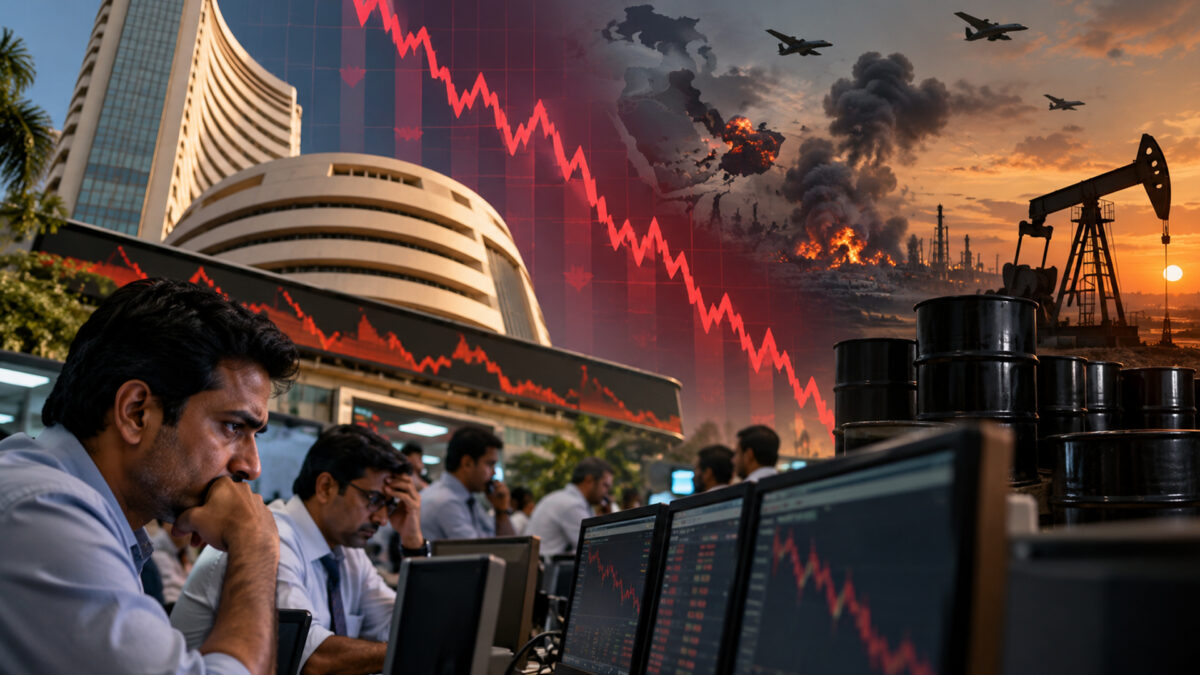
Stock markets came under heavy selling pressure on Monday, with benchmark indices suffering one of their sharpest falls in recent sessions. Rising crude oil prices, continuing geopolitical tensions and persistent foreign investor selling combined to weaken sentiment across Dalal Street.

The BSE Sensex fell 1,124.02 points, or 1.52%, to close at 72,771.72, while the NSE Nifty50 declined 360.25 points, or 1.56%, to settle at 22,780.25. The Nifty moved below the 22,800 mark as selling intensified through the session.

The fall came after a weak start to the trading day. Investors were already cautious following mixed global cues, while concerns over the continuing conflict involving the United States and Iran added to uncertainty around global energy supplies.

Crude oil prices remained one of the biggest concerns for Indian investors. Brent crude moved above the $100-a-barrel level as markets assessed the potential impact of the US-Iran conflict on supplies and shipping through the Strait of Hormuz.

The Strait is a crucial route for global oil shipments. Any prolonged disruption could push energy prices higher and increase pressure on countries that depend heavily on imported crude.

India is particularly sensitive to changes in global oil prices because it imports a large share of its crude requirement. A sustained increase in crude can raise the country’s import bill, widen pressure on the trade deficit and make it more difficult to contain inflation.

Higher energy costs can also affect businesses by increasing transportation, logistics and production expenses. Investors therefore tend to closely track crude prices when assessing the outlook for Indian corporate earnings.

The market’s decline was broad-based, although a handful of stocks managed to buck the trend.

Dr Reddy’s Laboratories was among the notable gainers, rising around 2%. The pharmaceutical major provided some support in an otherwise weak market. Infosys was another stock that remained in positive territory.

The gains in these counters, however, were not enough to offset widespread selling across other large-cap stocks.

On the losing side, Jio Financial Services was among the biggest laggards, falling around 3%. Bajaj Auto, Tata Consumer Products and Adani Ports were also among the prominent losers.

Tata Consumer Products declined more than 2%, while Adani Ports also faced strong selling pressure. Weakness in these heavyweight stocks added to the pressure on the benchmark indices.

The broader market was also affected, with mid-cap and small-cap shares coming under pressure. The weakness across different segments suggested that investors were adopting a cautious approach rather than limiting their selling to a few sectors.

Foreign investor activity remained another important factor behind the market decline.

Foreign Portfolio Investors, or FPIs, have been reducing exposure to Indian equities amid concerns over global interest rates, currency movements and geopolitical risks. Foreign institutional investors sold Indian shares worth ₹3,693.93 crore on Friday, according to exchange data.

Domestic institutional investors provided some support, purchasing equities worth around ₹2,838.17 crore on the same day. However, domestic buying was not sufficient to completely absorb the foreign selling pressure.

Continued foreign outflows can affect market liquidity and weigh particularly heavily on large-cap stocks. Investors are therefore watching daily FPI and domestic institutional investor flows closely.

The Indian rupee also remained under pressure against the US dollar. Currency weakness can add to concerns created by higher crude prices because oil is largely imported and paid for in dollars.

A weaker rupee makes imports more expensive and can increase the domestic cost of crude oil. It can also influence corporate earnings differently across sectors, with import-heavy businesses facing higher costs while some exporters may benefit from favourable currency movements.

The combination of expensive oil and a weaker rupee therefore remains an important risk for the Indian economy and financial markets.

Global uncertainty keeps investors cautious

The latest market decline also reflects the wider uncertainty in global financial markets. Investors are closely monitoring developments in West Asia, movements in US bond yields, the dollar and expectations around global interest rates.

Any further escalation in the US-Iran conflict could keep crude prices elevated and increase volatility across global markets. On the other hand, signs of easing tensions could help reduce some of the pressure on energy prices and improve investor sentiment.

For Indian equities, the immediate focus remains on whether crude oil prices stay above the $100 level, the direction of foreign fund flows and the movement of the rupee.

Monday’s sharp decline has added to the recent weakness in the domestic market. The Sensex and Nifty have been under pressure for several sessions, with investors becoming increasingly sensitive to global developments.

The coming sessions will therefore be closely watched for signs of stabilisation. Corporate earnings, foreign investment flows, crude prices and geopolitical developments are likely to remain key factors determining market direction.

With uncertainty still high, investors are expected to remain cautious while assessing how long elevated oil prices and global risks could affect India’s inflation outlook, corporate margins and economic growth.


Categories
Corporate

Sensex rebounds 315 points, Nifty closes above 23,100

Indian benchmark indices recovered on Friday after a sharp fall in the previous session, with the Sensex gaining 315 points and the Nifty 50 rising 77 points as investors returned to select banking, auto and large-cap stocks.

The BSE Sensex ended 315.20 points, or 0.43%, higher at 73,895.74, while the Nifty 50 gained 77.40 points, or 0.34%, to close at 23,140.50.

The rebound was helped by buying in several heavyweight stocks, although trading remained cautious amid concerns over foreign fund outflows, crude oil prices, global bond yields and geopolitical developments.

Axis Bank emerged as the top Sensex gainer, rising around 3%, while Asian Paints gained about 2%. Mahindra & Mahindra also rose around 2%. Bajaj Finance, HCL Technologies and Titan were among the other notable gainers, each adding more than 1%.

On the losing side, Trent and Infosys fell around 1% each, limiting the market’s gains.

The broader market gave a mixed picture. While the benchmark indices recovered, the Nifty Midcap 100 ended in the red, whereas the Nifty Smallcap 100 closed higher. This showed that investors remained selective even as buying returned to large-cap stocks.

The market opened with modest gains after Thursday’s steep decline. The Sensex rose more than 100 points in early trade, while the Nifty hovered around the 23,100 level. IT stocks remained under pressure during the session, while banking, financial services, auto, realty and metal stocks attracted buying interest.

The previous day’s sell-off had weighed heavily on investor sentiment. On September 24, the Sensex fell 1,247.71 points, or 1.67%, to 73,580.54, while the Nifty declined 383.70 points, or 1.64%, to 23,063.10. Several large-cap stocks, including HDFC Life, Bajaj Finance, Axis Bank and Bajaj Finserv, came under heavy selling pressure.

Friday’s recovery therefore covered only part of the previous session’s losses.

Banking stocks support recovery

Banking stocks were among the main drivers of Friday’s rebound. Axis Bank led the gains, recovering strongly after falling sharply in the previous session.

Mahindra & Mahindra also supported the market, while Asian Paints and other large-cap names added to the upward move.

The recovery was not uniform across sectors. IT stocks remained weak, with Infosys among the major laggards. Concerns around global technology demand and the broader international interest-rate environment continued to weigh on the sector.

Investors were also keeping an eye on the rupee. The Indian currency was trading at around ₹95.82 against the US dollar at 3.30 pm, compared with ₹95.96 in the previous session.

Global cues remain important

Global markets offered some support to Indian equities. European markets were trading higher, while US stock futures also pointed to a positive opening.

However, global bond markets remained a concern. The US dollar was on course for a second consecutive weekly gain as expectations of higher interest rates increased. US Treasury yields also remained elevated, adding pressure to emerging-market assets.

Crude oil prices remained another key factor for Indian investors. Oil prices have stayed sensitive to developments in the West Asia conflict and possible US-Iran talks. Any sustained rise in crude can increase India’s import bill and add to inflationary pressure.

Foreign investor selling has also remained a major concern for Dalal Street. Domestic institutional investors have provided some support, but persistent foreign outflows have kept the market under pressure.

Market volatility continues

The India VIX, a measure of expected market volatility, eased more than 4% on Friday, offering some relief after Thursday’s sharp sell-off.

Still, investors remained cautious. The market has been dealing with several competing signals, including global interest-rate expectations, crude oil movements, currency volatility and geopolitical tensions.

Friday’s session showed that investors were willing to buy stocks after the previous day’s decline, but the mixed performance of broader markets suggested that confidence had not fully returned.

The Sensex ended near 73,900, while the Nifty managed to reclaim and hold the 23,100 level. The focus now shifts to whether buying interest can sustain the recovery or whether global cues and continued foreign selling trigger another bout of volatility.

For investors, the coming sessions will remain important as markets assess crude oil prices, global bond yields, institutional fund flows and developments in West Asia. auto shares gain after sharp Thursday sell-off.


Categories
Corporate

Sensex crashes 1,200 points, Nifty tumbles below 23,100

Investors on Dalal Street had little to cheer about on Thursday as a wave of selling dragged Indian equities sharply lower. The Sensex plunged more than 1,200 points, while the Nifty 50 slipped below the 23,100 mark, as concerns over crude oil prices, rising global bond yields and fresh pressure on financial stocks weighed heavily on sentiment.

The BSE Sensex ended at 73,581.52, down 1,246.73 points, or 1.67%. The Nifty 50 fell 383.70 points, or 1.64%, to close at 23,063.10. The Nifty ended at its lowest level since April 7.

Selling was broad-based, with 47 of the 50 Nifty stocks ending in the red. The sharp fall also pushed the broader market lower, leaving investors facing one of the weakest sessions for Indian equities in recent months.

The market started under pressure and the selling intensified as the session progressed. The Sensex opened at 74,272.40 and slipped to an intraday low of around 73,582. The Nifty touched 23,046.15 during the day.

Financial stocks bore much of the damage. HDFC Life fell 6.16%, Bajaj Finance dropped 5.87% and Axis Bank declined 4.56%. Bajaj Finserv and InterGlobe Aviation were also among the major Nifty losers.

Insurance stocks came under particular pressure following proposed changes by the insurance regulator covering areas such as distribution costs, commissions, market conduct and digital practices. The developments triggered heavy selling across the insurance and financial-services space.

PB Fintech, the parent company of Policybazaar, was among the biggest casualties. Its shares plunged as much as 30% during the session, sharply reducing its market value. SBI Life, Max Financial Services and other insurance-related stocks also faced selling pressure.

The banking sector was not spared. The Nifty Bank index fell close to 2%, with private banks and financial services companies among the major drags on the market.

A few stocks managed to buck the broader trend. Cipla was the top Nifty 50 gainer, rising 1.16%. ONGC gained 0.89%, while NTPC edged up 0.18%. The gains, however, were too small to counter the widespread decline.

Global factors added to the pressure. Brent crude moved above $100 a barrel and later climbed further as uncertainty surrounding the US-Iran situation raised concerns about disruptions to global oil supplies.

Higher crude prices are a particular concern for India because the country depends heavily on imports to meet its energy requirements. A sustained rise in oil prices can increase import costs, put pressure on inflation and weigh on the rupee.

Bond markets also sent a cautious signal. The US 10-year Treasury yield rose to around 5.11%, while India’s benchmark 10-year government bond yield crossed 7.09% during the session. Higher US yields can make dollar assets more attractive and add pressure to emerging markets such as India.

The rupee also weakened against the dollar, falling 14 paise to around ₹95.87 in early trade.

Thursday’s market action also unfolded against the backdrop of the much-awaited listing of the National Stock Exchange. NSE made its debut on the stock market after its ₹22,569-crore initial public offering received strong investor demand.

The exchange had a muted start but later gained more than 5%, touching around ₹1,878. Its market capitalisation crossed ₹4.6 lakh crore during the session, putting it well ahead of listed rival BSE in market value.

The contrast was striking. While NSE began its journey as a listed company, the broader market was caught in a steep sell-off.

The India VIX, a measure of expected market volatility, also jumped during the session, reflecting growing nervousness among investors.

Categories
Corporate

Sensex gains 300 points, Nifty rises 110 points

The stock markets bounced back on Wednesday, with the Sensex gaining nearly 300 points and the Nifty rising more than 110 points as softer crude prices, stronger domestic economic data and easing concerns over the US-Iran conflict lifted investor sentiment.

The BSE Sensex climbed 299.17 points, or 0.40%, to close at 74,828.25. The NSE Nifty 50 gained 117.80 points, or 0.50%, to end at 23,446.80. The recovery came a day after both benchmarks had fallen sharply during the closing session.

The Nifty opened at 23,352.15 and moved between 23,349.55 and 23,466.90 during the session before settling near the day’s higher levels. Market breadth was positive, with 36 of the 50 Nifty stocks ending in the green and 14 closing lower.

The rebound was supported by a combination of domestic and global factors. Investors took some comfort from September’s flash Purchasing Managers’ Index data, which pointed to continued strength in India’s economic activity without a matching rise in inflation pressures.

The data helped shift attention back to domestic growth after markets had been weighed down by geopolitical uncertainty and oil-price swings. Analysts said investors were also watching crude prices closely because any sustained rise in oil could put pressure on India’s import bill, inflation and the rupee.

Brent crude remained below the $100-a-barrel mark on Wednesday, providing some relief to Indian equities. Oil prices had earlier risen sharply because of concerns about supply disruptions linked to the conflict involving the US and Iran. Hopes of diplomatic progress helped ease some of those concerns.

Metal stocks were among the biggest drivers of the day’s gains. The Nifty Metal index rose more than 2%, with buying seen across several metal companies. Nifty FMCG gained 1.27%, Nifty Pharma rose 0.72%, Nifty PSU Bank advanced 0.97% and Nifty Auto added 0.25%.

Bajaj Finance emerged as the biggest Nifty 50 gainer, rising 3.41%. Hindalco Industries gained 3.17%, while Tata Steel advanced 3.16%. The strength in these stocks helped the broader market recover after Tuesday’s sharp sell-off.

Other stocks that supported the Sensex included Bajaj Finserv, Larsen & Toubro, Power Grid, UltraTech Cement and Reliance Industries. Economic Times market data showed several of these stocks among the leading Sensex gainers during the session.

The IT sector, however, remained a weak spot. The Nifty IT index fell more than 1%, making it the biggest sectoral laggard. Nifty Media also declined, slipping 0.63%.

Among individual Nifty stocks, HCL Technologies was the biggest loser, falling 1.08%. Titan Company declined 0.98%, while Infosys slipped 0.86%. These losses limited the overall rise in the benchmark indices.

TCS was also among the weaker Sensex constituents, while HCL Tech, Infosys and Titan remained under pressure. Economic Times data showed TCS, Infosys and HCL Tech among the major Sensex losers during the day.

The broader market also showed signs of recovery. Buying was not limited to a handful of large companies, with participation across several sectors helping improve overall market breadth. The positive advance-decline ratio suggested that investors were willing to return to stocks after the previous day’s volatility.

The rupee and foreign fund flows remained important factors for investors. The Indian currency has been under pressure from elevated crude prices, a firm US dollar and foreign investor selling. Lower oil prices provided some relief, although analysts continued to flag sustained foreign institutional investor outflows as a risk for Indian equities.

Global markets also offered some support. Asian equities were mixed, with Japan’s Nikkei, Taiwan’s benchmark and South Korea’s Kospi ending higher, while Hong Kong’s Hang Seng declined. The positive performance of several Asian markets helped improve the overall risk mood.

Investors are now likely to keep a close watch on crude oil, US-Iran developments, global bond yields, foreign institutional flows and upcoming corporate earnings. The market’s recovery on Wednesday showed that buyers were willing to step in after the previous session’s decline, but volatility remains high.

Gold and silver also moved lower during the session. Gold fell 0.54% to ₹1,52,889 per 10 grams for 24-carat purity, while silver declined more than 1% to ₹2,37,341 a kg at the time of reporting.

The Wednesday session therefore brought some stability back to Dalal Street. The Sensex regained ground above 74,800 and the Nifty moved back above 23,400, with metals, banks and consumer stocks leading the recovery. However, global geopolitical developments and crude prices remain key factors that could influence the next market move.


Categories
Uncategorized

Sensex falls 330 points, Nifty slips below 23,350

The markets ended lower on Tuesday, September 22, snapping a four-session winning run as selling pressure returned in the second half of the session. The Sensex fell nearly 330 points, while the Nifty 50 closed below the 23,350 mark.

The BSE Sensex dropped 329.91 points, or 0.44%, to settle at 74,529.08. The NSE Nifty declined 85.30 points, or 0.36%, to close at 23,329. The market had started the day on a stronger note, but early gains faded as investors turned cautious.

Selling was particularly visible in information technology, FMCG and banking stocks. The Nifty IT index fell 0.86%, extending its decline for a third straight session. Mphasis, Persistent Systems, TCS, Infosys, HCL Technologies and Tech Mahindra were among the IT stocks that ended lower.

The broader market remained relatively mixed. The Nifty Midcap 100 ended 0.08% higher, while the Nifty Smallcap 100 slipped 0.23%. On the BSE, 2,171 shares advanced and 2,181 declined, showing a broadly weak market at the close.

Coal India emerged as the strongest performer among Nifty 50 stocks, gaining 3.21%. The stock benefited after Morgan Stanley upgraded the company, according to Reuters. Eternal rose 1.82%, while InterGlobe Aviation, popularly known as IndiGo, gained 1.80%. Titan Company and Dr Reddy’s Laboratories also finished higher, rising 1.10% and 1.06%, respectively.

On the other side, Tata Consumer Products was the biggest Nifty loser, falling 1.65%. Nestle India declined 1.52%, while Bajaj Finserv and Bajaj Finance dropped 1.43% and 1.22%, respectively. Sun Pharmaceutical Industries also fell 1.20%.

The IT sector remained one of the main drags on the market. Investors continued to remain cautious about demand and earnings prospects for technology companies. The Nifty IT index has now fallen for three consecutive sessions, adding to the pressure on the broader market.

Foreign fund flows also remained a concern. Foreign institutional investors sold shares worth ₹576.20 crore on Monday, while domestic institutional investors bought equities worth ₹2,797.27 crore. Continued foreign selling has been an important factor keeping investors cautious in recent sessions.

Crude oil prices provided some relief during the session but remained an important factor for Indian markets. Brent crude had fallen sharply on Monday and was trading around $100 a barrel on Tuesday. Investors were watching developments in West Asia, including signs of possible diplomatic engagement between the US and Iran.

Lower oil prices can support Indian equities because India imports a large share of its crude requirements. A sustained rise in crude, on the other hand, can increase inflationary pressure and put pressure on the country’s trade balance and corporate costs.

Global markets offered a mixed backdrop. Asian stocks largely ended higher after Wall Street posted strong gains on Monday. The Dow Jones Industrial Average rose 0.71%, while the S&P 500 gained 1.49%. The Nasdaq climbed 2.26% to a record closing level, helped by strong gains in technology and semiconductor stocks.

Despite these positive global cues, Indian markets struggled to hold their early gains. The upcoming derivatives expiry also added to the day’s volatility, with traders closely watching movements in futures and options positions.

Several individual stocks also remained in focus. Transrail Lighting jumped 14.52% after completing the first phase of a brownfield expansion that increased its conductor manufacturing capacity. Pace Digitek gained 9.11% after its subsidiary received a ₹488.46-crore order from NTPC GE Power Services for a battery energy storage system project.

Garden Reach Shipbuilders and Engineers gained 1% after its board approved a ₹2,896-crore capital outlay for a new greenfield shipyard in West Bengal.

The market’s four-day winning streak has now come to an end, with investors balancing global gains against domestic concerns such as foreign outflows, IT weakness, geopolitical uncertainty and crude oil prices.

The focus is likely to remain on global oil prices, foreign fund flows, the rupee, US bond yields and upcoming corporate developments as investors assess the next direction for the Sensex and Nifty.


Categories
Corporate

Sensex jumps 560 points, Nifty closes above 23,400

Indian benchmark indices ended higher on Monday, September 21, as easing crude oil prices, fresh foreign fund buying and positive global cues gave investors some relief after weeks of market pressure.

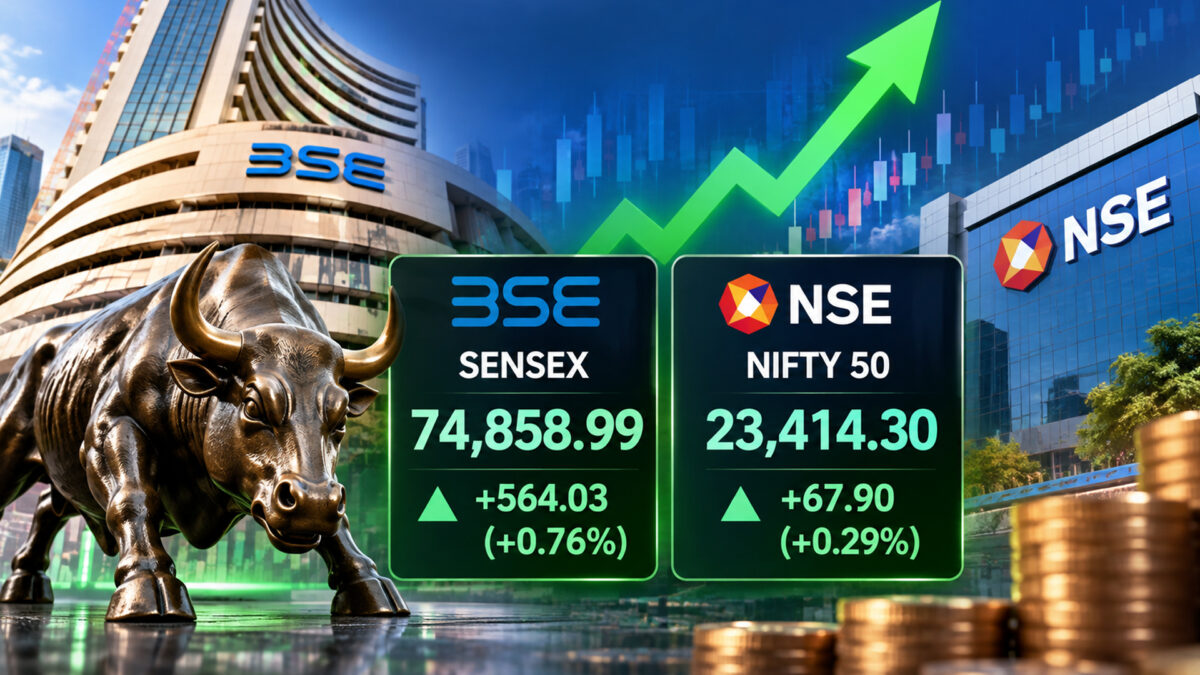
The Sensex climbed 564.03 points, or 0.76%, to close at 74,858.99, while the Nifty 50 gained 67.90 points, or 0.29%, to settle at 23,414.30. The Nifty extended its winning run to four sessions and closed above the 23,400 mark for the first time since September 10.

The recovery came after both benchmarks had recorded six consecutive weekly losses, their longest such losing streak in six years. Monday’s rise reflected renewed buying in heavyweight stocks, particularly after crude oil prices eased from recent highs.

The Sensex moved sharply higher during the day, touching an intraday high of 74,987.40, a gain of more than 690 points from its previous close. The Nifty also briefly crossed 23,450 before giving up some of its gains towards the close.

UltraTech Cement was among the strongest performers on the Sensex, rising more than 4%. HCL Technologies, Eternal and Titan Company were also among the major gainers. HCL Tech and Eternal were among the top performers on the Nifty as well, while ITC, Sun Pharma and Reliance Industries also ended higher.

On the other side, Bharti Airtel was among the biggest laggards, followed by Adani Ports, Bajaj Finance, Power Grid Corporation and Adani Enterprises. Airtel fell around 3% on the Nifty, while Adani Ports declined about 2%.

The broader market did not move in line with the benchmark indices. The Nifty Midcap 100 slipped 0.29%, while the Nifty Smallcap 100 remained broadly flat. This showed that Monday’s recovery was driven more by buying in large companies than by a broad-based rally across the market.

One of the biggest supports for the market was the fall in crude oil prices. Brent crude dropped to around $101.4-$101.7 a barrel, easing concerns over the impact of expensive oil on India’s inflation, corporate costs and trade deficit. India imports a large share of its crude requirements, making oil prices an important factor for the domestic stock market.

The decline in oil prices came despite continuing tensions in West Asia. Investors were watching developments involving the US and Iran, while hopes of diplomatic progress at the United Nations meeting helped ease some concerns about further disruption to oil supplies.

Foreign institutional investors also provided some support. FIIs bought Indian equities worth ₹599.54 crore on Friday, reversing six consecutive sessions of selling. Domestic institutional investors were also net buyers, purchasing equities worth more than ₹1,000 crore, according to exchange data.

Global markets offered another positive signal. Several Asian markets ended higher, while European equities also traded firmly. US stock futures were in positive territory during Indian market hours as investors looked ahead to developments in US-China trade and artificial intelligence talks and a planned meeting between US President Donald Trump and Chinese President Xi Jinping.

Investors were also keeping an eye on the National Stock Exchange’s IPO, which was scheduled to close for subscription on Monday. The issue had already been fully subscribed before the final day, adding to the activity in India’s primary market.

The banking sector also supported the recovery. HDFC Bank and ICICI Bank gained during the session, while Reliance Industries added to the broader market’s strength. These large companies carry significant weight in the benchmark indices, so their movement can have a sizeable impact on the Sensex and Nifty.

The rupee and bond markets also remained on investors’ radar as global monetary policy, oil prices and geopolitical tensions continued to influence sentiment. Elevated crude prices remain a concern even after Monday’s decline, particularly because a prolonged rise in oil could increase inflationary pressure and affect corporate earnings.

Monday’s rebound therefore offered some breathing room to Dalal Street after a prolonged period of selling. But the market remained selective, with large-cap stocks attracting buying while parts of the broader market stayed under pressure.

Investors will now watch crude oil movements, foreign fund flows, developments in the US-Iran conflict, global interest rates and upcoming corporate developments for further direction. After four straight sessions of gains, the ability of the Nifty to hold above 23,400 will remain an important level for market participants in the coming sessions.


Categories
Corporate

Sensex slips marginally, Nifty holds above 23,300

The markets ended mixed on Friday as a late recovery in select heavyweight shares helped the Nifty 50 finish higher, while the Sensex closed marginally lower. The Nifty 50 gained 75.80 points, or 0.33%, to close at 23,346.40. The index moved above the 23,300 mark during the session and touched an intraday high of 23,389. The Sensex, after gaining as much as 414 points in early trade, lost momentum and ended 19.63 points, or 0.03%, lower at 74,294.96.

Easing crude oil prices, positive Asian market cues and buying in banking and infrastructure stocks supported sentiment. However, continued foreign investor selling and weakness across several Tata Group and information technology stocks limited the gains.

The recovery came after several sessions of weakness in the Indian stock market. Investors found some comfort in lower crude prices, which eased concerns over inflation and India’s import bill. Brent crude remained above $100 a barrel but declined during the session, offering some relief to oil-sensitive sectors and the broader market.

Adani Ports emerged as the biggest Nifty gainer, rising 4.93% in late trading. Adani Enterprises gained 3.31%, while Bharti Airtel climbed 3.12%. HDFC Bank and Bajaj Finance were also among the strong performers, advancing 2.52% and 2.49%, respectively. The gains showed that buying interest was not limited to one sector, with infrastructure, telecom and financial stocks attracting investors.

The losing side was led by Tata Consultancy Services, which fell 3.88%. Tata Motors Passenger Vehicles and SBI Life Insurance were also among the prominent laggards. Coal India and Maruti Suzuki declined as well, adding to the pressure on selected large-cap shares.

Tata Group stocks remained under particular pressure during the session. TCS, Tata Motors Passenger Vehicles, Tata Investment Corporation and Tata Chemicals were among the group companies that recorded sharp declines. The selling came amid continuing uncertainty around Tata Sons, including questions surrounding its leadership and a possible listing of the holding company.

Information technology stocks were another weak spot. Selling in TCS weighed on the Nifty IT index and offset gains in banking and other sectors. The divergence between financial and technology stocks highlighted the selective nature of Friday’s buying rather than a broad-based market recovery.

The broader market, however, showed better participation. Mid-cap and small-cap stocks advanced during the session, with investors using the recent correction to pick up selected counters. The rise in market breadth indicated that domestic buyers remained active even as foreign investors continued to reduce their exposure to Indian equities.

Foreign institutional investor flows remained a concern. Overseas investors have been selling Indian shares amid elevated global bond yields, high US interest rates and uncertainty surrounding the Middle East. Domestic institutional investors have provided some support, helping absorb part of the foreign selling.

Crude oil remained a key factor behind the market’s movements. Prices above $100 a barrel continue to be a concern for India because the country relies heavily on imported crude. A sustained rise in oil prices can increase the import bill, put pressure on the rupee and raise concerns about inflation and corporate costs. The decline in crude on Friday therefore provided some breathing room for investors.

Global market cues were also supportive. Asian equities largely gained, helping improve risk appetite in Indian markets. Lower US bond yields and the easing in oil prices added to the positive tone, although concerns about global monetary policy and geopolitical tensions remained.

The Nifty’s close above 23,300 will be closely watched by traders after the index recovered from recent losses. Friday’s move, however, came against a backdrop of continued caution. The Sensex and Nifty have faced pressure in recent weeks as investors weighed high crude prices, foreign fund outflows, weak global cues and Middle East tensions.

The weekly picture remained weak despite Friday’s recovery. The Nifty declined about 0.22% during the week, while the Sensex lost around 0.65%. This marked the sixth consecutive weekly decline for Indian equities, the longest such losing streak since 2020.

Investors will now track crude oil prices, foreign institutional flows, the rupee and global bond yields for the next market cues. Developments in the Middle East and movement in large-cap stocks, particularly Tata Group and IT shares, are also likely to influence trading. Friday’s gains in the Nifty offered some relief, but the market remains sensitive to global risks and the direction of foreign investment flows.


Categories
Corporate

Sensex slips 20 points, Nifty rises to 23,270

Indian stock markets ended on a mixed note on Thursday, with the Nifty closing higher while the Sensex slipped marginally as investors remained cautious after the latest US Federal Reserve rate decision. The 30-share BSE Sensex fell 21.86 points, or 0.03%, to settle at 74,314.59, while the NSE Nifty50 gained 53 points, or 0.23%, to close at 23,270.60.

The session was marked by sharp swings. The Sensex climbed as much as 341 points during the day to touch 74,677.56, while the Nifty also moved above 23,300 before giving up part of its gains. Profit booking at higher levels and concerns over global interest rates kept the recovery in check.

Investors were assessing the impact of the US Federal Reserve’s latest decision to raise interest rates by 25 basis points. The move, along with indications that further tightening could remain possible, kept global markets cautious. Higher US rates can affect foreign investment flows into emerging markets such as India by making dollar assets relatively more attractive.

Crude oil prices remained another concern for domestic investors. Elevated oil prices are particularly important for India because the country imports a large share of its crude requirements. A sustained rise in crude can increase the import bill, put pressure on the rupee and complicate inflation management. Market participants therefore continued to watch oil prices closely.

Despite the cautious mood, buying emerged in several sectors. Auto, metal, media and pharmaceutical stocks were among the stronger performers, while banking and oil and gas stocks faced pressure. The broader market also remained firm, with mid-cap and small-cap indices gaining during the session.

HDFC Life emerged as the standout Nifty gainer, rising around 5%. Tata Motors Passenger Vehicles also gained more than 4%, while SBI Life Insurance advanced over 4%. Bharat Electronics, Dr Reddy’s Laboratories and InterGlobe Aviation were among other stocks that attracted buying interest.

The gains were not broad enough to lift all major stocks. ONGC was the biggest Nifty loser, declining around 1.9%. Titan Company fell about 1.4%, while HDFC Bank dropped around 1.2%. Hindustan Unilever, Coal India and Nestle India also ended lower.

Banking stocks were among the key drags on the market. HDFC Bank and ICICI Bank featured among the major losers, while the Nifty Bank index declined 236.70 points, or 0.42%, to close at 56,055.75. Weakness in heavyweight banking stocks limited the impact of gains in insurance, auto and metal counters.

Tata group stocks, meanwhile, provided support to the broader market. Tata Motors, Tata Steel and Tata Investment gained during the session, with the auto and metal segments benefiting from buying interest. The Nifty Auto index was among the stronger sectoral performers.

Market breadth remained positive despite the subdued headline indices. The gains in mid-cap and small-cap shares indicated that investors were still willing to take selective positions, particularly in stocks that had corrected during the recent market decline. This value buying helped prevent a deeper fall in the benchmark indices.

The National Stock Exchange’s initial public offering also remained a major focus. The ₹22,569-crore NSE IPO opened for subscription on Thursday, adding another layer to the market’s liquidity picture. Strong interest in new issues can divert some investor funds from the secondary market, particularly when several IPOs are open at the same time.

Foreign institutional investor activity continued to be closely watched. Overseas investors have remained sellers in Indian equities, while domestic institutional investors have provided some support. This divergence has helped cushion the impact of foreign selling but has also contributed to volatility in the benchmark indices.

The rupee and global bond yields were also important market indicators. A stronger dollar following the US rate decision could add pressure to emerging-market currencies, including the Indian rupee. Investors are also assessing how higher US borrowing costs could affect global liquidity and capital flows into Indian stocks.

Thursday’s trading showed that investors were not taking a broad-based position in either direction. Instead, buying remained concentrated in selected sectors and stocks, while heavyweight banking, oil and consumer shares faced selling pressure.

The Nifty’s close above 23,250 offered some support after recent volatility, but the index remained below the 23,300 level that investors were watching closely. The Sensex, meanwhile, ended near 74,300 after failing to hold its intraday gains.

Markets are likely to remain sensitive to movements in crude oil, the rupee, foreign fund flows and global interest-rate expectations in the coming sessions. Investors will also track the progress of the NSE IPO and other primary-market offerings.

The mixed close reflected the current mood on Dalal Street: selective buying is providing support, but global monetary policy, elevated oil prices and continued foreign selling are keeping investors cautious.


Categories
Corporate

Sensex gains 333 points, Nifty reclaims 23,200

Markets recovered on Wednesday after two straight sessions of losses, with the Sensex gaining around 333 points and the Nifty 50 reclaiming the 23,200 mark. Buying returned to banking, financial, FMCG and selected heavyweight stocks, although persistent concerns over crude oil prices, US interest rates and geopolitical tensions kept investors cautious.

The BSE Sensex ended 332.63 points, or 0.45%, higher at 74,336.45. The NSE Nifty 50 advanced 99 points, or 0.43%, to close at 23,217.60. The recovery came a day after both benchmarks suffered losses of more than 1%, with the Nifty closing at its lowest level in about five months.

The market opened on a positive note, helped by relatively better global cues and a mild easing in crude oil prices. The Sensex climbed more than 400 points in early trade, while the Nifty moved above 23,250. Gains, however, moderated through the session as investors remained focused on the US Federal Reserve’s interest-rate decision and developments in the Middle East.

Banking and financial stocks provided much of the support. HDFC Life emerged as the top gainer among the Nifty stocks in the afternoon snapshot, rising 2.73%. SBI Life gained 2.65%, while State Bank of India climbed 2.42%. ITC advanced 2.38% and Nestle India added 1.65%.

Other strong performers included Axis Bank and Bharat Electronics. Axis Bank gained about 2.24% in afternoon trade, while BEL rose 2.11%. SBI also remained among the key contributors to the market recovery. The broader strength in financial stocks helped offset weakness in information technology shares.

The biggest pressure came from IT stocks. TCS was the top loser in the Nifty snapshot, falling 2.76% to ₹2,188.80. Wipro declined 1.83%, while Infosys slipped 1.58%. Tech Mahindra and Larsen & Toubro also ended lower, falling 1.14% and 1.12%, respectively.

The weakness in technology stocks came as investors continued to assess the impact of elevated US Treasury yields and the outlook for interest rates. The US 10-year Treasury yield remained around the 5% level, keeping pressure on equity valuations and adding to concerns for companies with significant exposure to overseas markets.

Crude oil remained another major concern for Dalal Street. Brent crude was trading around $108 a barrel despite edging lower during Wednesday’s early trade. Oil prices have remained elevated amid concerns over supply disruptions and continuing tensions in the Middle East. India, as a major crude importer, remains particularly sensitive to a sustained rise in global oil prices.

The rupee also remained under pressure. The Indian currency had closed at around ₹95.96 against the US dollar on Tuesday. A weaker rupee combined with expensive crude can raise concerns about imported inflation and corporate costs, adding another layer of uncertainty for investors.

Foreign institutional investors continued to sell Indian equities. FIIs offloaded shares worth ₹2,977.86 crore on September 15, while domestic institutional investors bought equities worth ₹2,686.05 crore. The divergence highlights the continued support from domestic investors even as overseas flows remain cautious.

The rebound was broad-based, with 12 of 16 major sectoral indices ending higher. FMCG and PSU bank stocks were among the stronger sectors, while IT and pharma were the only major sectoral indices to finish in negative territory.

Wednesday also saw activity in the IPO market. Kanohar Electricals made its stock market debut at ₹685.50 on the NSE against an issue price of ₹632, representing an 8.47% premium. Glass Wall Systems also listed at a premium, opening at ₹194 on the NSE against its issue price of ₹182. Prasol Chemicals, however, made a weaker debut and listed at a discount.

Market participants are now turning their attention to the US Federal Reserve’s policy decision and its guidance on the interest-rate outlook. Any indication of tighter monetary policy could influence global equity flows, bond yields, the dollar and emerging-market currencies, including the Indian rupee.

The market’s Wednesday recovery therefore offered some relief after the sharp sell-off seen earlier in the week, but it did not remove the larger concerns hanging over Indian equities. High crude prices, elevated US yields, foreign selling and geopolitical uncertainty remain key factors investors are watching.

The Sensex and Nifty may have regained some lost ground, but the market remains sensitive to global developments. The next moves in oil prices, the Fed’s policy signals and foreign fund flows are likely to remain central to the direction of the Indian stock market in the near term.