
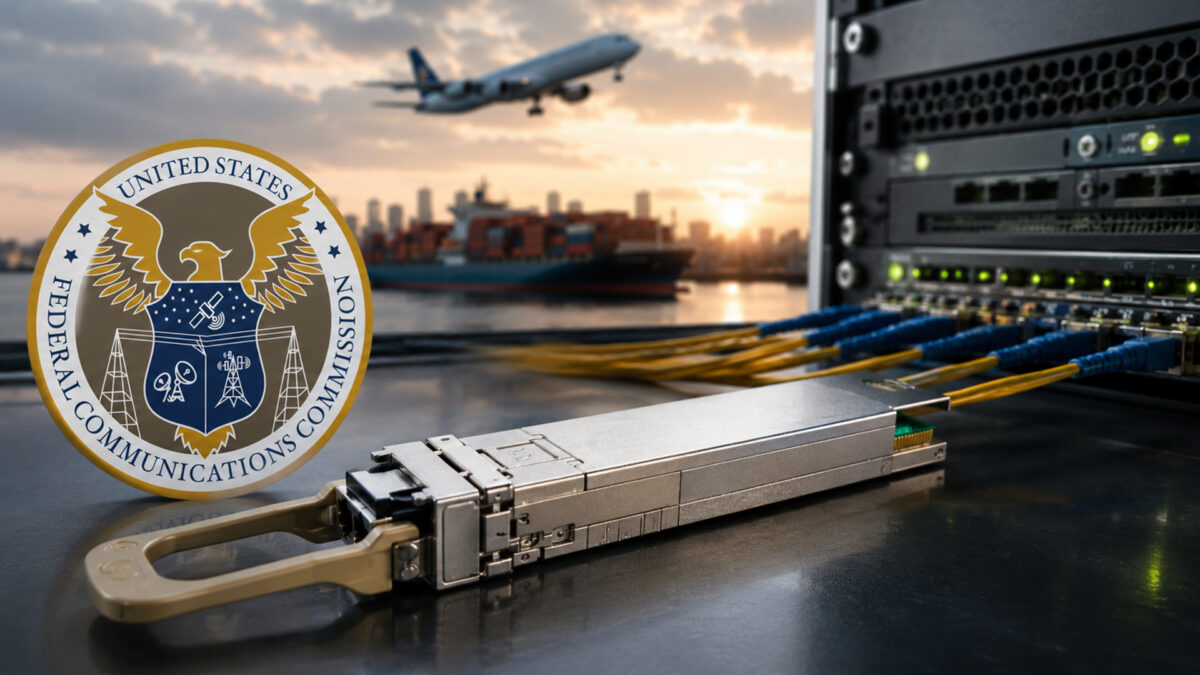
The United States is moving to tighten restrictions on Chinese technology used in two strategically important areas, artificial intelligence infrastructure and renewable energy, as the Trump administration seeks to reduce dependence on foreign suppliers and strengthen domestic manufacturing.
The latest move involves a possible US ban on new Chinese-made optical transceivers, components that are critical to the high-speed networks connecting servers inside data centres. At the same time, an existing Federal Communications Commission (FCC) restriction on new foreign-made power inverters is pushing companies to expand manufacturing capacity in the US.
The developments underline a broader shift in US technology and energy policy, where supply-chain security is increasingly being treated as a national security issue.
The FCC is reportedly preparing a proposal that would add new-model optical transceivers manufactured in China to equipment covered by restrictions under the Secure Networks Act. The precise definition of a Chinese manufacturer and what qualifies as a “new model” has not yet been disclosed.
Optical transceivers may not be as familiar to consumers as AI chips or servers, but they are essential to modern data centres. They convert electrical signals into optical signals and allow huge volumes of data to move rapidly through fibre-optic networks.
That makes them particularly important as companies race to build AI data centres. Advanced AI systems require enormous computing power, but the chips themselves are only part of the equation. The processors also need fast, reliable connections to communicate with one another and share data.
China has a major position in this supply chain. According to TrendForce data cited by Tom’s Hardware, Chinese optical-module manufacturers account for about 56% of global manufacturing capacity for the technology in 2026. The proposed restrictions are therefore aimed not only at cybersecurity concerns but also at reducing US dependence on Chinese suppliers.
US officials have argued that Chinese-made equipment used in critical infrastructure could create cybersecurity and national-security vulnerabilities. FCC Chairman Brendan Carr has said restrictions are intended to encourage companies to bring production to the US before potentially risky foreign technologies become deeply embedded in American infrastructure.
The FCC has already taken similar action involving other technologies. Since December, the agency has restricted new models of foreign drones, routers, robots and power inverters, with waivers available to some non-Chinese suppliers. In July, the FCC also barred new Chinese humanoid and quadruped robots and connected power inverters from gaining US approval.
The inverter restrictions are already beginning to reshape the US solar industry.
Power inverters are a critical part of solar and battery systems because they convert electricity and enable renewable-energy installations and storage systems to connect with the electricity grid. The US has traditionally relied heavily on imported inverter equipment.
Wood Mackenzie estimates that more than 200 GWac of photovoltaic inverters have been supplied to commercial, industrial and utility-scale projects in the US over the past decade. More than 90% were imported, including more than 70 GW from Chinese-headquartered manufacturers, most of which were supplied from factories in Southeast Asia. Chinese vendors accounted for nearly half of the US inverter market in 2024 and 2025.
The new restrictions could have significant consequences for solar developers because US-made equipment is currently more expensive. Wood Mackenzie expects average inverter prices to increase in 2027 as procurement shifts away from cheaper foreign products towards domestic manufacturing.
However, the US is also rapidly expanding its ability to make the equipment at home. Manufacturers have announced plans for more than 100 GWac of US photovoltaic and power-conversion-system inverter manufacturing capacity by the end of 2027. If those projects are completed, domestic production could meet the new demand created by the FCC restrictions.
The immediate challenge is cost. Domestic manufacturing involves higher labour, component and production expenses, meaning solar project developers could face higher upfront costs. Wood Mackenzie expects prices to moderate over time as more factories come online and competition increases.
The shift could nevertheless provide companies with greater supply-chain certainty. Developers would become less exposed to sudden import restrictions, geopolitical tensions or changes in US-China trade policy.
The same calculation is now emerging in the AI sector. US hyperscalers are investing heavily in data centres and increasingly depend on optical interconnects to move data between large numbers of AI processors. A sudden restriction on Chinese optical transceivers could therefore increase procurement costs and put pressure on availability while alternative suppliers expand production.
Industry analysts have warned that restrictions could also have unintended consequences for American technology companies. Cutting off a major supplier base could increase costs for data-centre operators and potentially affect the efficiency and pace of AI infrastructure expansion.
There are also questions about how quickly alternative supply chains can develop. While the US is building domestic capacity in areas such as solar inverters, optical networking has a different manufacturing ecosystem and China currently holds a substantial share of global capacity.
The policy also faces concerns over transparency. FCC Commissioner Anna Gomez has supported the national-security rationale behind the restrictions but criticised what she described as a chaotic rollout of major technology-policy changes. She has called for greater transparency to ensure that the rules do not appear to favour particular companies or technologies.
For the US, the broader objective is becoming clear: reduce dependence on China in technologies considered essential to the future economy. AI data centres, fibre-optic networks, solar installations and battery systems are increasingly being viewed not merely as commercial infrastructure but as strategic assets.